Have you ever heard two people tell the same story in completely different ways? One person says, "We went outside and it started to rain." Another says, "The sky snapped open, and rain came racing down like thrown beads." The event is the same, but the voice feels different. That difference matters in narrative writing. It is what helps readers hear the storyteller in their minds, picture the scene, and feel the mood.
In writing, voice is the unique feeling a reader gets from the narrator or speaker. It includes attitude, personality, rhythm, and word choice. Voice can sound calm, nervous, playful, bold, mysterious, serious, or excited. As [Figure 1] shows, even when two passages describe the same event, the writer's choices can make one sound flat and another sound alive with personality.
When you write a narrative, you are not only telling what happened. You are also shaping how it feels to hear the story told. A shy narrator may use softer words and shorter thoughts. A dramatic narrator may use stronger images and sharper sounds. A humorous narrator may notice silly details that others ignore.
Voice is the special style and personality that comes through in a piece of writing. Narrative voice is the way the storyteller sounds. Personal voice is the writer's own way of expressing thoughts, feelings, and experiences.
Voice grows from many small choices. A writer can use sounds, comparisons, layout, and emphasis to make the writing feel more personal. These choices are especially powerful in narratives because stories depend on mood, pacing, and the reader's connection to the teller.
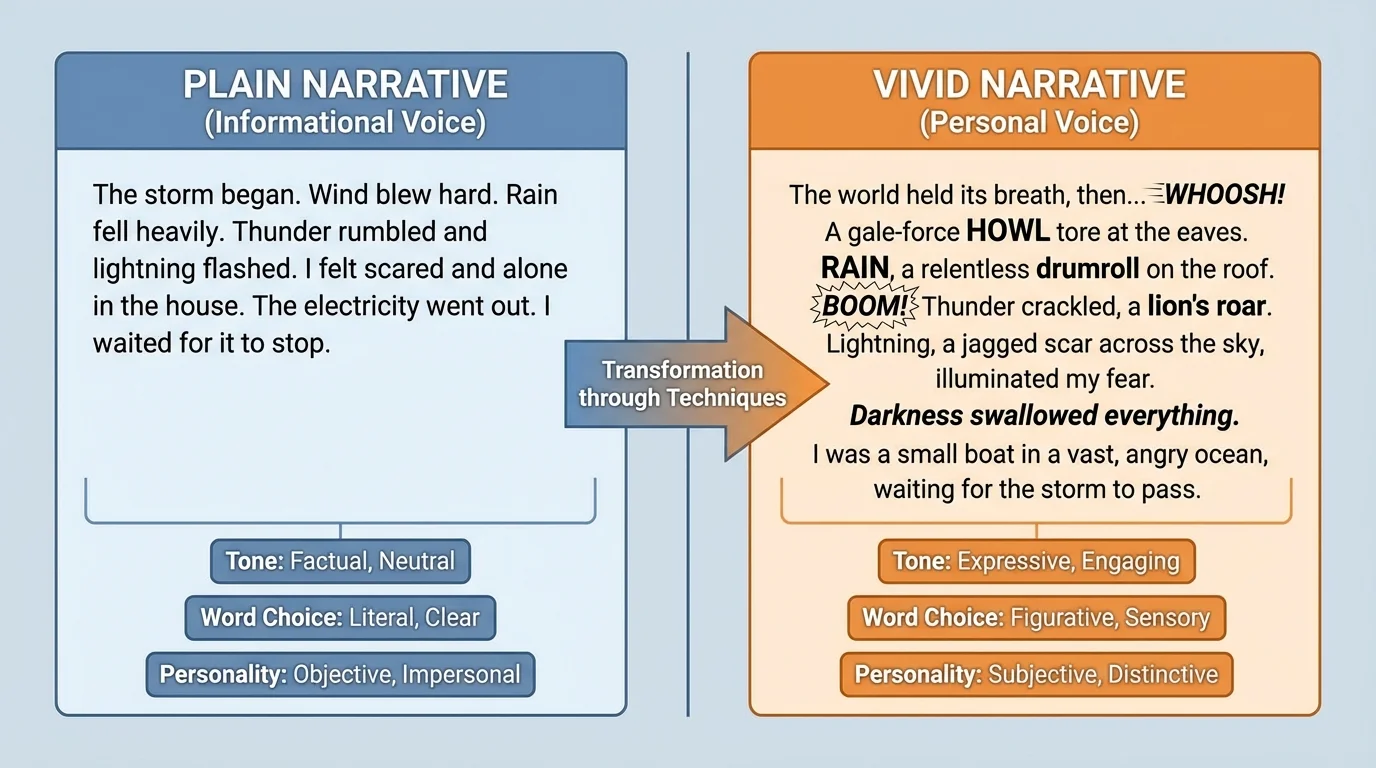
A strong voice also helps organize events. In a well-structured story, the beginning, middle, and end work together. Voice guides the reader through those events. For example, a tense voice can make a simple walk home feel suspenseful, while a cheerful voice can turn the same walk into an adventure.
Readers often remember stories because of voice. They may forget a small detail, but they remember the storyteller who sounded brave, worried, sarcastic, or full of wonder. That is why learning specific techniques matters: these tools help create a voice that readers can hear clearly.
Stylistic techniques are special writing choices that shape how language sounds and feels. Some of the most useful ones involve sound. These are especially helpful in stories because readers do not just understand the words; they almost hear them.
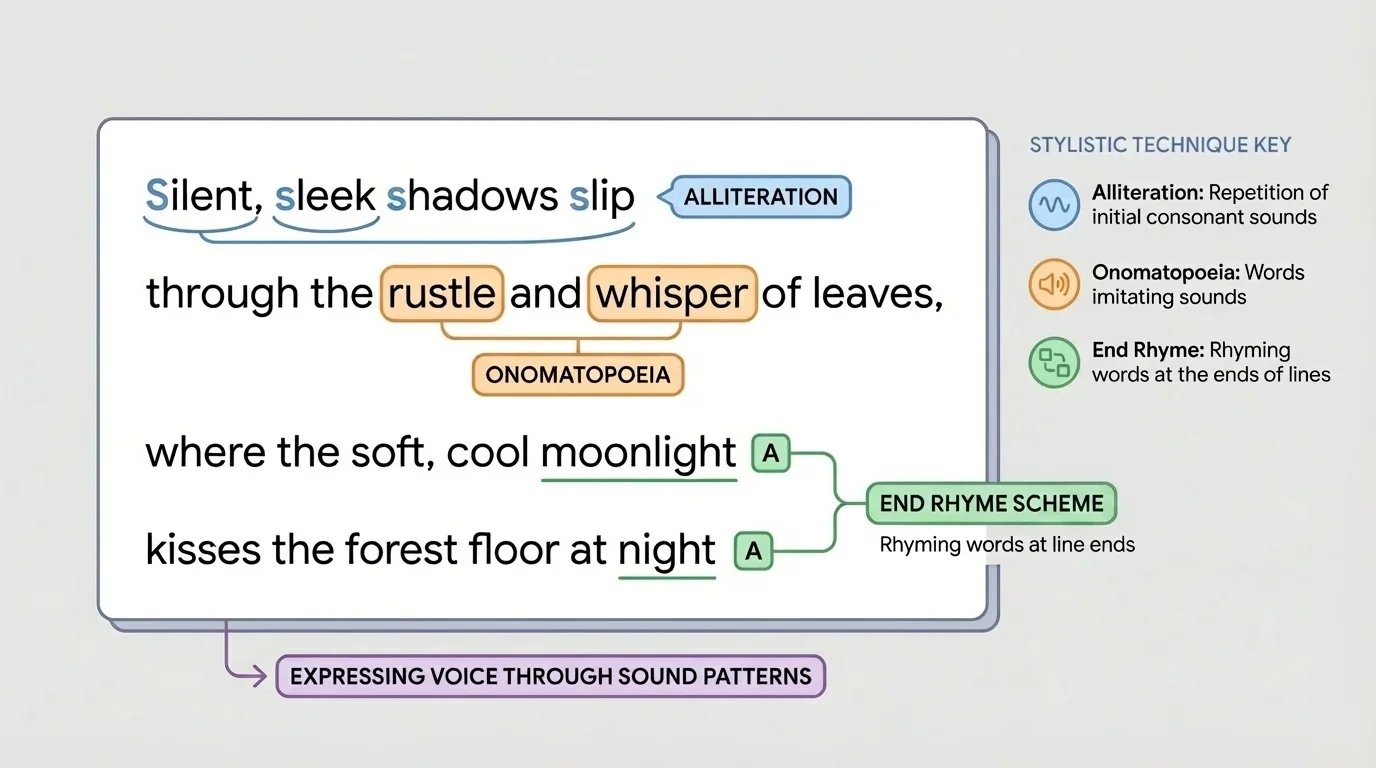
Sound patterns help readers hear a narrator's attitude, as [Figure 2] illustrates through repeated beginning sounds, sound-imitating words, and rhyme. A writer may use a soft pattern to create calm or a harsh pattern to create tension.
Alliteration is the repetition of beginning consonant sounds in nearby words. For example: "The alliteration in 'wild wind whipped the windows' makes the storm feel active and strong." The repeated w sound gives the sentence a rushing movement. Alliteration can make a line memorable and can match the feeling of the event.
Onomatopoeia is a word that imitates a sound. Words like buzz, clang, thud, snap, and sizzle help a reader hear what is happening. If a narrator says, "The locker door slammed with a thud," the sound adds force to the moment. Onomatopoeia often makes action scenes feel immediate.
Rhyme scheme is the pattern of end rhymes in lines of poetry, often marked with letters such as AABB or ABAB. Even though rhyme scheme belongs mainly to poetry, it can still matter when a writer tells a story in verse or uses a poetic style inside a narrative. A neat rhyme pattern can make a voice sound musical, playful, or carefully controlled.
Sound does not have to be loud to be effective. Quiet repetition can also matter. A narrator thinking sadly might repeat soft sounds like s or m. A panicked narrator might use sharp sounds like k, t, or p. The point is not merely decoration. The point is to make sound support feeling.
Many commercials and song lyrics use alliteration because repeated sounds are easier to remember. Writers use the same trick in stories when they want an image or emotion to stick in the reader's mind.
Writers also create pattern through repetition of words or sentence beginnings. For example: "I waited at the gate. I waited by the tree. I waited until the streetlights blinked awake." That repeated opening makes the voice sound patient at first, then lonely.
Later in a story, the same sound device can signal a change. A gentle pattern at the beginning might become rougher during conflict. This shift in sound can work the way music works in a movie: it changes the emotional color of the scene.
Figurative language helps writers express ideas in imaginative ways rather than only literal ones. It adds layers of meaning and often reveals how a narrator sees the world. Two narrators might both describe a sunset, but one may call it "a gold coin sinking into the hills," while another calls it "a tired eye closing." Each image suggests a different voice.
Simile compares two unlike things using like or as. A narrator might say, "My backpack felt like a bag of bricks." That comparison helps the reader sense weight and frustration. Similes are useful when a writer wants to make a feeling or experience easier to imagine.
Metaphor makes a direct comparison without using like or as. "The classroom was a furnace" tells us the room felt extremely hot. A metaphor can sound stronger and more dramatic than a simile because it states the comparison as if it were true.
Personification gives human qualities to animals, objects, or ideas. "The old house groaned in the wind" gives the house a human-like action. Personification can make a setting feel alive, which is very useful in stories where the place matters as much as the people.
Why figurative language shapes voice
Figurative language does more than paint a picture. It shows what kind of mind is telling the story. A narrator who compares thunder to drums may feel excited. A narrator who compares it to doors being kicked open may feel afraid. The comparison reveals personality, mood, and point of view.
Figurative language should fit the story and the narrator. If the narrator is a soccer player, they might compare a crowd to a roaring stadium. If the narrator loves cooking, they might describe morning sunlight as butter melting across the floor. The comparison feels more believable when it grows naturally from the character's experiences.
These techniques also make emotional moments stronger. A simple sentence like "I was nervous" tells the feeling. A figurative sentence like "My thoughts were a jar of bees" helps the reader experience the feeling. Good narrative writing often combines both clear information and imaginative expression.
As you saw earlier with sound devices in [Figure 2], the best effect comes when the technique matches the mood. A silly metaphor in a serious moment can weaken the scene, while a sharp, fitting comparison can make it unforgettable.
The way words look on the page can affect how readers hear them. Page layout can control pace and emotion, as [Figure 3] shows through changes in line length, emphasis, and spacing. These choices are called graphic elements.
Capital letters can show strong emotion, shouting, urgency, or sudden emphasis. For example: "RUN!" feels louder and more urgent than "run." However, too many capital letters can make writing hard to read and can reduce their power. If everything is emphasized, nothing stands out.
Line length matters, especially in verse narratives or highly expressive writing. Short lines can slow the reader down or make each word feel important. They can also create tension: "I reached for the handle. It turned. Slowly." Longer lines can create a flowing, thoughtful feeling.
Word position matters too. A writer may place a powerful word at the end of a sentence or line so it lands with force. Compare these two endings: "I opened the door and saw my bike, scratched and bent" and "I opened the door and saw my bike, broken." The final word can hit harder because of where it stands.
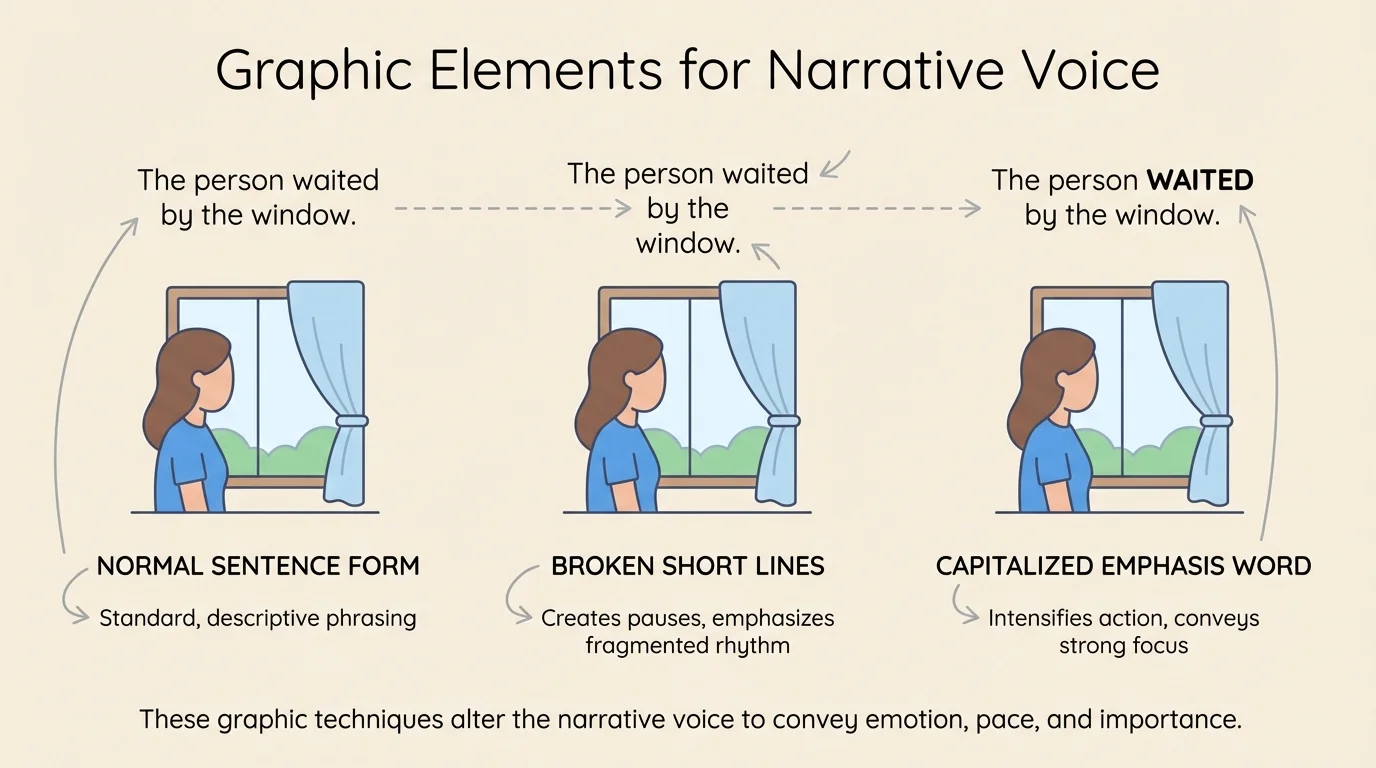
Spacing and breaks can shape silence. A sudden one-line paragraph can feel like a pause or a shock. For example: "Then I saw it." If this sentence stands alone, it feels heavier than if it is buried in the middle of a longer paragraph.
Writers sometimes use repeated punctuation or dashes for voice, but they should do so carefully. Too many exclamation marks or odd spaces can seem messy rather than meaningful. Graphic choices should help the reader, not distract the reader.
Stories usually include clear sequencing: a beginning that introduces a situation, a middle with rising action or problem-solving, and an ending that shows a result or change. Voice techniques work best when they support that structure instead of interrupting it.
Graphic elements are especially useful in moments of surprise, fear, excitement, or reflection. In a chase scene, short paragraphs and sharp line breaks can speed the pulse. In a thoughtful memory scene, longer sentences and gentle spacing can create a slower rhythm.
Writers rarely use just one tool at a time. A strong passage often combines sound, figurative language, and graphic choices. For example: "The bus coughed at the curb. I stepped on. Every seat looked full. Every face looked closed." Here, the verb coughed gives personification, the repeated structure creates rhythm, and the short sentences make the narrator sound tense and observant.
When techniques work together, they can reveal both the event and the teller. Consider this example: "Rain rattled on the roof, wild as thrown pebbles, and I counted each strike as if the storm were knocking for me." This line uses sound in rattled, a simile in wild as thrown pebbles, and a hint of personification in the storm knocking. The voice feels nervous and imaginative.
Example: Changing voice with different techniques
Here is the same basic event: a student enters a dark room.
Step 1: Plain version
"I walked into the dark room and looked around."
Step 2: Add sound and figurative language for a fearful voice
"I stepped into the dark room. The floorboards creaked. Shadows clung to the corners like spiders."
Step 3: Add graphic emphasis for stronger tension
"I stepped into the dark room. Creak. The corners were full of shadows, hanging like spiders. I did not move."
Each version tells the same event, but the later versions have a clearer voice and mood.
Writers should think about purpose. Are they trying to show excitement? sadness? humor? wonder? Once the purpose is clear, the techniques become easier to choose. A playful voice may use bouncy alliteration and surprising similes. A serious voice may use fewer comparisons and more controlled rhythm.
As seen in [Figure 3], visual arrangement can strengthen this effect. A single word placed alone can echo fear or surprise in a way that a crowded paragraph cannot.
A narrator's age, personality, background, and feelings all affect voice. A confident narrator might say, "The hallway swallowed noise, but I kept walking." A nervous narrator in the same hallway might say, "My shoes clicked too loudly, and every step sounded wrong." The details they notice are different because the voices are different.
Voice can also change during a story. At the start, a narrator may sound calm. During conflict, the sentences may become shorter and sharper. At the end, the voice may soften as the narrator reflects on what happened. These shifts help the event sequence feel real and emotionally connected.
In personal narratives, voice often comes from honest feelings and specific memories. In imagined narratives, voice may come from the character the writer invents. Either way, details should feel believable. If a narrator sounds terrified, the words should support that. If the narrator sounds amused, the images and sounds should match.
"The right word may be effective, but no word was ever as effective as a rightly timed pause."
— adapted from the idea of careful expression in writing
This idea connects to graphic elements and pacing. Sometimes a pause, a short line, or a sudden one-sentence paragraph becomes part of the voice. Silence on the page can be as powerful as sound in the sentence.
Different moments in a story call for different strengths. During action, onomatopoeia and short bursts may help. During description, similes and metaphors may deepen the picture. During reflection, longer lines and thoughtful comparisons may sound more natural.
One common mistake is overuse. If every sentence has alliteration, every object is personified, and every important word is in capital letters, the writing may feel crowded. Strong writers choose carefully. They let the most important moments carry the strongest effects.
Another mistake is using comparisons that do not fit the narrator. If a character who knows nothing about sailing suddenly compares anger to "a storm-tossed mast in northern seas," the voice may feel fake. Comparisons should grow from what the narrator would truly notice or know.
Writers should also avoid unclear layout. Strange spacing, random line breaks, or lots of capital letters can distract the reader. Graphic elements should make meaning sharper, not more confusing.
A strong choice is to reread a passage aloud. If the sound feels wrong, the voice may need adjusting. If a dramatic scene sounds too smooth, adding shorter lines or sharper sound words may help. If a thoughtful scene feels choppy, longer flowing sentences may fit better.
| Technique | What it does | Best use | Watch out for |
|---|---|---|---|
| Alliteration | Repeats beginning sounds | Creates rhythm and emphasis | Too much can sound forced |
| Onomatopoeia | Imitates real sounds | Makes action vivid | Can sound childish if overused |
| Rhyme scheme | Creates a rhyme pattern | Builds musical voice in verse | May feel unnatural if forced |
| Simile | Compares using like or as | Makes images clear | Weak if ordinary or vague |
| Metaphor | Makes a direct comparison | Adds power and depth | Can confuse if unclear |
| Personification | Gives human traits to nonhuman things | Brings setting to life | Can become silly in serious scenes |
| Capital letters | Adds visual emphasis | Shows urgency or strong feeling | Loses power if everywhere |
| Line length/word position | Controls pace and emphasis | Shapes mood and rhythm | Can seem random without purpose |
Table 1. A comparison of common techniques, their effects, useful purposes, and cautions.
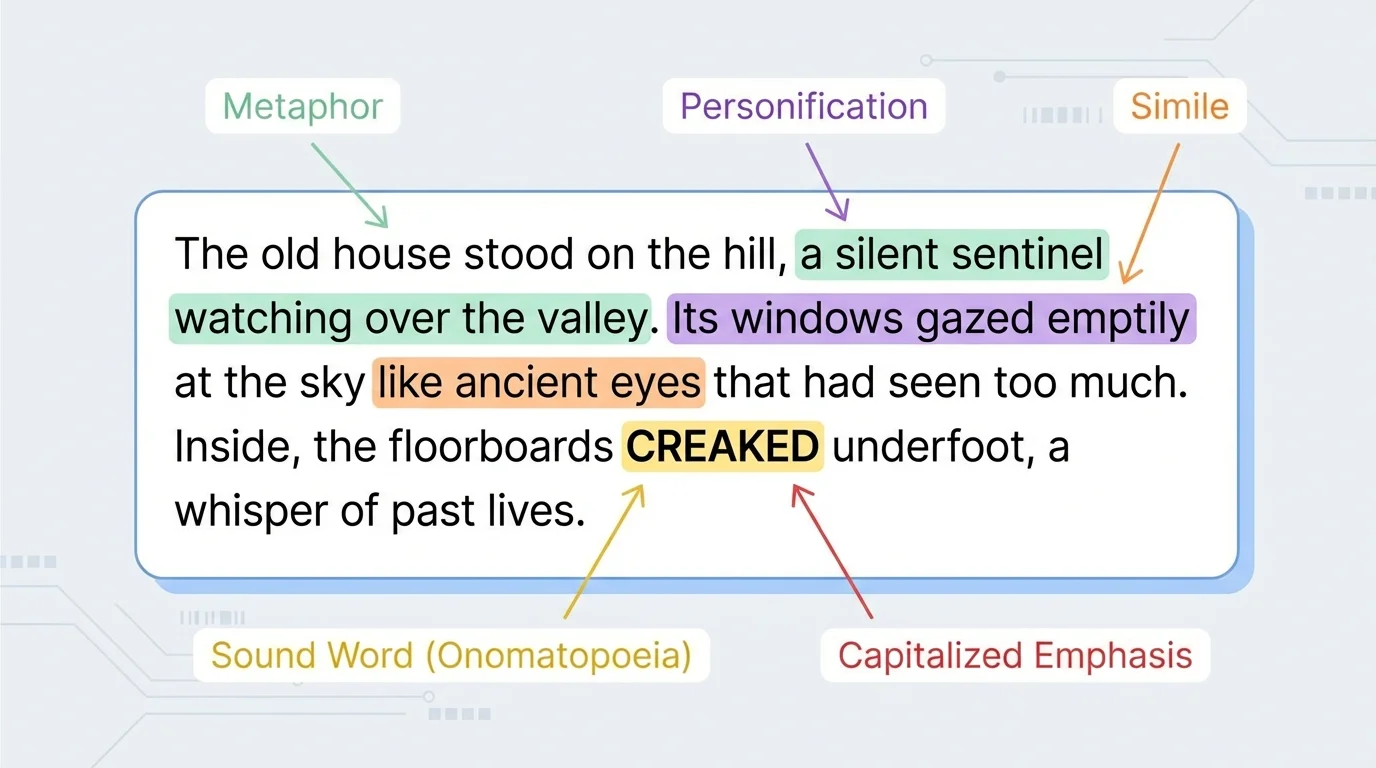
A model passage helps show how these techniques work together and highlights the exact places where sound, figurative language, and visual emphasis shape the narrator's voice. Read this example: "The last bell clanged, and the hallway burst open. Lockers banged like cymbals. Backpacks bumped my shoulders. Above the noise, one thought flashed bright in my mind: TODAY."
[Figure 4] This short passage creates an energetic, slightly overwhelmed voice. The word clanged gives onomatopoeia. The simile like cymbals compares locker sounds to music, which makes the chaos seem loud and metallic. The phrase thought flashed bright creates a metaphorical image that helps the reader sense sudden excitement. The final capitalized word, TODAY, adds visual emphasis and makes the narrator's feeling jump off the page.
Now compare that to this passage: "The bell whispered away. My classroom emptied like a tide pulling back from shore. Desks waited in neat rows, and the window held the last gray piece of sky." This voice is quieter and more reflective. The comparison to a tide makes the room feel slowly emptied. The personification in desks waited gives the setting a still, lonely mood.
Example: One event, two voices
Event: a student misses the bus.
Step 1: Frustrated voice
"The bus groaned away just as I reached the curb. My backpack thumped against my spine, and heat rushed to my face."
Step 2: Humorous voice
"The bus puffed off like it had somewhere glamorous to be, leaving me on the sidewalk with one untied shoe and a very offended expression."
Step 3: Reflective voice
"The bus rolled away, quiet and certain. I stood still for a moment, listening to the morning settle around me."
The plot is the same, but the voice changes the whole experience for the reader.
As in [Figure 1], the biggest difference is not the event itself but the way language presents it. Voice turns information into experience.
When writers choose sound, comparison, and layout carefully, readers do more than understand the story. They hear the narrator, feel the mood, and move through the events with stronger attention and emotion.
