A speech that changes history, a memoir about surviving a disaster, a magazine article written like a story, a biography excerpt that feels almost cinematic: all of these can be literary nonfiction. These texts are true, but they do more than deliver facts. They use scenes, voice, structure, and vivid details to make readers think and feel. That is why reading literary nonfiction is powerful—and sometimes challenging.
By the end of seventh grade, readers are expected to read and understand literary nonfiction in the grades 6–8 text complexity band proficiently. That means being able to handle texts written for middle school readers, including some that are fairly demanding. At the higher end of that range, readers may need scaffolding, or support, to make meaning from the text without someone else doing the thinking for them.
Literary nonfiction presents real people, events, and ideas, but it uses some of the same craft moves that writers use in literature. As [Figure 1] shows, this kind of writing stands between fiction and purely informational text. It is factual, but it may also include dialogue, description, reflection, suspense, or a carefully shaped structure.
For example, a science textbook might explain how volcanoes form in a direct, organized way. A literary nonfiction piece about a volcanic eruption might still include accurate science, but it may begin with the sound of the mountain rumbling, describe what a witness saw, and build tension as events unfold. Both texts are nonfiction, but the second one uses literary techniques to draw the reader in.
Writers of literary nonfiction often aim to do several things at once: inform, reveal character, create mood, share insight, and explore meaning. A memoir may tell what happened to a person, but it may also show how that person changed. A speech may argue for justice, but it may also use rhythm, repetition, and emotional appeal to move an audience.
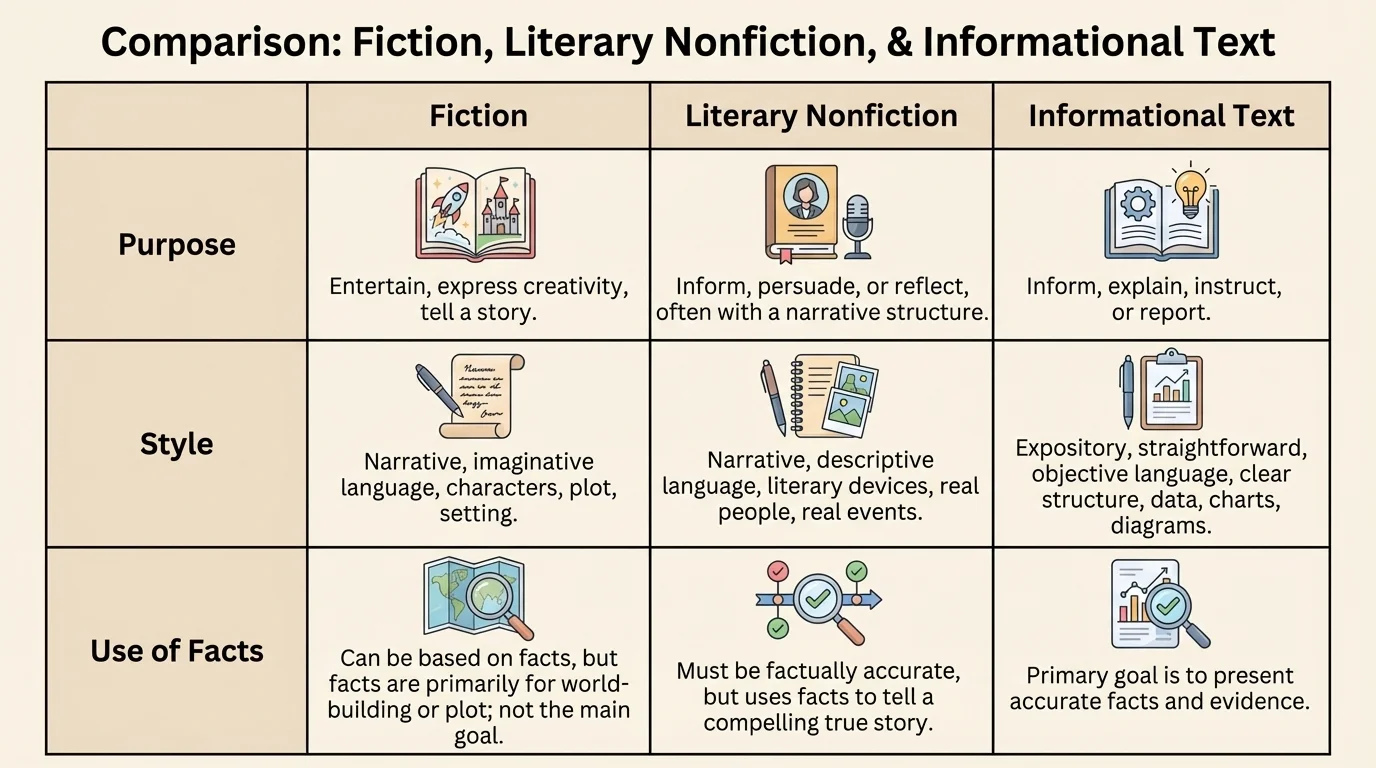
Some common forms of literary nonfiction include memoirs, personal essays, speeches, biographies, autobiographies, travel writing, and narrative journalism. In each form, facts matter. The writer cannot invent events. However, the writer can shape the material through selection, arrangement, tone, and point of view.
Literary nonfiction is true writing that uses literary techniques such as description, structure, voice, and reflection to communicate real experiences, people, or ideas.
Comprehension is understanding what a text says, how it says it, and what it means.
This is why readers must do more than collect facts. They need to notice how the writer tells the truth. Later, when analyzing a memoir or speech, the same event can seem hopeful, bitter, urgent, or reflective depending on the writer's choices.
Not all texts in middle school feel equally difficult. [Figure 2] illustrates that complexity comes from several interacting features, not just from long words. A text may be challenging because of its structure, its ideas, its vocabulary, the amount of background knowledge it expects, or the way the author develops meaning indirectly.
One important feature is structure. Some texts follow a simple timeline: first this happened, then that happened. Others move back and forth in time, include flashbacks, shift from story to reflection, or weave together several ideas. A memoir might begin with an important moment, jump backward to childhood, and then return to the present. If readers do not track the structure carefully, they can lose the thread.
Another feature is point of view. In literary nonfiction, the narrator may be the person who experienced the events, a biographer describing someone else, or a journalist reporting while also shaping the reader's focus. The writer's perspective affects what details are included, what is emphasized, and what tone the text creates.
Tone can also add complexity. Sometimes the writer says exactly what they mean. Other times, the writer's attitude is subtle. A speech may sound calm on the surface, but carry deep anger underneath. A memoir may use humor to describe painful experiences. Readers must pay attention to word choice, sentence rhythm, and details to understand tone clearly.
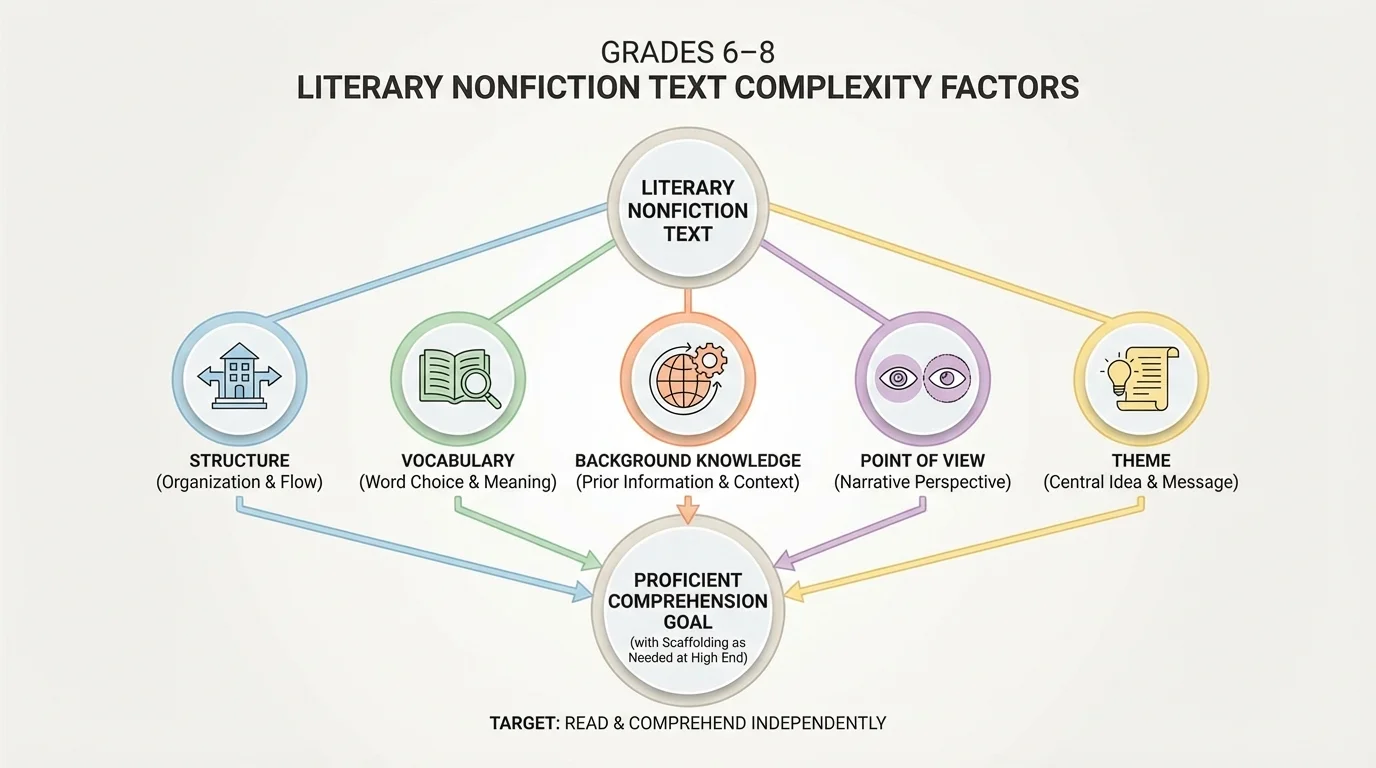
Background knowledge matters too. A speech from the civil rights movement may be harder to understand if a reader does not know the historical situation. A personal essay about immigration may include cultural references that are not explained directly. When a text assumes knowledge, readers need to pause and build context.
Vocabulary can increase difficulty, but not only because of unfamiliar words. Some words have special meanings in context. Others are abstract, such as identity, justice, or sacrifice. In literary nonfiction, writers often choose exact words that carry emotion or shades of meaning, so readers must think carefully about why that word appears instead of a simpler one.
At the upper end of the grades 6–8 text complexity band, texts often combine several of these features. A speech with historical references, layered tone, and complex syntax may be much more demanding than a short personal narrative written in straightforward language. That is why strong readers learn to slow down when needed.
Some of the most widely studied nonfiction texts in school are speeches and essays that were written for adults, not students. Readers often understand them through support such as historical context, guided annotation, and discussion.
Complexity is not a sign that a text is "too hard" to approach. It means the text rewards close reading. The more carefully readers examine how the text works, the more meaning they uncover.
Strong reading is an active process, as [Figure 3] shows through the stages of preparing, monitoring, and reflecting. Readers do not simply move their eyes across the page. They set a purpose, notice confusion, ask questions, and return to important parts.
Before reading, it helps to preview the title, author, headings, opening lines, and any notes about the source. If the text is a speech, ask: Who is speaking, and to whom? If it is a memoir, ask: What period of the writer's life is described? If it is a historical narrative, ask: What event is at the center?
During reading, readers should annotate in ways that help them think. Annotation does not mean covering the page with random marks. It means making useful notes: circling unfamiliar words, underlining a striking detail, marking a shift in time, or noting a question in the margin. A reader might write, "This detail makes the narrator sound proud," or "Why does the writer repeat this phrase?"
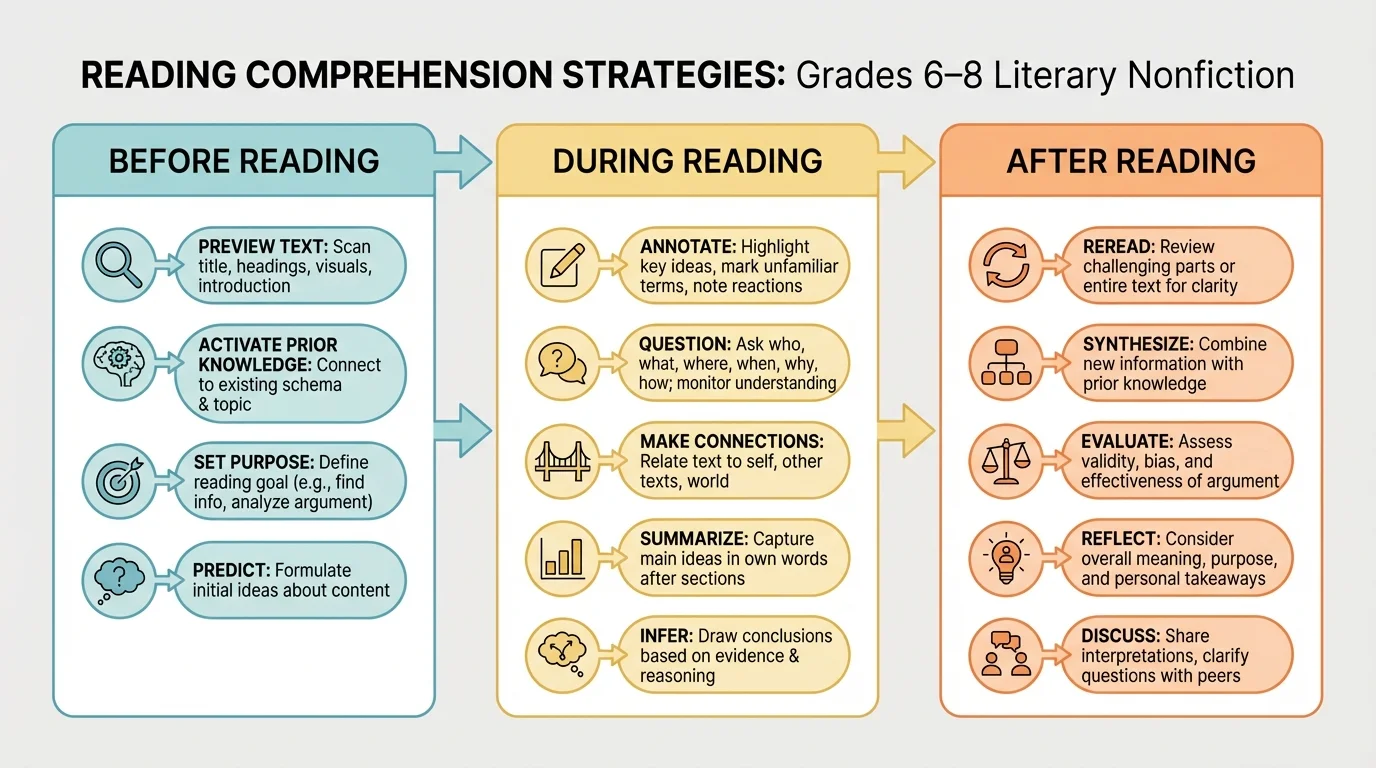
Questioning is especially important. Ask what happened, but also why the writer included it. Ask how the beginning connects to the ending. Ask what the writer wants the reader to feel or understand. In literary nonfiction, meaning is often built through patterns rather than one single statement.
After reading, readers should summarize the text, identify the central idea, and think about how the writer developed that idea. A strong summary is brief and accurate. It does not retell every detail. Instead, it captures the most important events, ideas, and insights.
Reading a memoir excerpt
Suppose a memoir excerpt describes a student arriving at a new school in a different country.
Step 1: Before reading, preview the title and first paragraph.
The title may suggest the topic is change or belonging.
Step 2: During reading, notice details that reveal feelings.
If the narrator describes the hallway as "loud as thunder," that comparison suggests stress or overwhelm.
Step 3: After reading, identify the central idea.
The text may show that entering a new community can feel isolating at first, but small acts of kindness can create connection.
Rereading is not a sign of weakness. Skilled readers reread difficult passages because understanding deepens over time. The first reading may help you follow events. The second reading may reveal tone, symbolism, or how a detail supports the central idea.
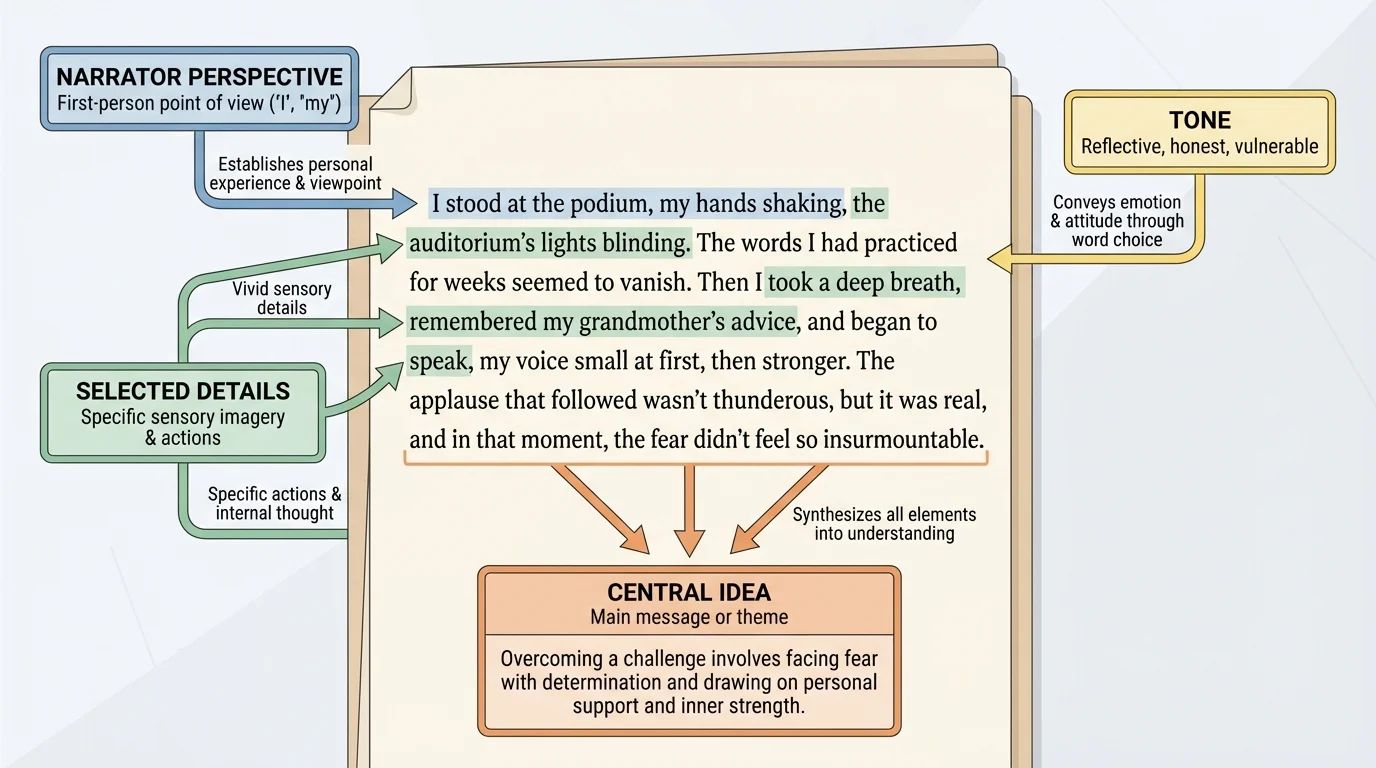
In literary nonfiction, literary elements do not work alone. As [Figure 4] illustrates, the narrator's perspective, the structure of the text, the tone, and the selected details connect to build meaning. If readers analyze these elements separately and never link them, they miss how the text actually works.
Start with the central idea. This is the main message, insight, or understanding the text develops. Then ask how the writer builds it. Does the author choose one vivid memory to represent a bigger truth? Does the speech use repetition to emphasize urgency? Does the structure move from hardship to hope?
Consider a memoir about training for a difficult race after an injury. The central idea might be that perseverance involves both physical effort and mental discipline. The writer may support this through short, determined sentences, painful sensory details, and a structure that alternates between setbacks and progress. The tone may shift from frustration to resolve. Each element strengthens the others.
Another example might be a speech calling for social change. The speaker may begin with personal experience, expand to a larger problem, and end with a challenge to the audience. Here, structure shapes persuasion. The speaker's point of view gives credibility, while emotional and memorable language creates impact. The central idea becomes stronger because the elements are connected carefully.
Readers should also think about what the writer leaves out. Since nonfiction writers select details, omission matters. If a biography emphasizes certain struggles but barely mentions success, the portrait of the person may feel more serious or more critical. Selection is part of meaning.
How literary elements connect
When readers analyze literary nonfiction well, they trace relationships. The writer's point of view affects which details appear. Those details help create tone. Tone influences how readers interpret events. Structure controls the order in which ideas unfold. Together, these elements build the central idea and shape the reader's response.
This kind of analysis moves beyond "what happened?" to "how does the writing create meaning?" That question is the heart of close reading.
Some texts in the grades 6–8 text complexity band are especially demanding. They may contain old-fashioned language, complex sentences, allusions, subtle tone, or historical references. Readers can still understand these texts with support that helps them access the meaning while keeping the challenge intact.
Scaffolding can take many forms. A teacher might provide a short note about the historical setting before students read a speech. Students might receive a small set of guiding questions. Difficult vocabulary may be previewed. The class may read an especially dense paragraph aloud and break down its syntax together.
The key idea is that scaffolding supports the reader's thinking without replacing it. If someone else explains every line, the student is not building independence. Effective scaffolding gives enough help for the reader to do the hard work successfully.
For example, a student reading a historical speech may first learn who the audience was and what event prompted the speech. That support makes the language easier to interpret. Later, the student can analyze repetition, tone, and argument with greater confidence. In this way, support opens the door to deeper comprehension.
When a text feels difficult, return to earlier reading habits: identify who is speaking, track the structure, mark unfamiliar words, and ask what each paragraph adds to the whole. Basic strategies remain useful even when the text becomes more advanced.
As we saw earlier in [Figure 2], complexity comes from many factors at once. Scaffolding helps readers manage those factors one by one until they can handle more of them independently.
These skills matter because literary nonfiction appears in many forms. A memoir asks readers to understand personal experience and reflection. A biography excerpt asks readers to notice how an author presents another person's life. A speech requires attention to audience, purpose, and persuasive language. A travel essay may blend description, culture, and insight. Narrative journalism often tells a true story while also explaining a real issue.
The same reader may need slightly different approaches depending on the type. In a memoir, personal voice may be the strongest clue to meaning. In a speech, repetition and rhetorical patterns may matter more. In a biography, the writer's choices about focus and detail may reveal a particular interpretation of the subject.
Consider these text types side by side:
| Text type | What readers focus on | Common literary features |
|---|---|---|
| Memoir | Personal experience and reflection | Voice, sensory detail, shifts in time |
| Speech | Audience, purpose, persuasion | Repetition, emotional appeal, strong tone |
| Biography excerpt | How a subject is portrayed | Selected details, structure, explanatory commentary |
| Personal essay | Idea developed through experience | Reflection, examples, thoughtful structure |
| Narrative journalism | True event told as a story | Scenes, pacing, quotations, factual reporting |
Table 1. Common forms of literary nonfiction and the reading focus each one often requires.
When readers adjust their attention to fit the form, comprehension improves. They begin to see not only what kind of text they are reading, but also how that kind of text shapes meaning.
Case study: reading a speech and a memoir
A reader compares a speech about equality with a memoir excerpt about a student facing unfair treatment.
Step 1: Identify the shared idea.
Both texts may deal with dignity and justice.
Step 2: Notice how each form develops meaning differently.
The speech may use repetition and broad claims, while the memoir uses one lived experience and personal reflection.
Step 3: Draw a deeper conclusion.
The comparison shows that authors can explore similar ideas through different structures, tones, and details.
That kind of flexible reading prepares students for more advanced texts in later grades, where nonfiction often becomes even more layered and demanding.
Proficient readers build stamina. They can stay with a text even when the meaning does not become clear immediately. They monitor comprehension by noticing confusion early instead of waiting until the end. They use context to figure out unfamiliar vocabulary, but they also know when a word is important enough to check more carefully.
They also support their ideas with evidence. If a reader says the narrator sounds conflicted, there should be details or phrases from the text that support that claim. If a reader says the structure creates suspense, they should be able to explain how the order of events affects the reader.
Another habit is openness to revision. A first interpretation is not always the best one. After rereading, a reader may realize that a speaker's tone is not simply angry but also sorrowful, or that a memoir's ending is more uncertain than hopeful. Good readers are willing to change their understanding when the evidence points in a new direction.
As shown earlier in [Figure 3], reading is a cycle rather than a one-time act. Previewing, annotating, questioning, summarizing, and rereading work together. And as we saw in [Figure 4], analysis becomes stronger when readers connect elements rather than treating each one as separate.
"The text is not a container of facts only; it is also a crafted piece of writing that invites interpretation."
By the end of the year, successful readers can approach literary nonfiction with confidence. They know how to understand the facts, track the craft, and explain how meaning develops. With scaffolding when texts become especially demanding, they continue growing toward independent, thoughtful reading.
