One word can change everything. If an author writes that a character walked into a room, you picture one thing. If the author writes that the character stormed into the room, the whole scene feels different immediately. Good readers do more than recognize words on a page. They notice how words work, what they suggest, and why an author chose them.
Authors choose words carefully because words do more than name objects or actions. They create images, reveal feelings, build tone, and shape the reader's response. The exact word in a sentence can make a character seem brave, nervous, rude, mysterious, or kind.
When you read closely, you are not only asking, "What does this word mean?" You are also asking, "Why this word?" and "What effect does it create?" That deeper kind of reading helps you understand both literary texts, such as stories and poems, and informational texts, such as articles and essays.
Denotation is a word's direct, dictionary meaning. Connotation is the feeling or idea a word suggests beyond its dictionary meaning. Tone is the author's or speaker's attitude toward a subject, character, or audience.
For example, the words home and house are related, but they do not feel exactly the same. House usually points to a building. Home often suggests comfort, belonging, and family. That difference matters when an author wants readers to feel something specific.
Sometimes a word is unfamiliar. Other times a word is familiar but used in an unusual way. In both cases, readers should look at the context clues around the word. Context clues are hints in nearby sentences that help explain meaning.
Writers often reveal meaning through definitions, examples, contrasts, synonyms, or descriptions. If a sentence says, "The path was treacherous, with loose rocks, deep mud, and sudden drops," the surrounding details suggest that treacherous means dangerous. You do not need to stop reading and guess wildly; the text helps you.
Context also helps when a word has more than one meaning. In the sentence, "She sat by the bank and watched the water," bank means the land beside a river. In the sentence, "He went to the bank to deposit a check," the same word means a financial institution. Readers must rely on the situation in the text, not just the word by itself.
Meaning depends on use, not just on the dictionary. A dictionary gives possible meanings, but the sentence, paragraph, and whole text tell you which meaning fits. Strong readers move back and forth between the word and its context until the meaning becomes clear.
Authors also use phrases whose meanings cannot be understood one word at a time. If a narrator says, "My brother spilled the secret, and now the whole class knows," the word spilled does not mean liquid fell from a container. The context shows that it means revealed or told something.
Not every phrase means exactly what it says. figurative language uses words in a creative way to produce a stronger picture or idea. As [Figure 1] shows, the same word can be literal in one sentence and figurative in another, and recognizing that difference keeps you from misunderstanding the text.
A literal meaning is the exact, ordinary meaning of a word or phrase. If a text says, "The backpack was heavy," that usually means it had a lot of weight. A figurative meaning goes beyond the ordinary meaning. If a text says, "A heavy silence filled the room," silence does not weigh anything. The word heavy suggests tension, sadness, or seriousness.
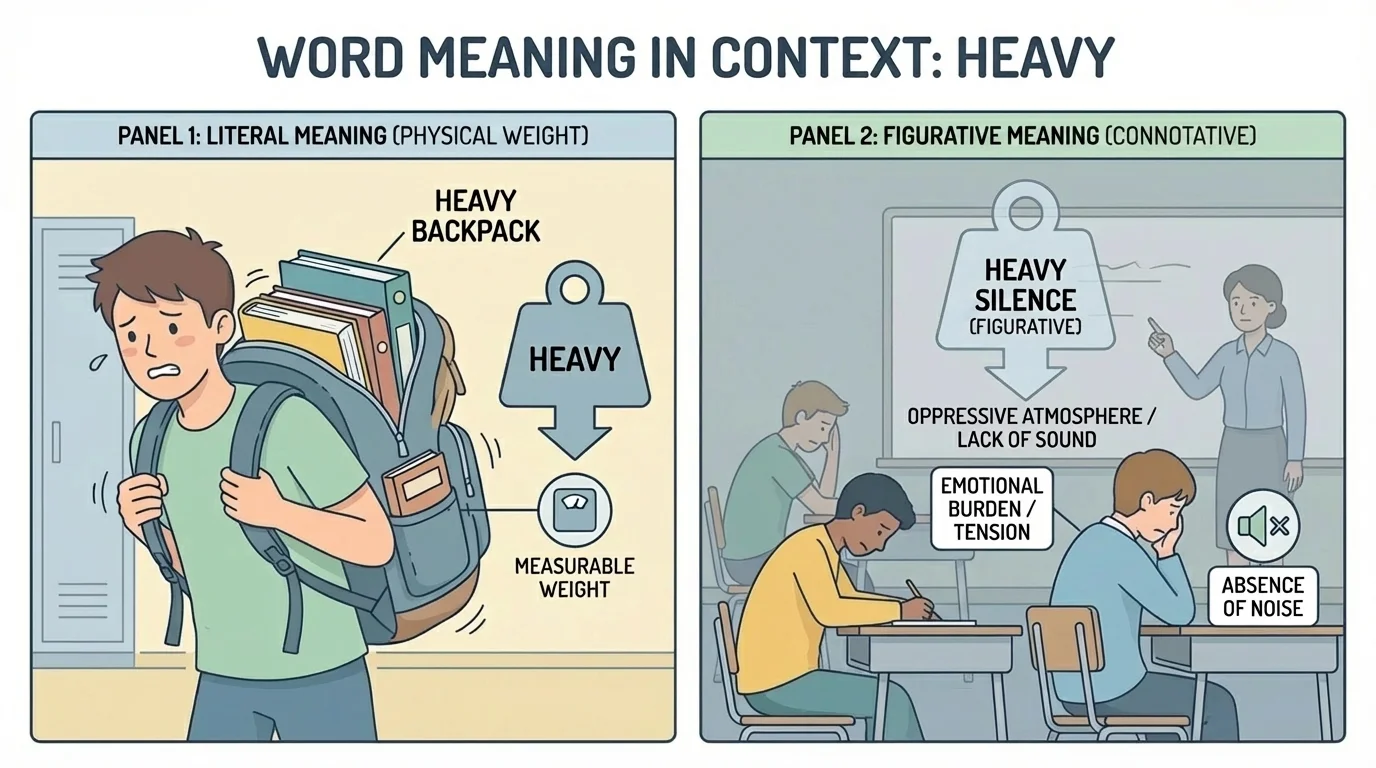
Common types of figurative language include simile, metaphor, personification, hyperbole, and idiom. A simile compares two unlike things using like or as, such as "The clouds moved like ships." A metaphor makes a direct comparison, such as "Time is a thief." Personification gives human qualities to nonhuman things, as in "The wind whispered through the trees." Hyperbole is exaggeration for effect, such as "I have told you a million times." An idiom is an expression whose meaning is different from the literal meanings of the individual words, such as "break the ice."
To interpret figurative language, ask what idea or feeling the phrase creates. If a poem says, "Hope was a tiny candle in the storm," the poet does not mean hope is actual wax and flame. The metaphor suggests that hope is small, fragile, and still powerful enough to matter.
Later in a text, figurative meaning often connects to theme or character. The contrast in [Figure 1] helps show why readers must decide whether a phrase is physical and exact or emotional and symbolic. That choice changes interpretation.
Many everyday expressions are figurative even when people no longer notice. Phrases like grasp an idea, cold shoulder, and under pressure all use language in ways that go beyond literal meaning.
In literature, figurative language often creates stronger imagery than literal language alone. Saying "The sun set" is clear. Saying "The sun slipped behind the hills" adds motion and mood. The second version gives the scene a softer, more artistic tone.
Words may have similar dictionary meanings but very different emotional effects. This is called connotation. As [Figure 2] illustrates, small differences in wording can push a reader toward a positive, negative, or neutral response.
Consider these words: slim, skinny, and scrawny. All can describe someone who is not large. But slim often sounds positive, skinny may sound neutral or slightly negative, and scrawny usually sounds clearly negative. The denotation is similar, but the connotation changes how the person is viewed.
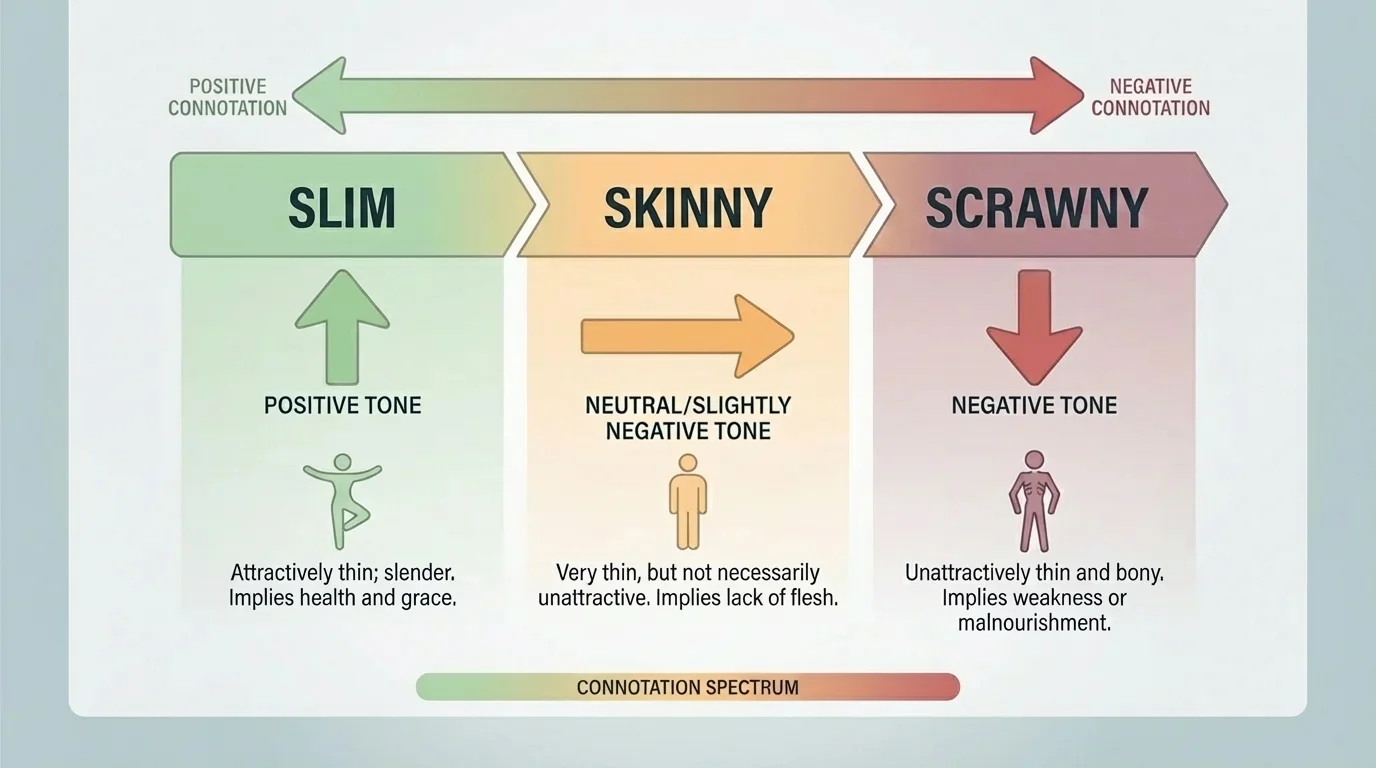
Connotation matters in both literature and everyday life. A journalist might write that a crowd was determined, while another writer might call the same crowd aggressive. Those words do not create the same impression. One sounds more admirable; the other sounds more threatening.
Here are more examples of words with related denotations but different connotations:
| Word Group | More Positive or Neutral | More Negative |
|---|---|---|
| Talking | chatting, discussing | babbling, arguing |
| Walking | strolling, marching | dragging, stomping |
| Old | vintage, experienced | worn-out, ancient |
| Cheap | economical, affordable | stingy, low-quality |
Table 1. Examples of similar ideas expressed with different connotations.
Connotation can also reveal a speaker's attitude. If a character says, "That little speech was interesting," the word little may not simply describe size. It may suggest disrespect or dismissal. Readers should pay attention to whether a word carries admiration, sarcasm, fear, warmth, or criticism.
Analyzing connotation in a sentence
Sentence: "The dog crept across the yard."
Step 1: Identify the basic action.
The basic action is moving from one place to another.
Step 2: Compare the word to a simpler synonym.
The author could have written walked instead of crept.
Step 3: Notice the connotation.
Crept suggests quietness, caution, secrecy, or fear.
Step 4: Explain the effect.
The sentence now feels tense or suspicious. The dog may be nervous, hunting, or trying not to be noticed.
A single verb creates a more vivid meaning and a different tone than a basic verb would.
When analyzing a word's connotation, do not stop at "positive" or "negative." Try to be specific. Ask whether the word sounds proud, playful, gloomy, respectful, sharp, peaceful, or threatening. The more exact your thinking, the stronger your analysis becomes.
The chart in [Figure 2] helps explain why authors do not treat synonyms as perfectly interchangeable. Similar words may point to the same general idea while creating completely different emotional shades.
Some words have a special meaning in a particular subject area. This is called a technical meaning. In everyday conversation, a word may mean one thing, but in science, sports, music, medicine, or technology, it may mean something more exact.
For example, the word volume in daily speech can mean how loud sound is. In mathematics, it means the amount of space inside a three-dimensional object. The word cell might mean a small room in a prison, but in biology it means the basic unit of life. The word draft can mean a rough version of writing, a current of air, or the process teams use to choose players in sports.
When reading informational texts, you must notice the subject and purpose of the text. If you are reading a science article, technical language will usually be precise and important to the main idea. If you misunderstand a technical term, you may misunderstand the whole passage.
Words can have more than one meaning. You already use context to figure out whether bat means an animal or sports equipment. Technical meaning uses the same skill, but with more specialized subject vocabulary.
Technical meaning also appears in literary texts when an author includes specialized settings or characters. A story about a surgeon, a mechanic, or a video game designer may use terms from that field to create realism. Readers should ask whether the word is being used in its everyday sense or in a field-specific way.
Authors use diction, or word choice, to shape a text's tone. As [Figure 3] illustrates, changing one verb in a sentence can shift the reader's sense of a scene from calm to angry to formal to dreamy.
Look at these versions of a sentence: "She walked into the auditorium." "She marched into the auditorium." "She drifted into the auditorium." "She stomped into the auditorium." The basic action stays similar, but the feeling changes each time. Marched sounds confident or strict. Drifted sounds relaxed or distracted. Stomped sounds angry.
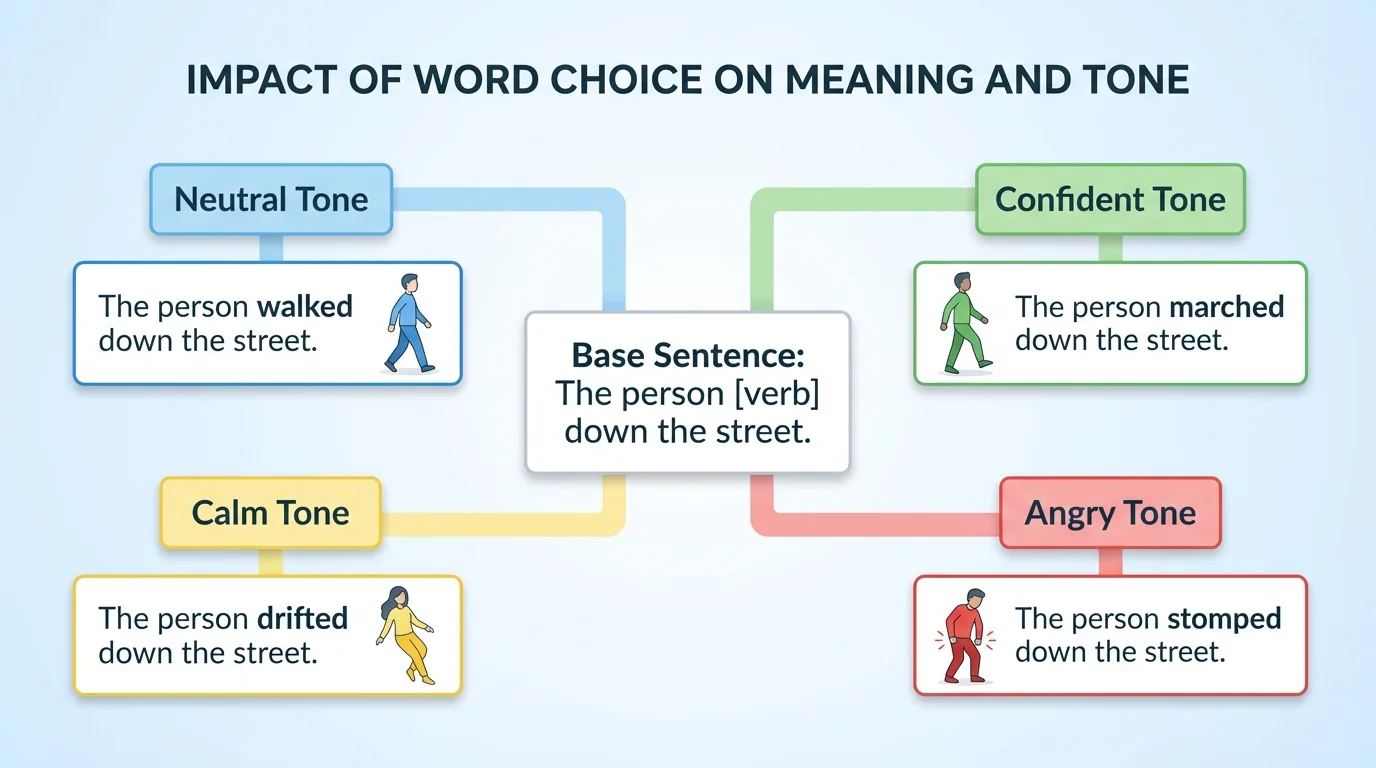
Tone is not the same as topic. Two texts can be about the same event but sound entirely different. A writer describing rain might use words like gentle, silver, and refreshing to create a peaceful tone. Another writer describing rain might use cold, relentless, and gray to create a gloomy tone.
In fiction, tone can influence how readers judge characters and situations. If a narrator describes a place as cozy, readers may feel welcome. If the same place is described as cramped, readers may feel uncomfortable. Both words could refer to a small space, but their tones differ sharply.
Word choice also affects pacing and intensity. Short, harsh words can make a moment feel sudden or tense. Longer, softer words can make a scene feel slower and calmer. The branching examples in [Figure 3] show how quickly tone shifts when diction shifts.
"The difference between the almost right word and the right word is really a large matter."
— Mark Twain
This idea matters because strong analysis pays attention to precision. Instead of saying, "The author used a good word," explain what the word suggests and how it shapes tone. The best responses connect the word to a larger effect in the passage.
Good readers often compare a word in the text with other words the author might have used. This helps reveal purpose. Why write gazed instead of looked? Why write declared instead of said? Why write fragrance instead of smell?
In literary texts, these choices often develop character, setting, theme, or mood. If a poet writes that leaves fluttered to the ground, the verb gives a delicate image. If the poet writes that leaves dropped to the ground, the image feels plainer. The first choice is more vivid and may create a more graceful tone.
In informational texts, specific word choice can shape clarity and credibility. A science article might use precise terms to sound accurate and trustworthy. A speech might use emotionally loaded words to persuade an audience. Readers should notice whether a writer seems objective, biased, urgent, respectful, or dramatic.
Comparing two sentence versions
Version A: "The leader spoke to the crowd."
Version B: "The leader boomed at the crowd."
Step 1: Determine the basic meaning.
Both sentences describe a leader using a voice to address people.
Step 2: Analyze the more specific word.
Boomed suggests loudness, power, and perhaps dramatic force.
Step 3: Explain the tone.
Version A is neutral. Version B creates a stronger, more intense tone and makes the leader seem commanding.
By comparing simple and specific wording, you can explain why diction matters.
Sometimes an author chooses a softer word to be gentle, polite, or indirect. Sometimes the author chooses a stronger word to shock, emphasize, or persuade. There is rarely a random choice in effective writing.
When you analyze word meaning in a text, move step by step. First, identify the word or phrase that seems important, unusual, repeated, or emotionally powerful. Next, read the surrounding sentences for context clues. Then decide whether the meaning is literal, figurative, connotative, or technical. Finally, explain the effect of that choice on meaning and tone.
A useful set of questions can guide you: What does the word mean here? Does it mean the same thing it usually means? What feeling does it suggest? Is it connected to a certain subject area? Why might the author have chosen this word instead of a simpler one?
These questions are especially important in poetry because poems often pack many meanings into very few words. But they also matter in stories, speeches, historical writing, science texts, and opinion articles. In every kind of text, meaning depends on the choices the writer makes.
Strong analysis connects word choice to a larger purpose. It is not enough to define a word. Explain how the word supports characterization, imagery, mood, theme, argument, or tone. That connection turns observation into real analysis.
For example, if a story repeatedly uses winter words like frozen, barren, and pale, those words may do more than describe weather. Together they may create a lonely tone or reflect a character's emotional state. Looking at patterns of diction helps readers see bigger ideas.
One common mistake is relying only on the first dictionary definition. Words in texts do not always use the most common meaning. Another mistake is ignoring connotation. Two words may seem alike, but their emotional effects can be very different.
A third mistake is taking figurative language literally. If a character says, "I'm drowning in homework," readers should understand this as exaggeration, not an actual emergency. A fourth mistake is forgetting the type of text. A technical article may use a familiar word in a highly specific way.
Another mistake is describing tone with vague labels only. Instead of saying the tone is just "bad" or "good," choose accurate words such as hopeful, sarcastic, tense, formal, admiring, or bitter. Precise language leads to precise analysis.
Careful readers notice that meaning in a text is built, not simply delivered. Words interact with one another, with the subject, and with the author's purpose. That is why understanding word choice is one of the most important reading skills.
