Two people can read the exact same speech from a page and react very differently when they hear it spoken aloud. On paper, the words may seem calm and formal. Out loud, the same words might sound urgent, inspiring, or even angry. That difference is the heart of this skill: understanding how a message changes when it is presented in a different form.
[Figure 1] shows that when readers compare a written work to an audio, video, or multimedia version, they are studying more than just the words. They are noticing how the medium shapes the message through the different tools each form uses. A printed text relies on word choice, structure, and punctuation. An audio version adds voice and sound. A video version adds facial expression, movement, and visuals. A multimedia version may combine text, images, music, narration, and graphics all at once.
This matters in real life. People learn from podcasts, news videos, documentaries, websites, speeches, and written articles every day. If you can compare these forms carefully, you become a stronger reader, listener, and thinker. You stop asking only, "What does it say?" and start asking, "How does the way it is delivered change its meaning and effect?"
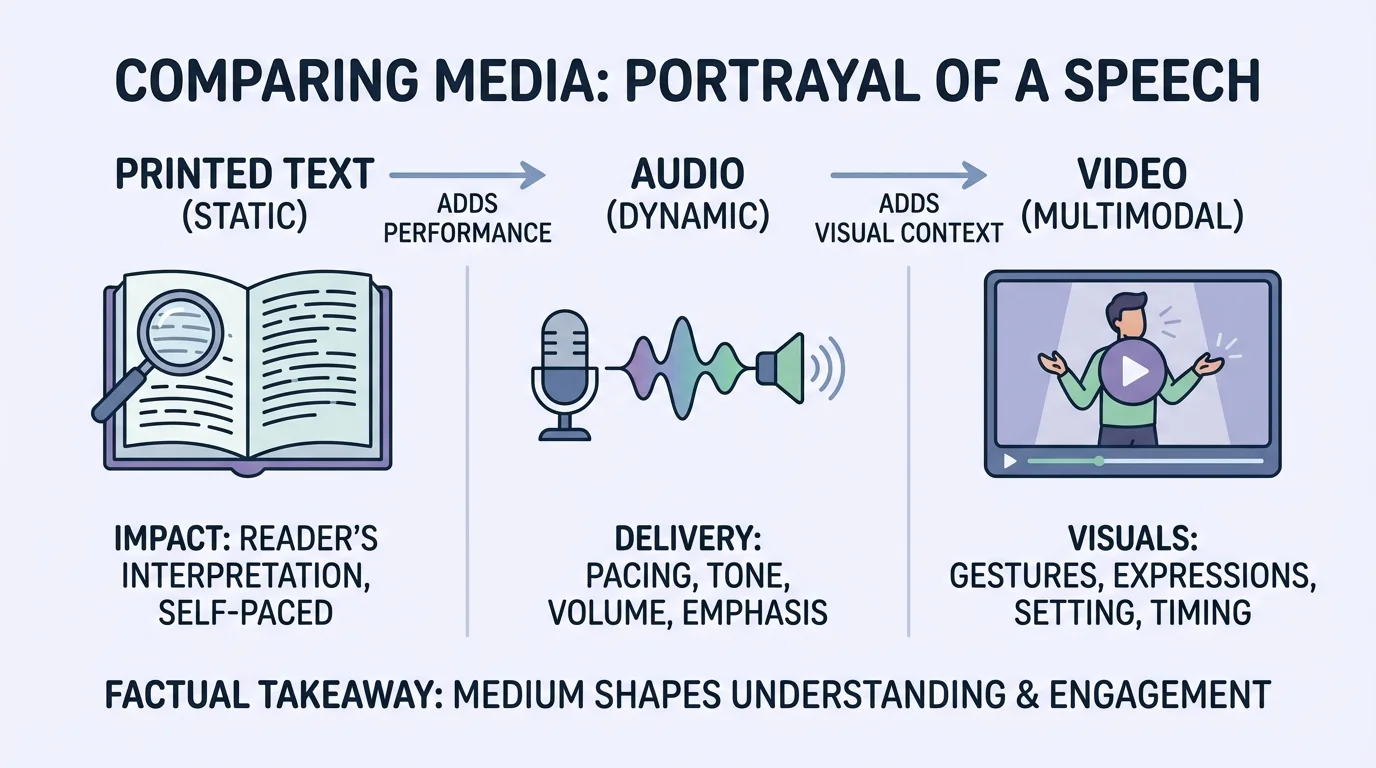
A portrayal is the way a subject, event, person, or idea is presented. A text might portray a leader as thoughtful by using careful, detailed language. A video of the same leader might portray that person as confident because of eye contact, posture, and strong voice projection. The subject is the same, but the portrayal is not exactly the same.
Each medium has strengths and limits. Written text gives readers control. You can pause, reread, underline, and think deeply about a sentence. Audio gives you sound clues that a page cannot fully provide, such as trembling emotion, excitement, or sarcasm. Video gives you body language and setting. Multimedia can guide your attention with images, music, sound effects, and on-screen text.
Because of these differences, one version may make an idea seem more powerful, more emotional, more dramatic, or clearer than another version. That does not always mean one is better in every way. It means each medium creates its own experience for the audience.
Medium is the form in which a message is presented, such as print, audio, video, or multimedia.
Portrayal is the way a subject is shown or presented.
Delivery is the way a speaker presents words aloud, including pace, pauses, stress, and emotion.
Tone is the feeling or attitude expressed through words or voice.
When you compare versions, you are not just listing differences. You are explaining why those differences matter. For example, if a poem on the page seems mysterious, but a video version adds bright music and cheerful animation, the mood may shift. Your job is to notice the change and analyze its effect on the audience.
A written text often gives the fullest access to the author's exact language. Readers can study individual words, sentence patterns, and structure. You can look at how a paragraph builds an idea, how a heading organizes information, or how punctuation creates rhythm.
Print is especially strong when a text is complex. In an informational article, readers can stop to examine evidence, trace the author's reasoning, and connect one section to another. In a speech transcript, readers can notice repeated phrases, persuasive word choice, and powerful lines that might pass by quickly when heard only once.
Written text also leaves more room for the reader's imagination. If you read a description of a storm, you picture it in your own mind. A video version shows one specific storm, with one specific color, sound, and setting. That can be powerful, but it is also more fixed.
Some famous speeches are studied in schools mainly through printed transcripts because readers can more easily notice patterns such as repetition, parallel structure, and key word choices when they see the lines on the page.
Still, print has limitations. A text does not let you hear hesitation, confidence, grief, excitement, or urgency unless those qualities are suggested through the wording. Readers must infer tone from clues in the language.
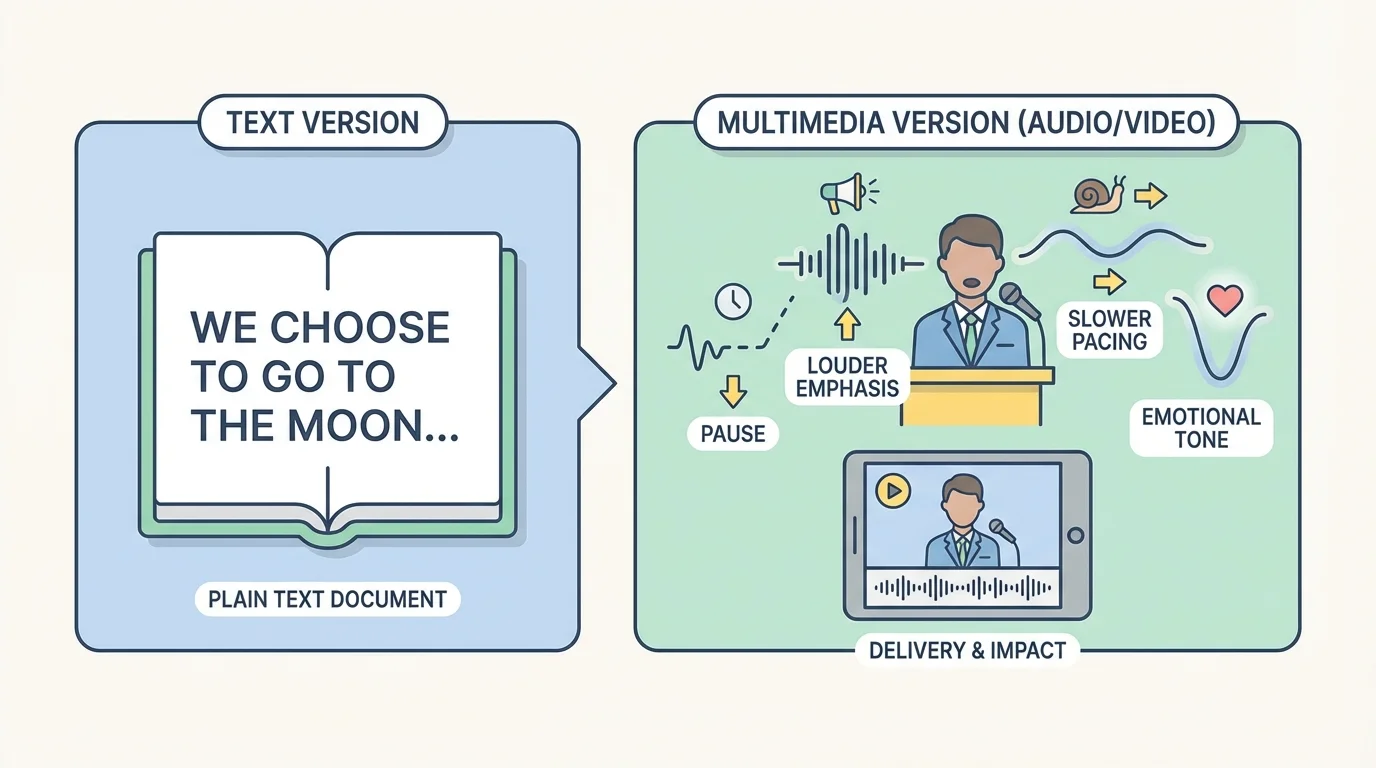
[Figure 2] shows that when you hear words spoken aloud, delivery becomes part of the message, and features like stress and pause shape meaning. A speaker can slow down before an important point, raise volume to show passion, or pause for effect. These choices can make listeners feel suspense, sadness, pride, or urgency.
Audio is especially important when the text is a speech, poem, interview, or dramatic scene. Hearing a voice reveals qualities that may stay hidden on the page. A line that looks simple in print may sound powerful when spoken firmly. A sentence that seems serious might sound playful if the speaker laughs slightly or changes pitch.
Pacing matters too. Fast pacing can create excitement, panic, or energy. Slow pacing can make a message feel thoughtful, serious, or emotional. Emphasis also matters. If a speaker stresses one word, that word may stand out as the key idea.
For example, consider the sentence: We must act now. In print, readers may understand it as urgent. In audio, the speaker can make must sound forceful, act sound commanding, or now sound immediate. The meaning stays related, but the impact changes.
Audio can also include music, silence, or background sound. A historical podcast might add solemn music to make an event feel serious. A dramatic reading might use silence after an important line so listeners have time to absorb it. The spoken form is not only about words; it is about how those words arrive in the listener's ears.
Why speech delivery changes meaning
Words carry meaning, but voice adds another layer. Volume can signal confidence or anger. Pitch can suggest excitement, fear, or calm. Pauses can create suspense or show emotion. Even if the script does not change, the listener's understanding can shift because delivery guides how the message feels.
This is why hearing a speech by the original speaker can be more powerful than reading it silently. The speaker's own voice may reveal determination, sorrow, humor, or hope in a way that print alone cannot fully reproduce.
[Figure 3] shows that video adds visual evidence to spoken or written words, and facial expression, movement, and setting work alongside language. In a speech video, a viewer notices gestures, eye contact, clothing, audience reaction, and background setting. These details shape how the message is understood.
Multimedia goes even further by combining modes. A website about climate change might include text, charts, photos, narration, animation, and short video clips. A documentary may combine interviews, historical footage, music, maps, and captions. These layers can make information clearer, more emotional, or more persuasive.
Visuals can guide attention strongly. If a video pairs a speech about hardship with black-and-white images of destruction, the emotional effect becomes stronger. If upbeat music plays under serious words, the tone may become confusing or mixed. Camera choices also matter. A close-up can make a speaker seem sincere and personal. A distant shot can make the scene feel formal or detached.
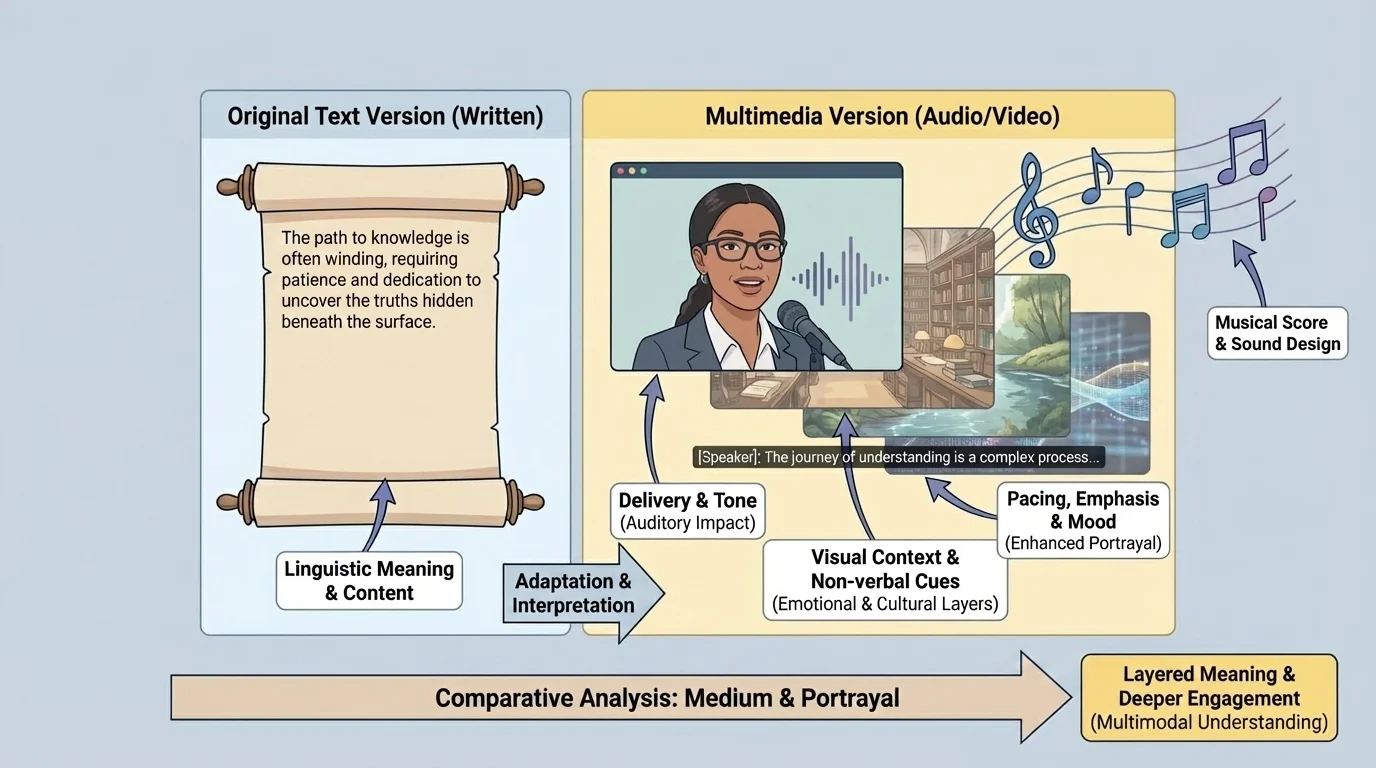
Editing shapes meaning too. A video can cut quickly between scenes to create tension or move slowly to create reflection. Multimedia can also simplify ideas through graphics and labels, which may help an audience understand complicated information faster than text alone.
However, video and multimedia can also influence viewers so strongly that they may focus more on the presentation than on the words themselves. That is why careful viewers ask whether music, images, and editing support the message honestly or try to push the audience too forcefully.
When analyzing any source, keep the central idea in mind. Then ask how details support that idea. Comparing media builds on the same skill: first understand the message, then examine how each version presents it.
Multimedia does not just repeat a message. It can reshape the audience's attention, mood, and understanding.
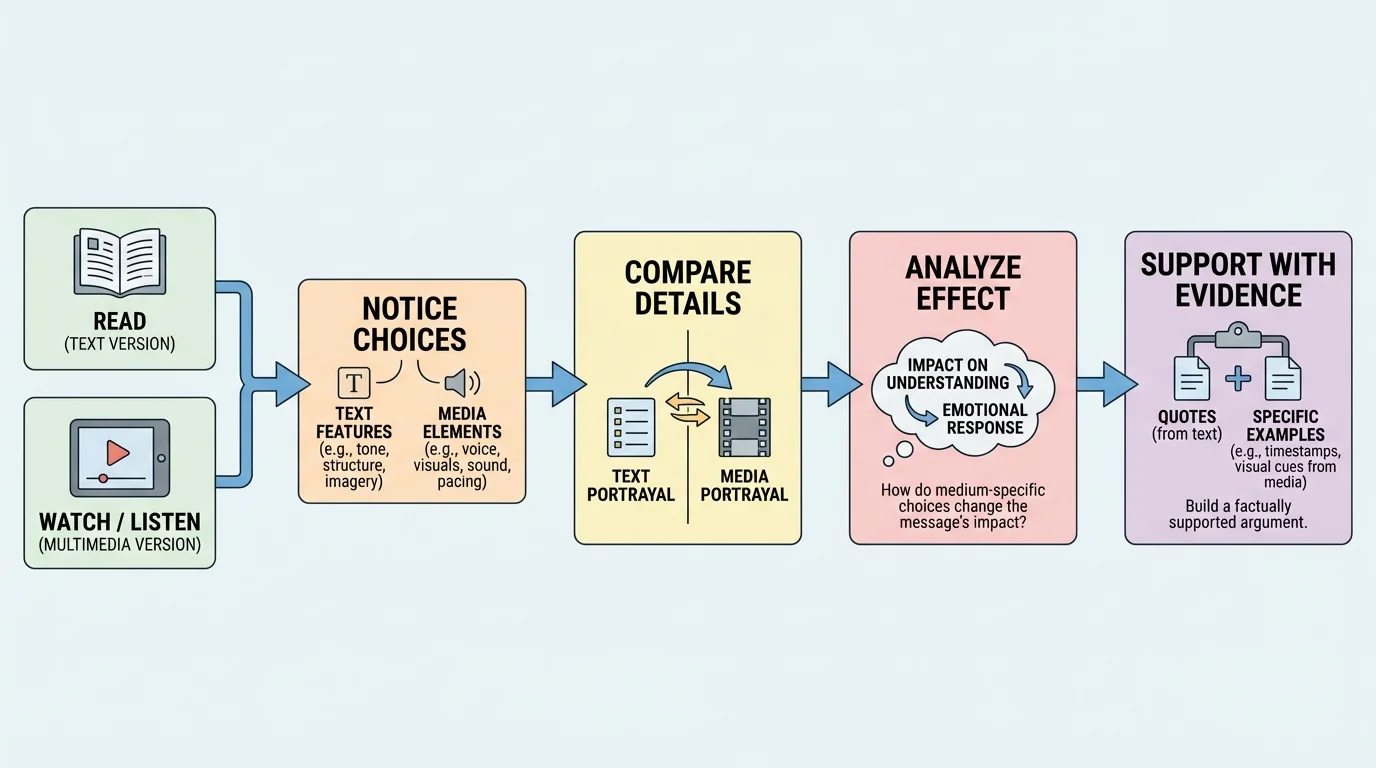
[Figure 4] shows a clear process for comparing versions in a thoughtful way. Without a process, students often end up saying only that one version was "better" or "more interesting." Strong analysis goes deeper than preference.
Start by identifying what stays the same. What is the main topic, claim, event, or theme in both versions? Then notice what changes. Are words added, removed, rearranged, spoken with emotion, or supported by visuals?
Next, think about purpose and audience. Is the version trying to inform, persuade, inspire, entertain, or warn? Which details help it do that? Then ask about impact: how does each version affect the audience's understanding or feelings?
A strong comparison usually includes these questions:
You should support every claim with evidence. In a written text, that may mean quoting a phrase, pointing to a repeated word, or describing how the paragraph is organized. In audio or video, that may mean describing a pause, gesture, image, camera shot, or musical cue.
Suppose students read the transcript of a speech calling for community action. On the page, the speech may appear formal and carefully structured. Readers notice repeated phrases such as We can rebuild and We will not give up. These repetitions make the message persuasive and memorable.
Case study: comparing a printed speech and a spoken performance
Step 1: Examine the written version.
The transcript reveals repetition, strong verbs, and a clear structure that moves from a problem to a solution.
Step 2: Examine the audio or video version.
The speaker raises their voice on key lines, pauses before the final statement, and makes direct eye contact with the audience.
Step 3: Analyze the effect.
The transcript helps readers study the language closely, but the performance makes the message feel more urgent and inspiring because delivery adds emotion.
A strong conclusion would explain not only that the spoken version is more moving, but also which choices create that effect.
Now imagine the speaker's voice grows quiet before the final line, then becomes louder on the last sentence. That shift can make the ending feel dramatic and memorable. If the audience applauds in the video, viewers may sense the speech's public power in a way a transcript does not fully capture.
Still, the transcript may be better for close analysis. A student can return to exact words and examine the author's reasoning. This is why comparing media is not about naming a winner in every situation. It is about understanding the strengths of each version.
A short story and a film version often differ in obvious ways. The print version may describe a character's thoughts directly. The film version may show those thoughts indirectly through facial expression, music, lighting, and action.
If a story says that a character felt isolated, the text might explain that feeling with detailed narration. A film clip might place the character alone in a wide, empty hallway with dim lighting and echoing footsteps. The idea is similar, but the method is different.
Film also has time limits. Directors may cut scenes, combine characters, or remove details. Because of this, a video version may be faster and more dramatic, while the written version may be richer in explanation and inner thought.
Case study: comparing print fiction and a filmed scene
Step 1: Identify an important moment in both versions.
Choose a scene in which the main character faces a difficult decision.
Step 2: Compare what each medium emphasizes.
The story may focus on internal thinking, while the film emphasizes visual mood through lighting, music, and expression.
Step 3: Decide how the portrayal changes.
The written version may make the character seem reflective and complex, while the film version may make the same moment feel tense and immediate.
An effective analysis names the exact details that create those impressions.
This kind of comparison helps students understand adaptation. When creators move a work from one medium to another, they must make choices. Some choices preserve the original effect. Others change it.
When you evaluate effectiveness, avoid saying only, "I liked the video more." Personal response matters, but academic analysis requires reasons. You must connect your opinion to purpose, audience, and evidence.
For example, if the goal is to study a speaker's word choice, the written text may be more effective because readers can slow down and inspect the language. If the goal is to feel the emotion and urgency of a speech, the audio or video may be more effective because delivery and expression deepen the impact.
Sometimes a multimedia version is most effective because it makes difficult information easier to understand. Charts, narration, captions, and images can work together to explain a complex topic. At other times, multimedia may distract from the core message if it adds too many effects.
| Medium | Common Strengths | Possible Limits |
|---|---|---|
| Written text | Precise language, rereading, close study | Less immediate emotion or sound |
| Audio | Voice, tone, pauses, emphasis | No visual context |
| Video | Gesture, setting, facial expression, audience reaction | May move too quickly for close study |
| Multimedia | Combines text, image, sound, and graphics | Can overwhelm or manipulate attention |
Table 1. Comparison of strengths and limits of different media when presenting the same message.
Your evaluation should match the goal. A version can be more effective for one purpose and less effective for another. That is a thoughtful judgment.
One common mistake is writing a summary instead of a comparison. A summary retells what happens or what the source says. A comparison explains how two versions present that content differently and why those differences matter.
Another mistake is noticing a difference but not analyzing it. For instance, saying "the video had music" is only an observation. Strong analysis explains the effect: "The slow piano music makes the speech feel solemn and emotional."
A third mistake is ignoring the audience. Different media affect audiences in different ways. A younger audience might understand a multimedia presentation more easily because visuals support the explanation. A researcher may prefer a written text for careful study and citation.
"The message is not only in the words. It is also in the way the words are delivered."
It is also important not to assume that visual or audio versions are always stronger. Sometimes simple print is more powerful because nothing distracts from the language.
Good comparison writing uses precise evidence from both versions. For a text, you might quote a line or describe how a paragraph is organized. For audio, you might note that the speaker pauses before a key sentence. For video, you might point out a close-up shot, a change in lighting, or the audience's reaction. For multimedia, you might mention how captions, images, and music work together.
You can build strong analysis by using sentence patterns such as these:
Notice that each sentence goes beyond naming a feature. It explains effect. That is the goal of analysis.
Earlier, [Figure 4] laid out a comparison process, and that process works best when every step leads to evidence-based claims. Careful readers and viewers do not guess. They point to exact features and explain what those features do.
When you compare a text to an audio, video, or multimedia version, you are learning to notice craft. You are asking how creators shape audience understanding through language, sound, image, and performance. That skill helps in literature, history, science communication, news analysis, and everyday life.
