Two people can read the same story and remember completely different things. One remembers the action. Another remembers a powerful message about family, courage, or change. Strong readers do more than follow what happens. They look underneath the events to understand what the text is really saying. That deeper meaning often includes more than one important idea, and learning to spot those ideas helps you read with sharper attention and think with more precision.
When you determine central ideas, you are asking: What important ideas does this text develop, and how does the author build them over time? In many texts, especially stories and literary nonfiction, one idea is not enough. A text may explore friendship and responsibility, or freedom and sacrifice, or survival and identity. Your job is not just to name those ideas, but to explain how the text reveals them through details, events, characters, and conflicts.
Reading for central ideas helps you move beyond the surface. If a story is about a girl training for a race, the race itself may be exciting, but the text may also be developing ideas about discipline, self-doubt, and perseverance. If you only retell the plot, you miss the larger meaning.
This skill matters in school and beyond the classroom. News articles, speeches, memoirs, novels, and even documentaries often contain multiple central ideas. Being able to track them helps you understand what matters most, compare texts more thoughtfully, and explain your thinking with evidence.
Central idea is an important message, insight, or understanding that a text develops. It is bigger than one fact or event.
Topic is the subject of a text, such as friendship, migration, or teamwork.
Supporting details are the specific facts, actions, descriptions, or examples that help develop a central idea.
Objective summary is a brief retelling of the text's main ideas and key events without personal opinions or extra commentary.
A useful way to think about this is to separate what the text is about from what the text says about that subject. The topic might be loss. A central idea might be that people begin to heal when they allow others to help them. The topic is broad; the central idea is more specific and meaningful.
Students often confuse several related ideas. A topic is usually one or two words. A central idea is a complete thought about that topic. A plot event is something that happens. A summary retells the most important parts. An objective summary does that fairly and neutrally, without saying whether you liked the text or whether a character was "annoying" or "awesome."
In literary texts, some readers also use the word theme. Theme and central idea are closely related. In many classrooms, theme is used most often for a life lesson or message in fiction, while central idea can be used more broadly in both fiction and nonfiction. What matters most is that you can explain the important ideas clearly and support them with details from the text.
Good readers already know how to identify important events, conflicts, and character changes. Those skills are the foundation for finding central ideas, because major ideas usually grow out of those important parts of the text.
Another term that matters is supporting detail. Supporting details are not random facts. They are the pieces of evidence that show why a central idea makes sense. If you say a central idea is that trust must be earned, you should be able to point to details showing characters breaking trust, rebuilding it, or struggling to believe one another.
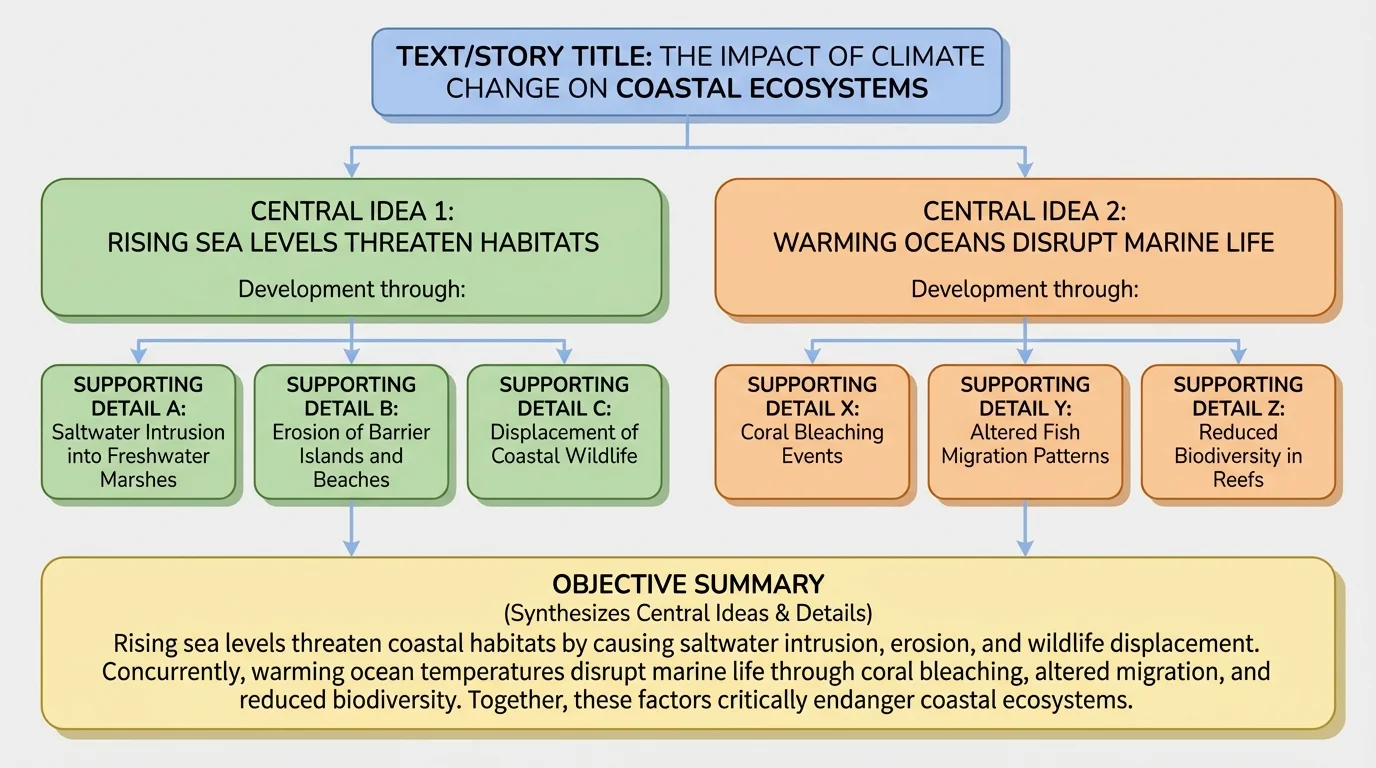
One strong method is to look for repetition and emphasis. When a text returns to the same problem, value, feeling, or conflict again and again, that is a clue. A text-analysis organizer, as shown in [Figure 1], helps readers separate the broad ideas from the details that support them. If several different moments all point toward the same message, that message may be a central idea.
Another method is to notice what changes. Ask yourself: What does the main character learn? What pressure keeps appearing? What problem grows more important? What do different scenes have in common? Writers often build central ideas by placing characters in situations that test them over and over.
You should also pay attention to contrasts. Sometimes a text develops two central ideas by comparing two characters, two settings, or two choices. For example, one character may choose comfort while another chooses honesty. That contrast may reveal ideas about courage, integrity, or consequences.
A text can have more than one central idea because human experiences are complex. A story about moving to a new city might develop one central idea about belonging and another about family support. These ideas are different, but they can work together. The character may feel lonely in the new place while also learning that family can provide strength during change.
When naming central ideas, avoid making them too broad or too narrow. "Friendship" is too broad because it is only a topic. "Ava shared her lunch on page 3" is too narrow because it is just one detail. A stronger central idea would be: friendship grows through small acts of loyalty and kindness.
Many strong readers first notice central ideas without realizing it. When you say, "This story is really about learning who you are," you are already moving from plot toward deeper analysis.
To test whether you have found a true central idea, ask two questions. First, does this idea connect to multiple parts of the text? Second, can I support it with several details, not just one? If the answer to both is yes, you are probably on the right track.
Finding a central idea is only part of the job. You also need to analyze its development, or how it grows and changes over the course of the text.
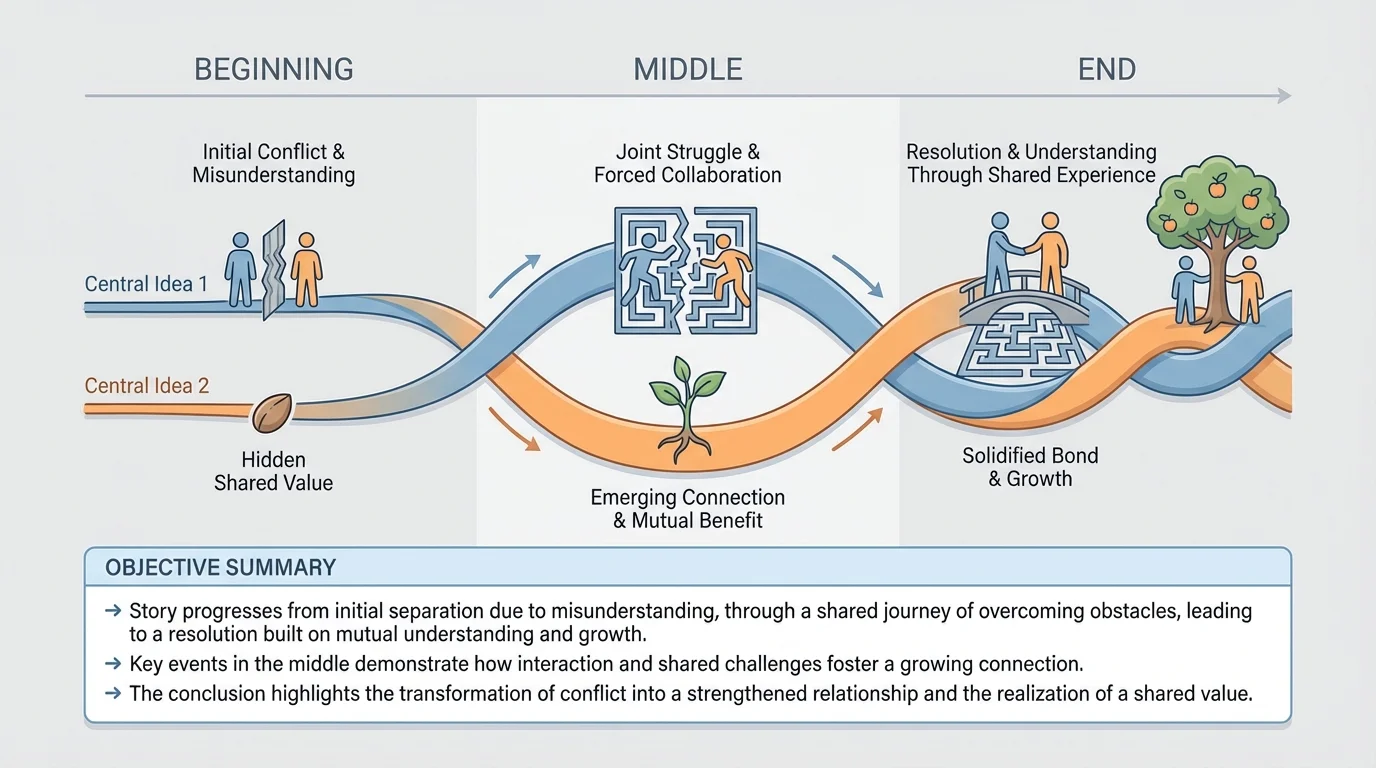
At the beginning of a text, a central idea may appear as a hint. A character may feel left out, hide the truth, or avoid a difficult task. In the middle, the author usually adds complications. The character faces consequences, learns new information, or has to make a difficult choice. As shown in [Figure 2], by the end, the events often reveal the full meaning of the idea.
Development does not always mean that the idea stays exactly the same. Sometimes it deepens. Sometimes it becomes more complex. Sometimes two ideas start separately and then connect. A story may begin as if it is mainly about winning, but later reveal that it is more deeply about self-respect and teamwork.
Pay attention to signal moments: turning points, arguments, discoveries, decisions, and endings. These moments often strengthen or shift central ideas. If a character finally tells the truth after hiding something for most of the story, the author may be developing an idea about honesty, guilt, or the difficulty of doing what is right.
Authors also develop ideas through patterns in language. Repeated images, descriptions, or symbols can matter. If a story keeps describing doors, windows, or locked spaces, those details may connect to ideas about freedom, fear, or opportunity. Even if the text never states the idea directly, the pattern helps readers infer it.
In literary texts, central ideas are closely connected to literary elements. This is why careful readers do not treat these elements as separate boxes. They work together.
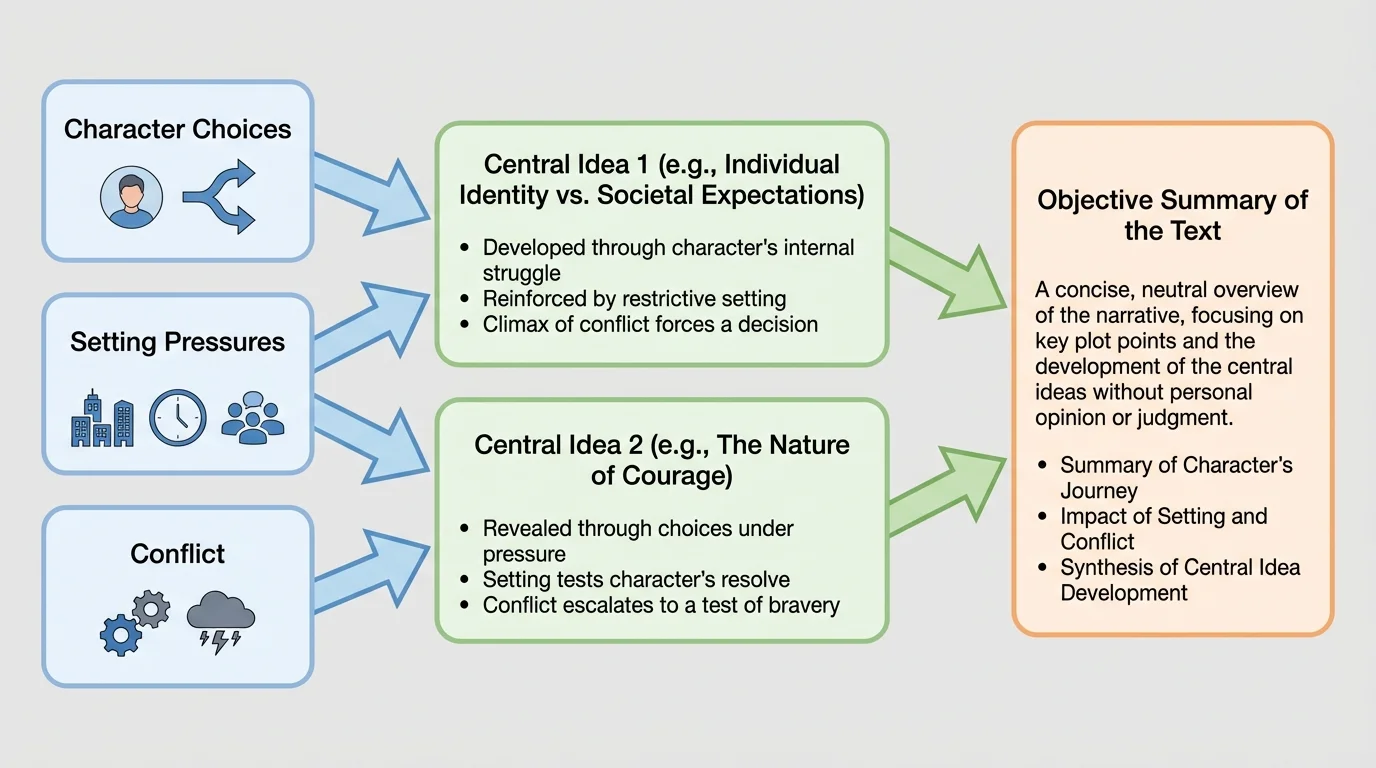
[Figure 3] shows how character matters because the choices, feelings, and changes of characters often reveal what the text values. If a character learns to ask for help, that can support a central idea about trust or community.
Setting matters because place and time create pressure. A story set during a drought may naturally develop ideas about survival, responsibility, or sharing limited resources. A setting can also shape mood and symbolize larger ideas.
Conflict matters because struggle reveals what is at stake. A conflict between siblings might develop ideas about loyalty and jealousy. A conflict between a person and society might develop ideas about justice or freedom.
Plot matters because the order of events shows development. Early events introduce tensions, middle events test characters, and final events reveal consequences. When you analyze development, you are really tracing how the plot and literary elements build the central ideas step by step.
Suppose a story follows a boy who refuses to join his family's fishing work because he wants to become a musician. At first, the conflict seems to be about career choice. But if the setting shows the family depends on his labor, and the character begins to understand their struggle, the story may also develop central ideas about duty, identity, and respect for family sacrifice.
How literary elements reveal meaning
Authors rarely announce central ideas in a single sentence. Instead, they build meaning through scenes, dialogue, setting details, conflict, and changes in characters. That means a reader must gather clues from different parts of the text and connect them into a larger understanding.
Later, when you explain a central idea, you should connect it to these elements. Instead of saying only, "The story is about courage," you might say, "The story develops the central idea that courage often means acting despite fear, shown through the character's decision to protect her brother during the storm." That explanation is more precise and more convincing.
One common mistake is choosing a detail instead of a central idea. If a story includes a broken bicycle, that object may be important, but it is not automatically a central idea. Ask what the broken bicycle represents or helps reveal. Perhaps it connects to poverty, disappointment, or perseverance.
Another mistake is turning analysis into opinion. Saying "This story teaches a great lesson" is a reaction, not an explanation. Saying "The text develops the idea that people become stronger when they face disappointment honestly" is analysis. Readers should be able to support analysis with evidence from the text.
A third mistake is making the idea too obvious and incomplete. For example, "family is important" is often too vague. Important how? A more developed statement might be, "The text suggests that family support can help people endure uncertainty and change."
| Weak Response | Why It Is Weak | Stronger Response |
|---|---|---|
| Friendship | Only a topic | Friendship grows when people remain loyal during difficult moments. |
| The dog runs away. | Only an event | Loss can help characters realize what they truly value. |
| I liked the ending. | Personal opinion | The ending reinforces the idea that forgiveness requires honesty. |
Table 1. Comparison of weak responses and stronger central-idea statements.
The organizer in [Figure 1] is helpful here because it separates major ideas from the details beneath them. If a point cannot hold several supporting details, it is probably not central enough.
Once you understand the central ideas and key events, you are ready to write a summary. A summary is shorter than the original text, but it still captures the essential meaning.
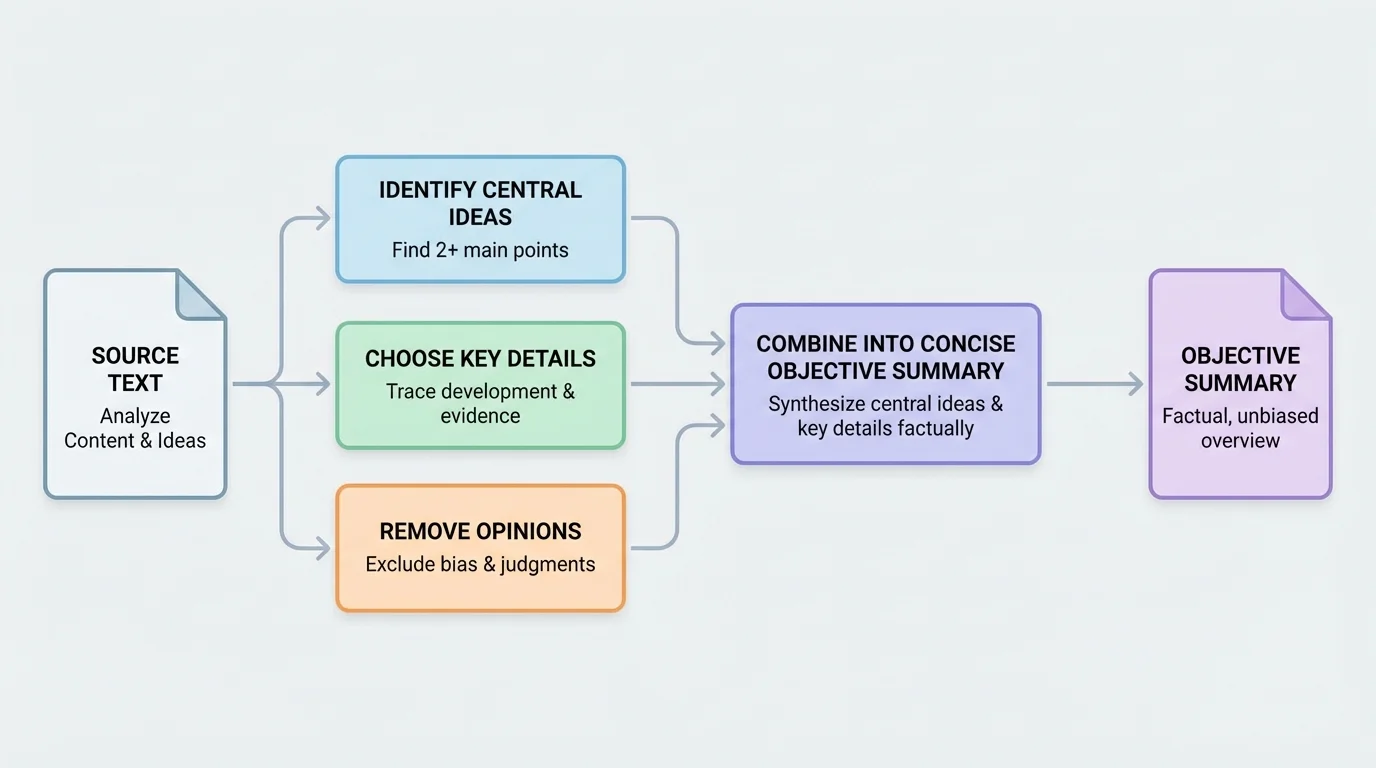
[Figure 4] An objective summary includes the main situation, the most important events or points, and the central ideas of the text. It does not include your opinions, extra examples, or tiny details that do not matter to the whole.
To stay objective, use neutral language. Instead of saying, "The selfish mayor finally makes a decent choice," say, "The mayor changes his decision after seeing the effects on the town." The second sentence reports what happens without judging the character.
A good summary also follows the text accurately. It should not change events, exaggerate meaning, or add ideas that are not really there. If the text suggests a message about resilience, do not suddenly claim it is mainly about leadership unless the details truly support that.
Most summaries are written in the present tense when discussing literature. For example: "Mara returns to her hometown, struggles to reconnect with her father, and learns that forgiveness requires honesty." This sentence is brief, accurate, and neutral.
From notes to objective summary
Suppose you read a story about Lina, who joins her school newspaper and uncovers a problem with unfair lunch policies.
Step 1: Identify the most important events
Lina notices some students are embarrassed by the lunch system. She investigates, interviews people, and writes an article. Adults resist at first, but the article leads to change.
Step 2: Identify central ideas
Possible central ideas include the power of speaking up and the importance of dignity and fairness.
Step 3: Remove opinions and minor details
Leave out statements like "Lina is amazing" or tiny facts such as what color notebook she uses, unless those details matter to the whole text.
Step 4: Write the summary
Lina joins the school newspaper and discovers that lunch rules embarrass some students. As she investigates and publishes an article despite resistance, the story develops the ideas that speaking up can lead to change and that fairness should protect people's dignity.
Notice that the summary does not include every scene. It focuses on the most important developments and states the central ideas clearly. That is what makes it effective.
Consider this short fictional scenario: A girl named Nia spends the summer with her grandfather in a mountain town after her parents separate. At first, she is angry and withdrawn. Her grandfather asks her to help restore an old garden behind his house. Nia resists, saying the garden is dead and there is no point. Over time, she notices that her grandfather keeps working even after storms ruin sections of the garden. As they work, he tells stories about years when the town survived fires, floods, and loss. Near the end of the story, Nia chooses to replant a section by herself after another storm damages it. She realizes that rebuilding something does not erase pain, but it gives pain somewhere to go.
This text develops at least two central ideas. One central idea is that healing takes patience and effort. Another is that resilience often grows through connection with others. These are not stated directly in the first lines; they develop through events, conversations, and character change.
At the beginning, Nia's anger and refusal to help suggest emotional hurt. In the middle, the grandfather's steady work and stories add evidence that recovery is slow and active, not magical. By the end, Nia's decision to replant the damaged section shows that she has begun to change. That action strongly develops the idea that healing requires effort.
The second central idea also develops across the text. Nia does not become stronger all alone. Her grandfather's example, stories, and companionship matter. This connects back to the interaction of literary elements we saw in [Figure 3], where character relationships and setting pressures help reveal central ideas. The mountain town, with its history of natural damage and rebuilding, supports the idea of resilience through connection.
An objective summary of this scenario might read: Nia spends the summer with her grandfather after her parents separate and reluctantly helps him restore a storm-damaged garden. As she watches his steady work and learns about the town's past hardships, she begins to rebuild part of the garden herself. The text develops the ideas that healing takes patience and that resilience grows through supportive relationships.
"What matters most in a summary is not how much you include, but whether you include what matters most."
That summary is objective because it stays neutral, includes the key events, and states the main ideas without adding personal reaction.
Mistake 1: Listing topics instead of central ideas. Fix it by turning a one-word subject into a full statement. Change "trust" into "trust must be built through consistent actions."
Mistake 2: Mentioning only one idea when the text clearly develops more than one. Fix it by looking for another pattern that appears across the text. Ask what else the author emphasizes through conflict, setting, or character change.
Mistake 3: Explaining the beginning of the text but not the whole development. Fix it by tracing the idea from beginning to middle to end, as shown earlier in [Figure 2]. Development means movement over the entire text.
Mistake 4: Writing a summary that sounds like a review. Fix it by removing judgment words such as "boring," "beautiful," "stupid," or "incredible." Replace them with factual, neutral language.
Mistake 5: Including too many tiny details. Fix it by asking whether each detail helps explain the whole text. If it does not, leave it out.
As your reading becomes more advanced, this skill becomes even more valuable. Complex texts often contain layered meanings, and readers must follow several important ideas at once. The ability to determine two or more central ideas, analyze how they develop, and summarize objectively is one of the clearest signs of deep understanding.
