A single scene can feel completely different depending on how you experience it. A poem read silently may seem calm and thoughtful, but the same poem performed aloud with dramatic pauses can feel intense. A story on the page lets you imagine every detail for yourself, while a film version makes choices for you through lighting, music, camera angles, and color. Learning to compare these versions helps you become a sharper reader and a more careful viewer.
When you compare a written work with an audio, filmed, staged, or multimedia version, you are studying both the adaptation and the original. You are asking important questions: What parts stayed true to the original? What changed? Why did those changes happen? Most importantly, how do the special tools of each medium affect the way the audience understands the work?
A medium is the form used to present a work. A novel is one medium. A play performed on stage is another. An audiobook, a movie, and a interactive digital version are also different media. Each medium has strengths and limits. A written story can describe a character's private thoughts directly. A film can show a facial expression instantly. A stage performance can create energy through live acting. An audio version can make listeners focus on tone and sound.
Compare means to look for similarities. Contrast means to look for differences. When you compare and contrast versions of a work, you study how each version presents the same characters, events, ideas, or emotions in its own way.
Medium matters because meaning is not carried only by words. It is also carried by delivery, design, timing, and sound. If a written story says, "The room was dark," that creates one effect. In a movie, darkness can be shown through shadows, dim blue light, and a slow camera movement. In audio, darkness may be suggested by echoing footsteps, a creaking door, and silence before a whisper. The basic idea stays the same, but the experience changes.
When a work is adapted, some literary elements often remain recognizable. The main plot may stay mostly the same. The major characters may still have the same names and goals. The setting and central conflict often remain connected to the original. The theme, or main message, may also stay similar.
However, many details can change. Scenes may be shortened, combined, or removed. A minor character may become more important. Dialogue may be added. Events may be shown in a different order. A poem may gain background music when performed aloud. A drama read on paper may feel more formal than the same lines spoken by actors. These changes do not always make the adaptation worse. They often reflect the needs of the new medium.
For example, a story that spends five pages describing a storm may become a ten-second film shot with thunder, flashing light, and rain against a window. The film version does not need as many words because visuals and sound do some of the work. On the other hand, the written version may offer deeper access to a character's thoughts during the storm.
Each medium has its own artistic tools, as [Figure 1] illustrates through the same moment presented in four different forms. A written text relies on word choice, imagery, figurative language, sentence structure, and pacing created by paragraphs or line breaks. Audio relies on voice, tone, volume, speed, pauses, music, and sound effects. Film and multimedia use visual design, camera angle, focus, movement, editing, color, and sound. Stage drama uses actors' bodies, live movement, costumes, props, set design, and lighting seen by a live audience.
These techniques are not just decorative. They shape the audience's feelings and ideas. A low, trembling voice in an audiobook can make a character sound afraid. A close-up in a film can make the audience notice a tiny reaction. A spotlight on stage can direct attention to one actor while the rest of the stage fades into darkness. In written text, a short sentence after a long paragraph can create surprise.
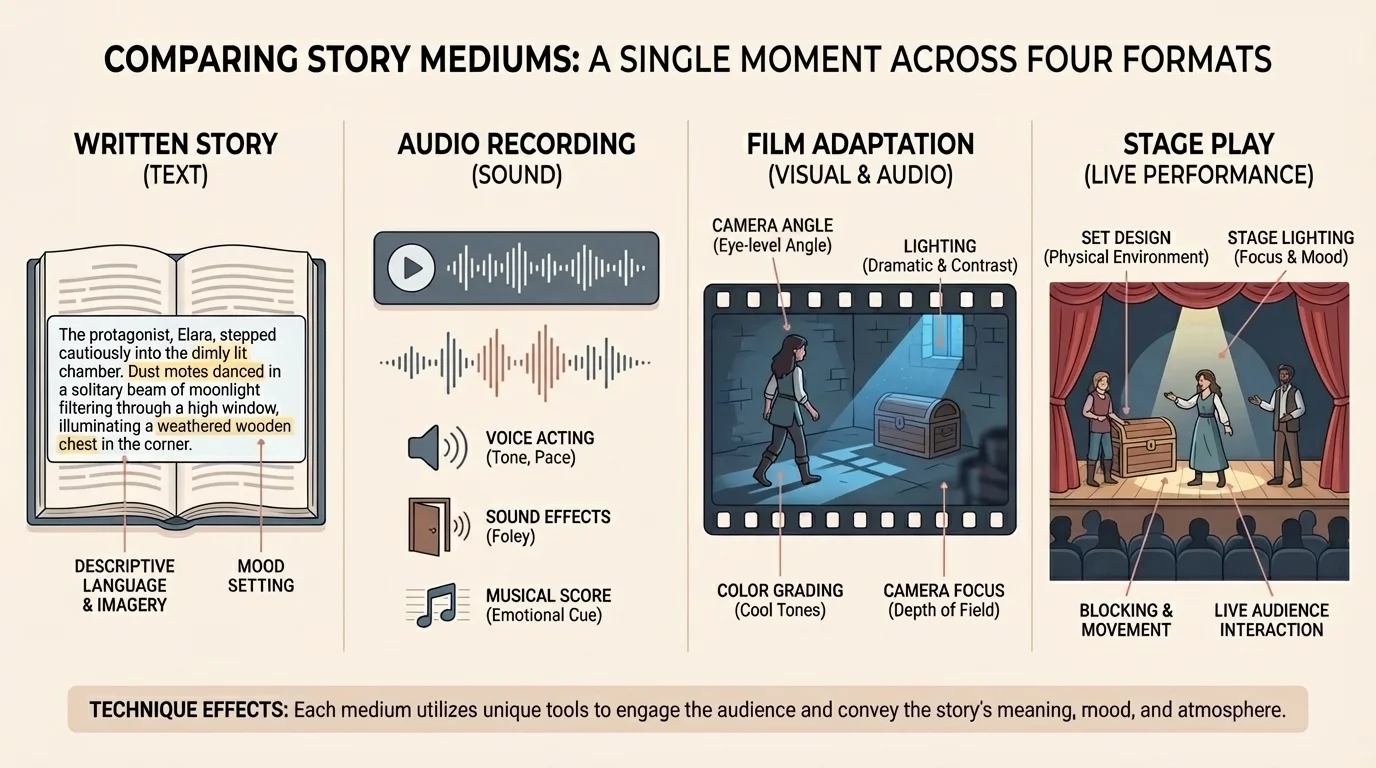
Because each medium uses different tools, strong analysis should ask not only what happens, but also how the medium makes it happen. Two versions may show the same event, yet create different moods. One may feel suspenseful, another tragic, and another hopeful. The difference often comes from techniques that belong especially to that medium.
Effect of medium-specific techniques
When you analyze a work across media, focus on effect. Ask how a choice changes mood, reveals character, emphasizes theme, or guides the audience's attention. A technique matters because of what it makes the audience think, feel, or notice.
This is why simple statements like "the movie was better" are too weak. Good analysis explains the reason. For example, "The film version makes the conflict feel more urgent because fast cuts, loud thunder, and dark lighting create tension" is much stronger than a plain opinion.
A written story, drama, or poem gives readers special power: the power to imagine. The author can describe a place in detail, reveal a character's thoughts directly, or build suspense slowly through narration. Readers can pause, reread, and think carefully about important lines.
In prose, description helps shape setting and mood. In drama scripts, dialogue and stage directions provide clues about action and tone. In poetry, line breaks, rhythm, repetition, and figurative language can create emotional impact. Written texts often leave more room for the reader's imagination than visual versions do.
Suppose a poem says, "The moon dragged silver across the lake." That line creates an image through metaphor. A film version might show the lake directly, but the poem's wording invites the reader to build the picture inwardly. The effect is different. Neither is automatically better. The question is how each medium creates meaning.
Many famous films are based on books, but even when the dialogue stays close to the original, actors' expressions and directors' choices can change how viewers interpret a scene.
Written texts also control pacing in unique ways. A reader may slow down at an important passage or speed up during action. In film or stage performance, the pace is usually controlled more by the creators and performers. That changes the audience's experience of suspense, emotion, and focus.
An audio version removes the visual world and makes sound do more work. The narration becomes extremely important. A narrator's voice can sound cheerful, serious, fearful, sarcastic, tired, or mysterious. That tone affects how listeners understand characters and events.
Sound effects can establish setting very quickly. Birds and wind may suggest a forest. Traffic and sirens may suggest a city. Footsteps, breathing, and a sudden crash can make a moment feel close and urgent. Music can build emotion, signal danger, or suggest hope. Silence can be just as powerful, especially before an important line.
For example, if a written story says, "He opened the letter with shaking hands," an audio version can add a trembling breath, the rustle of paper, and a long pause before the character speaks. Those sounds can heighten suspense. Listeners cannot see the hands, but they can still feel the tension.
Audio versions also guide imagination in a different way from written text. The listener still imagines the scene, but the performer's voice shapes that imagination more strongly. A listener may picture a character differently after hearing a deep, confident voice than after reading the same lines silently.
Film and multimedia versions use many tools at once, and [Figure 2] shows how changes in camera angle and lighting can completely alter the way one character appears. Viewers receive words, images, sounds, movement, and timing all together. Because of this, film can create immediate emotional effects very quickly.
Lighting influences mood. Bright, warm light can make a scene feel safe or joyful. Dim light, shadows, or sharp contrast can make it feel tense, secretive, or frightening. Color also matters. Blue tones may feel cold or lonely. Red may suggest danger, anger, or passion. Soft gold may suggest memory or comfort.
Camera focus directs attention. If the background is blurred and one object is sharp, the audience knows what to notice. A close-up can show a tear, a clenched jaw, or a glance of fear. A long shot can make a character seem small and isolated in a large setting. Camera movement matters too: a quick shake can create chaos, while a slow steady movement can build suspense.
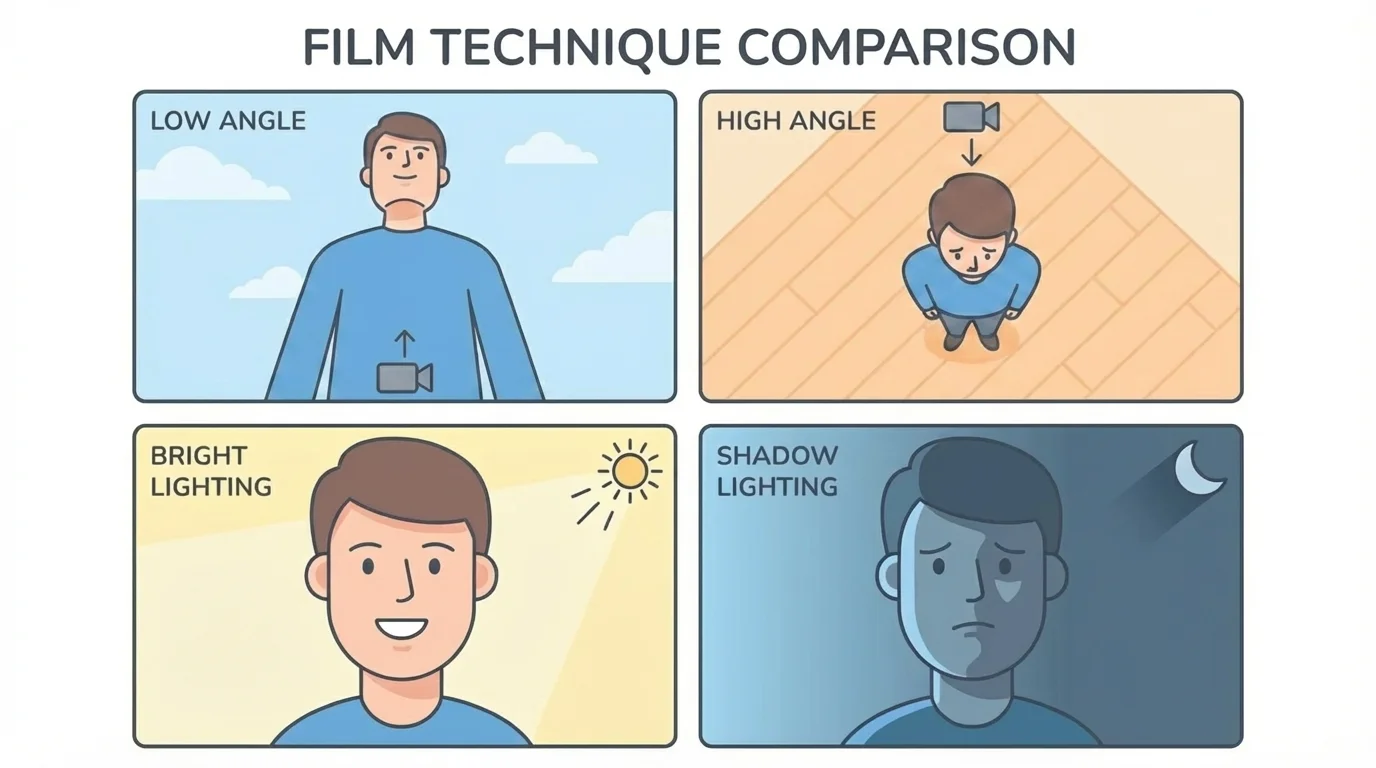
Camera angles shape power and emotion. A low angle looking up at a character can make that person seem powerful or threatening. A high angle looking down can make a character seem weak, trapped, or lonely. Editing also affects meaning. Fast cuts can create excitement or confusion. Longer shots can allow viewers to focus on emotion or detail.
Multimedia versions may add text on screen, animation, interactive choices, or layered music and visuals. These features can make the audience more active, but they can also change the original work by emphasizing some ideas over others. As we saw earlier in [Figure 1], the same event may feel different depending on whether words, sound, visuals, or live performance carry the main emotional weight.
Film technique example
A written story says, "Maya stood alone in the hallway after the argument." A film adaptation can present that same moment in several ways.
Step 1: Use a long shot
If Maya appears small in a long empty hallway, the viewer feels her isolation.
Step 2: Add cool blue lighting
The scene feels colder and more emotionally distant.
Step 3: Include echoing footsteps and no music
The silence and echo make the moment feel uncomfortable and lonely.
The event is the same, but the medium-specific techniques deepen the emotional effect.
When analyzing film, avoid listing techniques without linking them to meaning. Instead of saying "There was dark lighting and close-ups," explain the effect: "Dark lighting and close-ups make the scene feel tense and force the viewer to notice Maya's sadness."
Stage performance has its own special power because it happens live, and [Figure 3] displays how actor positions, props, and lighting zones guide the audience's attention. The audience shares space and time with the actors. This creates energy that is different from reading a script or watching a film.
In staged drama, blocking means the planned movement and positioning of actors on stage. If two characters stand far apart, the audience may sense conflict. If one actor steps forward into a spotlight, that character gains importance. Props, costumes, and set design help establish time, place, and personality.
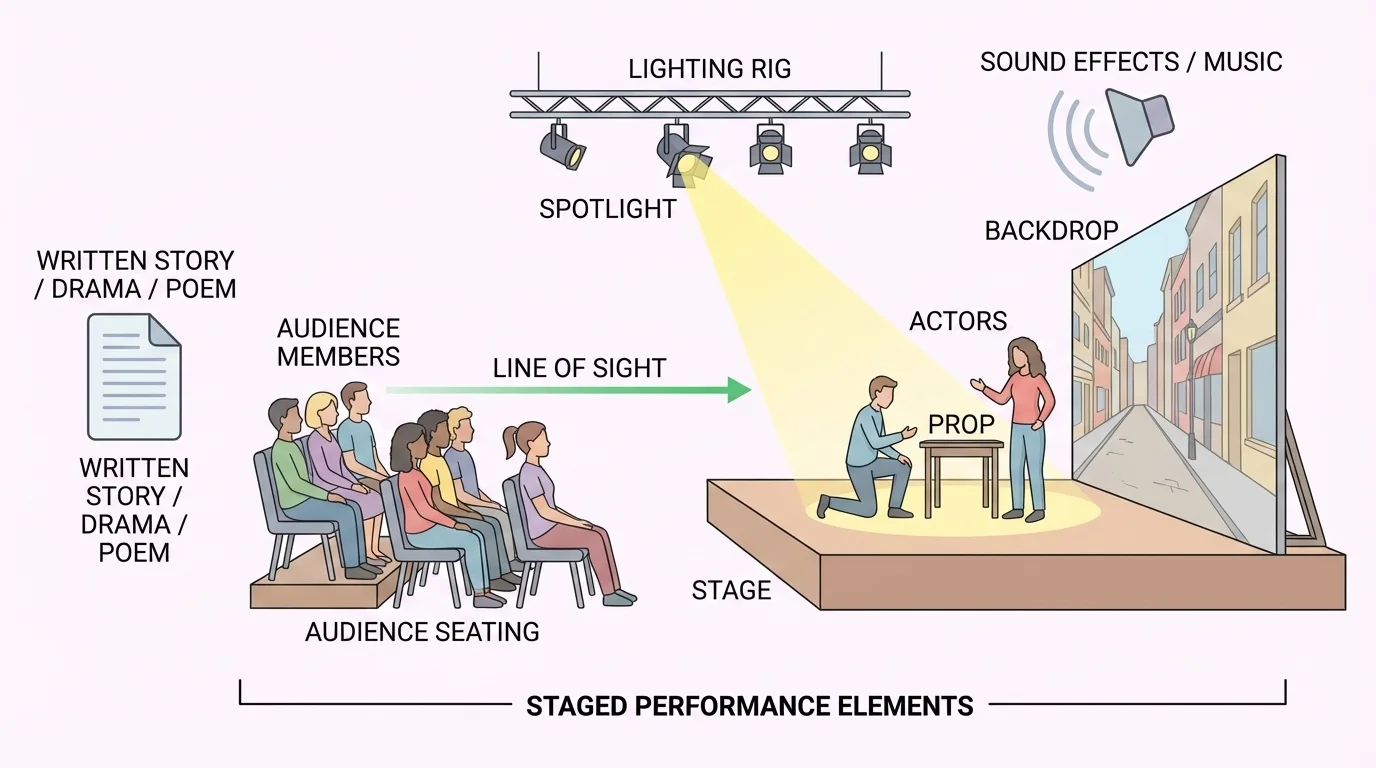
Lighting on stage can show mood just as film lighting does, but it works differently because the audience sees the whole stage at once. A director may use a spotlight, colored wash, or darkness in part of the stage to create focus. Sound in theater may come from music, live voices, backstage effects, or silence shared by the audience and actors.
Another important difference is performance style. The same line in a printed script can sound angry, sarcastic, heartbroken, or humorous depending on the actor's delivery. Stage drama also often depends on gestures, posture, and facial expression. Later, when you compare stage and film, remember that film can zoom in, but theater usually relies more on body language visible from a distance. This difference connects back to framing and focus.
A strong comparison starts with literary elements: character, setting, conflict, plot, tone, and theme. Then it adds medium-specific techniques. Ask these questions:
Use specific evidence. In a written text, quote or describe exact lines. In a performance or film, refer to exact moments, sounds, lighting choices, or visual details. Do not stop at description. Always move to analysis by explaining the effect.
Literary elements such as character, conflict, setting, mood, and theme still matter in every medium. The difference is that each medium reveals those elements using different tools.
A useful sentence frame is: "In the written version, the author creates ___ through ___. In the film or stage version, the director or performer creates a similar or different effect through ___." This structure keeps your response focused on evidence and effect.
To see how comparison works, consider the same scene across three media, as [Figure 4] presents in parallel panels. A girl waits on a porch during a storm for her older brother to return home after an argument. The core event stays the same in all versions: waiting, storm, worry, and reunion.
In the written version, the author may describe the porch boards vibrating under thunder, the girl counting lightning flashes, and her thoughts racing with guilt. The reader feels close to her inner emotions because the narration can directly describe them.
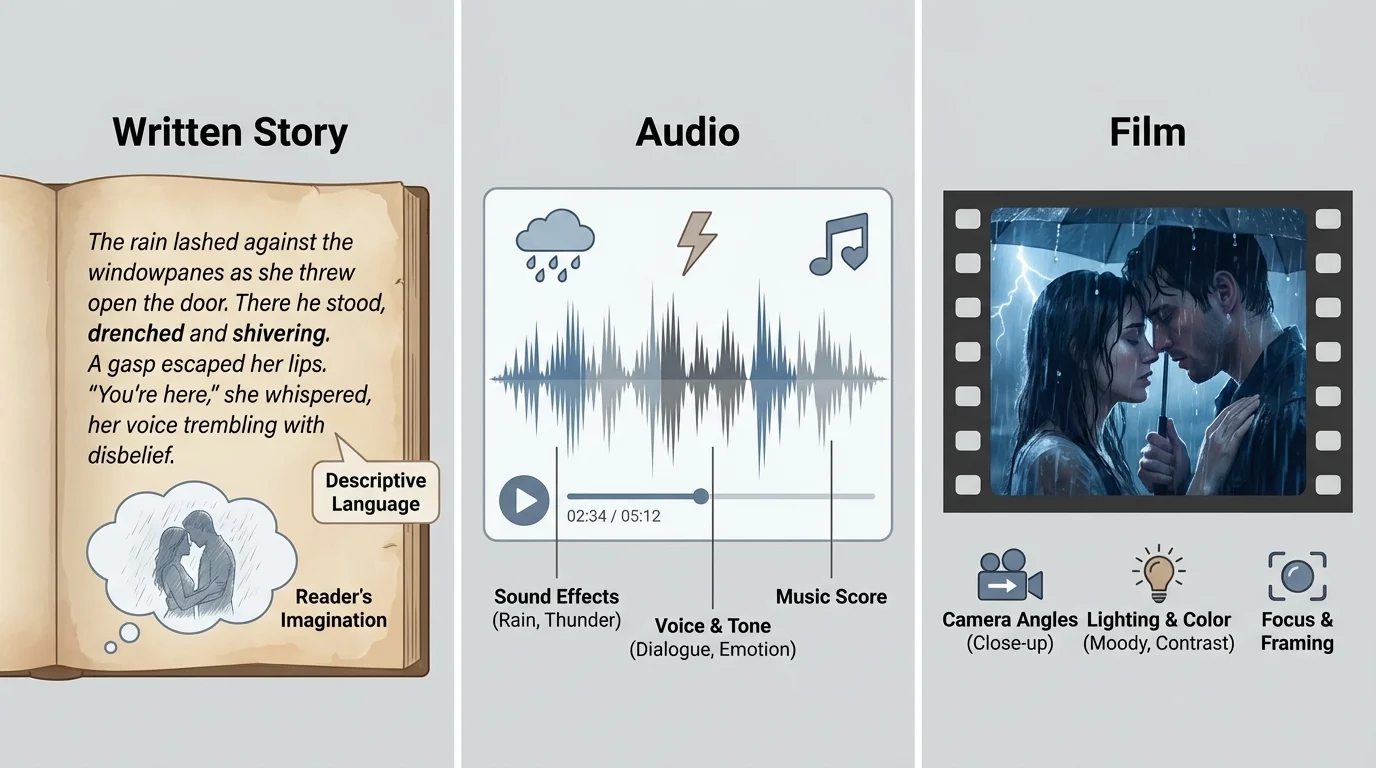
In the audio version, the listener hears rain hitting the roof, distant thunder, and the girl's unsteady breathing. When the brother's footsteps finally approach, the pause before the door opens creates suspense. The emotional force comes from sound and timing rather than visual detail.
In the film version, the director may show a close-up of the girl gripping the railing, then cut to a wide shot of the empty road. Blue-gray lighting makes the storm feel cold and heavy. When the brother appears, the camera may shift to a tighter frame on their faces to show relief. Here, viewers do not hear her thoughts directly unless voice-over is used, but they see emotion through expression and visual design.
Comparing the storm scene
Step 1: Identify the shared element
All three versions show worry before a reunion.
Step 2: Identify what each medium emphasizes
The written version emphasizes inner thought, the audio version emphasizes suspense through sound, and the film version emphasizes visual emotion and atmosphere.
Step 3: Explain the effect
The written version may feel more reflective, the audio version more tense, and the film version more immediate and visual.
This is the heart of compare-and-contrast analysis: same scene, different tools, different effects.
Notice that none of these versions is automatically the most faithful in every way. Faithfulness can mean preserving plot, preserving tone, preserving theme, or preserving character relationships. Sometimes an adaptation changes details but still captures the spirit of the original. The three-part comparison makes that clear.
Adaptations often change works for practical reasons. Films usually have time limits. Stage sets cannot always show every location from a novel. Audio versions need to replace visual information with sound. Multimedia versions may simplify parts of a story so users can interact with it more easily.
Some changes happen because directors and performers interpret the work differently. One filmmaker may view a character as brave, while another sees that same character as reckless. Their choices in acting, lighting, music, or color can push the audience toward one interpretation.
"The medium is the message."
— Marshall McLuhan
This idea does not mean the original words stop mattering. It means the form of presentation affects meaning. A whispered line in darkness does not feel the same as the same line printed on a page. Medium shapes message.
One common mistake is focusing only on plot differences. Plot matters, but strong analysis also explains changes in tone, mood, emphasis, and audience response. Another mistake is making unsupported judgments such as "the book is more interesting." Instead, explain what technique creates the stronger effect and why.
A third mistake is forgetting to mention evidence from both versions. If you compare a poem to a performance, include details from the poem's language and from the performer's delivery. If you compare a script to a stage production, mention both the written lines and the live staging choices.
Finally, do not treat visual or sound choices as random. Lighting, costume, music, pacing, framing, and movement are usually selected on purpose. Your job is to ask what those choices help the audience understand.
| Medium | Key Techniques | Common Effects |
|---|---|---|
| Written text | Description, imagery, figurative language, narration, line breaks, pacing | Builds imagination, reveals thoughts, shapes tone through words |
| Audio | Voice, pacing, pauses, music, silence, sound effects | Creates mood through sound, highlights emotion and suspense |
| Film | Lighting, color, camera angle, focus, editing, music | Creates immediate visual mood, directs attention, shapes power and emotion |
| Stage drama | Blocking, costumes, props, set, live delivery, stage lighting | Creates live energy, uses space and movement to show relationships |
| Multimedia | Visuals, sound, text, animation, interactivity | Combines modes, may guide audience choices and attention |
Table 1. Comparison of major media, their unique techniques, and their typical effects on an audience.
When you compare a written story, drama, or poem with its audio, filmed, staged, or multimedia version, you are doing more than spotting changes. You are studying how art works. You are learning how creators use different tools to shape the same material in different ways. That kind of close attention makes you a stronger reader, viewer, and thinker.
