A story can be told in many ways, but the way it is built changes how we understand it. Think about receiving important news in a private voice message, in a group chat, or before a crowd. The message may stay almost the same, but the form changes the feeling. Literature works the same way. In a poem or drama, the writer does not only choose words. The writer also chooses a shape, a pattern, and a structure. Those choices help create meaning.
When readers analyze literature closely, they do more than ask, "What happens?" They also ask, "Why is it arranged this way?" A character's lonely speech in a play means something different from that same idea spoken in conversation. A thought placed at the end of a sonnet can hit harder because the poem has been building toward it. Form and structure are not decorations. They are part of the message.
Form is the type or category of literary work something is. A play is one form, and a poem is another. Within poetry, a sonnet is a more specific form. Within drama, a tragedy or comedy is a broad dramatic form. Structure is how the parts are organized inside that form. In a poem, structure includes lines, stanzas, repetition, and rhyme. In a drama, structure includes acts, scenes, dialogue, and speeches.
If a writer wants to show confusion, the structure may feel broken, jumpy, or repetitive. If the writer wants to show control, the structure may feel balanced and orderly. That is why readers should pay attention to where a line ends, when a scene changes, or why one character speaks alone.
Form is the type or category of a literary work, such as a play, a poem, or a sonnet.
Structure is the way the parts of that work are arranged, such as scenes in a play or stanzas in a poem.
Meaning includes the ideas, emotions, message, and effects a text creates for the audience.
Writers use structure the way architects use blueprints. A building's function depends partly on how rooms, doors, and windows are arranged. In literature, the arrangement guides what the audience notices first, what feels important, and what lingers in the mind.
To analyze well, you need the right language. In drama, a act is a major section of a play, and a scene is a smaller section within an act. Dialogue is conversation between characters. A monologue is a long speech spoken by one character. A soliloquy is a special kind of speech in which a character speaks thoughts aloud while alone or as if alone, letting the audience hear private feelings.
In poetry, a stanza is a grouped set of lines, like a paragraph in prose. Rhyme scheme is the pattern of end rhymes. Repetition means repeating words, phrases, sounds, or structures for emphasis. A sonnet is a fixed poetic form with 14 lines. Free verse is poetry that does not follow a regular rhyme scheme or strict pattern.
These terms matter because they help readers move from simple noticing to deeper interpretation. Instead of saying, "This part sounds important," you can say, "The poet uses repetition in the final stanza to stress regret," or "The playwright uses a soliloquy to reveal the character's hidden fear."
When you studied literary elements before, you likely looked at character, setting, plot, and theme. Form and structure connect to all of them. They help reveal character, shape plot, build mood, and sharpen theme.
Strong analysis connects these literary elements instead of treating them as separate boxes. As [Figure 1] helps illustrate, a sudden short scene in a play can increase suspense in the plot, while a repeated line in a poem can reveal a speaker's emotional state.
Drama is meant to be performed, so its structure is built around what an audience hears and sees. A play is organized into visible parts such as acts, scenes, speaker names, dialogue, and stage directions. Each of these parts helps guide the audience's understanding.
Acts and scenes divide the action. A new act often signals a major shift, such as a change in time, place, or conflict. A new scene can tighten the focus or create contrast. For example, if one scene shows a public celebration and the next shows a private argument, the structure highlights the difference between appearance and reality.
Dialogue creates action through interaction. We learn about characters by what they say to each other, what they avoid saying, and how quickly the conversation moves. Fast back-and-forth dialogue can create excitement or tension. Long pauses or interrupted exchanges can suggest discomfort, secrets, or power struggles.
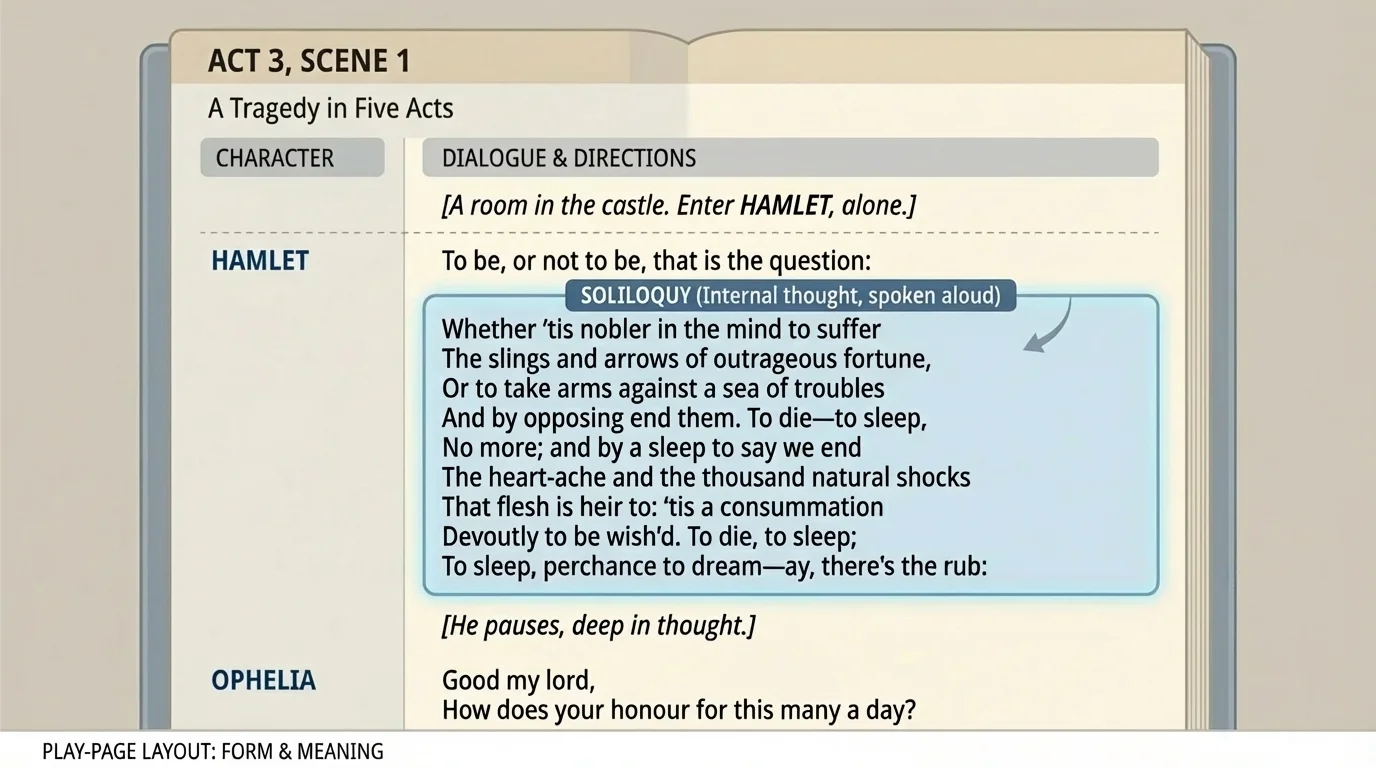
A monologue slows the action and gives one character control of the stage for a moment. This can focus attention on that character's ideas or emotions. But a soliloquy does something even more powerful: it opens a private window into the character's mind. In everyday life, people do not usually announce their deepest fears aloud when alone. In drama, however, a soliloquy lets the audience hear the truth behind a character's public actions.
Because of this, a soliloquy often contributes to meaning by creating intimacy. The audience becomes almost like a secret listener. If a character acts brave in front of others but speaks with fear in a soliloquy, the structure reveals inner conflict. The meaning is not only "this character is afraid." The deeper meaning may be that human beings hide weakness behind confidence.
Consider a simple example. In a scene, a prince tells his court, "I am ready." If that line stands alone, the audience may believe him. But if the playwright places a soliloquy right after that scene in which the prince admits, "My hands shake though no one sees," the structure changes everything. The public statement and the private speech work together. The contrast creates dramatic meaning.
Example: Why a soliloquy matters
A character has been pretending to support a dangerous plan.
Step 1: Notice the structural choice.
The playwright does not reveal the character's true feelings through dialogue with others. Instead, the truth appears in a soliloquy.
Step 2: Ask what that choice does.
The soliloquy allows the audience to hear hidden thoughts that other characters cannot hear.
Step 3: Connect structure to meaning.
This structure creates suspense because the audience now knows more than the other characters. It also shows that the character is divided between public loyalty and private doubt.
A strong interpretation would be: The soliloquy contributes to meaning by exposing the character's inner conflict and building tension through secrets.
Another dramatic feature is stage directions. These are instructions about movement, tone, gesture, or setting. Even though they may seem small, they shape meaning. A line like "I'm fine" means one thing if a character laughs and another if the character backs toward the door in silence. Structure in drama includes these performance clues because drama lives through action, not only through words.
Later in a play, the same dramatic layout remains important. As we see in [Figure 1], the separation between public dialogue and private speech helps readers track what is known openly and what is hidden. That difference often creates dramatic irony, a situation in which the audience knows something a character does not know.
Poetry often looks different from prose before you even read the first word. The poem's shape on the page gives clues about pacing, emphasis, and control. In poetry, where each line matters, structure can guide the reader's breath, attention, and emotion.
Line breaks are powerful. A poet chooses where to end a line, and that choice can create suspense, surprise, or emphasis. If a line ends on an important word, the eye pauses there. If the meaning continues into the next line, the reader moves forward quickly. This can mirror hesitation, rushing emotion, or a flowing thought.
Stanzas group ideas. A new stanza can mark a shift in time, tone, point of view, or argument. If the first stanza describes a calm field and the second stanza turns suddenly to war memories, the structural break makes that shift feel stronger.
Repetition gives words extra weight. Songwriters use repetition because repeated lines stay in the mind and deepen emotion. Poets do the same. A repeated phrase can sound hopeful, obsessive, mournful, or determined depending on context. Repetition often helps reveal what the speaker cannot let go of.
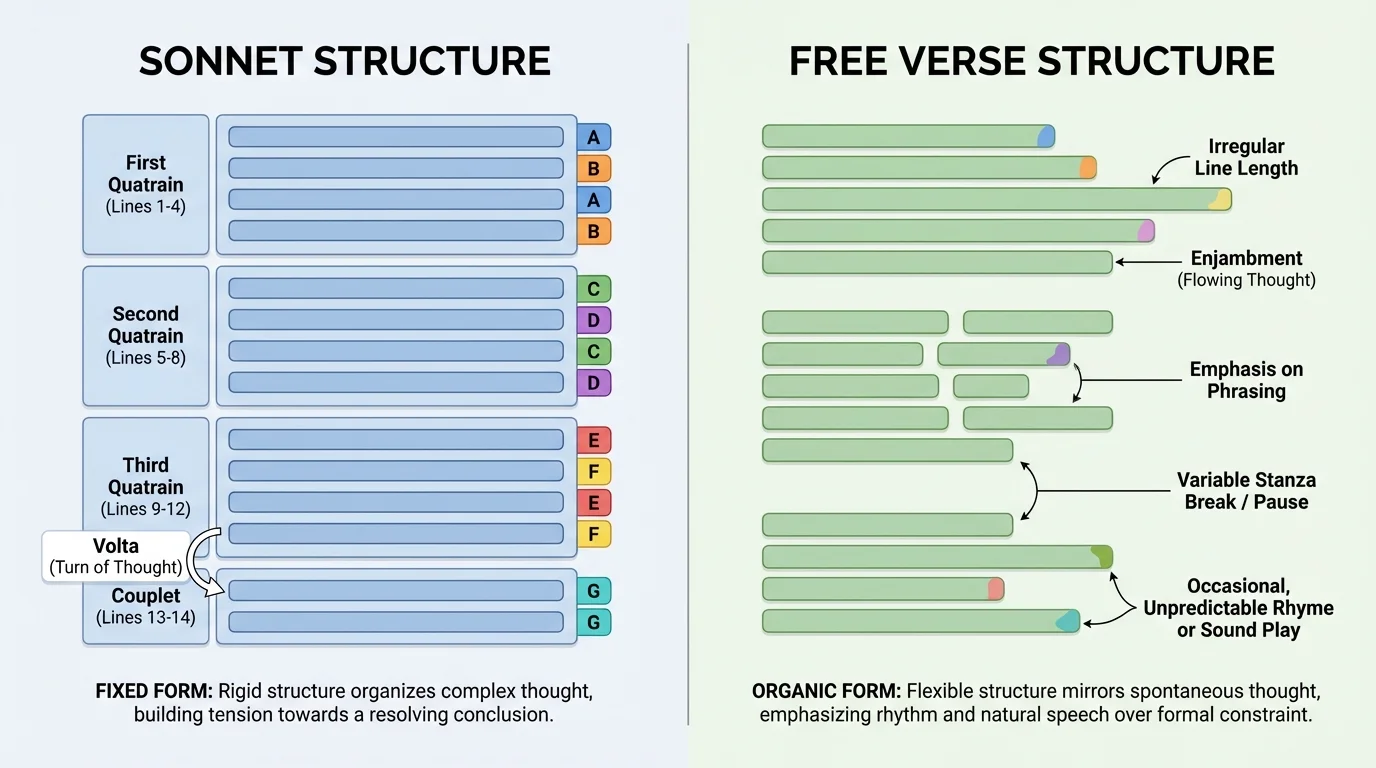
A fixed form such as a sonnet adds another layer of meaning. Sonnets are traditionally short, focused, and carefully shaped. Because the reader expects tight organization, any shift becomes important. Many sonnets include a turn in thought, sometimes from problem to answer, from admiration to doubt, or from emotion to reflection. That turn matters because the form sets up expectation and then develops it.
For example, suppose a sonnet spends its first section praising a friend's loyalty, but the final lines admit fear that time will change everything. The sonnet form supports this meaning by moving from controlled praise to a thoughtful ending. The structure feels like a mind working through an idea.
By contrast, free verse often feels more open and flexible. This does not mean it has no structure. Free verse still uses line breaks, repetition, imagery, and pacing. But because it does not follow a strict pattern, it can sound more like natural thought or speech. If a poet writes about grief in broken, uneven lines, the loose structure may reflect emotional disruption.
Form creates expectations
Readers bring expectations to a text. A sonnet suggests order, compression, and a shaped progression of thought. Free verse suggests freedom, flexibility, and a voice that may feel more immediate. Writers can meet these expectations or challenge them, and either choice contributes to meaning.
Rhyme and rhythm also matter. A regular pattern can create calm, music, or confidence. A disrupted pattern can signal conflict or change. If a poem rhymes steadily until the final line breaks the pattern, that break often draws attention to the poem's final idea.
Much later in your analysis, [Figure 2] still helps you remember that visual arrangement is not accidental. The shape of a sonnet and the open layout of free verse suggest different reading experiences before the reader even begins interpretation.
Sometimes the clearest way to understand form is to compare texts that explore similar ideas. The same emotional situation can feel very different depending on whether it appears as dialogue, soliloquy, sonnet, or free verse.
Imagine the same basic idea: a young athlete is afraid of failing in front of others. In a play scene with dialogue, that fear may appear through arguments, jokes, or silence with teammates. In a soliloquy, the athlete may confess private panic directly to the audience. In a sonnet, the fear may be shaped into a careful reflection about pressure and reputation. In free verse, the fear may spill out in jagged lines that feel breathless and immediate.
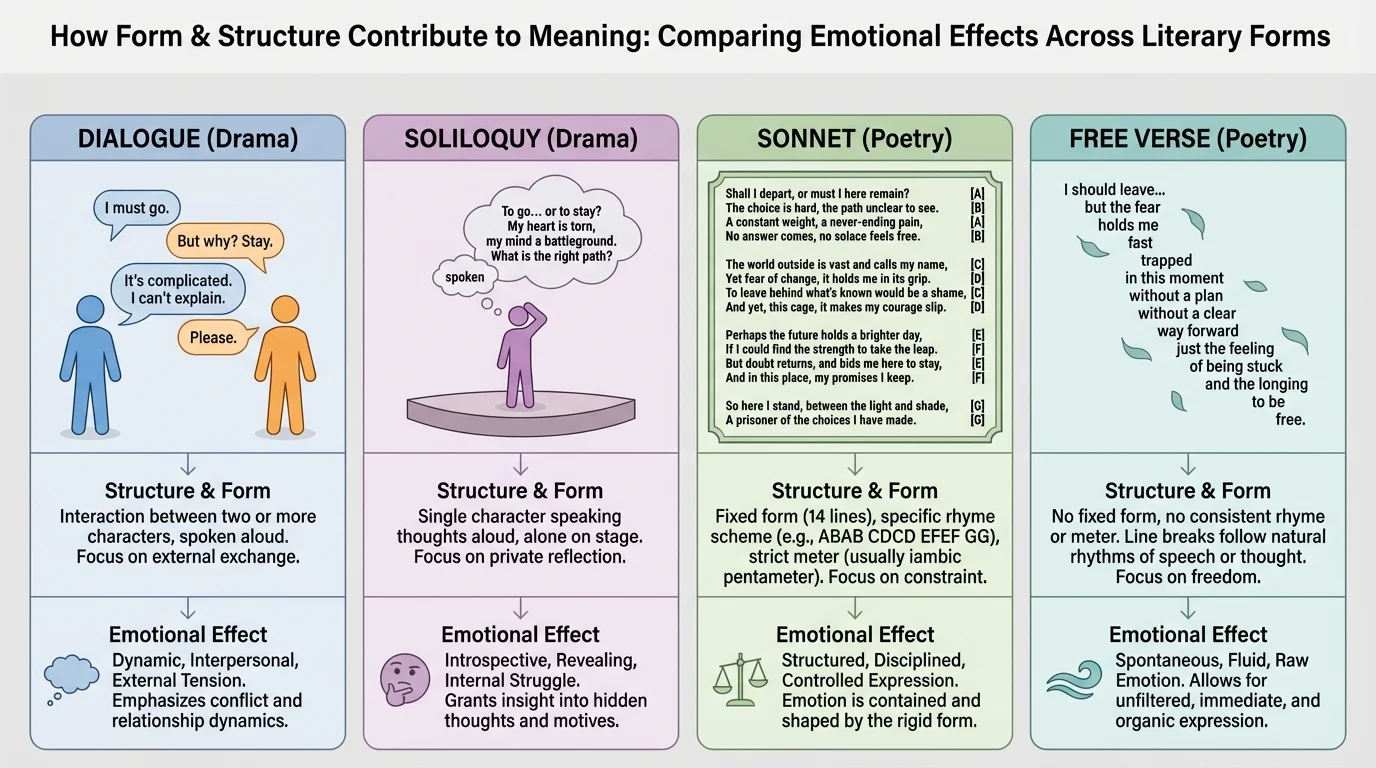
Notice that the core topic stays similar, but the meaning shifts in emphasis. Dialogue highlights relationships. Soliloquy highlights hidden thought. Sonnet highlights careful shaping and a turn in thinking. Free verse highlights emotional flow and freedom. This is why analysis should not stop with theme alone. The form changes how the theme is experienced.
| Form or Structure | What It Often Highlights | Possible Effect on Meaning |
|---|---|---|
| Dialogue | Conflict between characters | Shows tension, misunderstanding, or power |
| Soliloquy | Private thoughts | Reveals inner conflict or truth |
| Sonnet | Order and development of an idea | Makes the speaker seem thoughtful or controlled |
| Free verse | Natural voice and flexible movement | Can feel immediate, raw, or unpredictable |
| Repetition | Emphasis on key words or emotions | Shows obsession, determination, sorrow, or hope |
Table 1. Comparison of how common forms and structural choices contribute to meaning.
As [Figure 3] suggests, thinking this way helps readers make stronger claims. Instead of saying, "The poem is about sadness," you can say, "The poet's use of free verse and repeated short lines makes the sadness feel abrupt and hard to control."
When you analyze, start by noticing what the text looks and sounds like. Is it a play, a poem, a sonnet, or free verse? Are there stanzas, scenes, repeated phrases, long speeches, or sudden shifts? These are clues.
Next, ask what patterns you notice. Does a character speak differently when alone? Does the poem change in the last lines? Does the structure become more broken as emotions rise? Patterns matter because writers repeat or arrange things on purpose.
Analysis method
Step 1: Identify the form or structural feature.
Name it clearly: soliloquy, sonnet, stanza break, repetition, scene change, or free verse.
Step 2: Describe what happens.
Explain where it appears and what effect it creates in the moment.
Step 3: Connect it to meaning.
Ask how that choice reveals character, develops theme, shapes mood, or affects the audience.
A complete response links what the writer does to why it matters.
For example, if a poem repeats the line "I still remember," that repetition is not important just because it is repeated. It matters because it shows memory refusing to fade. If the repeated line appears at the start of each stanza, the structure makes memory feel inescapable and ongoing.
In drama, if a play places a cheerful public scene right before a dark private confession, the sequence matters. As [Figure 2] helps illustrate, the contrast can reveal hypocrisy, loneliness, or the difference between social performance and personal truth.
A common mistake is to identify a feature without explaining its effect. Saying "This poem is a sonnet" is only the beginning. The stronger question is, "How does the sonnet form shape the speaker's idea?" Another weak response is "There is repetition." Strong analysis asks what is repeated, where, and why.
Another mistake is to treat structure as separate from meaning. In strong reading, they are connected. A playwright does not add a soliloquy randomly. A poet does not choose stanza breaks accidentally. Structural choices guide the audience toward a particular experience.
Some of the most famous speeches in drama are soliloquies because audiences remember moments when they are trusted with a character's private thoughts. That special access makes the audience feel closely connected to the character, even when the character is flawed.
Try to use cause-and-effect language in analysis. Phrases such as "This structure emphasizes...," "The form helps reveal...," and "The stanza break marks a shift from... to..." make your ideas clearer and more precise.
As you compare forms, return to [Figure 3] and notice that different structures do not just package ideas differently; they shape emotion, pace, and perspective. That is the heart of literary analysis.
Good readers notice not only what a writer says but also how the writer builds the text. When a drama pauses for a soliloquy, the pause itself matters. When a poem tightens into a sonnet or opens into free verse, that shape matters too. Structure can create tension, highlight a turning point, reveal secrets, and deepen theme.
This kind of reading is useful far beyond literature class. Movies use scene cuts, close-ups, and voice-overs for reasons similar to plays and poems using scene changes, line breaks, and soliloquies. Musicians repeat choruses to make ideas memorable. Speakers pause before important words. In every case, structure shapes meaning.
"The meaning of a work is not only in what it says, but in how it is made."
When you read closely, you begin to see literature as something carefully designed. A poem's pattern and a play's arrangement are part of the author's message. The more clearly you connect those choices to their effects, the deeper your understanding becomes.
