Two people can walk away from the exact same moment with completely different stories. One student says, "He shoved me on purpose." Another says, "I tripped and bumped into him by accident." In real life, this happens all the time, and authors use that truth to make stories richer, more complicated, and more realistic. When you analyze how an author develops and contrasts points of view, you are studying not just what happens in a text, but how different minds interpret what happens.
In literature, a story is never just a list of events. It is shaped by a way of seeing. A brave character may describe a dark forest as exciting. A frightened character may describe that same forest as dangerous. Because of this, readers need to pay close attention to perspective. Understanding perspective helps you explain character conflict, theme, mood, and even the meaning of the whole text.
Point of view matters because it controls what readers know, what they feel, and whom they trust. If a story is told by a lonely narrator, ordinary events may seem sad. If the same story were told by a hopeful narrator, those events might seem full of possibility. Readers who notice these differences become stronger interpreters of literature.
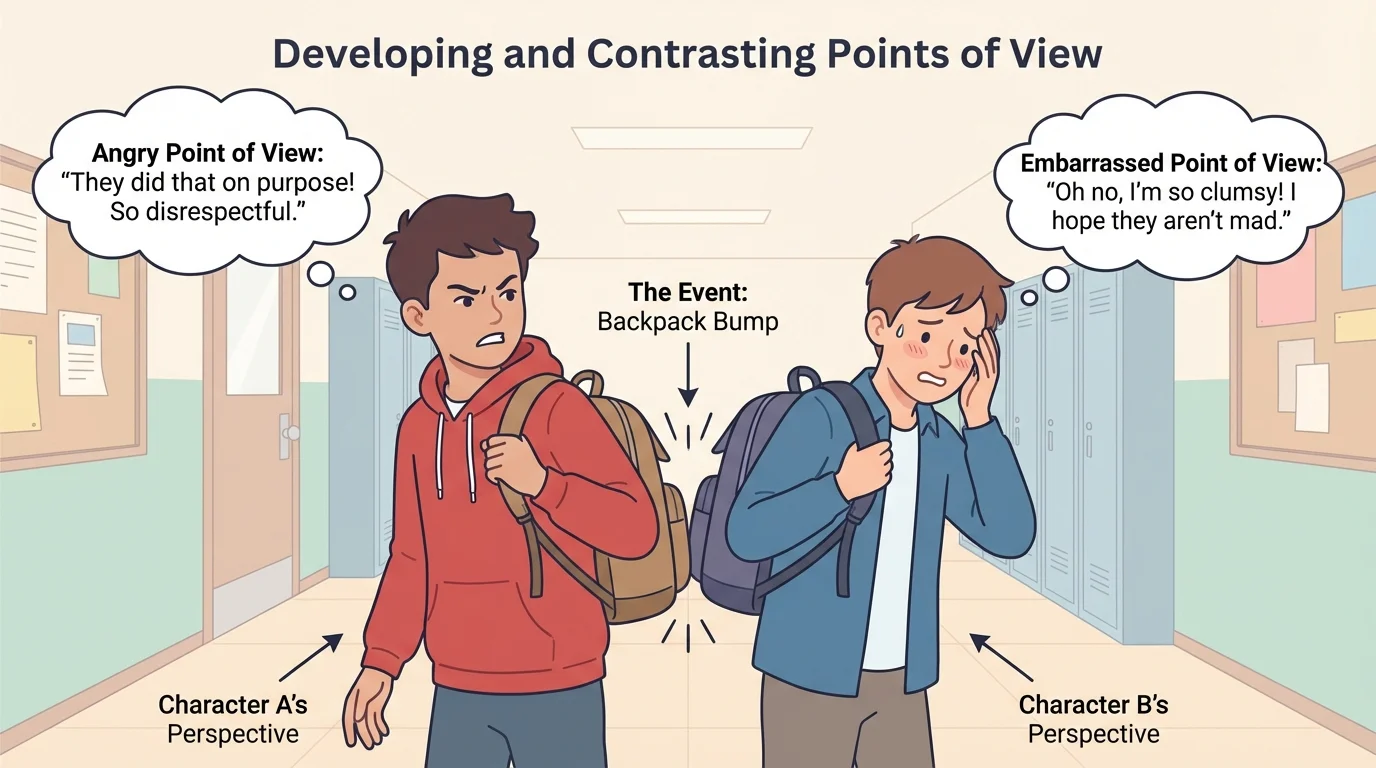
A point of view is the position from which a story is told or understood. It includes the thoughts, feelings, beliefs, experiences, and attitudes that shape how a character or narrator sees events. As [Figure 1] shows, even one small event can produce two very different interpretations when two people bring different emotions and assumptions to the event.
A narrator is the voice that tells the story. Sometimes the narrator is a character in the story. Sometimes the narrator stands outside the action. The narrator is not automatically the same as the author. The author creates the text, but the narrator is a crafted voice inside it. Good readers do not assume that everything a narrator says matches what the author believes.
Another important word is perspective. Perspective is the particular way a person views the world. It grows out of background, values, fears, hopes, and experiences. A character who has been treated unfairly may be suspicious. A character who feels safe may be trusting. Those differences shape the story.
Point of view is the angle from which a story is told or understood. Perspective is the way a character or narrator thinks about and interprets events. Narrator means the voice telling the story, while author means the real writer who created the text.
Sometimes students think point of view refers only to labels such as first person or third person. Those labels matter, but point of view is bigger than grammar. It also includes attitude. A first-person narrator can sound confident, jealous, confused, or dishonest. A third-person narration can still closely follow one character's thoughts and reveal that character's biases.
Authors do not usually stop the story and announce, "This character is bitter," or "This character is hopeful." Instead, they develop a point of view through clues. Readers gather those clues and build an understanding.
One clue is a character's thoughts. If a story tells us that Maya watches her teammates laugh and immediately assumes they are laughing at her, we learn that Maya may feel insecure or excluded. Another clue is dialogue. A character who says, "Of course they forgot me again," reveals a different outlook from a character who says, "Maybe they just got busy."
Actions also reveal perspective. A suspicious character checks the window locks twice. A confident character walks in without hesitation. Reactions to the same event are especially important. If two siblings hear thunder and one runs to the window in excitement while the other hides under a blanket, the author is showing different points of view through behavior.
Authors also use diction, or word choice, to shape perspective. Compare these two sentences: "The old house sat at the end of the road." "The broken-down house crouched at the end of the road." The basic setting is similar, but the second sentence sounds more threatening. Word choice tells readers how the narrator or character views the house.
How clues work together
Authors often build point of view through a combination of thoughts, dialogue, actions, and description. A single clue may not be enough, but several clues together create a strong picture of how a character sees the world.
Background matters too. A character's experiences affect judgment. A new student entering a cafeteria may notice every whisper because she already feels nervous. A student who has many friends may notice the same room as loud and welcoming. When analyzing point of view, ask what the character has lived through and how that history influences interpretation.
To contrast points of view means to show meaningful differences between them. Authors often place different perspectives side by side to create tension, deepen character relationships, or reveal a larger truth. A parent may think a rule is protective; a child may think the same rule is unfair. Neither view has to be simple or foolish. The contrast makes the text more layered.
One common method is to show different interpretations of the same event. We saw this idea earlier in [Figure 1]: one moment can feel like an attack to one person and an accident to another. In fiction, this kind of contrast often explains arguments, broken friendships, or dramatic misunderstandings.
Authors also contrast points of view to create irony. Irony happens when there is a gap between appearance and reality, or between what one character believes and what readers understand. For example, a proud narrator may insist he is admired, while his actions and others' responses suggest the opposite. The contrast between his self-image and the evidence in the text creates irony.
Sometimes contrasting points of view helps develop theme. In a story about freedom, one character may believe freedom means independence from all rules, while another believes freedom requires responsibility. The author can use their conflict to explore a big idea rather than simply choosing one side.
| Text Feature | What It Can Reveal | Question to Ask |
|---|---|---|
| Thoughts | Private feelings and judgments | What does the character assume? |
| Dialogue | Attitude toward others and events | How does the character speak? |
| Actions | Beliefs shown through behavior | How does the character respond? |
| Description | Emotional coloring of the scene | What details are emphasized? |
| Comparison to others | Conflicting perspectives | Who sees this differently? |
Table 1. Clues readers can use to analyze how a text develops and contrasts points of view.
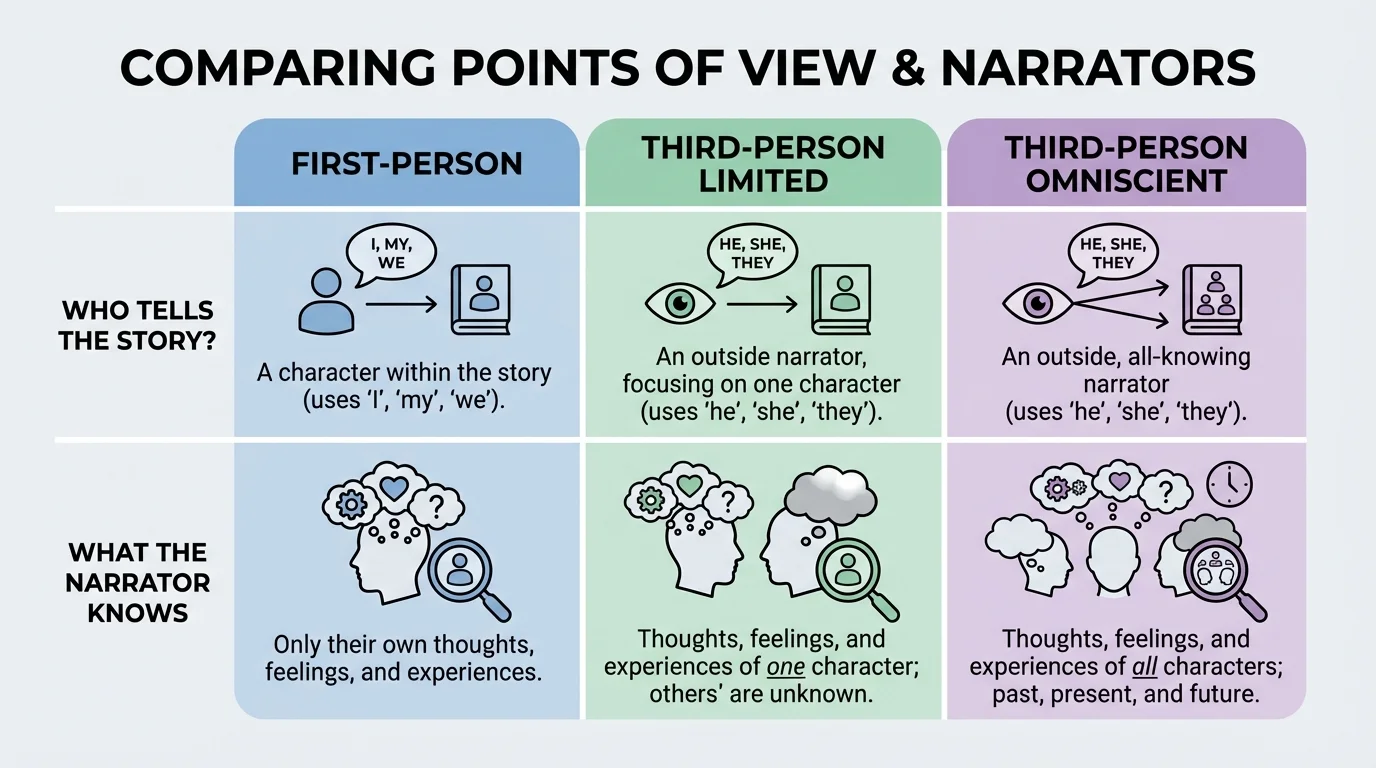
The type of narration affects how much readers know and how closely they connect to a perspective. Narration type changes what information is available and how limited or broad the story feels.
[Figure 2] First-person narration uses words like I and we. Readers experience events through one narrator's eyes. This can feel personal and vivid, but it is also limited. The narrator cannot directly know what other characters think.
Third-person limited narration uses words like he, she, or they but stays close to one character's thoughts. This gives some distance while still focusing on a specific perspective.
Third-person omniscient narration allows the narrator to know the thoughts and feelings of multiple characters. This lets the author contrast points of view more openly because readers can move from one mind to another.
Not every narrator is fully trustworthy. A reliable narrator presents events in a way readers can generally trust, even if the narrator has limited knowledge. An unreliable narrator may exaggerate, misunderstand, hide information, or lie. Unreliability does not mean the story is bad; it means readers must read carefully.
A narrator can be unreliable for many reasons: youth, fear, pride, confusion, bias, or dishonesty. For example, a narrator who says, "Everyone hates me," may not be reporting facts. That statement may reveal emotion more than truth. Readers should compare the narrator's claims with actions, dialogue, and other evidence in the text.
Some of the most memorable stories use narrators who misunderstand themselves. Readers discover the truth by noticing the difference between what the narrator says and what the text actually shows.
Reliability connects closely to point of view because every perspective has limits. Even an honest narrator sees only part of the picture. That is why contrasting perspectives can be so powerful: one perspective fills in what another misses.
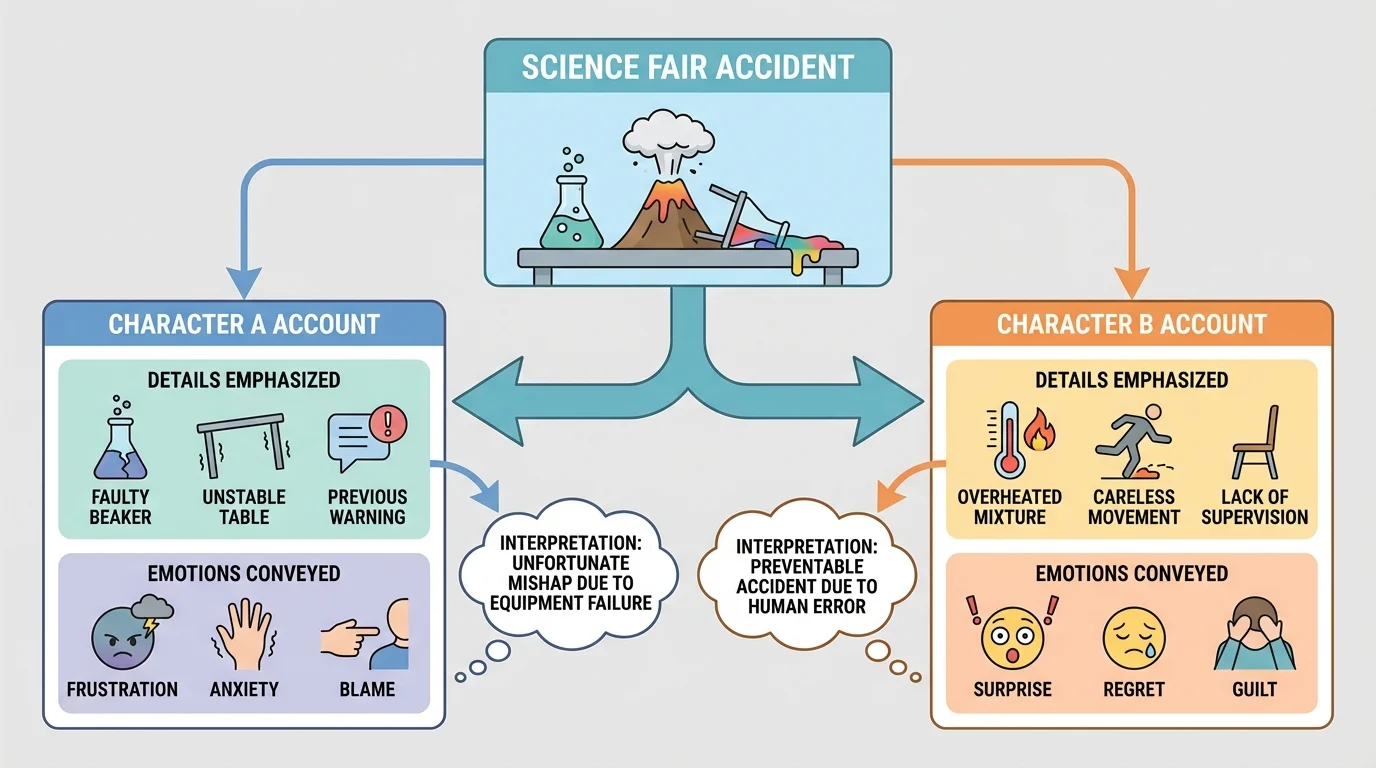
Authors do not only contrast viewpoints through character ideas. They also use structure, the way a text is organized. When an author places one character's account next to another's, readers can compare them directly. As [Figure 3] shows, one event can split into different narrative paths depending on whose perspective the author follows.
A novel might alternate chapters between two characters. A short story might begin with one narrator and later reveal another version of events. A poem might shift from a speaker's outer description to inner feelings. Structure guides comparison.
Details matter too. Authors choose what each character notices. A basketball player may describe the final seconds of a game in terms of pressure, noise, and movement. A fan in the stands may describe the same moment in terms of excitement, crowd energy, and surprise. What each person notices reveals what matters to them.
Pay attention to what is missing as well. If a narrator describes everyone else's flaws but never mentions his own mistakes, that absence is meaningful. If one chapter leaves out a crucial detail that appears later in another character's version, the author may be deliberately shaping suspense or contrast.
Sentence style can also contribute. Short, abrupt sentences can suggest anger, fear, or urgency. Longer, reflective sentences can suggest calm thinking or deep memory. The way a viewpoint sounds is part of how the author develops it.
Consider this original passage:
Jordan pushed through the backstage curtain and froze. The robotics trophy was gone from the table. "Of course," he muttered. "Sam got here first." He pictured Sam's smug smile from earlier that afternoon and felt heat rise in his face. When Sam entered a moment later, breathless and carrying a roll of tape, Jordan stepped in front of him. "You really couldn't wait five minutes?" he said.
Sam blinked. "What are you talking about?" He looked past Jordan at the empty table and then held up the tape. "The base cracked. Ms. Alvarez sent me to fix it before the judges came back."
This short passage contains two viewpoints. Jordan interprets the missing trophy as proof that Sam acted selfishly. His point of view is developed through suspicion, memory, and emotional reaction. The phrase "Of course" suggests he already expects the worst. The image of Sam's "smug smile" may reflect Jordan's bias, not a neutral fact.
Sam's point of view appears different. His dialogue sounds confused rather than guilty. He provides a practical explanation and holds the tape where readers can see evidence. The author contrasts the two points of view to create tension: Jordan assumes bad motives, while Sam seems focused on solving a problem.
Close analysis of the passage
Step 1: Identify the event.
The trophy is missing from the table backstage.
Step 2: Identify Jordan's perspective.
Jordan thinks Sam took the trophy for selfish reasons. His assumptions are shaped by anger and by his earlier impression of Sam.
Step 3: Identify Sam's perspective.
Sam sees the missing trophy as a repair problem, not a betrayal. His response suggests urgency and confusion.
Step 4: Explain the contrast.
The author contrasts Jordan's suspicion with Sam's practical explanation. This contrast builds conflict and makes readers question whose interpretation is more accurate.
This passage also shows why reliability matters. Jordan may not be lying, but he may be misreading the situation. That kind of limited perspective is common in realistic fiction. Readers must separate a character's interpretation from the full truth.
Authors often use these moments to reveal personality. Jordan may be competitive, insecure, or sensitive to disrespect. Sam may be calm under pressure. The conflict is not just about the trophy; it is about how each person sees others and expects to be treated.
When analyzing points of view, strong readers ask careful questions. Who is telling this part of the story? What does that person know, and what do they not know? What emotions shape their interpretation? Which words reveal judgment instead of neutral observation?
Readers also compare perspectives. Who sees the same event differently? Why? What details appear in one account but not another? How does the contrast affect the mood, conflict, or theme? The chart in [Figure 2] remains useful here because narration type often explains why one perspective feels narrow and another feels broad.
It also helps to ask what the author gains by presenting multiple views. Sometimes the author creates suspense. Sometimes the author reveals misunderstanding. Sometimes the author encourages empathy by helping readers understand more than one side of a conflict.
Readers already know that characters can have different traits and motivations. Point of view builds on that idea by showing how those traits and motivations shape what each character notices, believes, and feels.
One common mistake is confusing the author with the narrator. The narrator is a created voice, not the real person who wrote the text. Another mistake is retelling events without analyzing perspective. Saying "Jordan accused Sam" is only a start. Strong analysis explains why Jordan interpreted the event that way.
A third mistake is assuming one perspective must be completely right and the other completely wrong. In many texts, both viewpoints contain partial truth. That complexity is part of what makes literature interesting. As we saw in [Figure 3], the same event can branch into different interpretations depending on emotion, knowledge, and attention.
Finally, avoid using only labels like first person or third person without discussing effect. The important question is not just what the point of view is called, but how the author uses it. How does it shape understanding? How does it limit or expand knowledge? How does it bring different characters into contrast?
"A story is never only about what happened. It is also about who is telling it, who is listening, and what each person believes it means."
When you read with attention to point of view, you begin to notice that every description carries an attitude, every silence may matter, and every conflict may look different from another angle. That is one of the most powerful parts of literature: it teaches readers to look beyond a single version of events.
