A student would not usually talk to a principal the same way they talk to a best friend during lunch. That is not being fake; it is being adaptable. Strong speakers know how to adjust their words, tone, and delivery to fit the moment. In school, this matters during presentations, speeches, discussions, interviews, and even when asking or answering questions in class. Learning how to adapt speech helps you sound clear, respectful, and confident.
Speaking is not just about saying what you think. It is also about thinking carefully about who is listening, why you are speaking, and what setting you are in. A student presenting research to a class should sound different from that same student joking with teammates after practice. Both situations involve speaking, but they do not require the same language or delivery.
Every speaking situation has a context. Context includes the place, the audience, the purpose, and the level of formality. A quick comment in a hallway, a classroom discussion, a debate, and an awards speech all have different expectations. Good speakers notice those expectations and respond to them.
A audience is the person or group listening to you. Your speech should fit what your audience needs to hear and understand. If you are explaining a science project to younger students, you may need simpler words and more explanation. If you are presenting to classmates and a teacher, you may use more academic vocabulary and a more organized structure.
Your purpose is your reason for speaking. You might want to inform, persuade, explain, entertain, or honor someone. Purpose affects your choices. If your purpose is to persuade, your speech should include strong reasons and evidence. If your purpose is to inform, your speech should focus on accuracy and clarity.
Formal English is a clear, respectful, carefully structured style of language used in situations such as presentations, speeches, interviews, academic discussions, and professional communication. It avoids slang, overly casual expressions, and careless grammar.
Not every situation requires formal English. Talking casually with friends is normal, and informal speech has a place. The key skill is knowing when to shift. A strong speaker can move from informal conversation to formal presentation without losing clarity or confidence.
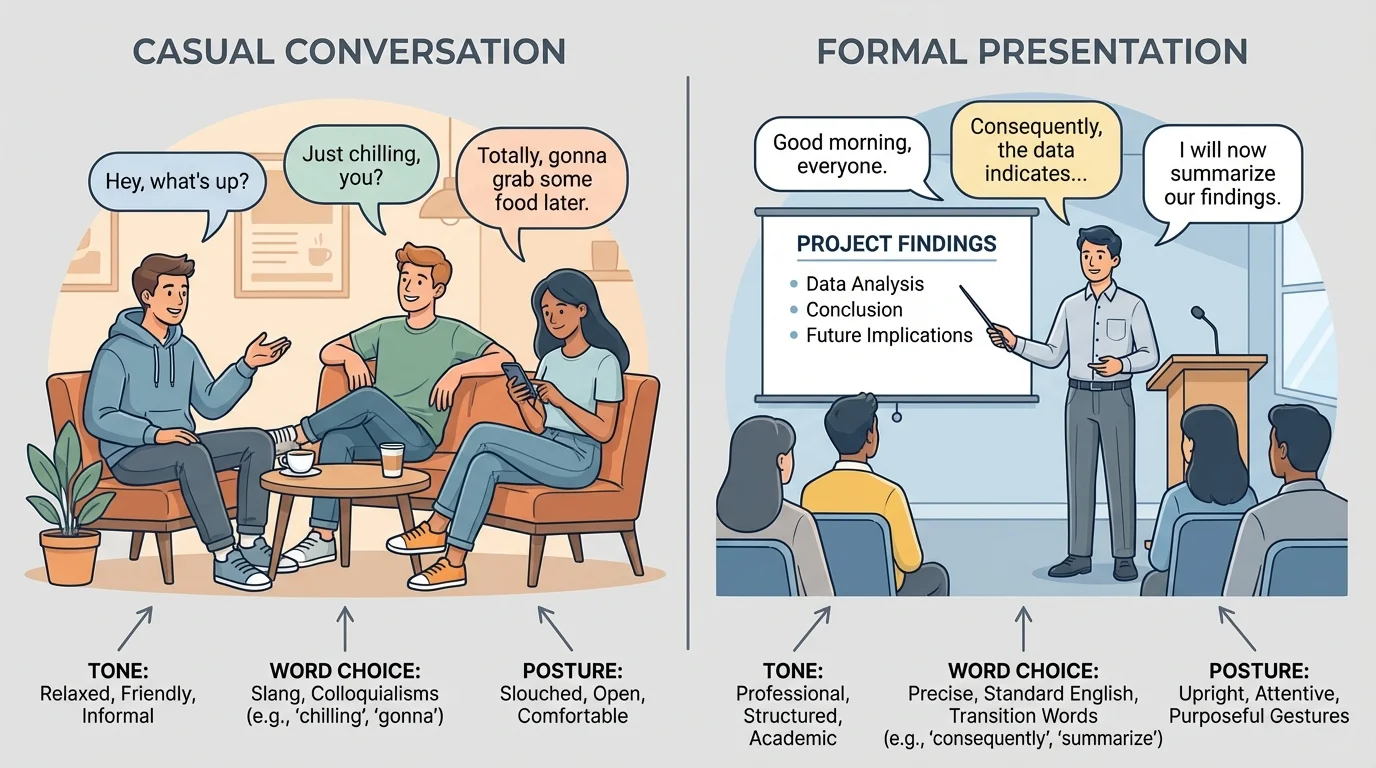
The difference between formal and informal speech becomes much easier to notice when you compare two situations side by side, as [Figure 1] shows. In both situations, the speaker may mean the same thing, but the wording, tone, and body language change to fit the setting.
Informal English is more relaxed. It may include shortened words, slang, inside jokes, interruptions, or unfinished sentences. For example, a student speaking informally might say, "Yeah, that movie was pretty awesome. I kind of liked how it ended." In a formal setting, that same idea might become, "I thought the ending was effective because it resolved the main conflict clearly."
Formal English usually includes complete sentences, correct grammar, specific word choice, and a respectful tone. Instead of saying, "That experiment was super cool and stuff," a student using formal English could say, "The experiment was interesting because it clearly showed how temperature affected the reaction."
Notice that formal English is not about trying to sound fancy. It is about sounding appropriate, clear, and thoughtful. Using very big words that you do not fully understand can make your speech confusing. Formal speech should be natural but polished.
In many school situations, formal English is expected. These include oral reports, class presentations, debates, ceremonies, interviews, and discussions with adults in professional roles. In those moments, speaking carefully shows respect for the audience and seriousness about the task.
Many strong public speakers sound conversational while still being formal. They do not speak like robots. Instead, they combine natural expression with careful word choice and clear structure.
As you compare your own speaking habits to the situations in [Figure 1], you can begin to hear the shift from casual language to purposeful, formal speech. That shift is one of the most useful communication skills you can build.
When adapting speech, ask yourself three questions: Who am I speaking to? Why am I speaking? What kind of language fits this moment? These questions help you make smart choices before you even begin talking.
Suppose you are sharing the results of a survey. If you are talking to friends, you might say, "Most people picked the first option." If you are giving a formal presentation, you might say, "Our survey results show that the first option was the most popular choice among participants." The second version is more complete and professional.
Tone also matters. Tone is the attitude your voice and words express. A respectful tone is important in formal speaking. That does not mean sounding flat or emotionless. It means avoiding rude, careless, or overly casual expressions. You can be enthusiastic and still be formal.
Different tasks call for different tones. A memorial speech should sound respectful and sincere. A science presentation should sound informed and precise. A student council speech may sound energetic and persuasive. The words, pacing, and emphasis should match the purpose.
| Situation | Likely Style | Example Choice |
|---|---|---|
| Chatting with a friend | Informal | Casual words and relaxed tone |
| Presenting research in class | Formal | Precise language and organized ideas |
| Interviewing for a school role | Formal | Respectful wording and complete answers |
| Group planning session | Mixed | Cooperative tone with clear communication |
| Giving a ceremonial speech | Formal | Serious tone and thoughtful phrasing |
Table 1. Comparison of likely speech styles in different situations.
Sometimes a situation is not fully formal or fully informal. In a group project, for example, students may speak comfortably but still need to be respectful, focused, and clear. Adapting speech does not always mean switching to one extreme or another. Often it means finding the right level for the task.
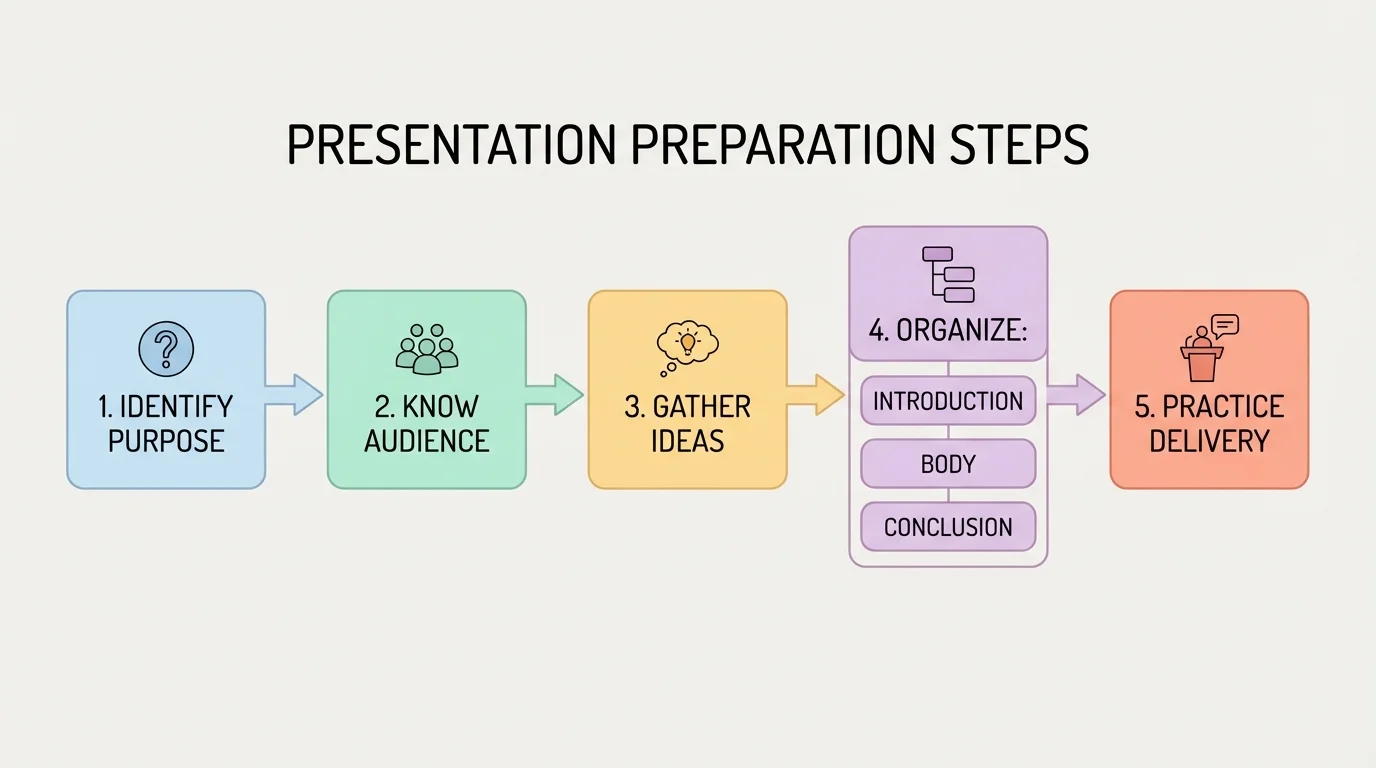
Strong presentations are built step by step, as [Figure 2] illustrates. Skilled speakers do not simply stand up and hope good words appear. They prepare with a clear plan.
Begin by deciding on your main message. What is the one important idea you want your audience to remember? If your topic is school recycling, your main message might be that a better recycling program can reduce waste and improve the school environment.
Next, organize your ideas. Most formal presentations include an introduction, a body, and a conclusion. The introduction grabs attention and states the topic. The body develops the main points in a logical order. The conclusion reinforces the main idea and leaves the audience with something memorable.
Transitions are also important. Transitions are words and phrases that guide listeners from one idea to the next. Examples include "first," "in addition," "for example," "however," and "finally." These small phrases help your audience follow your thinking.
Formal presentations should use evidence when appropriate. Evidence can include facts, examples, observations, quotations, or data. If you make a claim such as "students would recycle more if bins were easier to find," support it with reasons or examples. Evidence makes your speech stronger and more convincing.
Organization makes speaking easier to follow. Listeners cannot rewind a live speaker the way they can rewind a video. That is why formal speaking needs clear structure. When your ideas are grouped logically and introduced with transitions, your audience can stay focused on meaning instead of trying to figure out where you are going.
Planning also helps you choose the right level of formality. If you write out or outline your key ideas ahead of time, you can replace casual phrases with more precise ones. You can also remove filler words before they become habits during the presentation.
Later, when you practice your final speech, the sequence in [Figure 2] continues to matter. Speakers who know their purpose, audience, and structure usually sound much more confident than speakers who prepare only at the last minute.
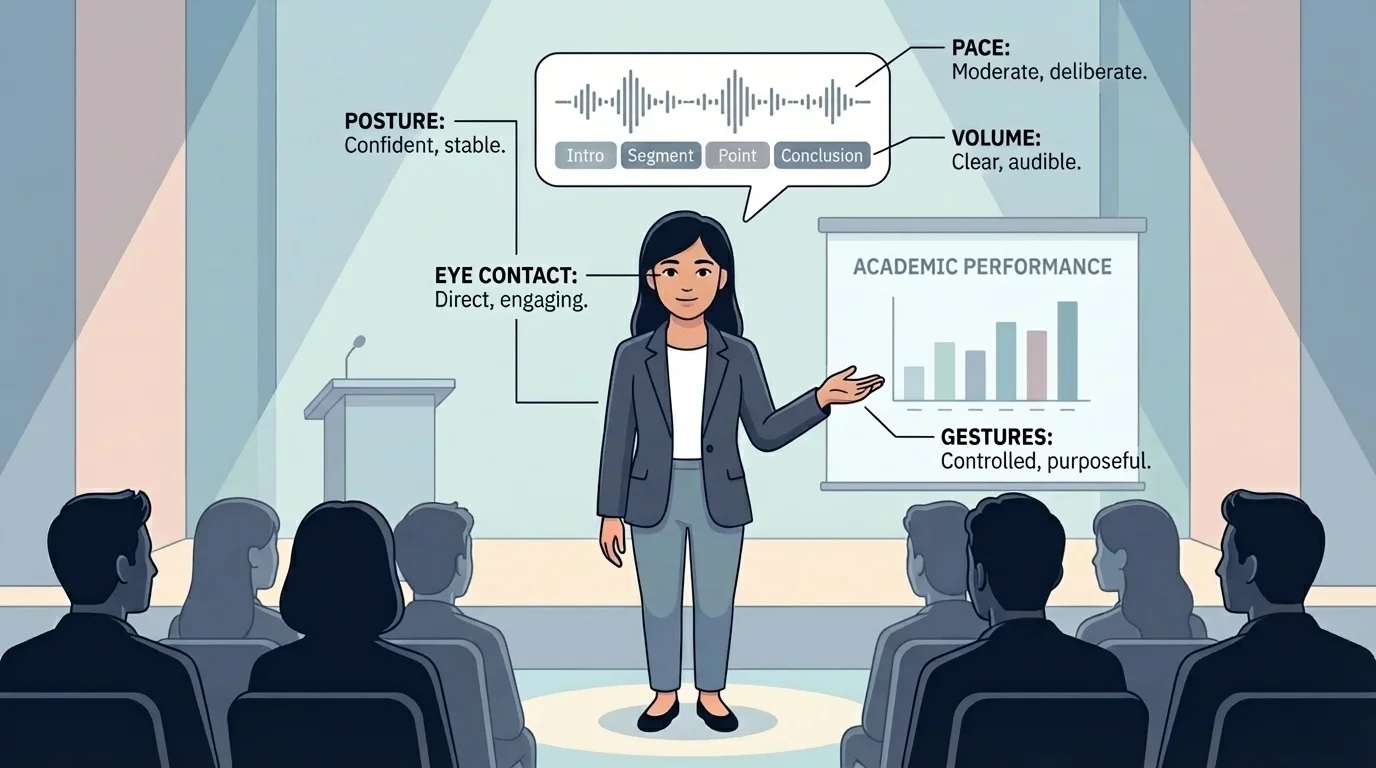
Good speaking is not only about the words on the page. Delivery techniques work together during a presentation, as [Figure 3] shows, to help a speaker sound confident and keep an audience engaged.
Volume means how loudly or softly you speak. In a formal presentation, your audience should hear you easily without strain. Speaking too quietly can make even a strong idea disappear. Speaking too loudly can sound harsh. Aim for clear, steady volume.
Pace is the speed of your speech. Nervous speakers often rush. When you speak too fast, the audience may miss important points. When you slow down slightly and pause at key moments, your message becomes easier to understand.
Pronunciation matters because formal speech should be easy to follow. This does not mean changing your accent or sounding unnatural. It means saying words clearly enough that listeners can understand them. If a presentation includes special vocabulary, practice those words before speaking.
Eye contact, posture, and gestures also shape how your message is received. Standing upright shows readiness. Looking at the audience builds connection. Natural hand gestures can emphasize important points. These features make the speaker appear more engaged and confident.
Facial expression is part of delivery too. If your face shows interest, seriousness, or enthusiasm that matches your message, your audience is more likely to stay connected. A speech about an exciting discovery should not sound bored. A respectful speech should not sound joking or careless.
One of the most common mistakes is reading directly from notes or slides. Notes should support you, not control you. Glance at them when needed, but speak to the audience. As the presenter in [Figure 3] demonstrates, effective delivery depends on connection, not just recitation.
Revising a delivery approach
A student begins a speech by staring at the paper and saying, "Um, so, like, today I'm gonna talk about pollution and stuff." Here is how that opening can be improved.
Step 1: Remove filler words.
Take out expressions such as "um," "like," and "and stuff," which weaken clarity.
Step 2: Use formal wording.
Replace "I'm gonna talk about" with "I will explain" or "Today I will discuss."
Step 3: Add eye contact and a steady pace.
Look up before speaking, begin clearly, and pause after the opening sentence.
An improved opening is: "Today I will discuss how pollution affects local waterways and what communities can do to reduce it."
Practicing aloud is one of the best ways to improve delivery. Silent practice helps with memory, but speaking aloud helps with timing, pronunciation, breathing, and confidence.
Formal speaking depends heavily on word choice. In casual conversation, people often rely on vague words such as "stuff," "things," or "really good." In formal speech, those words should usually be replaced with clearer language.
Precision means choosing words that express your exact meaning. Instead of saying, "The book was good," you might say, "The book was effective because its examples made the topic easier to understand." The second version gives the audience useful information.
Another important part of formal speaking is avoiding too much slang. Slang changes quickly and may not be understood by everyone. It can also make a speech sound less serious than the situation requires. If you are presenting to a broad audience, choose words that are widely understood.
Filler words are another problem. These include "um," "uh," "like," "you know," and "basically" when they are repeated too often. Nearly everyone uses filler words sometimes, especially when nervous. The goal is not perfection; the goal is control. Pausing briefly is usually stronger than filling silence with extra words.
From earlier speaking practice, you may already know that complete sentences, strong verbs, and specific details improve clarity. Formal speaking builds on those same skills but asks you to use them more consistently and deliberately.
You should also think about how to sound respectful when disagreeing. In a debate or discussion, formal speech does not attack people. It focuses on ideas. For example, instead of saying, "That makes no sense," you could say, "I understand that point, but I disagree because the evidence suggests a different conclusion."
Oral communication includes listening, not just speaking. In a formal setting, active listening helps you respond thoughtfully. If a classmate asks a question after your presentation, listen to the whole question before answering. Do not interrupt or rush to defend yourself before the person has finished.
Active listening means giving full attention to the speaker and showing that you are processing the message. This may include facing the speaker, making eye contact, nodding appropriately, and responding directly to what was said.
When answering questions, stay calm and clear. If you know the answer, respond directly. If the question is confusing, politely ask for clarification. If you do not know the answer, it is acceptable to say so honestly and then offer what you do know. For example: "I do not have that data with me, but my research did show that participation increased after the new program began."
Formal responses should remain respectful even under pressure. This matters in discussions, interviews, and debates. A strong speaker can disagree without becoming rude, and can answer challenging questions without losing composure.
"The way we speak can become the house we live in."
— Adapted from a communication principle about language and identity
Listening also helps you adapt in the moment. If you notice confused faces in the audience, you may need to explain a point more simply. If listeners seem ready for more detail, you may expand. Effective speaking is flexible, not mechanical.
Many students think formal speaking means sounding stiff or unnatural. Actually, the best formal speakers sound prepared, genuine, and clear. Here are several common problems and better choices.
Mumbling: Speak with enough volume and open your mouth clearly when pronouncing words. Practice difficult phrases aloud.
Rushing: Slow down and pause after important ideas. The audience needs time to think.
Reading every word: Use notes as reminders, not a script. Connect with listeners the way the presenter does in [Figure 3].
Too much slang: Replace casual expressions with more precise, appropriate language. This shift is similar to the contrast introduced earlier in [Figure 1].
Weak organization: Use a clear beginning, middle, and end. The preparation sequence from [Figure 2] helps prevent this problem.
Monotone delivery: Let your voice rise and fall naturally to match the ideas you are communicating.
Changing informal language into formal language
Here are examples of how a speaker can revise sentences for a formal context.
Step 1: Informal sentence
"A lot of kids thought the rule was dumb."
Step 2: Identify the problem
The sentence uses vague wording and an insulting term that sounds disrespectful.
Step 3: Revise for formal speech
"Many students believed the rule was unfair and wanted it to be reconsidered."
The revised sentence keeps the meaning but improves tone, precision, and respect.
Fixing mistakes is part of becoming a stronger speaker. Few people begin as polished presenters. Improvement comes from preparation, feedback, and practice.
Adapting speech is not only a school skill. Adults use it in job interviews, meetings, community events, ceremonies, public announcements, and professional conversations. Students use it when leading groups, interviewing for opportunities, presenting ideas, and speaking to people in positions of responsibility.
Digital communication can also require formal English. A video presentation, recorded speech, or formal online meeting still calls for clear language, careful tone, and strong delivery. Even when the audience is on a screen, the expectations for organization and respect remain.
Think about athletes giving press conferences, scientists explaining discoveries, or community leaders speaking after an important event. Their words matter, but so do their tone, pacing, and ability to respond to questions. The same communication principles apply in smaller school settings.
When you adapt your speech well, people are more likely to understand you, trust your message, and take your ideas seriously. That is a powerful skill in class, in the community, and in the future.
