A great story does not begin when "something happens." It begins when a reader feels grounded enough to care that something is happening. Think about the difference between walking into the middle of a movie with no idea who anyone is and starting at a scene that quickly tells you where you are, whose eyes you are seeing through, and why the moment matters. Strong narrative writing does exactly that: it engages the reader and orients the reader.
When writers create real or imagined narratives, they need more than action. A fast-moving event can still feel confusing if the reader does not know the setting, the perspective, or the people involved. Good narrative openings give readers enough information to follow the story while still leaving room for curiosity.
To do this well, writers usually focus on four big moves: establish context, choose a clear perspective, introduce a narrator and/or characters, and organize events so they unfold in a natural, logical way. These moves do not make writing boring or formulaic. In fact, they help a story feel smooth, vivid, and believable.
Context is the background information that helps the reader understand a scene, such as the time, place, situation, and stakes. Point of view is the position from which a story is told. A narrator is the voice telling the story, and an event sequence is the order in which story events happen.
Writers often think of a narrative as a chain. Each link needs to connect to the next. If the opening is missing key information, the chain starts weak. If the sequence jumps around without purpose, the chain breaks. Your job as a writer is to guide the reader from moment to moment without losing them.
The beginning of a narrative is not just an introduction. It is a promise. It tells the reader what kind of story this will be and how to read it. A suspenseful beginning creates tension. A reflective beginning suggests that the narrator is looking back on an important moment. A humorous beginning signals a lighter tone.
At the same time, the beginning must help the reader get oriented. That means the reader should begin to understand questions like these: Who is telling this story? Where is this happening? When is it happening? What is going on already? What problem, change, or challenge might be coming?
Notice that orienting the reader does not mean explaining everything at once. Skilled writers give information in a controlled way. They reveal enough to create clarity, but not so much that the opening becomes a long report. A narrative should feel like a door opening, not a history textbook dumping facts.
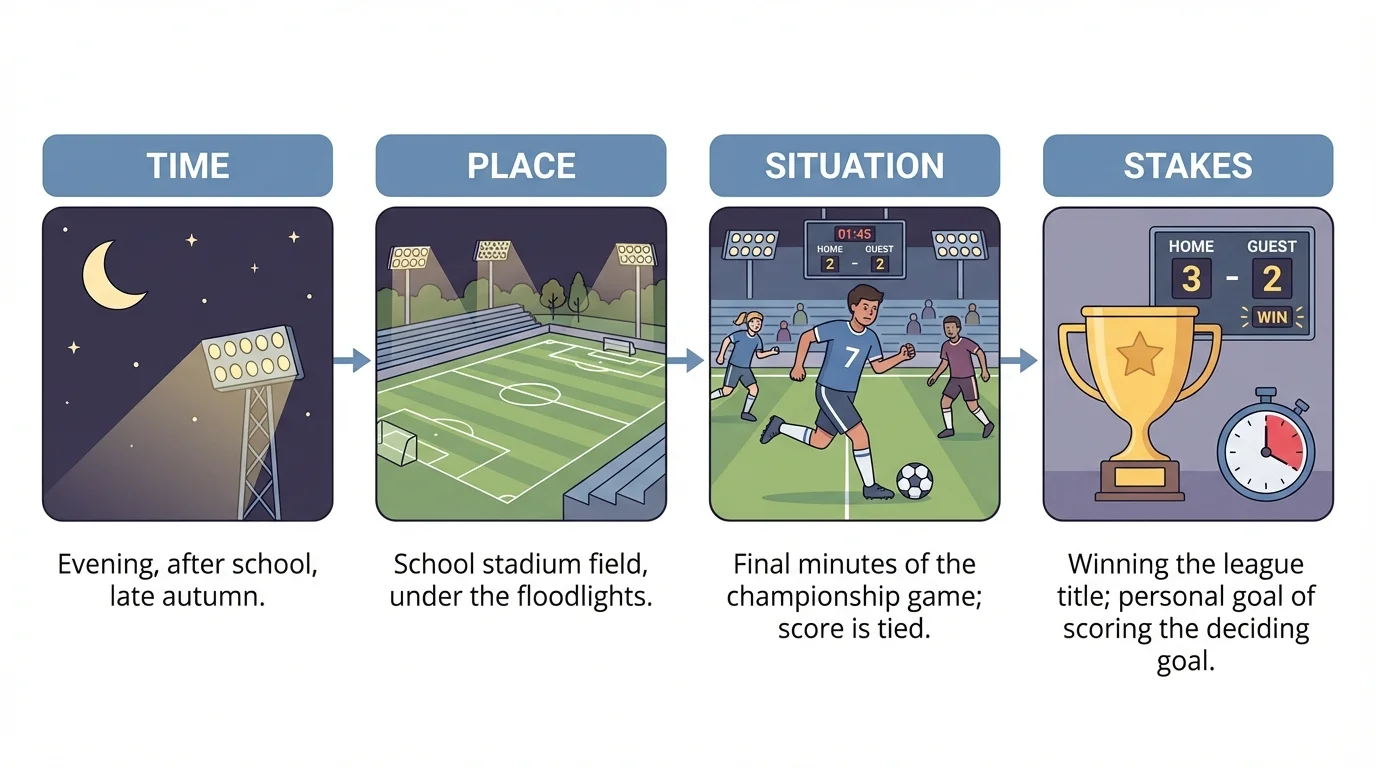
Context helps the reader step into the world of the story. Readers need clues about where and when the story takes place, what situation is already in motion, and why the moment matters, as [Figure 1] shows through a simple planning frame. Without context, even interesting events can seem random.
There are four useful parts of context: time, place, situation, and stakes. Time answers when the story happens. Place answers where. Situation explains what is going on. Stakes reveal why the event matters to the narrator or characters.
For example, compare these two openings:
Weak opening: "I ran across the field and yelled."
Stronger opening: "Under the stadium lights at our final soccer game of the season, I sprinted across the wet field and shouted for Maya to pass before the defenders closed in."
The stronger version gives the reader a place, a time clue, a situation, and a reason the moment matters. The reader can picture the scene and feel the pressure.
Context can be given directly, but it often works best when woven into action. Instead of writing, "It was a cold morning in December and I was nervous about the concert," you might write, "My fingers shook as I tightened the bow on my violin backstage, while wind rattled the auditorium doors." That sentence gives sensory clues, place, and emotion at the same time.
Specific details are powerful because they make a scene feel real. "School hallway" is general. "The hallway outside the science lab, with its peeling robotics posters and smell of bleach" is more vivid. Specificity helps readers trust the story world.
Readers often decide within the first few lines whether a story feels clear enough to continue. A strong opening does not need explosions or drama; it needs direction.
Another important part of context is tone. The same setting can feel peaceful, tense, lonely, or exciting depending on the details a writer chooses. As we see in [Figure 1], context is not just background information. It shapes the reader's emotional understanding of the story from the start.
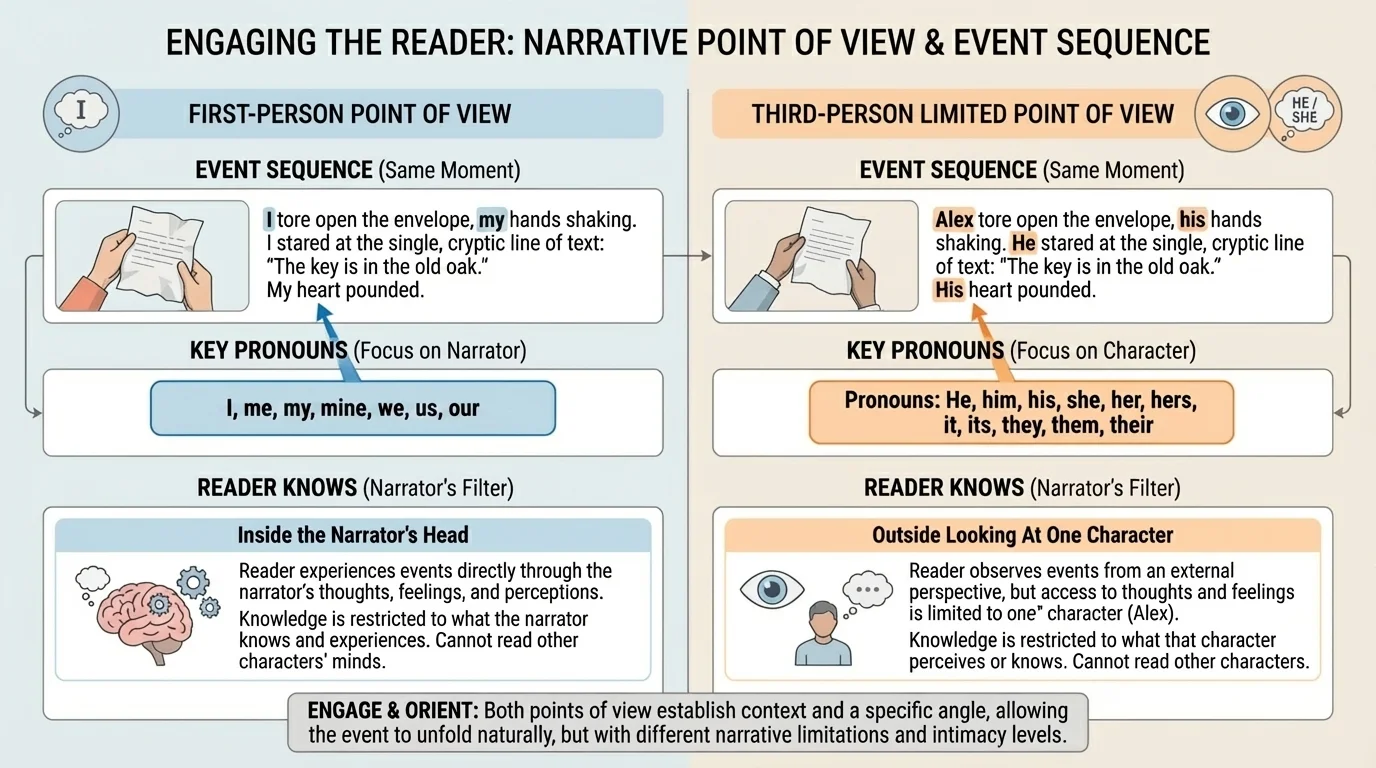
Point of view determines how the reader experiences the story. It shapes what the reader knows, what the reader notices, and how close the reader feels to the events, as [Figure 2] illustrates. Choosing a point of view is not a small decision. It affects every sentence.
One common option is first person, which uses words like I, me, and my. In first person, the narrator is inside the story. This point of view can feel immediate and personal because the reader hears the narrator's thoughts and reactions directly.
Another common option is third person limited, which uses he, she, or they but follows the thoughts and experiences of one character closely. This can still feel personal, but it gives the writer a little more distance.
A third option is third person omniscient, in which the narrator knows the thoughts and feelings of multiple characters. This can work well, but it is harder to manage because the writer must stay clear and organized.
Look at the difference in these versions of the same moment:
First person: "I knew I was late the second I heard the band begin warming up behind the curtain."
Third person limited: "Jalen knew he was late the second he heard the band begin warming up behind the curtain."
The event is the same, but the feeling changes slightly. First person sounds more immediate and personal. Third person limited sounds a little more controlled.
Whatever point of view you choose, stay consistent unless you have a very clear reason to shift. A story that begins in first person and suddenly slips into third person can confuse readers. Likewise, if you are using third person limited and suddenly reveal what another character is secretly thinking, the perspective becomes shaky.
Point of view also influences word choice. A seventh grader describing a basketball tryout, a grandparent remembering a storm, and an outside narrator telling the same event would sound different. The voice should match the storyteller.
Example: Matching point of view to purpose
Suppose you want readers to feel a character's nervousness before giving a speech.
Step 1: Choose the perspective that gives access to emotion.
First person or third person limited will usually work better than a distant narrator.
Step 2: Write details the character would notice.
Hands sweating, a dry throat, the sound of papers shaking, or the sight of the audience staring.
Step 3: Keep the knowledge level consistent.
If the narrator only knows their own thoughts, do not suddenly explain everyone else's hidden feelings.
The chosen point of view should make the emotional experience clearer, not more confusing.
Later in a narrative, the same point of view continues to guide what can be shown. That is why the comparison in [Figure 2] matters so much: perspective changes not just pronouns, but the entire reader experience.
A reader does not need a full biography on the first page, but they do need a clear sense of who matters in the story. When you introduce a narrator or a character, focus on details that connect to the action.
One effective method is to introduce a character through action. Instead of saying, "My brother is impatient," you could write, "My brother tapped the steering wheel so hard at every red light that the loose coins in the cup holder jumped." The action reveals the trait.
Another method is dialogue. The words a character chooses can quickly show attitude, relationships, or mood. "Move over, I've got this," sounds different from "Do you want help?" Dialogue can also orient the reader by showing what problem is already happening.
A third method is selective description. Selective means you only include details that matter. If a character's muddy shoes, cracked phone screen, or perfectly ironed uniform tells us something useful, include it. If a detail does not help develop the scene or character, it may not belong in the opening.
Names also matter. If you introduce several characters at once, readers may become lost. It is usually easier to bring in one or two important people clearly, then add others as needed.
Character introduction works best when it serves the moment. Readers learn characters fastest when description, action, and dialogue work together. A single sentence can reveal appearance, mood, and conflict if it is well chosen. For example, "Mrs. Alvarez stood at the bus door in her bright yellow raincoat, scanning our faces like she already knew who had forgotten the permission slips."
The narrator also needs a believable voice. If the narrator is a student, the voice should sound like that student's way of noticing and thinking. If the narrator is older and reflecting on the past, the voice may include more insight. Voice creates trust between writer and reader.
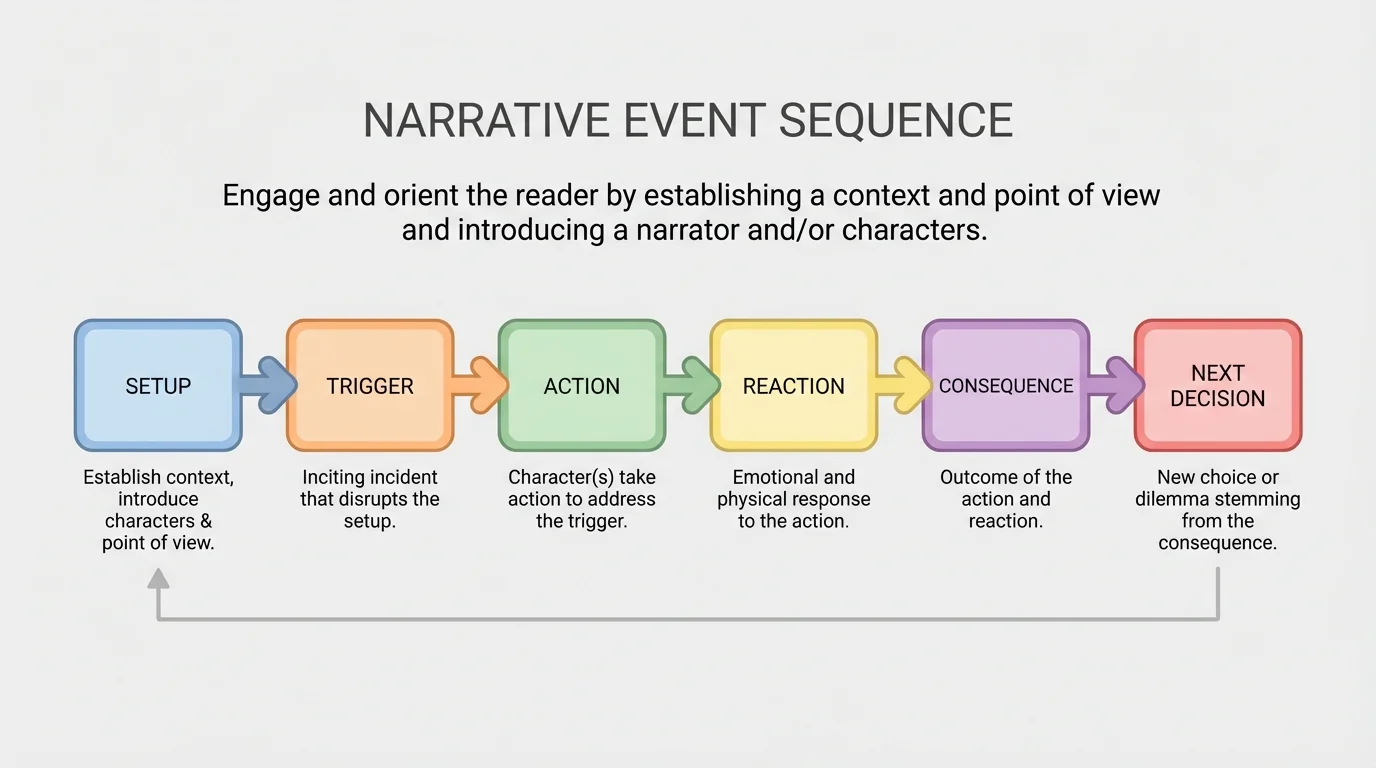
A strong narrative does not just list things that happen. It creates an event sequence in which one moment leads clearly to the next, as [Figure 3] shows in a simple cause-and-effect flow. Readers should not feel as if scenes are dropped in from nowhere.
Usually, events unfold naturally when the writer pays attention to cause and effect. Something happens, someone reacts, and that reaction leads to the next event. This chain helps the story feel believable.
Consider this sequence: "Nora forgot her lab notebook. She borrowed paper from her partner. During the experiment, she wrote down the wrong temperature. The group's results did not match the others. Her teacher asked what happened." Each event connects to the one before it.
Transitions also help readers follow time and movement. Words and phrases like later that afternoon, after a few minutes, meanwhile, as soon as, and by the time can signal shifts clearly. Good transitions are especially important when a narrative covers several events.
Pacing matters too. Pacing is the speed at which a story moves. Big, important moments often deserve slower pacing with more detail. Less important moments can move quickly. If a character spends six paragraphs opening a locker but only one sentence facing a major decision, the pacing may feel off.
One common mistake is the "then, then, then" problem. A writer may list events in order, but without meaning: "We got on the bus. Then we sat down. Then we talked. Then we got there." This is chronological, but not dramatic or purposeful. A better sequence shows what changes and why.
Another mistake is jumping in time or place without signaling it. If the story moves from the cafeteria to a thunderstorm at home, the reader needs a transition. Clear event order helps the reader stay oriented and emotionally connected.
Much later in the story, the pattern in [Figure 3] still applies. Even surprising events should grow out of what came before. Surprise is exciting; randomness is confusing.
Different kinds of openings can engage readers, but the best ones all create interest and clarity together.
Action opening: "The fire alarm started just as I slid the memory card into the computer." This creates immediate movement and a problem.
Dialogue opening: "'Do not press send,' Lena whispered, already reaching across the table for my phone." This introduces conflict through speech.
Reflection opening: "I did not understand why my grandfather saved every broken watch until the day he handed one to me." This creates curiosity and a thoughtful tone.
Setting-based opening: "By sunrise, the entire fishing pier had disappeared into fog, and the town sounded as if it were holding its breath." This builds atmosphere while orienting the reader.
What these openings have in common is that they suggest a direction. They make readers ask a question: What happened next? Why is this important? A strong beginning invites the reader forward.
Example: Revising an opening
Draft: "It was a day I will never forget. I went somewhere important."
Step 1: Add context.
Where is the narrator? When is this happening? What is the event?
Step 2: Add point of view and voice.
Let the sentence sound like a real narrator, not a vague announcement.
Step 3: Add a meaningful detail.
Choose one sensory or specific detail that anchors the reader.
Revision: "I had rehearsed my spelling bee introduction so many times on the drive downtown that when I finally stepped onto the bright middle-school stage, the words sounded borrowed."
The revised version orients the reader much faster. We know the event, the place, the narrator's feeling, and the importance of the moment.
To keep readers engaged, writers often build scenes rather than simply summarizing events. A scene usually includes action, dialogue, and sensory details that make readers feel present in the moment.
Sensory details appeal to sight, sound, smell, taste, and touch. They help the reader experience the setting. In a narrative, sensory detail should not be random decoration. It should support mood, conflict, or character.
For example, if a student is waiting outside the principal's office, the writer might mention the buzz of fluorescent lights, the sharp smell of dry-erase markers, and the cold metal chair. Those details create tension because they fit the situation.
Dialogue can also do several jobs at once. It can reveal character, move the plot, and clarify relationships. Compare these lines:
"Are you coming?"
"Are you coming, or am I doing this alone again?"
The second line reveals more about the relationship and conflict.
Good dialogue usually sounds natural without copying every part of real conversation. In actual speech, people repeat themselves, pause, and go off topic. In narrative writing, dialogue should sound believable but purposeful.
From earlier writing work, remember that descriptive details are strongest when they are precise and relevant. More detail is not always better. The best details are the ones that help the reader understand the moment.
Writers also balance scene and summary. Not every event needs full dialogue and detailed action. Sometimes a brief summary moves the story forward efficiently. The key is knowing which moments deserve the spotlight.
Logical organization is not only about time order. It is also about consistency. The narrator's voice should remain believable. Characters should act in ways that make sense based on what the reader knows. Settings should stay clear enough that the reader can picture where events happen.
When revising a narrative, ask yourself several questions. Does the opening tell the reader enough to get oriented? Is the point of view clear and consistent? Are characters introduced before they become important? Does each event connect to the next? Are time shifts signaled?
Revision often means adding information in small, strategic ways. You may need one sentence that names the location, one line of dialogue that reveals a relationship, or one transition that makes a time jump clear. Tiny changes can make a story much easier to follow.
It also helps to read the story as if you know nothing about it. Writers sometimes forget that the reader cannot see the story in their head. If a friend or classmate would ask, "Wait, where are they?" or "Who is speaking?" then the narrative probably needs stronger orientation.
"Clarity is kindness to your reader."
— A useful writing principle
That idea is especially important in narrative writing. You are not making the story simpler by clarifying it. You are making it stronger. Readers can enjoy suspense, surprise, and complexity only when they understand the path they are on.
Read this short example:
"By the time our bus pulled into the museum parking lot, my quiz sheet was damp from being folded and unfolded in my pocket. I had signed up to lead our group through the planetarium exhibit, which seemed like a good idea in homeroom and a terrible one now. 'You're still doing the introduction, right?' Ethan asked as we stepped onto the sidewalk. I looked up at the glass doors, where our reflections wobbled in the morning rain, and said, 'Probably.'"
This opening works because it does several things quickly. It establishes context: we are at a museum, arriving by bus, likely on a school trip, in the morning rain. It sets stakes: the narrator has to lead a group and feels nervous. It introduces another character, Ethan, through dialogue. It keeps the point of view in first person, which lets us feel the narrator's anxiety directly.
The sequence also unfolds naturally. First the bus arrives. Then we learn about the folded quiz sheet, which hints at nervousness. Then we learn why the narrator is worried. Then Ethan speaks, increasing the pressure. Finally, the narrator answers in an uncertain way. Each detail leads smoothly to the next.
Example: Why this sequence feels natural
Step 1: Start with arrival.
The bus pulling in gives the scene a clear beginning.
Step 2: Add a clue about emotion.
The damp quiz sheet shows nervousness without directly explaining everything.
Step 3: Reveal the situation.
The narrator must lead the group through an exhibit.
Step 4: Increase tension through dialogue.
Ethan's question makes the responsibility feel immediate.
This order helps the reader understand both the action and the feeling of the moment.
You can use the same approach in your own narratives. Start by grounding the reader. Let the perspective stay clear. Introduce characters in ways that matter. Then build a sequence in which actions, reactions, and consequences connect.
