One movie can make the past feel thrilling, emotional, and personal. A textbook chapter about the same period can feel careful, factual, and exact. Which one tells the "real" story? The answer is more interesting than choosing one side. Literature often helps readers feel history, while historical writing helps readers verify history. Strong readers learn to use both. When you compare a story set in the past with a factual account of the same period, you begin to see how authors make choices about what to include, what to leave out, and what to change.
This skill matters far beyond English class. People encounter history in novels, films, documentaries, museum exhibits, websites, and social media posts. Some of these sources are carefully researched. Others mix fact with invention. Learning to compare a literary version of the past with a historical one helps you become a more thoughtful reader, a better researcher, and a more careful thinker.
When you read a story about ancient Egypt, the American Revolution, or the Great Depression, you are not just following a plot. You are also noticing how the author builds a world. The setting, speech, clothing, habits, and conflicts all create a picture of a time and place. That picture may be partly accurate, partly imagined, or a mix of both.
A historical account has a different job. It usually aims to explain what is known from evidence such as letters, government records, artifacts, interviews, photographs, and the work of historians. It may still reflect a writer's point of view, but it is expected to stay close to verifiable facts.
Fiction is writing that includes invented elements, such as imagined dialogue, scenes, or characters.
Historical account is a factual explanation or description of people, events, or life in the past based on evidence.
Portrayal is the way a person, place, event, or time period is presented to the audience.
Compare and contrast means to identify similarities and differences between two texts or ideas.
When you compare these two kinds of texts, you are not trying to "catch" fiction making mistakes. You are trying to understand why authors of fiction alter history. Sometimes they change details to make a story more dramatic. Sometimes they combine several real people into one character. Sometimes they focus on one experience to help readers connect emotionally with a larger historical event.
A fictional portrayal may include facts, but it is still shaped by storytelling choices. A historical account may also have style and voice, but it is guided by evidence. Readers need to pay attention to both content and purpose.
Another important idea is point of view. In fiction, point of view strongly shapes what readers notice. If a novel is told by a young soldier, readers may experience confusion, fear, and excitement. A history article about the same battle might explain causes, dates, leaders, and results instead. Neither text is doing the exact same job.
You also need to think about credibility. A credible source is one that can be trusted because it is accurate, supported by evidence, and created by a knowledgeable author or organization. In research, students often compare a literary text with more than one credible informational source so they can test whether a detail is likely true, exaggerated, simplified, or invented.
Many famous historical novels include extensive research, but even very accurate novels usually invent dialogue because no one can know every exact conversation from the past.
That detail matters because dialogue can strongly influence how a character seems. A historical figure may sound brave, funny, cold, or wise in a novel, even if the exact words were created by the author. This is one reason readers must separate the verified person from the artistic version of that person.
Authors of fiction often make changes for clear reasons. One common change is the use of a composite character. A composite character combines traits or experiences from several real people into one invented person. This helps keep the story focused and easier to follow.
Another common change is compressed timeline. Real history can unfold over months or years, but stories often shorten events so the plot moves quickly. A novelist may place several important incidents within a few days even if they were actually spread out over a much longer period.
Authors may also simplify complicated events. Real history is messy. People disagree, records are incomplete, and causes are often complex. A story may reduce these complexities so readers can follow the emotional journey of a main character.
How fiction uses history
Fiction often uses history as a framework. The author may keep the real setting, major conflict, and important public events, but create private scenes, conversations, and personal viewpoints. This can make the past feel vivid and human. At the same time, it can change how readers understand what truly happened unless they compare the story with factual sources.
Theme also affects historical fiction. If an author wants to explore courage, injustice, survival, or freedom, the story may highlight certain facts and downplay others. This does not automatically make the work weak or dishonest. It means the work is shaped by artistic purpose.
A historical account is strongest when it relies on evidence. Some evidence comes from primary sources, which are materials created during the time being studied, such as letters, speeches, diaries, laws, maps, and photographs. Other evidence comes from secondary sources, which explain or analyze the past later, often using many primary sources.
Readers should ask useful questions: Who wrote this? When was it written? What evidence does it use? Does it agree with other reliable sources? Is the language factual, emotional, or strongly persuasive?
Historical accounts can still differ from one another. Historians may disagree about causes, importance, or meaning. But they are expected to support claims with evidence. That expectation is what separates history writing from pure invention.
When you cite evidence, you can use direct quotations, paraphrases, or specific details from a text. Strong analysis does not rely on general statements like "the book shows history well." It points to exact details and explains what those details mean.
This is especially important when using multiple sources. If one article says a town was peaceful and another describes serious conflict, you should not ignore the disagreement. You should notice it and ask why the sources differ.
A useful method is to organize details by categories, as [Figure 1] shows through a side-by-side comparison tool. Instead of simply saying "these texts are alike" or "these texts are different," compare the same feature in both texts: setting, character behavior, key events, daily life, language, or major conflicts.
Start by identifying the shared subject. Are both texts about the same period, place, or person? Then list important details from the literary text and from the historical account. Finally, decide which details match, which details differ, and what those differences suggest about the author's purpose.
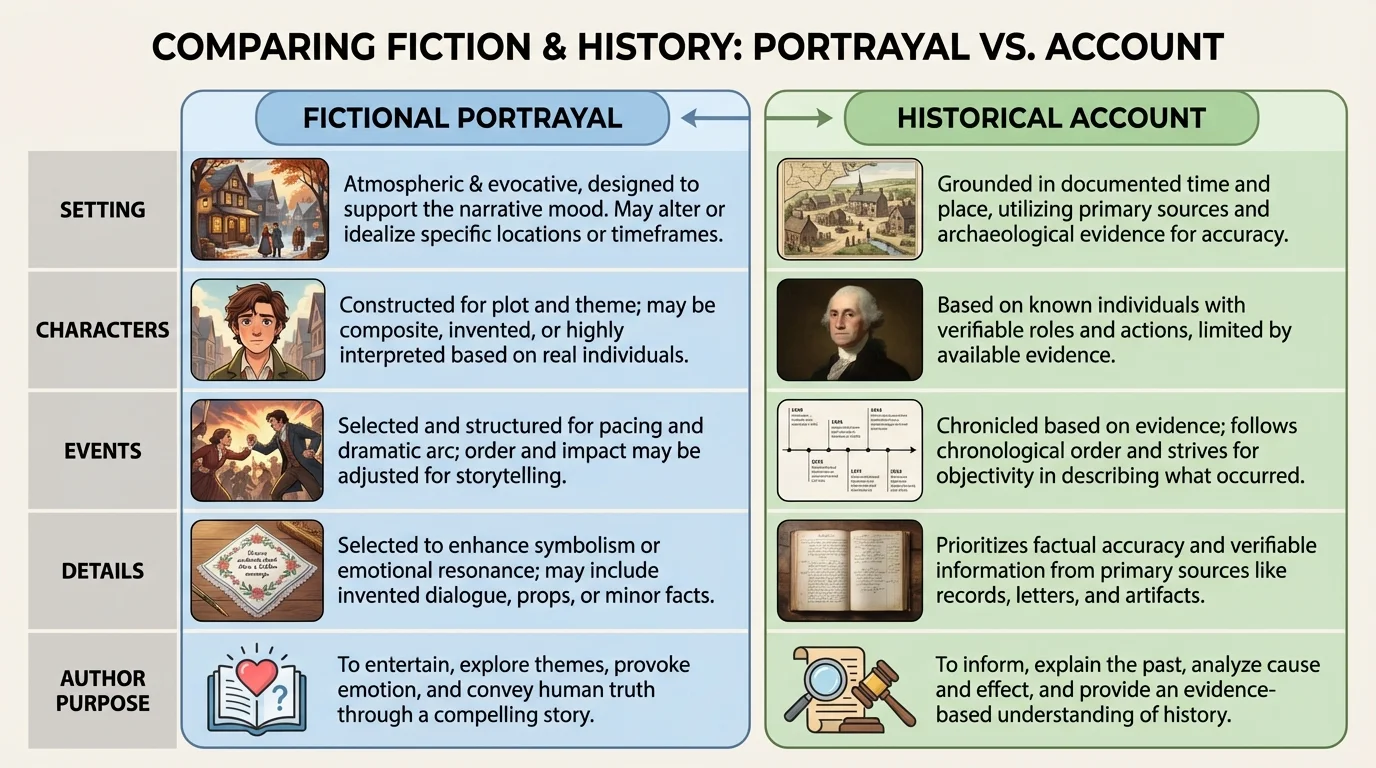
For example, suppose a novel shows a frontier town as full of constant danger, dramatic standoffs, and daily violence. A historical article about the same kind of town may reveal that while danger existed, many people spent most of their time farming, trading, cooking, teaching, building homes, and solving ordinary problems. The fiction is not necessarily false, but it may emphasize the most exciting parts of life in order to create suspense.
When writing your comparison, use clear language such as both, however, in contrast, similarly, and unlike. These signal words help show relationships between ideas.
| Feature to Compare | Questions to Ask |
|---|---|
| Time period | Do both texts place events in the same years or era? |
| Setting | How is the place described in each text? |
| Character | Is the person shown as more heroic, fearful, harsh, or kind in one text? |
| Events | Are events added, removed, or rearranged? |
| Details | Which facts match historical evidence and which seem invented? |
| Purpose | Is the goal to inform, entertain, persuade, or create emotion? |
Table 1. Questions students can use when comparing a fictional portrayal with a historical account.
Later, when you build a full analysis, the organizer in [Figure 1] helps you move from collecting details to explaining author choices. The goal is not just to spot differences, but to explain what those differences do for the reader.
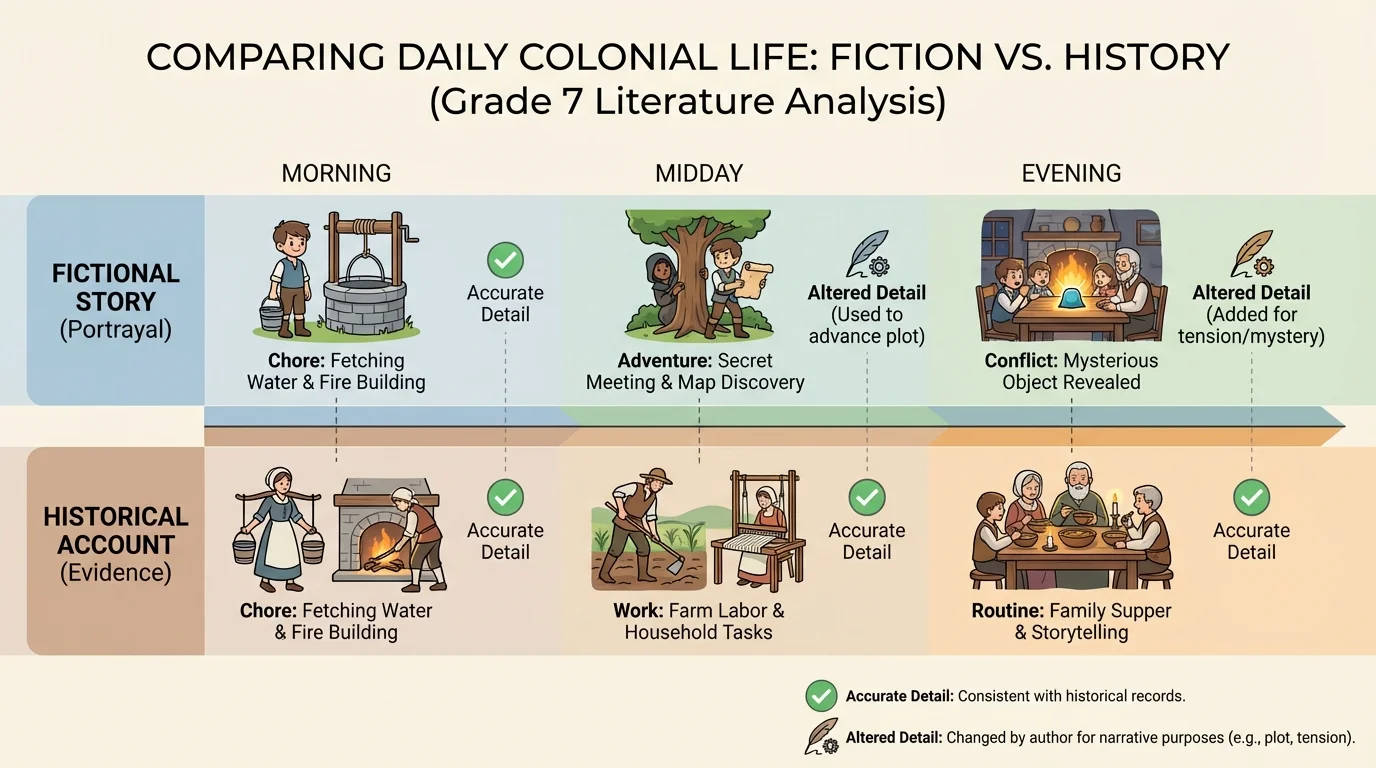
[Figure 2] Suppose a story set in Colonial America follows a young apprentice in Boston. The fictional chapter describes crowded streets, arguments about taxes, secret nighttime meetings, and a dramatic messenger racing through the city. The reader feels tension and urgency. Sequence matters here, and comparing the story's fast-moving order of events with the slower, more complex historical pattern can help readers notice important differences.
A historical account of Boston in the same era might explain trade rules, British control, protests, and the roles of merchants, workers, and political leaders. It may note that while conflict was real, daily life also included work routines, family responsibilities, and long stretches without dramatic action.
Comparing the two texts, you might notice several similarities: both mention taxation, protest, and public tension. But the differences are just as important. The fictional portrayal may present nearly every day as urgent and dangerous. The historical account may show that conflict built over time and involved many economic and political causes.
The novel may also focus on one young character's feelings, while the history text looks at groups, laws, and public events. That difference affects how readers understand the period. The story personalizes the era; the history account broadens it.
Case study analysis
A student compares a fictional scene about a colonial protest with a historical article on protests in Boston.
Step 1: Identify a shared historical topic.
Both texts focus on colonial protest against British policies.
Step 2: Gather evidence from each text.
The story describes shouting crowds, fear, and a secret warning. The article explains taxes, organized resistance, and dates of major protests.
Step 3: Compare accuracy and emphasis.
Both texts present unrest, but the story emphasizes danger and suspense more strongly than the article does.
Step 4: Draw a conclusion.
The author of fiction uses real historical tension but heightens emotion and pace to keep readers engaged.
This kind of conclusion is stronger than saying the story is "wrong." It explains that the fiction selects and intensifies certain truths. When readers compare the sequence with the fuller historical record, they can see how storytelling often compresses time and narrows attention.
Now consider a fictional portrayal of a real historical figure such as Harriet Tubman, Julius Caesar, or Joan of Arc. A novel might present that person through dramatic speeches, private thoughts, and intense scenes of decision. A biography or encyclopedia article about the same figure will likely focus on documented actions, dates, places, and historical significance.
If the literary version makes the figure seem fearless every moment, but historical sources show uncertainty, setbacks, or conflicting reports, that contrast matters. Fiction often smooths a person into a clearer character arc. History often reveals a more complicated human being.
Readers should ask whether the fictional text turns the person into a symbol. Heroes in stories may appear unusually confident, villains unusually cruel, and turning points unusually neat. Real people are usually less simple than that.
"The past is never exactly what a story makes it, but stories can help us care enough to study it more closely."
— Reading principle for historical literature
This is why comparing a story to factual sources is so valuable. It helps you appreciate the power of literature without confusing emotional truth with documented truth.
Strong comparison depends on evidence-based thinking, and [Figure 3] illustrates a practical sequence for moving from a question to a conclusion. You might begin with a research question such as: How accurately does a novel portray life for children during the Industrial Revolution? A good question is specific enough to investigate but broad enough to allow comparison.
Next, gather multiple credible sources. One source may not be enough. If a novel shows children working dangerous factory jobs, you might compare it with a museum article, a historian's summary, and a primary source such as a worker's testimony. Looking across sources helps you avoid depending on a single voice.
As you read, collect relevant details. You can quote exact words, paraphrase information, and note patterns. Then sort evidence into categories such as accurate detail, invented detail, emotional emphasis, and missing information.
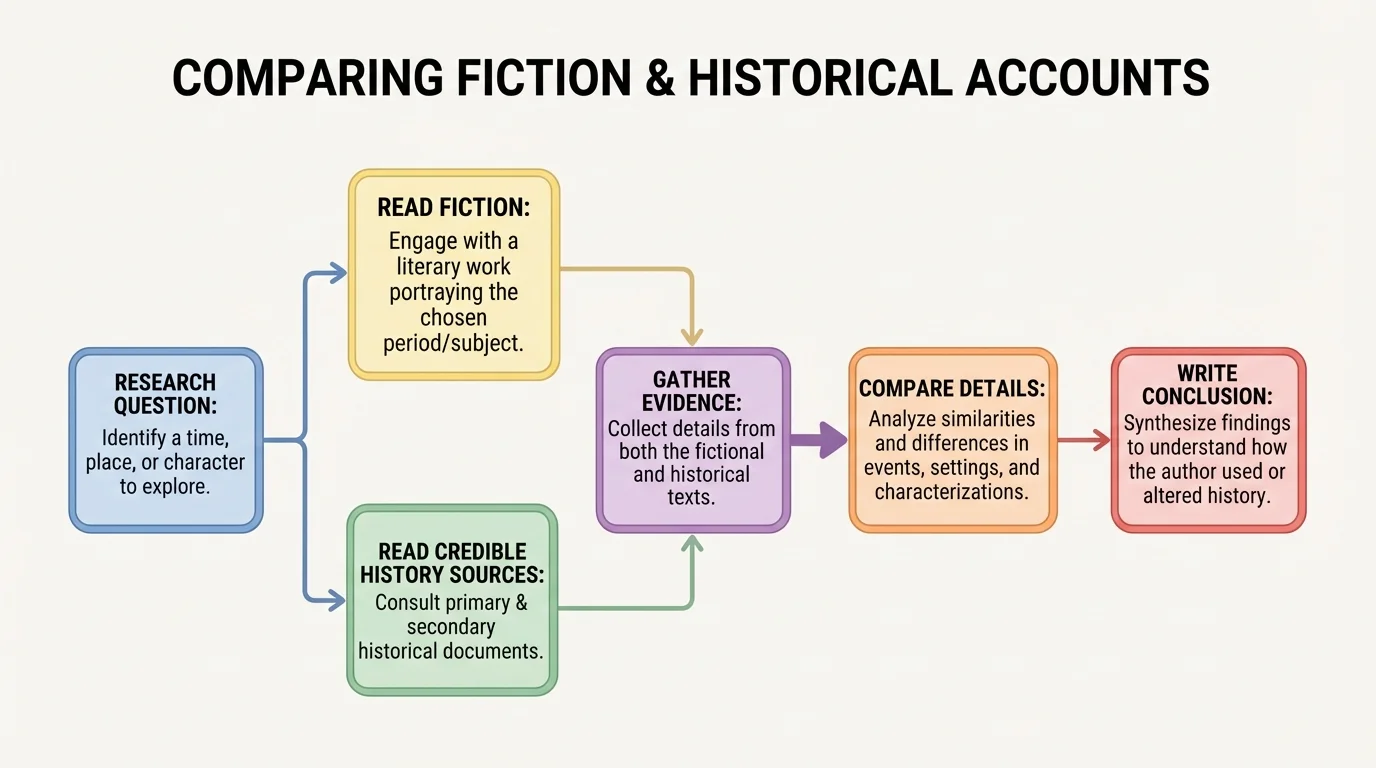
Your conclusion should answer the research question directly. For instance, you might write that the novel accurately portrays harsh working conditions and long hours, but it invents a particular main character and simplifies the range of jobs children performed. That conclusion is balanced because it recognizes both truth and alteration.
Notice that comparison is not only about finding errors. Sometimes fiction includes details that are historically accurate even when the plot is invented. In other cases, the plot may be invented but still reveal realistic social pressures, fears, or values. The research path in [Figure 3] helps students separate these layers carefully.
Building a short research conclusion
Question: How does a historical novel portray life during westward expansion?
Step 1: Read the novel closely.
Note details about travel, food, weather, family roles, and conflict.
Step 2: Read informational sources.
Use a textbook section, a museum website, and one primary source diary excerpt.
Step 3: Sort evidence.
Separate details that match across sources from details that seem added for drama.
Step 4: Write the conclusion.
The novel reflects many true hardships of travel but increases the number of dramatic dangers and gives one family an unusually symbolic role.
This process blends reading, research, and writing. It asks you to think like both a literary analyst and a historian.
After comparing texts, you need to present your findings in a format that fits the task. A short paragraph may work for a quick response. A multi-paragraph essay may be better for a deeper analysis. Sometimes a chart, slide presentation, or research notes page can help organize evidence before writing.
A strong conclusion usually includes three parts: the shared subject, the major similarity or difference, and an explanation of what the fictional author changed or emphasized. For example: Both texts describe life during the California Gold Rush, but the novel focuses more on sudden danger and personal rivalry. The author alters history by narrowing attention to dramatic moments in order to build tension and develop the main character.
Notice how that response does more than list facts. It interprets the author's choices. That is the heart of literary analysis.
One common mistake is assuming that if a story changes anything, it has no historical value. That is too simple. Fiction can still reveal attitudes, struggles, and possibilities that help readers connect with the past.
Another mistake is trusting a fictional portrayal more than factual evidence just because the story feels vivid. Emotion can be powerful, but readers still need proof.
A third mistake is using weak evidence. Statements like "the texts are different" are not enough. Name the exact difference. Explain why it matters. Support the point with details from both texts.
Finally, avoid judging fiction and history as if they must do the same thing. A novel is not a textbook, and a historical account is not a drama. The most useful question is not "Which one wins?" but "What can I learn by reading them together?"
