A story can make your heart race even when you are sitting perfectly still. That happens because good writers do more than report events. They choose exactly how to reveal a moment, a character, or a turning point. A slammed locker, a whispered warning, a pause before an answer, or the smell of rain on a track field can pull readers into the action. Narrative writing becomes powerful when it uses technique to make experiences feel real.
When writers create narratives, they are not simply saying what happened first, next, and last. They are shaping the reader's experience. The most effective narratives use dialogue, pacing, and description to develop events and characters in a way that feels clear, meaningful, and engaging. These techniques help readers hear voices, picture settings, sense emotion, and understand why moments matter.
Whether a narrative is based on a true memory or completely imagined, it needs structure and detail. Readers should be able to follow the sequence of events, understand who the characters are, and notice how the situation changes. Strong narratives are organized, but they also feel alive.
A narrative tells the story of an experience or event, but a strong narrative does something more: it makes the reader feel present inside the story. If a writer says, "I was nervous before the game," the reader gets the basic idea. But if the writer says, "My fingers kept slipping on the water bottle, and the whistle in the gym sounded much louder than usual," the nervousness becomes visible and specific.
Narrative techniques are writing methods authors use to develop experiences, events, and characters. Important techniques include dialogue, which shows what characters say; pacing, which controls the speed of the story; and description, which uses details to create images, mood, and meaning.
These techniques work best when they are connected to a purpose. A writer might slow down pacing at an important moment to build suspense. A writer might include a short line of dialogue to reveal fear, confidence, or conflict. A writer might describe only a few exact details rather than everything in sight. The goal is not to add words just to add words. The goal is to help the reader experience the story more fully.
Three of the most useful tools in narrative writing are dialogue, pacing, and description. Although each one can be studied on its own, in good writing they often work together.
Dialogue lets readers hear characters speak. It can reveal personality, relationships, conflict, and important information. Pacing controls how quickly or slowly events unfold. It helps writers speed through minor moments and pause on major ones. Description allows readers to picture people, places, objects, and actions through carefully chosen details.
If a writer uses only one of these tools, the narrative may feel flat. A story with only dialogue may sound like a script and provide too little setting or action. A story with only description may feel slow and overstuffed. A story that rushes from event to event may confuse the reader. Balance matters.
Good dialogue does more than fill space with conversation. It reveals feelings, builds conflict, and shows relationships, as [Figure 1] illustrates through the difference between flat speech and dialogue supported by action. When characters speak, readers learn not only what they say, but also how they say it and what they avoid saying.
Effective dialogue sounds natural, but it is usually more focused than real conversation. In real life, people repeat themselves, wander off-topic, and use many filler words. In a narrative, dialogue should feel believable without including every "um," pause, or side comment. Each line should do some work in the story.
Dialogue can serve several purposes. It can reveal character: a confident character may speak in short, direct sentences, while a nervous character may hesitate. It can advance the plot: a warning, confession, or argument can change what happens next. It can also create tension: two characters may speak politely while clearly disagreeing underneath their words.
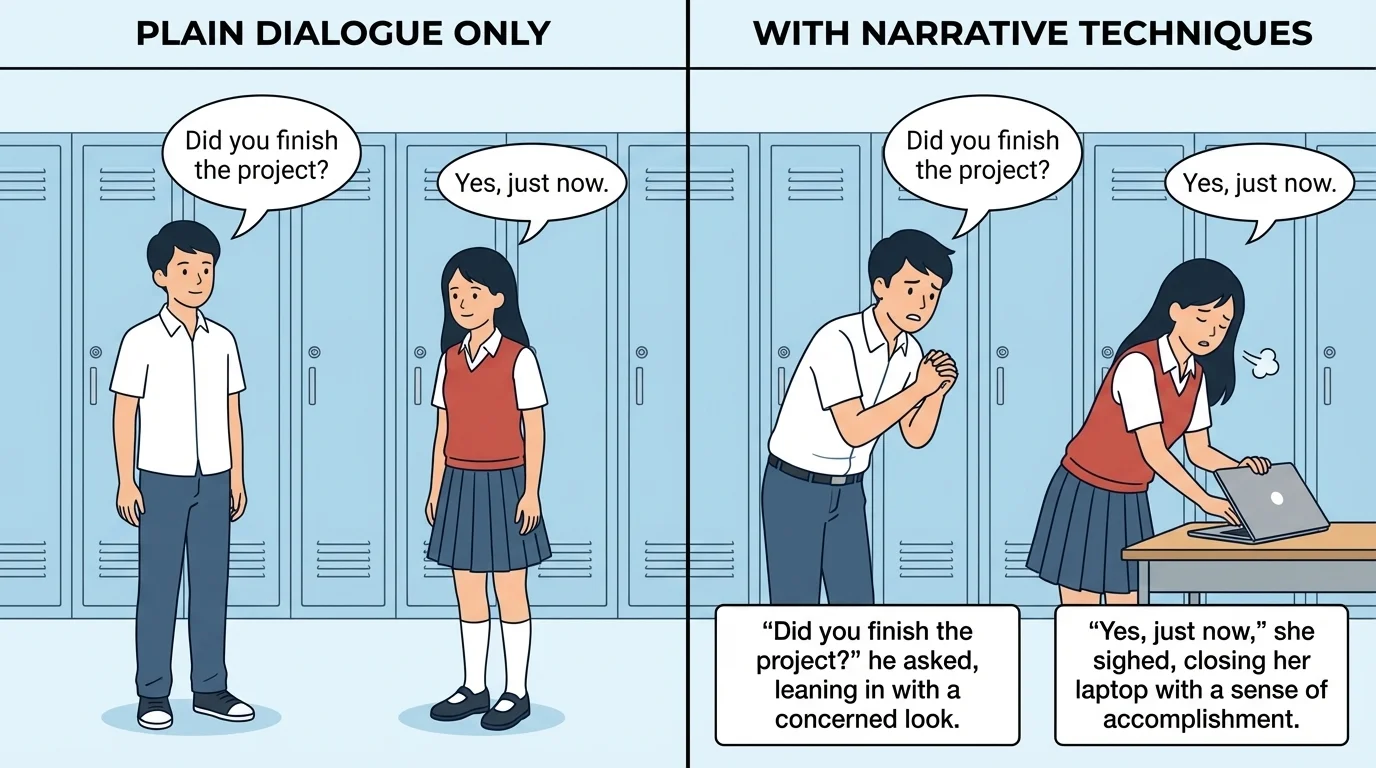
Writers often strengthen dialogue with action beats. An action beat is a brief action connected to a line of speech. For example, "I'm fine," Maya said, is simple. "I'm fine." Maya twisted the strap of her backpack until her knuckles turned pale is stronger. The action gives the reader extra information. Maya's words say one thing, but her body suggests something else.
Dialogue tags such as said, asked, and whispered can help readers track who is speaking. Usually, simple tags work best. Overusing dramatic tags like exclaimed, retorted, or growled can become distracting. A writer should trust the words and situation to carry much of the emotion.
Consider the difference between these two versions:
Example: flat dialogue and stronger dialogue
Version 1: "Are you coming?" Leo said. "Maybe," Ava said. "We're late," Leo said.
Version 2: "Are you coming?" Leo stood at the door, one hand on the knob. Ava kept her eyes on the science poster she was rolling into a tube. "Maybe." "Ava, the bus leaves in two minutes."
The second version adds movement and context. Readers can infer that Ava is hesitating, and Leo is feeling urgency.
Later in a story, a writer can return to the same technique for a different purpose. The contrast seen earlier in [Figure 1] matters because even a short action next to dialogue can reveal fear, anger, embarrassment, or excitement without directly naming the emotion.
Pacing controls how quickly or slowly a story moves, and writers control it by choosing what to expand, what to shorten, and where to pause. Skilled writers do not give equal space to every second of an event. They zoom in on important moments and glide past less important ones.
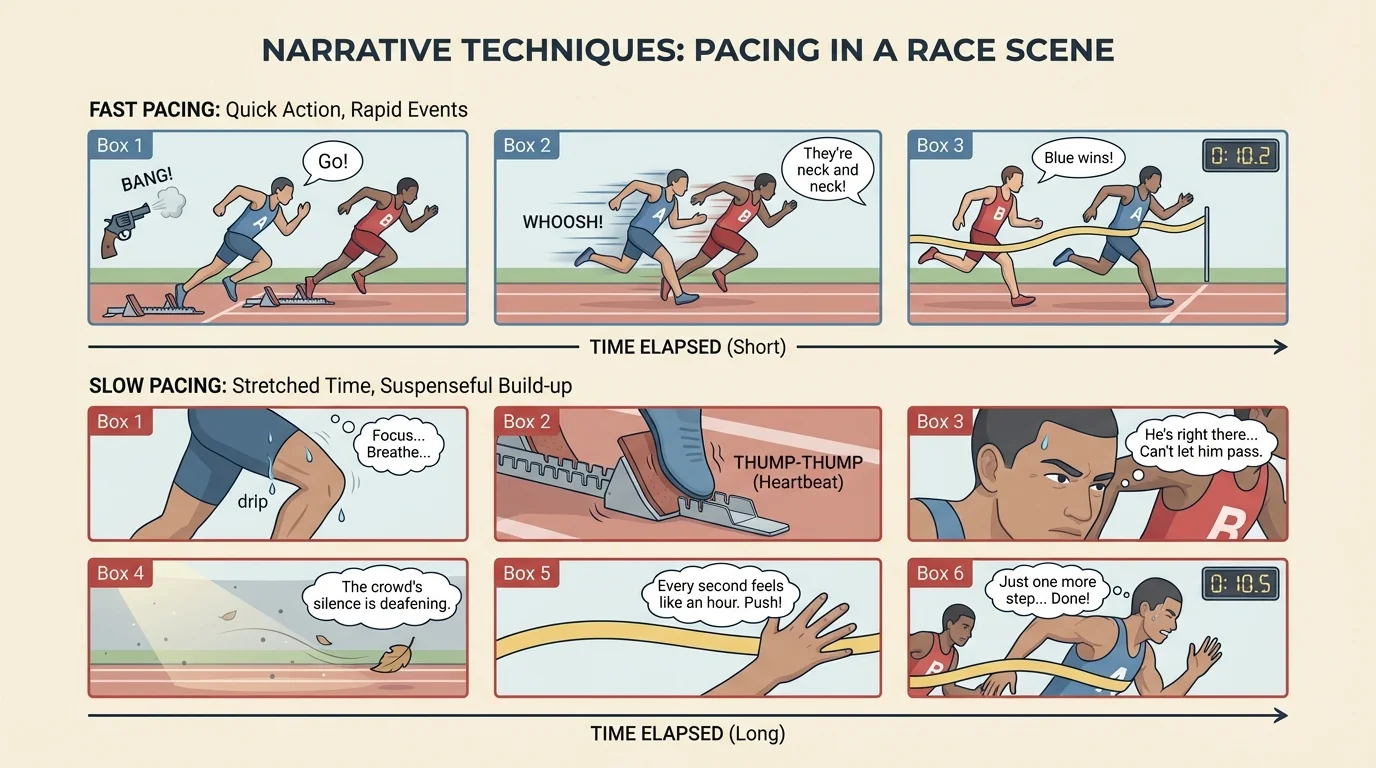
[Figure 2] Fast pacing is useful in action scenes, transitions, and moments when events happen quickly. Short sentences, fewer descriptive details, and quick shifts from one action to the next can create speed. For example: "The bell rang. Jordan grabbed his binder, dodged a backpack on the floor, and sprinted down the stairs." The reader moves rapidly through the scene.
Slow pacing is useful when a writer wants to build suspense, highlight emotion, or make a moment feel important. Longer sentences, more description, and close attention to small actions can stretch time. For example: "Jordan reached for the doorknob, but before his hand touched the metal, he heard voices on the other side. One laugh. Then silence." The moment feels tense because the writer slows it down.
One common pacing mistake is rushing through the most important part of the story. A student might spend a full paragraph describing breakfast and then give the main conflict only one sentence. Usually, the moment of decision, conflict, surprise, or change deserves more space than routine background actions.
How pacing shapes importance
Writers signal importance by the amount of attention they give a moment. When a scene slows down, readers understand that the details matter. When time jumps ahead, readers understand that the skipped material is less important to the central experience.
Pacing also helps create a logical event sequence. Readers should understand how one event leads to the next. Words and phrases such as later that afternoon, at first, meanwhile, after a long pause, and by the time can guide the reader through time clearly. These transitions are small, but they help a story feel organized rather than choppy.
The comparison in [Figure 2] shows that the same event can feel rushed or suspenseful depending on how many details the writer includes and where the writer pauses. Pacing is not just about speed. It is about emphasis.
Strong description helps readers picture the story world, but it does more than create an image. It can also reveal mood, deepen character, and prepare readers for what is coming next. Effective description uses specific details instead of vague ones. Compare "the room was messy" with "sneakers lay under the desk, three open notebooks covered the bed, and a half-finished model bridge leaned sideways on the windowsill." The second version lets readers see the room.
Writers often use sensory details to make scenes vivid. These details appeal to sight, sound, smell, taste, and touch. A crowded cafeteria might be described by the clatter of trays, the smell of pizza, the sticky tabletop, and the blur of backpacks moving between tables. Sensory language makes experiences feel immediate.
However, strong description is not the same as long description. Good writers choose relevant details. If a character is scared while walking into a basement, the description should focus on details that support that feeling: the weak light, the dust in the air, the creak of the stairs. Listing every object in the basement would not help as much.
Professional authors often revise by cutting descriptive details that are accurate but unimportant. A scene becomes stronger when each detail earns its place.
Description can also reveal character indirectly. If a narrator notices the exact condition of every machine in a robotics lab, readers may infer that the narrator is observant and interested in engineering. If another narrator notices only the flickering light and the exit sign, readers may infer anxiety or distraction. What a character notices tells us something about that character.
Characterization is the process of revealing a character's personality, motives, and traits. Writers can directly tell readers that a character is brave, impatient, or generous, but narratives are often more powerful when they show those qualities through dialogue, actions, pacing, and description.
Dialogue can reveal attitude. A character who answers with sarcasm sounds different from one who answers with caution. Pacing can reveal emotion. A scene may slow down around a character's difficult choice, showing that the choice matters deeply. Description can reveal habits, values, and mood. A student who carefully straightens every paper before speaking may seem controlled or anxious. A student who leaves muddy shoes by the door and laughs while apologizing may seem relaxed and informal.
Characters also become more believable when they respond to events in ways that make sense. If a character is usually calm but suddenly shouts, the narrative should provide enough context for the change. Development means that readers can trace how and why the character changes, not just notice that a change happened.
Example: showing character instead of only telling
Telling: Nia was determined.
Showing: Nia reread the instructions under the flickering library lamp, erased her design for the third time, and kept working even after the custodian rolled his cart past her table.
The second version gives readers evidence. They can infer determination from Nia's actions.
Character development also becomes stronger when the writer includes contradiction and complexity. A character can be brave in one situation and uncertain in another. A friend can be loyal but also jealous. These combinations make characters feel like real people instead of simple labels.
Strong narratives develop not only characters but also the experiences and events around them. Most narratives follow a clear sequence. The writer chooses where the story starts, how information is revealed, and which moment becomes the turning point.
A well-structured event sequence usually includes a beginning that introduces the situation, a rising action that builds tension or complication, a climax that brings the main conflict to its peak, and a resolution that shows the result. Not every narrative follows this pattern in exactly the same way, but readers still need a sense of movement and change.
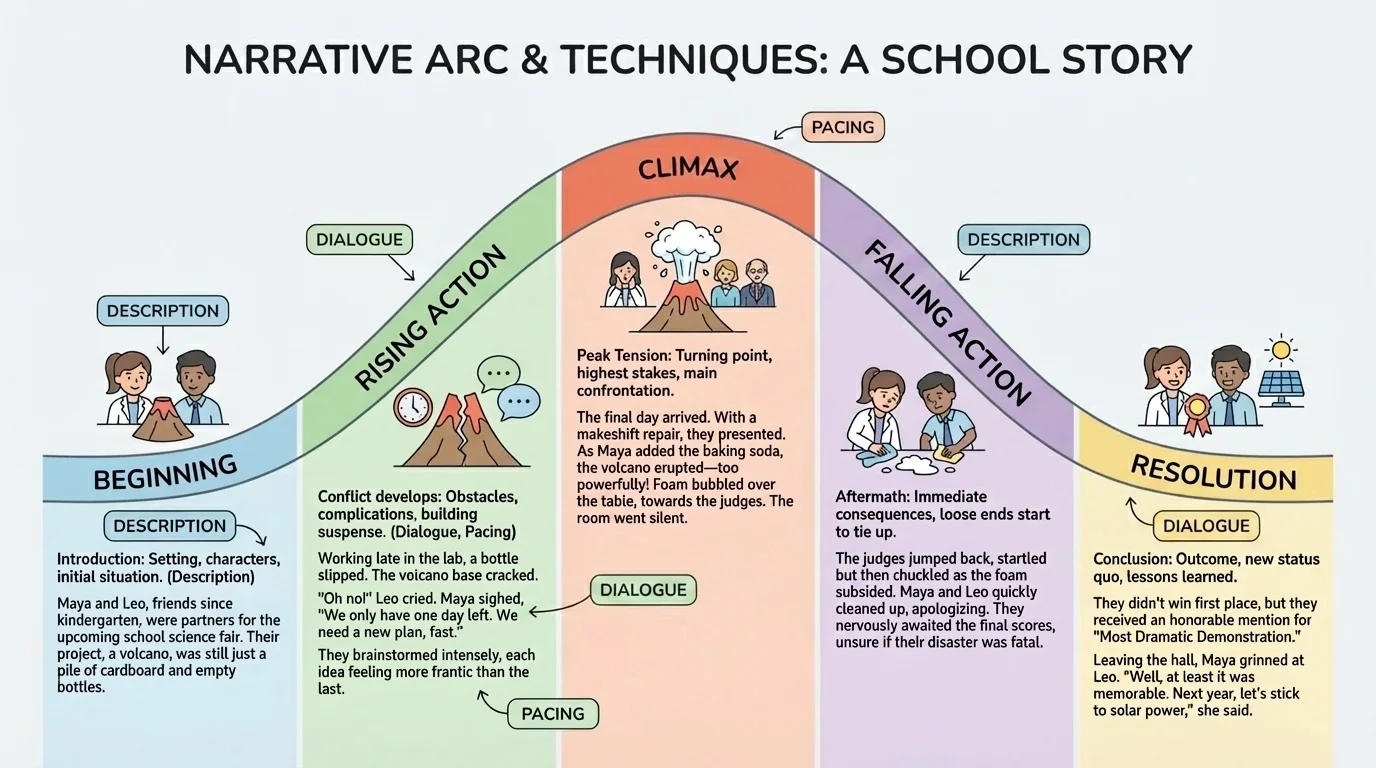
[Figure 3] For example, a narrative about a student giving a speech might begin with the announcement of the contest, build through preparation and self-doubt, reach a climax when the student steps onto the stage, and resolve with the speech's outcome and the student's new understanding. Each event should connect logically to the next.
Cause and effect are essential. If a character misses the bus, that should lead to a meaningful consequence. If two friends argue, the narrative should show what caused the argument and how it affects later scenes. Random events can confuse readers unless the story deliberately explains their purpose.
The arc in [Figure 3] remains useful even in short narratives because it helps writers decide which moments deserve the most detail. Usually, the climax and the events leading directly to it need the strongest pacing and the most vivid description.
One common mistake is too much explanation. When writers explain every feeling directly, readers have less room to infer meaning. Instead of writing "Eli was embarrassed," a writer might show Eli dropping his eyes, answering too quickly, or stuffing the graded paper deeper into his binder.
Another mistake is irrelevant detail. A detail is not automatically useful just because it is descriptive. If the story is about a tense piano audition, a long description of the hallway paint color may not matter unless it contributes to mood or meaning.
A third mistake is unnatural dialogue. Dialogue that sounds stiff or gives information characters already know can feel fake. For example, "Hello, my sister Ana, who is fourteen years old and has attended West Middle School for two years," does not sound like real speech. Writers should aim for dialogue that sounds believable and purposeful.
From earlier writing work, remember that a strong paragraph usually stays focused on one main idea. Narrative writing follows the same principle: each scene should center on a meaningful action, feeling, or change rather than trying to do everything at once.
Another problem is uneven pacing. If a major event is rushed while minor actions are stretched too long, the story feels unbalanced. Writers should ask: Which moment matters most? Which details help readers understand it? Which parts can be shortened?
Look at how these techniques can work together in a short passage:
By the time the final bell rang, the gym had gone strangely quiet. Serena stood behind the curtain, rubbing the chalk dust from her palms onto the sides of her jeans. On the other side, the judges shuffled papers. "You're up next," Mr. Salazar whispered. Serena nodded, but her throat felt too tight to answer. She peeked through the gap in the curtain and spotted her little brother in the third row, sitting so straight that his feet barely touched the floor. Suddenly the speech cards in her hand stopped feeling like paper and started feeling like a promise.
This passage uses description through details like the quiet gym, chalk dust, and shuffled papers. It uses dialogue in a short but meaningful line from Mr. Salazar. It uses pacing by slowing down the seconds before Serena steps out, making the moment feel tense and important. It also develops Serena's character by showing her nervousness and her sense of responsibility.
Analysis of the passage
Technique 1: The description focuses on details connected to Serena's emotions. The gym is not described in every possible way; only the details that build tension are included.
Technique 2: The line of dialogue is brief, but it moves the event forward and confirms that the big moment has arrived.
Technique 3: The pacing slows the scene by noticing Serena's small actions before she steps onstage. That makes readers feel the pressure with her.
Technique 4: Character is revealed through response. Serena does not announce, "I am nervous but determined." Her actions and thoughts let readers infer that.
When writers combine techniques well, a narrative becomes much more than a list of events. It becomes an experience the reader can follow, picture, and care about. That is the heart of effective narrative writing: selecting the right details, arranging events with purpose, and using language to bring people and moments to life.
"The strongest stories do not just tell readers what happened; they help readers feel why it mattered."
As narratives become more advanced, writers learn to make even small moments meaningful. A pause before a reply, the scrape of a chair on the floor, or a hand tightening around a note can carry emotion when placed carefully. Good technique is not decoration. It is the method by which a writer shapes meaning.
