A story can have exciting characters, strong dialogue, and vivid description, but if the reader cannot tell when or where things are happening, the whole narrative can become unclear. Transitions are the hidden guide rails of writing. They help readers move from one moment to the next, from one place to another, and from one scene to the next without getting lost. In narratives, that matters a lot, because stories depend on action unfolding in a clear and engaging way.
When writers tell a story, they are asking readers to travel through events in a certain order. Sometimes that order is simple: one thing happens, then another. Other times, a writer jumps backward to a memory, forward to a future moment, or across town to a new setting. Without clear signals, those shifts feel abrupt and confusing. With strong transitions, they feel natural.
Think about a movie scene that cuts from a basketball game to a player remembering last season's final shot. The audience understands the shift because the film gives clues through sound, visuals, or editing. In writing, the writer must create those clues with language. That is the job of transitions.
Transitions are words, phrases, or clauses that connect ideas and guide readers through a piece of writing. In narratives, transitions often show sequence, which is the order in which events happen, and they also signal shifts in time, place, mood, or focus.
Good transitions do more than glue sentences together. They shape the reader's experience. A fast series of transitions can speed up action. A slower, more detailed transition can make an important moment feel bigger. A well-chosen transition can even hint at mood, such as suspense, relief, or surprise.
Writers use several kinds of transitions. A single word can do the job, such as then, next, or later. A phrase can be more specific, such as at sunrise, a few minutes afterward, or on the other side of town. A clause can create an even smoother connection, such as when the final bell rang or after we crossed the bridge.
These different forms matter because they give writers flexibility. A single word is quick and efficient. A phrase adds detail. A clause can connect action and context at the same time. For example, compare these:
Word: Then, Maya opened the envelope.
Phrase: A few seconds later, Maya opened the envelope.
Clause: After her hands stopped shaking, Maya opened the envelope.
All three sentences move the reader forward, but each creates a different feeling. The last version does the most work because it shows both sequence and emotion.
When a narrative follows events in order, transitions act like signposts, helping readers track what happens first, next, and last in a simple chain of events. This is especially important in action scenes, personal narratives, and stories with several steps or stages.
[Figure 1] Common sequence transitions include first, next, then, soon, afterward, meanwhile, finally, and at last. These help the reader feel the movement of time. They are useful, but skilled writers also vary them so the writing does not sound mechanical.
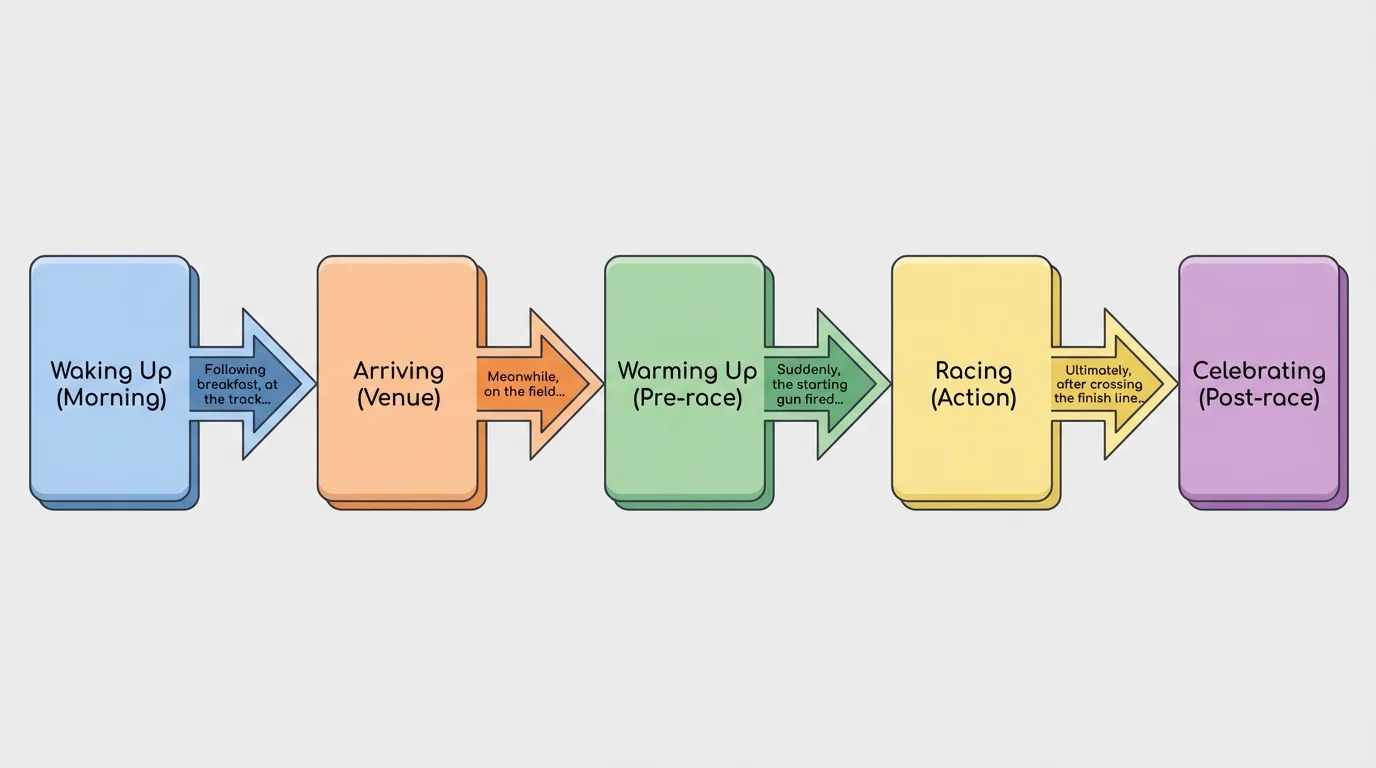
Here is a basic example:
I woke before sunrise. Then I pulled on my uniform. Next, I ran downstairs and grabbed my bag. After that, Dad drove me to the track. Finally, I heard my event called over the loudspeaker.
This version is clear, but it sounds repetitive because the transitions are too similar. Writers can improve it by mixing types of transitions and adding detail:
I woke before sunrise. A few minutes later, I pulled on my uniform and hurried downstairs. By the time Dad backed the car out of the driveway, I was already lacing my spikes. At the track, the cool air bit my face. Soon, my event was called over the loudspeaker.
The second version still shows sequence, but it sounds more natural. Notice that some transitions are short, while others are longer and more descriptive. That variety helps the writing flow.
Sequence transitions shape pacing. Short transitions such as then and next can make action move quickly. Longer transitions such as by the time the storm reached the hills or after we had searched for nearly an hour slow the pace slightly and let the writer add suspense, description, or emotion.
Later in a story, the same event chain remains easier to follow because the reader remembers the structure introduced earlier, much like the connected steps in [Figure 1]. That is why strong transitions are not just sentence tools; they help organize whole scenes.
Narratives do not always move straight ahead. Writers often shift to an earlier memory, jump ahead in time, or return to the present after a flashback. Those changes must be signaled clearly so the reader can follow the movement in time.
[Figure 2] Transitions for time shifts include phrases such as earlier that day, years before, back then, in that moment, the next morning, hours later, by nightfall, and when I was younger. These tell the reader exactly where the story is moving on the timeline.
A time shift becomes even clearer when the transition works together with verb tense and context. Read this example:
I stood at the bus stop, staring at the rain. Suddenly, I remembered last summer, when my cousin and I had danced through a storm without caring who saw us. Now, with my backpack growing heavier by the second, that memory felt like it belonged to someone braver.
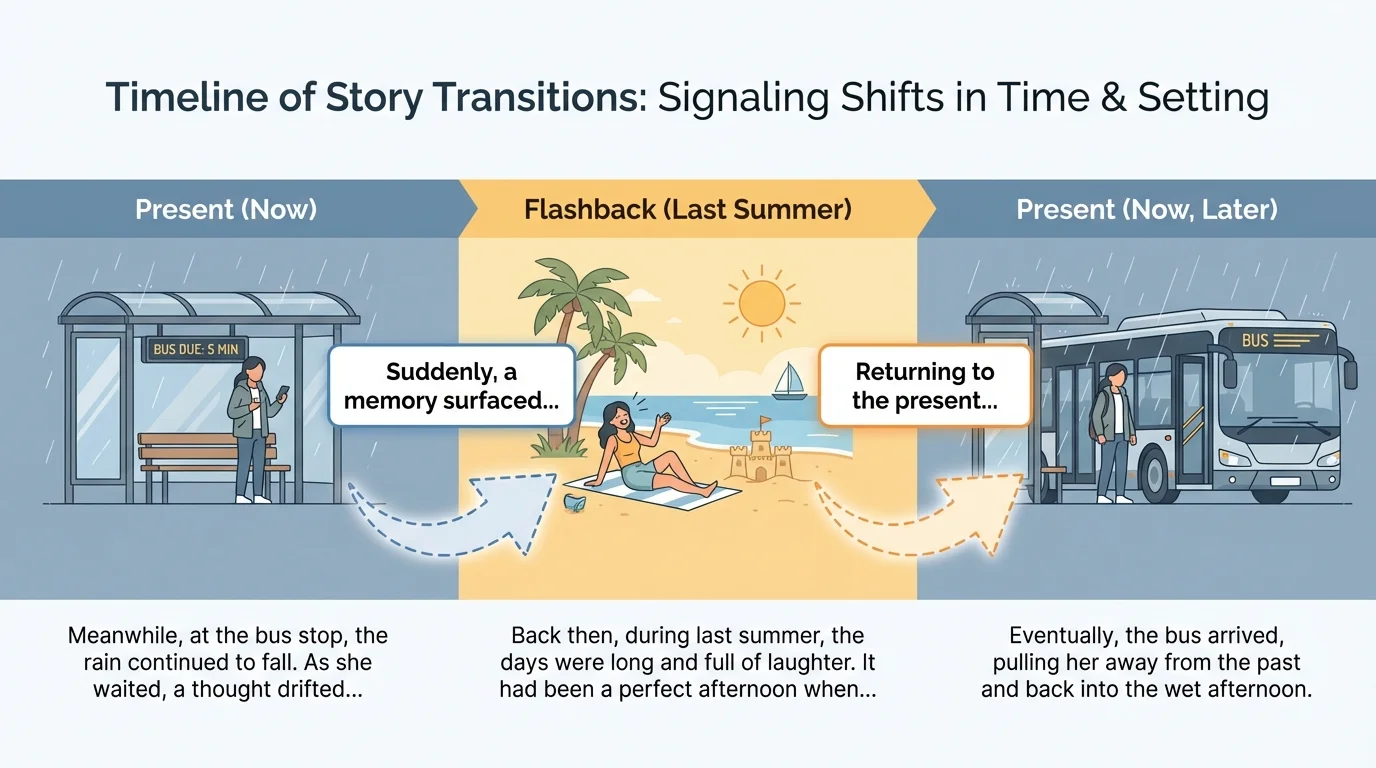
The phrase last summer signals the move into the past. The word Now signals the return to the present. Without those clues, the reader might not know whether the storm scene is still happening or whether the whole story has shifted.
Writers also use clauses to make time shifts smooth. For example: When the trophy caught the light, I was suddenly back in sixth grade. This kind of transition blends the present moment with a memory trigger. It feels more natural than a sudden jump.
Not every time shift has to be dramatic. Sometimes the writer simply needs to move the story forward. Phrases such as by lunchtime, later that week, or over the next few days can skip less important time and keep the narrative focused on the most meaningful events.
When you reread a narrative with several time changes, check whether each jump is easy to follow. The clear movement on the timeline in [Figure 2] is a useful model: readers should always know whether they are in the present, the past, or a later moment.
Modeling a weak and strong time shift
Weak version: I opened the old notebook. I was at the beach with my grandfather. I smiled and kept reading.
Step 1: Identify the problem
The middle sentence jumps into a memory without any signal, so the reader may think the story suddenly changed scenes for no reason.
Step 2: Add a transition that signals the shift
When I opened the old notebook, I was suddenly back at the beach with my grandfather. A moment later, I smiled and kept reading.
The improved version guides the reader into the memory and back out again.
Strong narratives often combine time transitions with sensory details. A memory might begin with the smell of chlorine, the squeak of old shoes on a gym floor, or the sharp sting of winter air. Those details make the shift vivid instead of mechanical.
Stories also move through places. A character may leave a classroom, enter a crowded hallway, and later end up at a quiet kitchen table. Those place changes need clear signals so the reader can picture the action accurately and follow the movement from one setting to another.
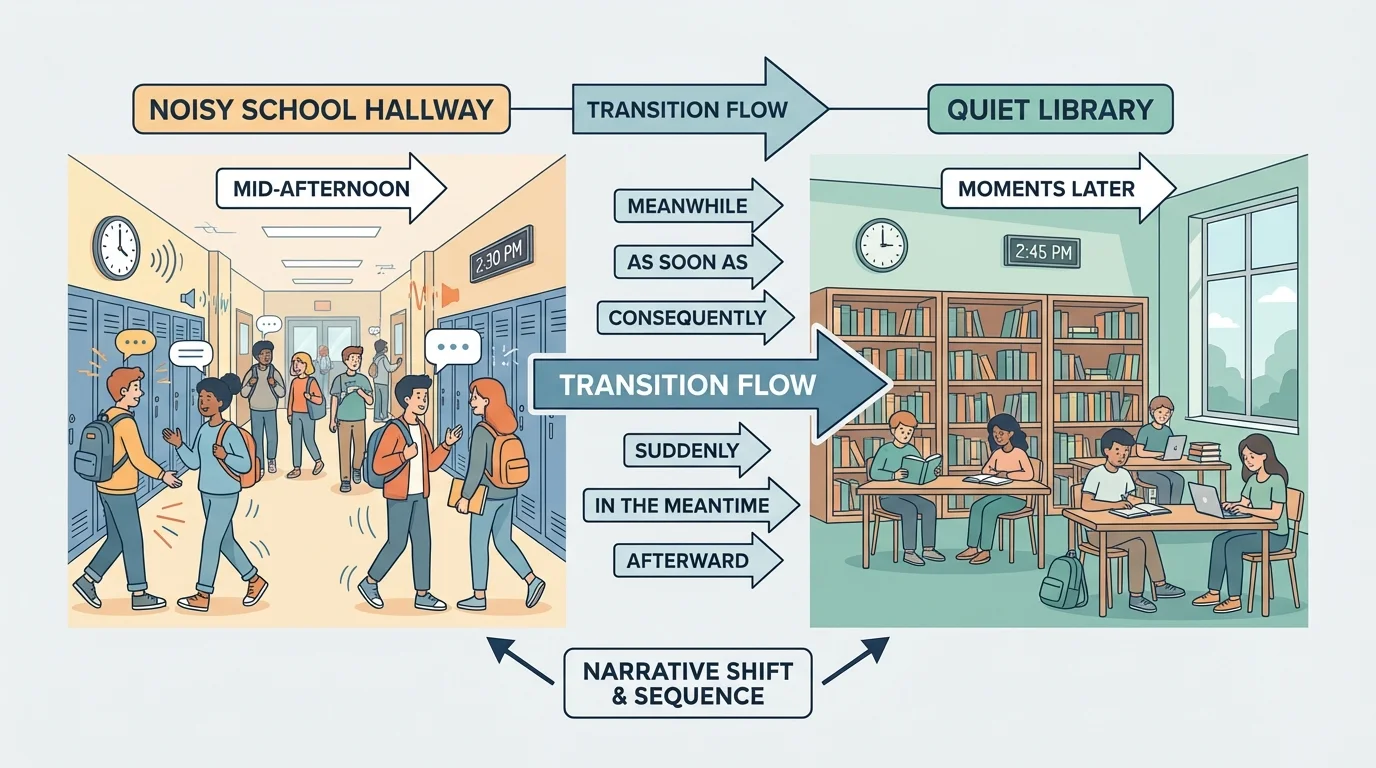
[Figure 3] Setting transitions can be direct, such as across the street, inside the gym, at the far end of the hallway, back at home, or on the roof. They can also be woven into clauses, such as when we stepped into the library or after the bus turned onto our block.
Compare these two versions:
Jalen left science class. People were whispering. He saw Ava at a table.
Jalen left science class and joined the river of students pouring into the hallway. A minute later, he slipped through the library doors, where the noise faded at once. Near the back windows, Ava sat alone at a table.
The second version tells the reader exactly where Jalen is at each stage. The transition A minute later signals time, while through the library doors and Near the back windows signal place. Time and setting often work together.
Clear setting shifts are especially important in longer narratives with several scenes. If a reader has to stop and ask, "Wait, where are they now?" the story loses momentum. The change from hallway to library in [Figure 3] shows how even a simple move becomes easier to follow when the writer names the new location quickly and precisely.
Film directors use visual transitions such as cuts, fades, and camera movement to guide viewers between scenes. Writers do the same kind of work with words, helping readers "see" changes in time and place without actual images.
Setting transitions can also affect mood. Moving from a bright soccer field to a dim locker room changes the emotional feeling of a scene. A transition can prepare the reader for that shift: By the time we reached the locker room, the cheers from the field had faded into a heavy silence.
Not all transitions fit every moment. If every sentence starts with then, the writing sounds flat. If every transition is long and dramatic, the writing can feel overloaded. Strong writers choose transitions based on what the moment needs.
A fast action scene may use brief transitions: Then, seconds later, at once. A reflective memory may use slower, more descriptive transitions: Years earlier, back when the house still smelled like cedar, before everything changed. A mysterious scene may use transitions that create suspense: Just as I reached the gate, moments before dawn, in the silence that followed.
| Type | Example | Best Use |
|---|---|---|
| Word | then, soon, finally | Quick, simple movement |
| Phrase | an hour later, at the edge of town | Clear detail about time or place |
| Clause | after the lights went out, when we reached the station | Smoother, more descriptive connection |
Table 1. A comparison of transition types and their best uses in narrative writing.
Writers should also think about voice. A serious narrative may use more natural, precise transitions. A humorous story might use playful transitions. The key is that the transition should feel as if it belongs in that story.
Transitions do not belong only at the start of sentences. They can appear in the middle or near the end, where they often sound more natural. For example: The crowd grew quiet as the singer stepped forward. Moments later, the first note rose through the auditorium. The transition fits smoothly into the paragraph instead of announcing itself too loudly.
Paragraph transitions matter, too. If one paragraph ends with a character racing through the rain and the next begins inside a warm kitchen, the opening of the new paragraph should signal that shift: By the time Elena pushed through her front door, her sleeves were soaked. That one line connects the scenes and orients the reader.
Dialogue can also work with transitions. A character might speak, and the next sentence can move time or place forward: "Don't be late," my brother called. Ten minutes later, I was still searching for my missing keys. The transition helps the conversation lead into action.
Strong narratives already use description, sensory details, dialogue, and logical pacing. Transitions connect all of those techniques. They help a writer decide not only what happens, but how the reader experiences the movement from moment to moment.
One useful habit is to read your narrative as if you are a first-time reader. At every new sentence or paragraph, ask two questions: When is this happening? and Where is this happening? If the answer is unclear, you may need a better transition.
One common mistake is overusing the same transition. A paragraph filled with then, then, then sounds repetitive. Fix this by varying your language and using more specific phrases or clauses.
Another mistake is using transitions that are too vague. Words like later may be fine sometimes, but they do not always tell enough. Later that afternoon or three days later gives the reader a clearer picture.
A third mistake is making a shift without any signal at all. If the story jumps from a present argument to a childhood memory, or from the soccer field to the hospital waiting room, the reader needs a clear transition to follow that movement.
Writers also sometimes use transitions that do not match the logic of the story. For example, meanwhile suggests that two things happen at the same time. Finally suggests a last event. If the transition does not match the actual relationship, the sentence becomes confusing.
Fixing repetitive and unclear transitions
Weak version: Then Marcus got on the bus. Then he sat down. Then he saw the envelope. Then he remembered his sister's warning.
Step 1: Replace repeated words with more precise transitions
Marcus got on the bus and dropped into the first empty seat. As the doors hissed shut, he noticed the envelope beside his backpack.
Step 2: Signal the mental shift clearly
At once, he remembered his sister's warning from that morning.
The revised version sounds smoother, avoids repetition, and makes the memory shift clear.
Another problem appears when transitions are forced into every sentence. Not every line needs one. If the order is already obvious, too many transitions can make the writing sound unnatural. Good writing balances clarity and flow.
Consider this short scene:
Before dawn, Lena slipped out of bed and crept toward the porch. Outside, the air smelled like wet grass and wood smoke. A few minutes later, she reached the shed behind her grandfather's house. When she pulled the door open, she froze. Hanging from a nail on the back wall was the same red lantern she had seen in her dream the night before.
This passage uses transitions to guide the reader through time and place. Before dawn sets the time. Outside shifts the setting. A few minutes later moves the action forward. When she pulled the door open introduces the next moment smoothly.
Now look at an example with a flashback:
Coach Ramirez handed Noah the medal without smiling. As Noah turned it over in his palm, he was suddenly back in the hospital room from two months earlier, listening to his brother whisper, "Win one for both of us." Now, under the glare of the stadium lights, the medal felt heavier than gold.
The clause As Noah turned it over in his palm connects the present to the memory. The phrase from two months earlier places the flashback in time. The word Now returns the reader to the present.
Here is an example of a setting shift in a longer scene:
The cafeteria buzzed with voices, trays clattering and sneakers squeaking against the floor. After lunch, Priya escaped upstairs to the art room, where the smell of paint and clay replaced the sour scent of French fries. Near the windows, she found the sketchbook she had hidden behind a stack of cardboard.
The transition After lunch moves time forward, and upstairs to the art room moves the reader to a new location. Because both shifts are clear, the reader can focus on the story itself.
When writers control sequence and shifts well, readers stay immersed. They are not busy untangling the timeline or guessing the setting. Instead, they can pay attention to character, tension, and meaning.
"The right transition does not just connect sentences. It guides the reader's mind."
That idea is especially important in narrative writing. A transition should not feel like a random attachment. It should feel like the exact bridge the reader needs at that moment.
