A movie can spend millions of dollars creating a thrilling chase or a tense storm scene. A writer works only with words. That is what makes strong narrative writing so powerful: the right word can make readers hear footsteps, smell smoke, or feel panic rising in a character's chest. When writers choose carefully, they do more than report what happened. They make the experience feel real.
When you write a narrative, your job is not just to recount events in order. Your job is to help readers see, hear, and feel those events. That happens through exact language, clear detail, and description that matters. A vague story may explain the basic plot, but a vivid story pulls the reader into the moment.
Precise language means choosing words that say exactly what you mean. Instead of using broad, blurry words like nice, bad, went, or thing, writers select words with sharper meaning. Compare these two sentences:
The dog went across the yard.
The muddy terrier darted across the yard.
The second sentence gives readers more. They learn the kind of dog, something about its appearance, and the way it moves. The verb darted is more energetic than went. The adjective muddy adds a quick visual detail. Precision makes writing stronger because every word carries information.
Precise language uses exact words and phrases that clearly communicate an image, action, or feeling. Descriptive details are specific pieces of information that help readers picture and understand a scene, character, or event. Sensory language appeals to the senses so readers can imagine what something looks, sounds, smells, feels, or tastes like.
In narratives, word choice also shapes mood. A character can walk, shuffle, stomp, pace, or drift. Each verb suggests a different feeling and situation. The action may be similar, but the effect on the reader changes.
Writers often improve a sentence not by making it longer, but by making it sharper, as [Figure 1] shows through side-by-side comparisons of weak and strong wording. Precision often begins with nouns and verbs. Specific nouns are clearer than general ones, and active verbs are usually stronger than forms of is, was, or went.
Look at these revisions:
Vague: The girl had something in her hand.
Precise: The girl clutched a cracked phone in her hand.
Vague: The weather was bad.
Precise: Freezing rain slashed against the windows.
Notice that precise writing is not about stuffing in as many adjectives as possible. It is about choosing the right details. One exact noun or one strong verb can do more work than three weak describing words.
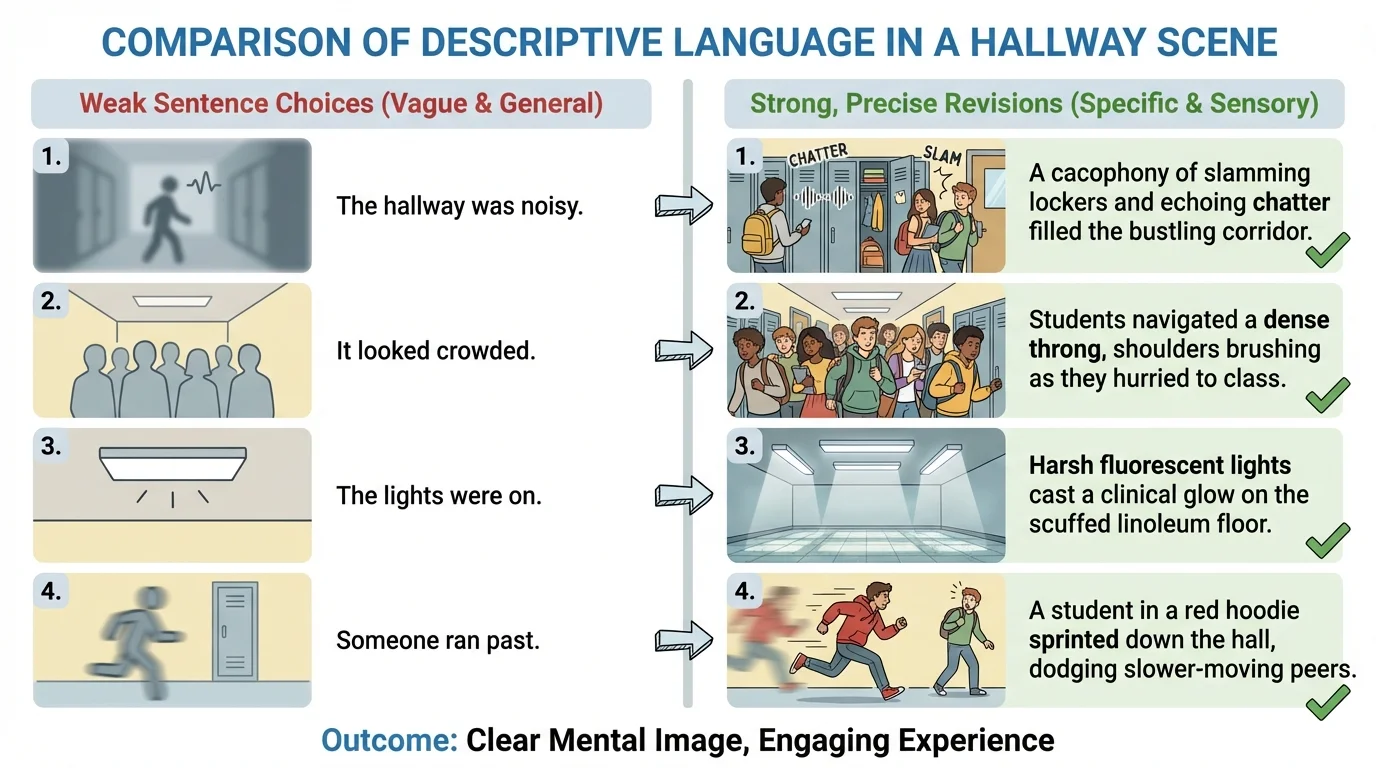
Writers also use precise word choice in phrases. A phrase like the old house gives some information, but the sagging house with boarded windows gives a more exact image. Precision helps readers build a mental picture without confusion.
Sometimes students think precise writing must sound fancy. It does not. The best word is not always the longest one. A simple word like snapped can be better than a more complicated but weaker phrase like made a sudden sound. Good narrative writing values clarity and effect.
Descriptive details help readers understand the important parts of a scene. These details can describe setting, appearance, movement, objects, weather, or small changes that reveal emotion. The key word is relevant. Details should support the scene, not distract from it.
Suppose you are writing about a student waiting outside the principal's office. You do not need to describe every tile on the floor or every poster on the wall. You should choose details that fit the moment: the buzzing fluorescent lights, the untouched hall pass, the student tapping a sneaker against the chair leg, the clock ticking too loudly. These details match the tension of the event.
Description has a job
Strong description is not random decoration. It helps create mood, reveal character, or focus attention on an important event. If a detail does not help the reader better understand the experience, it may not belong in the scene.
Relevant details can also reveal a character indirectly. Instead of writing, Marcus was nervous, a writer might describe Marcus rubbing his palms on his jeans, reading the same text message three times, and glancing at the door every few seconds. The reader understands the emotion through behavior.
This technique is often known as showing rather than merely telling. Telling is not always wrong; sometimes it moves the story along efficiently. But important moments usually become stronger when readers can observe clues for themselves.
[Figure 2] Sensory language helps readers experience a scene through the five senses and shows how one setting can include details of sight, sound, smell, touch, and taste. When you add sensory details, you turn a general description into a lived moment.
The five senses are:
Not every scene needs all five senses. In fact, forcing all five into one paragraph can feel unnatural. Effective writers choose the senses that matter most in that moment.
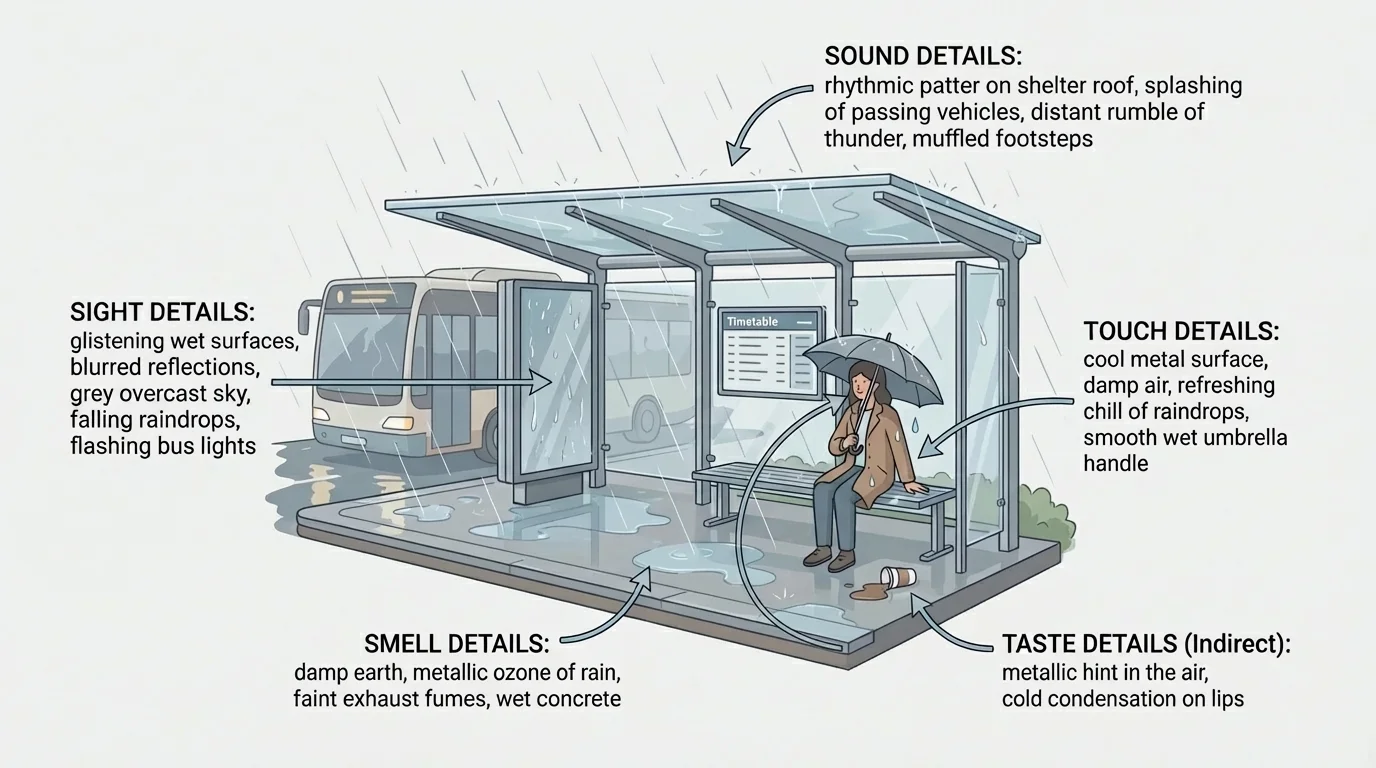
Consider this plain sentence: We waited for the bus in the rain.
Now consider this version: We huddled under the bus stop roof while cold rain drummed on the metal above us. My sleeves clung to my arms, and the air smelled like wet pavement and gasoline.
The second version gives sensory information through sound, touch, and smell. It helps the reader step into the setting. The details are also relevant because they support the discomfort and mood of waiting in bad weather.
The sense of smell is strongly connected to memory. That is one reason a brief smell detail in a narrative can make a scene feel especially real and emotional.
Sensory language also works in quieter scenes. A family kitchen might include the hiss of onions in a pan, the warmth of the oven against your face, and the sharp smell of garlic. A basketball gym might include squeaking sneakers, the echo of bouncing basketballs, and the sting of sweat in your eyes. Different settings invite different sensory choices.
Later in a narrative, the same setting can feel different depending on sensory details. A hallway before a game might vibrate with noise and energy. The same hallway after a loss might feel hollow and too bright. As with the rainy bus stop in [Figure 2], sensory details do more than decorate; they guide emotion.
Action scenes depend on movement, and movement depends on language. As [Figure 3] illustrates, strong verbs and sentence length work together to control pacing. If your verbs are weak, the action can feel slow or blurry even when something exciting is happening.
Compare these examples:
Weak: He went down the stairs and looked behind him.
Stronger: He pounded down the stairs and glanced over his shoulder.
Weak: The branch hit the window.
Stronger: The branch slammed against the window.
Pacing is the speed at which a story feels like it is moving. Writers can slow pacing to build suspense or speed it up to create urgency. Longer sentences with layered detail often slow a moment down so readers notice what matters. Shorter sentences can make action feel immediate.
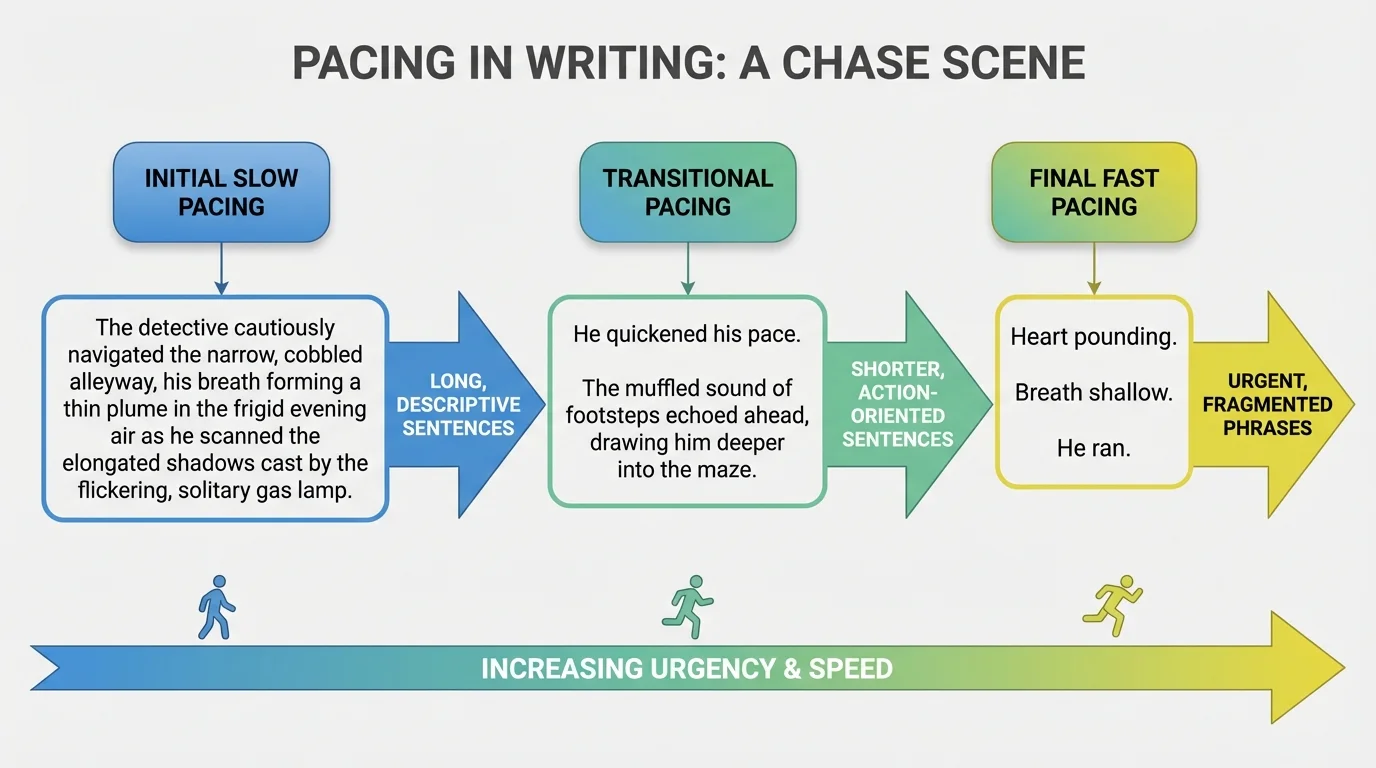
For example, a suspenseful moment might begin with careful description: The doorknob turned a fraction at a time, scraping softly against the metal plate. Then, when the danger bursts in, the sentences may shrink: The door flew open. Nora ran. Something crashed behind her.
Effective action writing is not only about speed. Readers need to understand what is happening. If every sentence is short and chaotic, the scene becomes confusing. Strong narratives balance clarity with excitement.
Revising an action sentence
Original sentence: The boy went quickly to the fence and got over it.
Step 1: Replace weak verbs.
Went quickly becomes sprinted, and got over becomes vaulted.
Step 2: Add one relevant detail.
The fence can become the chain-link fence, which gives a clearer image.
Step 3: Put it together.
Revised sentence: The boy sprinted to the chain-link fence and vaulted over it.
The revision is shorter than many weak descriptions, but it creates a sharper and more energetic image.
When writers return to a high-action scene later, the same principles still apply. The chase pattern in [Figure 3] reminds us that pacing changes inside a scene, not just between scenes.
Readers connect more deeply to narratives when emotions are shown through action, dialogue, and detail. Instead of writing Elena was embarrassed, you might write: Elena felt heat rush into her cheeks. She stared at her notebook and laughed a second too late, hoping no one had noticed.
Dialogue can also help reveal experience. What a character says, avoids saying, or says in a certain tone can add emotional depth. For example:
"I'm fine," Jamal said, yanking his backpack zipper so hard it split open.
The words say one thing, but the action suggests another. This gives the scene more complexity and realism.
Writers also use body language and setting details to support emotional moments. A shaky hand, a cracked voice, a hallway that suddenly feels too narrow, or a crowd that sounds far away can all deepen the reader's understanding of what a character is experiencing.
One of the hardest parts of narrative writing is deciding what to include and what to leave out. Strong writers do not describe everything. They choose details that fit the purpose of the scene.
If the moment is tense, choose details that increase tension. If the moment is joyful, choose details that support energy, warmth, or relief. If the scene is told from one character's point of view, describe what that character would notice. A nervous student in a new school might notice the loud lockers, unfamiliar faces, and room numbers. A basketball player late for practice might notice open space in the hall and the time flashing on a wall clock.
| Type of Detail | Useful When It... | Less Effective When It... |
|---|---|---|
| Visual detail | Helps readers picture something important | Lists too many unimportant objects |
| Sensory detail | Builds mood or realism | Feels forced or unrelated to the event |
| Action detail | Shows character emotion or movement | Repeats what readers already know |
| Dialogue detail | Reveals conflict, personality, or tension | Explains too much in an unnatural way |
Table 1. A comparison of effective and ineffective uses of narrative detail.
Relevant detail also depends on importance. A major turning point deserves more space and richer description than a minor transition. Writers often move quickly through less important moments and slow down when the scene matters most.
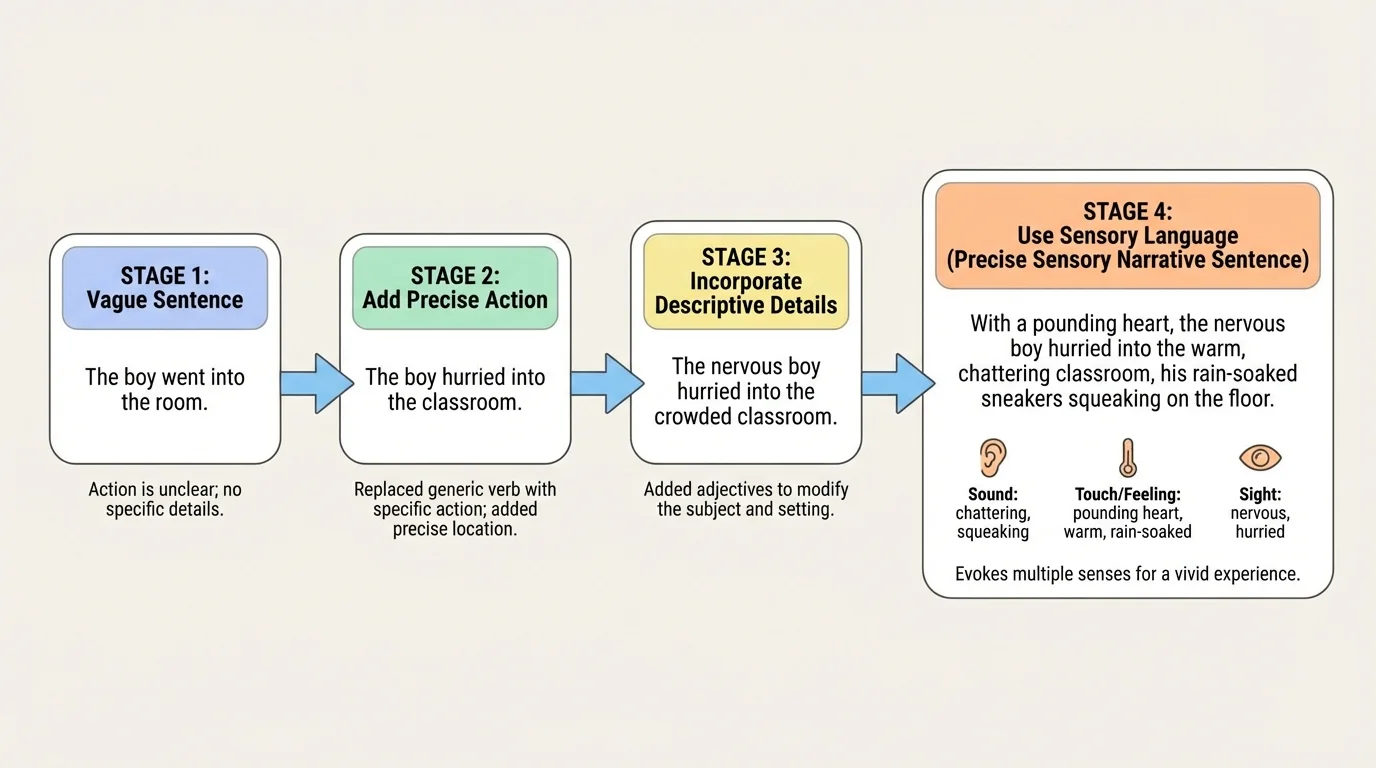
[Figure 4] First drafts often contain general words because writers are trying to get ideas down. Revision is where the writing becomes vivid. Revising for precision often happens in clear stages: identify weak spots, replace vague language, and sharpen the sentence's effect.
During revision, ask questions such as: What exactly does this look like? What is the character doing with their body? What would someone hear in this moment? Is this detail important? Is there a stronger verb? Can I replace a general word with a specific one?
Here are some common revision moves:
Revision is not just fixing grammar. It is re-seeing your writing. You are making choices about clarity, impact, and what the reader experiences.
For example, consider this draft sentence: It was scary in the woods. A stronger revision might be: The trees crowded close on both sides of the trail, and every crack of a branch made my stomach tighten. The revision does not label the feeling as scary. It creates the feeling through image and physical reaction.
The revision process in [Figure 4] also shows that good writing often grows by small changes. One stronger verb, one sharper noun, and one relevant sensory image can transform a sentence.
When precise language, descriptive detail, sensory language, action, and emotion work together, a narrative scene becomes much more effective. Read this passage and notice how the techniques support one another:
Model narrative passage
The warning bell rang just as Ava reached the science wing. She tightened her grip on the poster tube and sprinted the last few yards, her shoes squeaking against the polished floor. Room 214 stood open, bright with fluorescent light, and twenty faces turned toward her at once. Heat crawled up her neck. One corner of the poster had bent in the rain, and a drop of water slid onto her wrist as she stepped inside. "Nice timing," her partner whispered, half joking, half panicked. Ava forced a breath into her lungs, smoothed the damp paper, and faced the class.
This short passage uses precise verbs such as tightened, sprinted, turned, and smoothed. It includes relevant sensory details like the squeaking shoes, fluorescent light, heat in her neck, and water on her wrist. The details are not random; they all support the pressure of arriving late to present.
The passage also shows emotion rather than simply naming it. Instead of saying Ava was nervous, the writing shows her physical reactions and the way she moves. Even the brief dialogue adds tension because it reveals what the moment feels like for the characters.
Strong narratives are built from choices. Each exact word, each useful detail, and each sensory image helps shape the reader's experience. When writers choose with purpose, scenes stop sounding flat and start feeling alive.
