Have you ever read a story that seemed powerful until the last few lines, and then it just... stopped? A narrative can have vivid description, realistic dialogue, and exciting events, but if the ending feels rushed or random, the whole piece becomes weaker. A strong ending does more than tell the reader that the story is over. It helps the reader understand why the experience mattered.
When writers create narratives about real or imagined experiences, they need a conclusion that follows from the events and also reflects on them. That means the ending should make sense based on what happened, and it should give the reader a final thought, feeling, or understanding. The conclusion does not need to be dramatic. In fact, some of the best endings are quiet, honest, and simple.
In a narrative, the ending is the moment when the writer steps back slightly and lets the reader see the meaning of the experience. Sometimes the narrator has changed. Sometimes a relationship is different. Sometimes the event seems small, but the lesson or emotion lasts. An effective ending leaves the reader with the feeling that the story has reached a true stopping point.
A conclusion is the reader's last contact with the story. It shapes the final impression. If the ending matches the tone and events of the narrative, the story feels complete. If it does not match, the reader may feel confused, disappointed, or even tricked.
Think of a narrative like a path. The beginning opens the path, the middle develops the experience, and the ending brings the reader to a destination. That destination should not feel like a sudden jump to a different road. If a story is about a student finally speaking up during a difficult team project, the conclusion should connect to that moment of courage. It should not suddenly switch to a lecture about all students in the world needing confidence.
Conclusion is the ending of a piece of writing that brings the narrative to a close. In a strong narrative, the conclusion grows naturally from the events and gives the reader a sense of meaning, feeling, or change.
Reflection is thoughtful looking back on an experience in order to understand it better. In narrative writing, reflection often appears in the conclusion.
For students learning narrative writing, one of the most important skills is understanding that an ending is not just a final sentence. It is a final effect. It answers the reader's natural question: "So what did this experience mean?"
A strong narrative conclusion grows out of the story's earlier moments, as [Figure 1] shows through the movement from events to consequence and reflection. It does not come from nowhere. Instead, it connects the beginning, middle, and climax to a final understanding.
One job of the conclusion is to show the result of the events. What changed because of what happened? Maybe the narrator learned to trust someone. Maybe the narrator realized a mistake. Maybe nothing in the outside world changed much, but the narrator's thinking did. Readers want to feel that the events led somewhere.
Another job of the conclusion is to create emotional closure. The story might end with relief, regret, hope, pride, disappointment, or peace. The exact emotion depends on the story. A funny story may end with a light touch. A serious story may end with a thoughtful tone. The key is that the feeling should fit what came before.
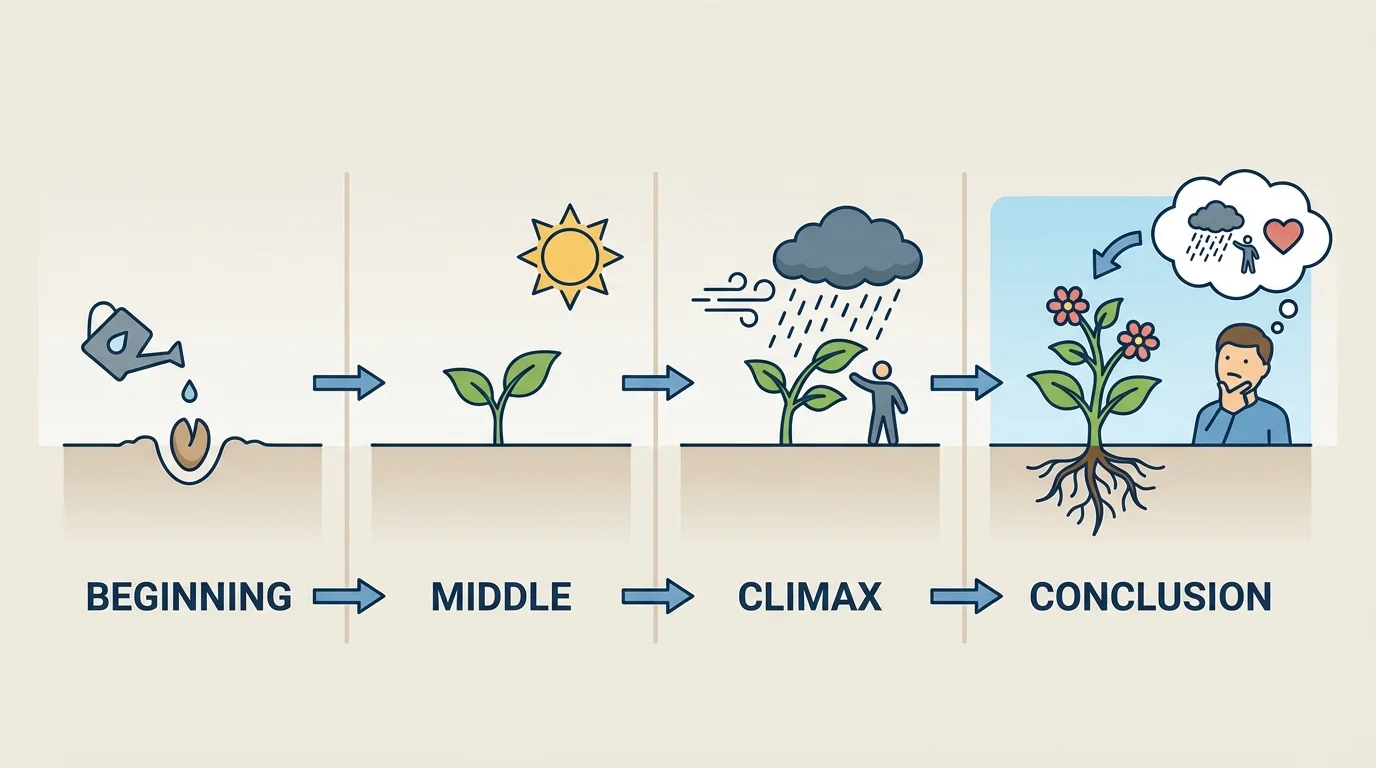
A conclusion can also reveal insight. Insight is a deeper understanding that comes from experience. In narratives, insight often appears when the narrator realizes something about self, other people, or life. This does not mean every story needs a giant lesson. Sometimes the insight is small but meaningful, such as understanding why a grandparent repeats a story or realizing that losing one game does not define an athlete.
Notice that strong conclusions usually do not repeat the whole plot. Readers already know what happened. The ending should move forward into meaning, not backward into a summary.
Professional writers often revise endings many times. An ending may be only a few lines long, but those lines carry a lot of weight because they shape the reader's final memory of the story.
Later in the piece, a writer may still rely on the same structure shown in [Figure 1]: event leads to consequence, and consequence leads to reflection. That pattern helps keep the conclusion connected to the narrative instead of making it feel pasted on.
A conclusion must make sense based on the story's event sequence. This means the ending should fit the order of events, the characters' actions, and the mood the story has built.
If a narrative describes a tense bike race in which the narrator falls, gets back up, and finishes last, a fitting conclusion might focus on determination, embarrassment, or a new understanding of success. An unfitting conclusion would be something unrelated, such as the narrator suddenly deciding to become a chef because of the race. That idea has not been prepared by the story.
Writers sometimes weaken their endings by adding a lesson that was never part of the actual experience. For example, after a story about getting lost on a field trip, the writer might end with, "That is why all humans must learn geography to survive in modern civilization." That sounds exaggerated and disconnected. A more believable ending would stay closer to the lived moment: perhaps the narrator feels relief, laughs later about the mistake, or becomes more careful.
To make sure the conclusion follows from the events, ask these questions:
These questions help the writer stay grounded in what actually happened in the narrative. They prevent the ending from drifting away from the story's core.
To reflect means to look back and think carefully. In narrative writing, reflection often appears near the end because the narrator now understands the experience differently than in the moment when it happened.
Reflection can be direct or indirect. A direct reflection clearly states what the narrator realized: "I had spent all week trying to impress everyone, but crossing the stage, I only looked for my mother in the crowd." An indirect reflection shows meaning through image, action, or small detail: "When I got home, I set the medal on the kitchen table beside the grocery list she had written that morning." The second version does not explain everything, but it still suggests what matters.
Reflection is not the same as a moral. A moral is a general lesson, often stated broadly, like a message in a fable. Reflection is more personal and specific. It grows from the narrator's experience. Instead of saying, "Always believe in yourself," a reflective ending might say, "For the first time, I heard my own voice before I heard the crowd." That line stays inside the story while still revealing meaning.
Good reflection sounds honest. It fits the narrator's age, voice, and personality. A seventh-grade narrator should not suddenly sound like a philosopher writing a speech. The language should still feel like the same person who told the story.
Reflection can focus on several things:
Even a fast-paced narrative can include reflection. The writer may only need one or two strong sentences. Reflection does not mean slowing the story too much. It means helping the reader see the lasting effect of the experience.
[Figure 2] shows several common conclusion patterns. Writers can choose different styles of endings depending on the story's purpose and tone. There is no single correct formula, but there are several effective approaches.
Here are some common types:
| Type of conclusion | What it does | Example effect |
|---|---|---|
| Circular ending | Connects back to an image, phrase, or idea from the beginning | Makes the story feel complete |
| Reflective ending | Shows what the narrator learned or understood | Leaves the reader thinking |
| Action ending | Ends with a final action that suggests meaning | Keeps the story vivid and active |
| Dialogue ending | Uses final spoken words to reveal emotion or change | Feels realistic and immediate |
| Future-looking ending | Hints at what the narrator will do or think next | Shows continuing impact |
Table 1. Common types of narrative conclusions and the effect each one can create.
A circular ending is especially powerful when the beginning includes a memorable image. If a story opens with a narrator avoiding the deep end of a pool, the conclusion might return to the pool image in a changed way. That return shows growth without saying too much.
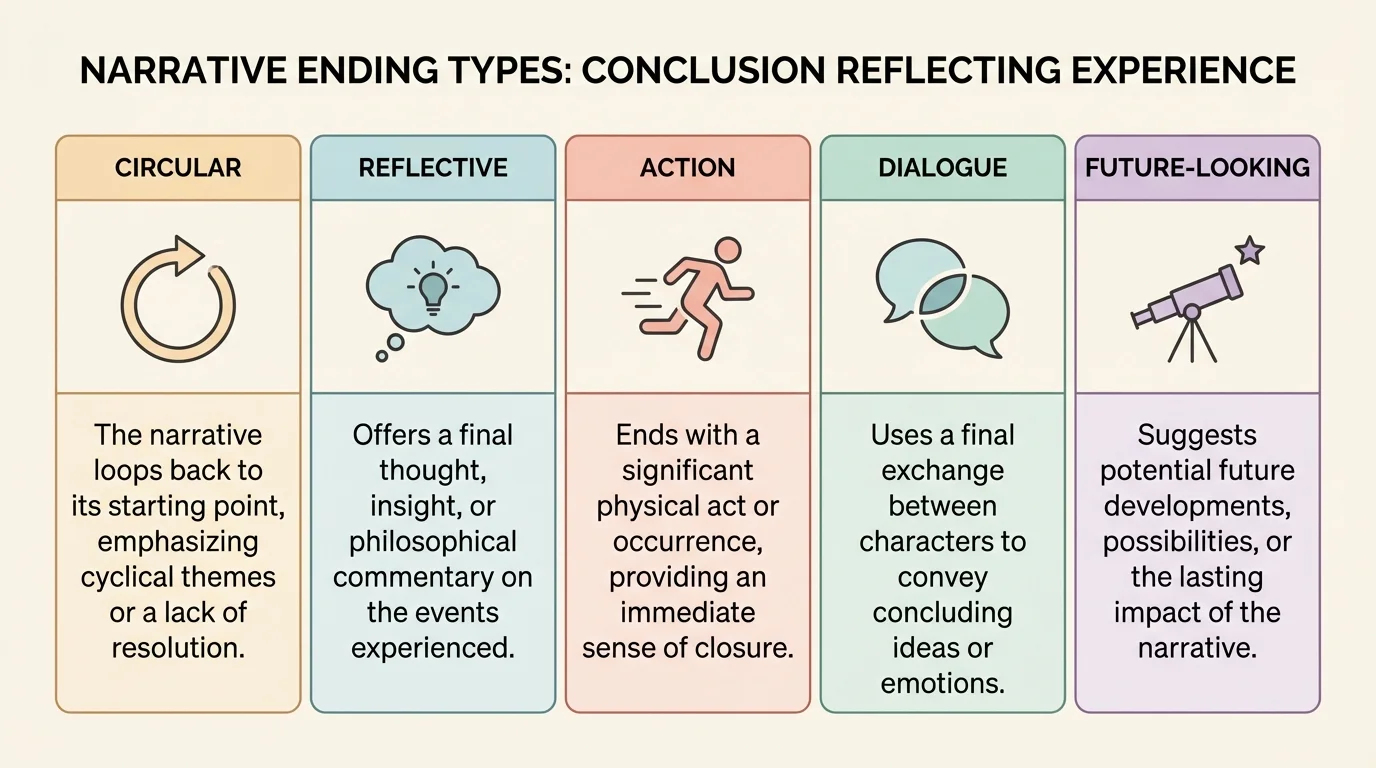
A reflective ending works well for personal experiences, especially when the event changed the narrator's thinking. A dialogue ending can be effective if the spoken words feel natural and reveal something important. A future-looking ending is useful when the event influences what comes next, such as deciding to try out again next season or planning to apologize.
The comparison also shows that these types can overlap. A conclusion may be both reflective and circular, or both action-based and future-looking. Good writing is flexible.
Knowing what not to do can help writers create stronger conclusions. Some weak endings appear often in student writing.
One weak ending is the sudden stop. This happens when the story ends right after the action, with no sense of meaning or effect. For example, "I crossed the finish line. The end." That tells what happened, but it does not help the reader feel why the moment mattered.
Another weak ending is the unearned lesson. This is when the writer adds a big statement that the story did not support. For example: "And that is why kindness is the most powerful force in the universe." If the narrative has not built toward that idea, the ending feels fake.
A third weak ending is the over-explained ending. In this kind of conclusion, the writer repeats every emotion and lesson in too much detail. Readers do not need every meaning spelled out. Trusting the reader is part of strong writing.
A final weak ending is the fake suspense ending in a story that should actually conclude. For example: "But little did I know, everything was about to change..." If the narrative is not part of a longer piece, this can feel like a movie trailer rather than a true ending.
A narrative is built from a sequence of events, not just isolated details. The conclusion should connect to the central conflict, experience, or turning point developed earlier in the writing.
Strong endings are usually specific, believable, and connected. They sound like the story itself, not like a speech added at the end.
[Figure 3] displays one useful drafting process that moves from the story's key event toward a meaningful ending. Instead of asking, "How can I sound deep?" ask, "What really changed, and what final moment can show that?"
Start by identifying the main event or turning point. Then think about the effect of that moment. Finally, shape one or two sentences that leave the reader with a clear final impression.
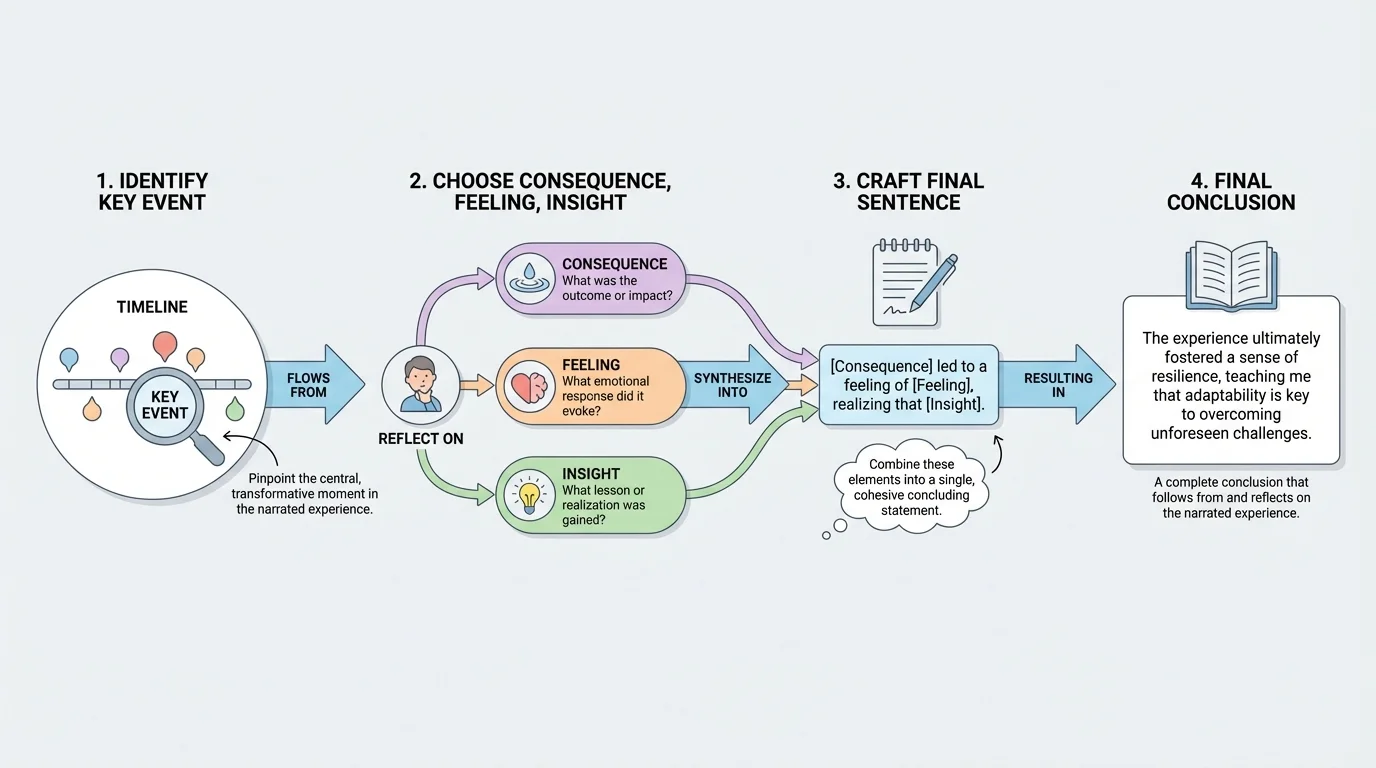
Example: from event to conclusion
Suppose a narrative tells the story of a student performing a violin solo after wanting to quit.
Step 1: Identify the turning point.
The turning point is not just the concert itself. It is the moment the student walks onstage despite fear.
Step 2: Identify the lasting effect.
The student learns that being nervous does not mean being unprepared or weak.
Step 3: Choose a fitting ending style.
A reflective ending or action ending would work well because the story is about internal change and a meaningful final moment.
Step 4: Draft concluding lines.
Possible conclusion: "My hands were still shaking when I lowered the bow, but this time I knew what the shaking meant. It didn't mean I was ready to quit. It meant I had stayed."
This conclusion follows from the events and reflects on the experience without sounding exaggerated.
The same process can be used for many kinds of narratives: a science fair mistake, a difficult conversation with a friend, a missed shot in a game, or an unexpected act of kindness. This structure keeps the writer focused on connection rather than decoration.
Looking closely at examples helps show why some conclusions work better than others.
Example 1: "When the bus finally pulled away, I could still see my grandfather in the station window, holding the paper bag of peaches against his jacket. I had thought the trip was about leaving home. Only then did I understand how much of home I was carrying with me."
This ending works because it connects a concrete image to a deeper realization. The peaches are a specific detail from the story, and the final sentence reflects on the experience.
Example 2: "Coach didn't say anything when I sat on the bench. He just handed me the water bottle and nodded toward the field. Next time, I nodded back."
This ending is brief, but it suggests change. The narrator has not solved everything, yet the final action shows renewed determination. It follows naturally from a sports narrative.
Comparing a weak ending and a stronger ending
Story situation: A student forgets lines in the school play but keeps going.
Weak ending: "So that is why you should never give up on your dreams because life is full of challenges and courage."
This ending sounds general and disconnected from the actual scene.
Stronger ending: "I missed two lines and said one backward, but the stage lights never exploded and the audience never laughed. When the curtain closed, I realized the scariest part had been the minutes before I spoke, not the words themselves."
This version stays close to the event and includes reflection that feels earned.
Example 3: "At dinner, my little brother kept asking how many fish I had caught. I told him, 'None.' Then I set the photo of the sunrise on the table between us, and for once he stopped talking."
This conclusion suggests that the experience mattered for a reason different from what the narrator first expected. It reflects through detail instead of a direct lesson.
Most good endings are revised. Writers often discover the real meaning of a narrative only after finishing a draft. That is normal. Revision helps uncover the strongest final lines.
When revising a conclusion, check for closure. Closure means the reader feels the story has reached a satisfying stopping point. Closure does not require that every problem be solved. It simply means the ending feels complete for this narrative.
Ask yourself revision questions such as these:
It can also help to read the final paragraph aloud. Strong conclusions often have a natural rhythm. If the ending sounds stiff, too formal, or too dramatic, it may need revision.
"A good ending doesn't just stop the story. It lets the story stay with the reader."
One useful strategy is to return to an earlier detail. If the story began with muddy cleats by the door, a cracked phone screen, the smell of onions in the kitchen, or the buzz before a spelling bee, the conclusion might revisit that detail in a changed way. This technique can create a sense of unity.
Another strategy is to cut the final sentence and see whether the ending becomes stronger. Sometimes writers explain one line too far. If the second-to-last sentence already carries the feeling, stopping there may be more powerful.
In the end, a strong conclusion is not about sounding impressive. It is about sounding true. When an ending follows from the events and reflects on the experience, the narrative feels whole.
