Picture yourself reading a text message from a friend, a science article, and the instructions for your favorite game—all in the same afternoon. 📱 Even if you don't notice it, your brain is constantly figuring out new words or confusing phrases using the words around them. That skill has a name: using context.
When you read, you will always meet words you don't know yet. You will see them in novels, science and history texts, math problems, social media posts, and test passages. You will not always have time to grab a dictionary or search the word. That's where context clues come in.
Context clues are hints in the text that help you figure out what a word probably means. Strong readers use them all the time to read faster, understand more deeply, and keep going even when they hit a tough word.
Context skills are especially important when words have more than one meaning. Think about the word "pitch" in baseball, "pitch" in music, and "pitch" in an advertisement. The letters are the same, but the meaning changes depending on the situation, or context.
Researchers estimate that students meet tens of thousands of different words in school reading, and most of them are not directly taught. Context clues are one of the main ways your vocabulary grows over time.
To use context well, you need to look closely at the sentence, the paragraph, and how the unknown word is used.
At its simplest, context means the words, phrases, and ideas that surround something. For vocabulary, context includes:
Context clues are the hints in the words and sentences around an unfamiliar word that help you guess its meaning.
Denotation is the basic, dictionary definition of a word.
Connotation is the extra feeling or idea that comes with a word, beyond the dictionary meaning (for example, "cheap" vs. "inexpensive").
Context works on different levels:
1. Sentence-level context – The words and punctuation in the same sentence can give direct hints. Sometimes the unknown word is explained right away, or there is a contrast or example that tells you what you need.
2. Paragraph or whole-text context – The main idea of the paragraph and the topic of the whole passage help you decide which meaning of a word fits best. If you are reading about chemistry, "solution" probably means a liquid mixture, not an answer to a math problem.
3. Position and function in the sentence – Even if no one explains the word, you can tell a lot from how it is used. Is it acting like a noun, verb, or adjective? Is it the thing doing the action, the action itself, or a describing word? Grammar is a powerful kind of context.
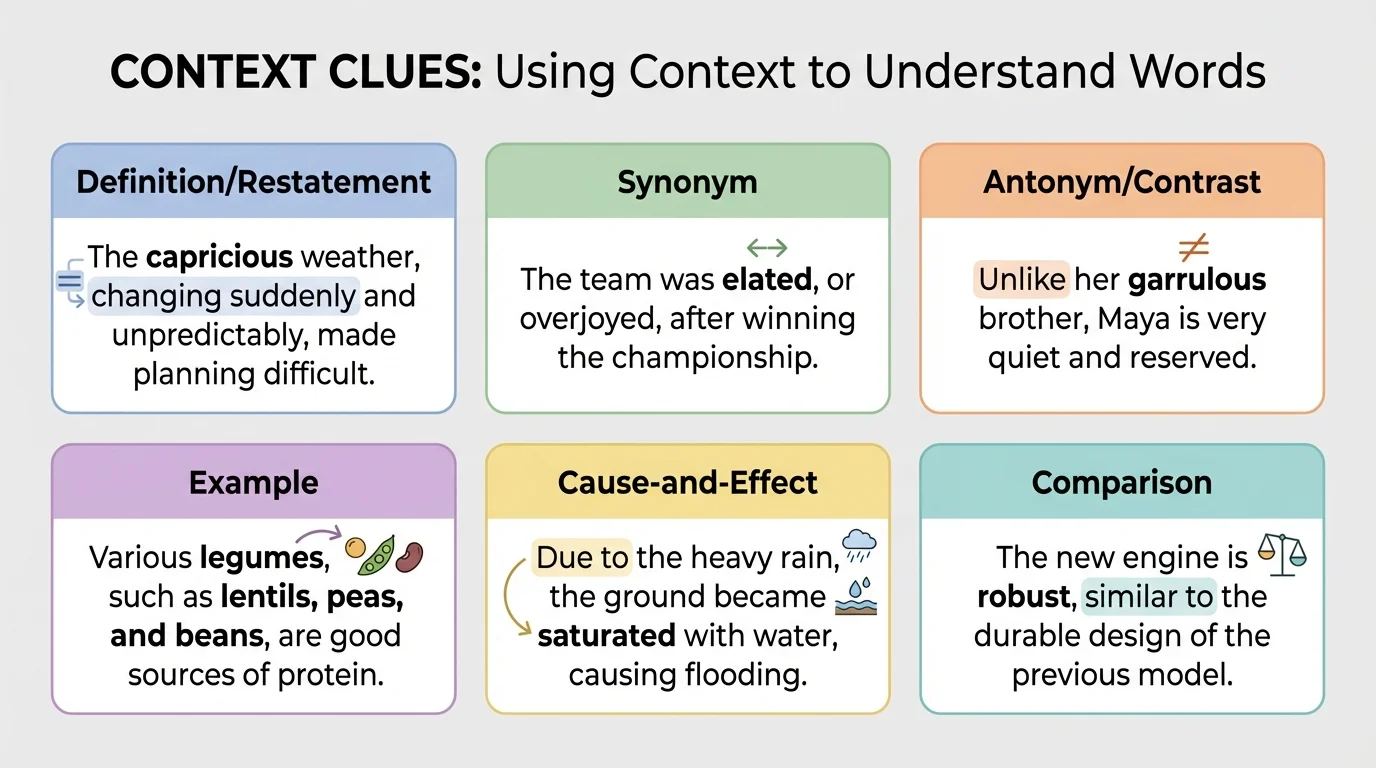
When authors write, they often leave specific kinds of hints around hard words. These are different types of sentence-level context clues, shown together in [Figure 1]. Learning to recognize them makes it easier to unlock new words quickly.
1. Definition or restatement clues
Sometimes the author simply explains the word right in the sentence, or in the one that follows.
Look for signal words like is, are, means, or, also called, that is, in other words.
Example:
• "The protagonist, or main character, faces several difficult choices."
Here, "or main character" tells you exactly what "protagonist" means.
• "Many animals are nocturnal; in other words, they are active at night and sleep during the day."
"In other words" introduces a restatement of "nocturnal."
2. Synonym (similar meaning) clues
A synonym clue uses a word that means nearly the same thing as the unknown word.
Look for signal words like and, also, similarly, likewise.
Example:
• "The storm was ferocious and extremely violent."
"Violent" is a synonym that helps explain "ferocious."
3. Antonym or contrast clues
An antonym is a word with the opposite meaning. Sometimes the author gives an opposite or shows a contrast to help you understand.
Look for contrast words like but, however, although, unlike, instead of, on the other hand.
Example:
• "Unlike his boastful brother, who bragged about everything, Marco was modest about his achievements."
"Unlike" and "modest" tell you that "boastful" is the opposite of modest—someone who brags.
• "The lake looked tranquil, but the ocean was rough and choppy."
The contrast with "rough and choppy" suggests that "tranquil" means calm and peaceful.
4. Example clues
Sometimes the sentence gives examples of the unknown word to show what it includes.
Look for signal words like such as, for example, including, like.
Example:
• "Many rodents, such as mice, rats, and squirrels, can be found in the park."
The examples (mice, rats, squirrels) show that "rodents" are that group of animals.
5. Cause-and-effect clues
Here, the sentence explains a cause or an effect related to the unknown word. You can use that relationship to guess the meaning.
Look for signal words like because, since, so, therefore, as a result.
Example:
• "Because the instructions were so ambiguous, the students built their models in completely different ways."
The result (students built models differently) suggests that "ambiguous" means unclear or confusing.
6. Comparison clues
Sometimes a new word is compared to something you already know.
Look for words like like, similar to, as, just as.
Example:
• "The surface of the moon is pitted, like a golf ball."
By comparing the moon to a golf ball, the author shows that "pitted" means covered with small dents or holes.
Recognizing these patterns helps you quickly decide which kind of clue you are seeing.
Even when there are no obvious signal words, the place of the unknown word in the sentence gives you powerful hints. This is where your knowledge of grammar becomes a tool for figuring out meaning. 🧠
First, ask: What part of speech is this likely to be?
Example 1:
"The arboretum near our school is filled with different kinds of trees and plants."
Example 2:
"The crowd converged on the field after the team won the championship."
Sometimes the same word can be different parts of speech, and context tells you which is which.
• "I will record the song on my phone." (verb: to capture sound)
• "She broke the school record in the 100-meter dash." (noun: the best result so far)
In each sentence, the position tells you if "record" is the action or the thing.
So far, we have focused on clues inside a single sentence. But often, the best hints come from reading a bit more. The topic, main idea, and tone of the paragraph or passage can show which meaning of a word makes sense.
Read this short paragraph:
"The old castle stood on the cliff, silent and empty. Ivy crawled up its walls, and shattered glass lay where windows had once been. Despite its ruined state, tourists came from all over the world to admire the majestic structure, taking photos and sketching it in their notebooks."
Even if you don't know "majestic," the rest of the paragraph helps:
From this context, you can guess that "majestic" has a positive meaning like grand, impressive, or noble.
Now consider a word with more than one meaning, like "charge":
• "The general ordered the soldiers to charge up the hill." (run forward in attack)
• "You will have to pay a late charge if the book is overdue." (fee or cost)
• "Please charge your laptop before class." (put electricity into)
If you read a paragraph about a battle, "charge" probably means to rush forward in attack. In a paragraph about money, it probably means a fee. In a tech manual, it most likely means putting electrical power into a device. The overall meaning of the paragraph points you toward the right definition.
All these ideas are helpful, but they work best when you turn them into a clear method you can use every time you meet a new word. You can combine sentence clues, paragraph clues, and grammar into one strategy. 🧩
Worked example: Using a full strategy
Read this sentence and the one after it:
"The walls of the canyon were so precipitous that the hikers had to move carefully, clinging to the rock. One wrong step on the steep cliff could send them tumbling far below."
Step 1: Read the full sentence and the next one.
Don't stop at the unknown word. Keep reading to collect more clues.
Step 2: Use word position to find the part of speech.
"Precipitous" comes between "so" and "that the hikers…" and describes "walls." It is acting like an adjective, a describing word.
Step 3: Look for context clue types.
The next sentence restates and explains: "One wrong step on the steep cliff…" This is a restatement/definition clue and an example clue. It uses a synonym ("steep") and an example (falling far below) to show the danger.
Step 4: Make a reasonable guess.
Since the canyon walls are dangerous, and the cliff is called "steep," you can guess "precipitous" means "very steep" or "almost vertical."
Step 5: Check your guess in the sentence.
Replace the word: "The walls of the canyon were so very steep that the hikers had to move carefully…" This makes sense with the rest of the information, so your guess is probably correct.
Later, if you check a dictionary, you will see that one meaning of "precipitous" is "very steep," which fits your guess.
When you meet your own unknown words, you can follow a similar set of steps:
Some English words are especially challenging because they have several different meanings, called polysemy. Context is the only way to know which meaning is intended.
Here are a few examples:
| Word | Sentence A (meaning) | Sentence B (meaning) |
|---|---|---|
| cell | "The biologist examined the cell under a microscope." (tiny unit of life) | "The prisoner spent years in a tiny cell." (small room) |
| volume | "Turn down the volume on the TV." (loudness) | "The library ordered the next volume in the series." (book in a set) |
| draft | "She felt a cold draft coming from the window." (current of air) | "He wrote a rough draft of his essay." (early version) |
| table | "The scientist looked at the data in the table." (organized chart) | "They sat at the kitchen table to eat dinner." (piece of furniture) |
Table 1. Examples of multiple-meaning words whose correct meaning depends on context.
The subject of the passage helps you choose:
Sometimes, even the connotation (emotional feeling) of surrounding words helps. For example, the word "slender" and "skinny" can both mean thin, but "slender" usually feels more positive. If the paragraph praises someone's graceful appearance, "slender" fits better. If the paragraph expresses worry about someone's health, "skinny" might fit the tone.
"The meaning of a word is its use in the language."
— Ludwig Wittgenstein
This quote reminds us that how a word is used in real sentences and situations—its context—is what really tells us what it means.
Context skills are not just for language arts class. They show up everywhere in your life. 🌍
Of course, sometimes context clues are not enough to give you a precise meaning, especially for very technical words. In those cases, using a dictionary, glossary, or reliable website is still important. But context usually gives you a strong first guess and helps the dictionary definition make sense when you look it up.
