A single letter can change everything. If someone writes "defiantly" when they mean "definitely," the sentence is still readable, but the meaning shifts in a strange way. In texting, gaming chats, essays, science reports, and job applications later in life, spelling sends a message about how carefully you write and communicate. Good spellers are not people who magically know every word. They are people who notice patterns, remember common words, and know exactly what to do when they are unsure.
Spelling is the correct arrangement of letters in a word. It is part of the conventions of standard English, along with capitalization and punctuation. When spelling is accurate, readers can focus on your ideas instead of stopping to decode what you meant.
Correct spelling matters for several reasons. First, it supports clarity. If you write "angel" when you mean "angle," your reader gets a completely different image. Second, it affects credibility. A piece of writing with many spelling mistakes can seem rushed or unpolished, even if the ideas are strong. Third, it improves efficiency. When readers do not have to guess at words, they understand your message more quickly.
Frequently used words are words that appear often in everyday reading and writing, such as because, friend, their, and enough. Reference materials are tools that help writers check information, including dictionaries, glossaries, spell checkers, and trusted people who can confirm correct spelling.
Spelling also connects to audience and purpose. A quick note to a friend may be informal, but a school assignment, an email to a teacher, or a public post should still be accurate. The more important the writing task is, the more important it becomes to check every doubtful word.
Some words appear so often that writers should aim to spell them automatically. These include everyday words like because, people, different, another, through, thought, which, school, answer, friend, and writing. These are not always easy, but repeated correct use helps them become familiar.
Automatic spelling matters because writing flows better when you do not have to stop at every common word. When you know high-frequency words quickly, you can focus more attention on ideas, sentence structure, and organization.
Many frequently used words are difficult because English spelling is not perfectly predictable. For example, the word said does not sound exactly the way it looks, and the word enough ends with the sound of f even though it is spelled with gh. That is why memory, reading, and repeated exposure all matter.
English includes words borrowed from many languages, which is one reason its spelling system has so many surprises. That is also why patterns help, but patterns do not explain every word.
Another important group includes commonly confused words: their, there, and they're; your and you're; to, too, and two; its and it's. These words may sound alike, but they have different spellings and meanings. Correct spelling is not just about hearing sounds. It is also about choosing the right word for the sentence.
Strong spellers do more than memorize. They use patterns. One useful strategy is to look for syllables, or word parts that can be spoken as beats. For example, in-for-ma-tion becomes easier to spell when you break it into parts instead of trying to grab the whole word at once.
Another strategy is to notice prefixes and suffixes. In the word unhelpful, the prefix un- means "not," the base word is help, and the suffix -ful means "full of." In the word careless, the suffix -less means "without." When you understand the parts, the spelling becomes more logical.
Word origins can help too. Many academic words are built from root words. For example, the root spect means "look," so words like inspect, respect, and spectator share part of their spelling. In science and social studies, knowing roots can help you spell unfamiliar vocabulary more accurately.
Patterns also include common letter combinations. English often uses tion in words like nation, action, and education. It often uses able in words like comfortable and available. Noticing these repeated chunks is faster than treating every word as brand new.
Why patterns help but do not solve everything
English spelling is partly phonetic, which means letters often represent sounds, but it is also shaped by word history and meaning. That is why a pattern can guide you toward the right spelling without guaranteeing it. A careful writer combines patterns with checking tools when a word still seems uncertain.
Reading widely strengthens spelling because your brain sees correct forms again and again. When you read novels, articles, captions, and informational texts, you build a visual memory of words. Over time, some spellings begin to "look right" or "look wrong," and that instinct becomes a useful editing tool.
Even excellent writers check spellings. That is not weakness; it is responsibility. If a word is less familiar, more technical, or newly learned, you should confirm it instead of guessing. This is especially important in content-area writing, where one missing letter can make a term incorrect.
Useful reference materials include a print dictionary, a digital dictionary, a spell checker, classroom word walls or glossaries, and trusted peers or adults. Each tool has strengths. A dictionary gives the official spelling and meaning. Spell check works quickly during drafting. A trusted person may help you notice an error your eyes skipped over.
Reference materials are most useful when you use them at the right time. During drafting, you may keep writing and mark a doubtful word to check later. During revising and editing, you should slow down and verify uncertain spellings carefully. Good writing often comes from this habit of checking, not from instant perfection.
A dictionary entry includes more than just the word itself. On a print dictionary page, quick visual clues help you find and confirm a word. Learning to read those clues makes dictionary use much faster and more accurate.
In a print dictionary, the words at the top corners of the page are called guide words. [Figure 1] shows where they appear and how they help you locate entries quickly. They show the first and last entry on that page. If you want to look up magnify, for example, guide words help you decide whether you are on the right page before you search line by line.
Entries are in alphabetical order. To find a word, pay attention to each letter, not just the first one. For example, form, formal, and format all begin the same way, so you must continue comparing letters until the words separate. This is especially important when several similar words appear together.
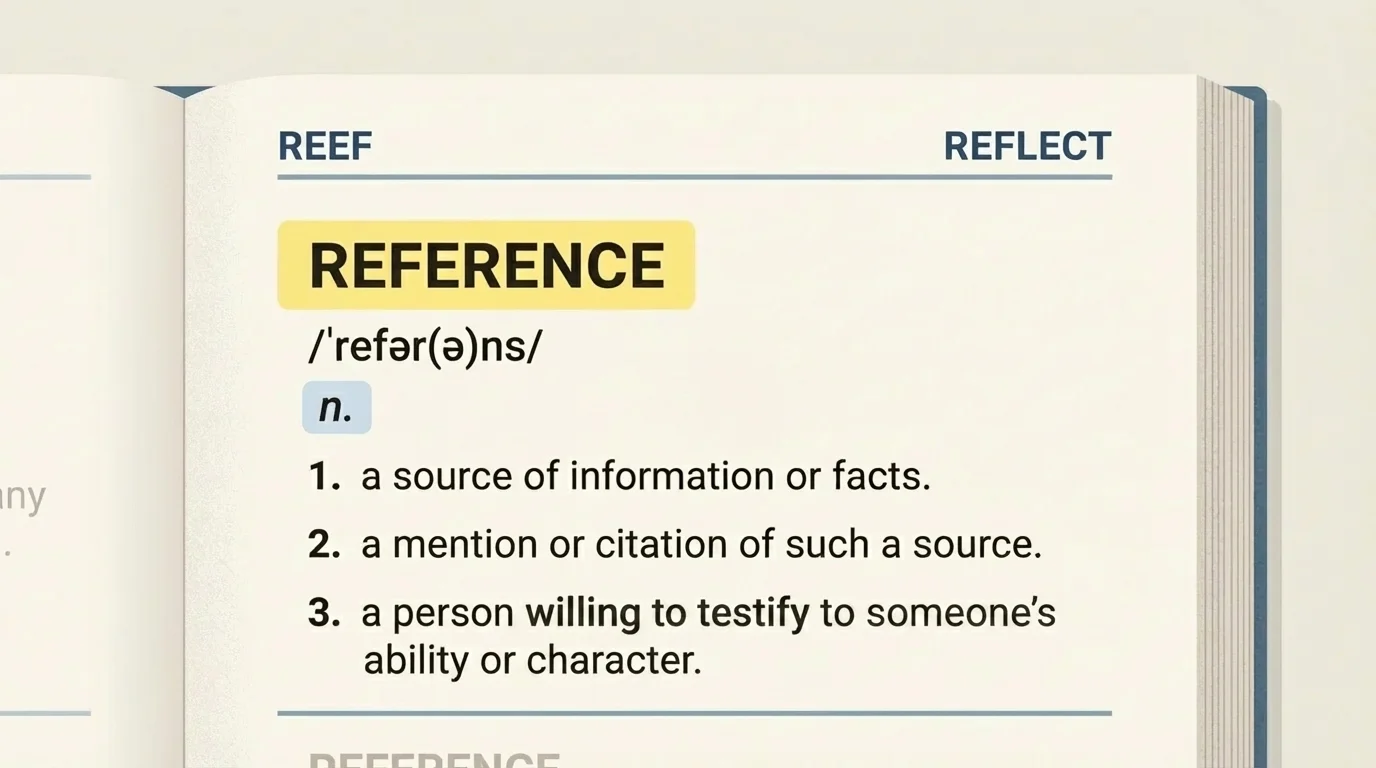
A dictionary also gives useful details beyond spelling. It may show pronunciation, the part of speech, different meanings, and sometimes example sentences. If you are choosing between two possible spellings, these details help you confirm that you have found the exact word you need.
Suppose you want to describe a very bright object and are unsure whether the word is luminous or luminous. Looking it up confirms the standard spelling luminous. That check protects your writing from a mistake that might otherwise stay unnoticed.
Using a dictionary to check a less familiar word
Step 1: Identify the doubtful word.
You want to write: "The scientist made a careful observation," but you are not sure whether it is spelled observation or observasion.
Step 2: Search alphabetically.
Look under words beginning with ob-, then continue letter by letter: obs...
Step 3: Confirm the full entry.
The dictionary lists observation, not observasion, and shows that it is a noun.
You can now use the correct spelling with confidence.
Later, when you work with other unfamiliar words, the same method applies. The page structure in [Figure 1] reminds you that dictionaries are designed to help readers find answers efficiently, not slowly by trial and error.
Digital tools are helpful, but they are not perfect. A word processor may underline a misspelled word, while another error slips through because the wrong word is still a real word. That means writers must stay alert instead of trusting every suggestion automatically.
Spell check is excellent for catching many typing mistakes such as missing letters, repeated letters, or accidental letter swaps. [Figure 2] highlights both the usefulness and the limits of this tool. If you type becuase, it will often suggest because. This can save time during drafting and editing.
However, spell check may miss homophone errors and word-choice errors. A sentence like "Their going to win" may not be fully corrected if the software does not recognize the grammar problem. Likewise, "I read the hole article" contains the correctly spelled but incorrect word hole instead of whole.
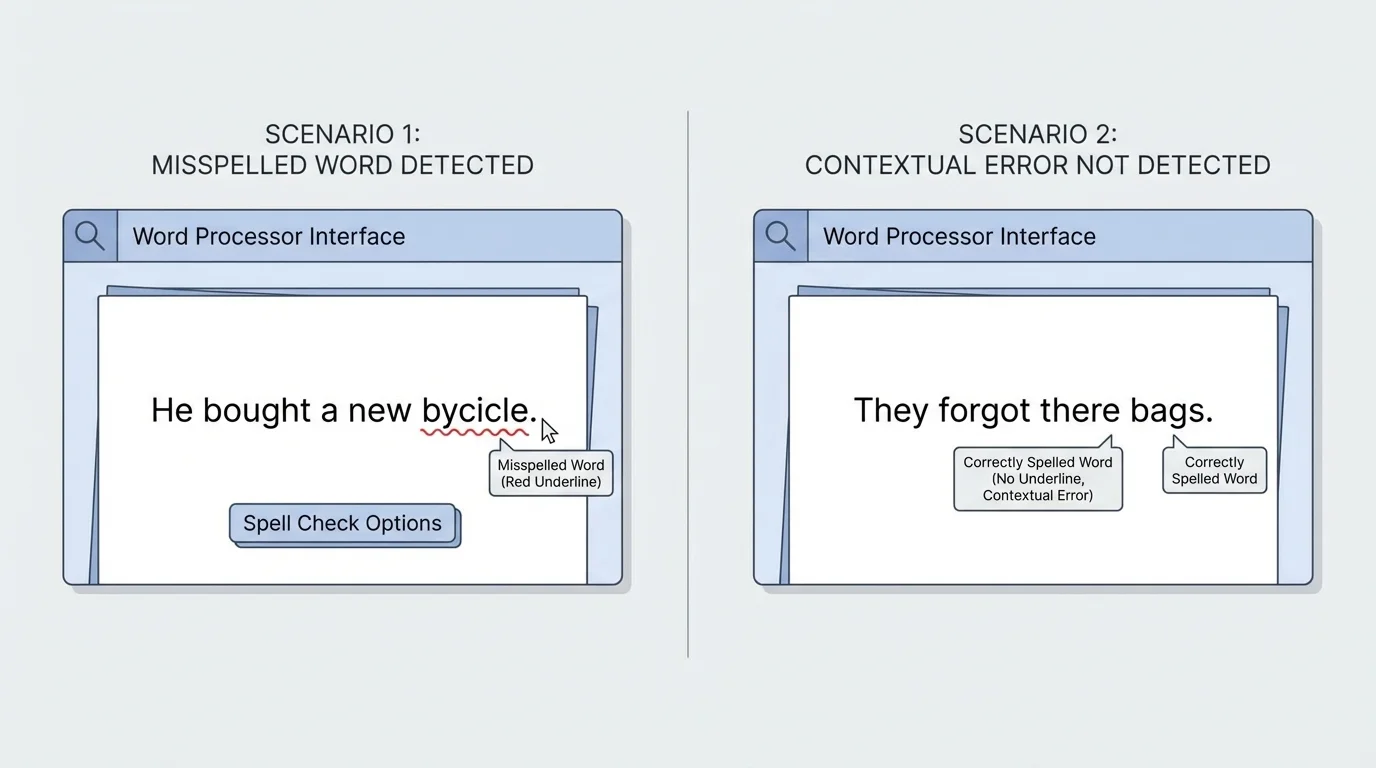
Autocorrect can also introduce mistakes. Sometimes it changes a word into a different word that fits common typing patterns but not your meaning. This happens often with names, technical terms, and newer vocabulary. For that reason, always reread after accepting a suggestion.
Digital dictionaries are powerful because they are fast and searchable. Many also include audio pronunciation, word history, and examples. But speed should not replace thinking. If you search only by sound, you may choose a word that sounds right but does not fit the sentence.
Editing and revising are not the same. Revising improves ideas, structure, and clarity. Editing checks conventions such as spelling, punctuation, and grammar. Strong writers usually revise first and edit carefully afterward.
A smart writer uses technology as a tool, not a substitute for judgment. The contrast in [Figure 2] makes this clear: software helps, but your brain must still check meaning, context, and correctness.
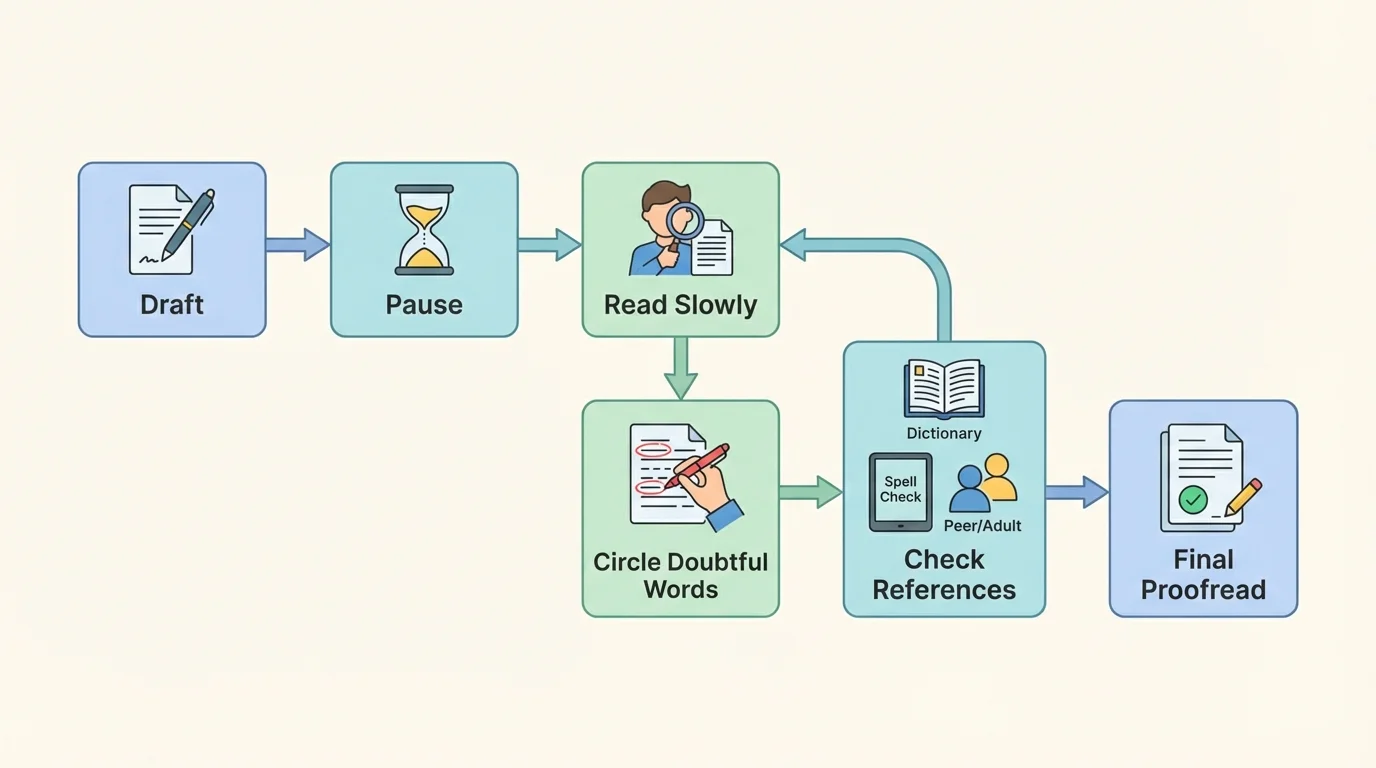
Spelling improves most when you use a repeatable editing routine. A clear proofreading sequence helps you catch more errors than a rushed final glance. Writers who follow steps usually find mistakes that they would miss if they skimmed quickly.
First, finish your draft before trying to perfect every word. [Figure 3] outlines a useful sequence for checking spelling efficiently. Stopping every few seconds can break your focus. If you are unsure about a spelling while drafting, underline it, highlight it, or leave yourself a note so you can check it later.
Next, take a short break if possible. Even a few minutes can help your eyes reset. Then read your writing slowly, one line at a time. Some writers read aloud because hearing the sentence helps them notice words they skipped mentally while writing.
Another useful method is to look for one kind of error at a time. On one pass, check homophones. On another, check words with suffixes. On another, check names, titles, and subject-specific vocabulary. This focused method works better than trying to catch every problem at once.
Keep a personal list of words you often misspell. Maybe your list includes separate, necessary, favorite, or environment. When you notice a repeated mistake, add it to the list and review it before turning in major assignments. Over time, your list becomes a custom study guide based on your real writing habits.
A practical spelling-edit routine
Step 1: Draft without stopping for every doubtful word.
Mark uncertain spellings so you can return to them later.
Step 2: Read slowly from beginning to end.
Circle words that look wrong, sound wrong, or seem unfamiliar.
Step 3: Check each circled word with a dictionary, digital reference, or trusted adult.
Do not replace a word unless you know the new spelling and meaning are correct.
Step 4: Make one final proofread for common trouble words.
Pay special attention to words you have misspelled before.
This routine builds independence because it turns spelling into a process, not a guess.
When assignments become longer and more complex, routines matter even more. The sequence in [Figure 3] shows that careful editing is not one quick act. It is a series of deliberate checks that protect your ideas.
One major trouble spot is homophones, words that sound alike but differ in spelling and meaning. Examples include principal and principle, peace and piece, and waist and waste. Because your ear cannot always help you here, context matters.
Another trouble spot is adding endings. Sometimes you double a final consonant before adding a suffix, as in begin to beginning. Sometimes you do not, as in open to opening. A useful clue is stress: words with a stressed final syllable often double the consonant before adding -ing or -ed.
Silent letters cause trouble too. In words like knock, sign, and answer, some letters are not pronounced clearly in normal speech. That is why reading, memory, and reference tools remain important.
Apostrophe-related spelling can also confuse writers. Compare its and it's. The first shows possession, and the second is a contraction for it is. These are small differences with big effects on correctness.
| Common problem | Example of error | Correct form | Why it matters |
|---|---|---|---|
| Homophone confusion | There dog ran away. | Their dog ran away. | The wrong word changes meaning. |
| Silent letter | anser | answer | Pronunciation alone may mislead you. |
| Suffix added incorrectly | begining | beginning | Word formation rules matter. |
| Apostrophe confusion | Its raining. | It's raining. | Spelling and grammar connect. |
Table 1. Common spelling trouble spots and the correct forms students often need in their writing.
Content-area vocabulary deserves special attention. In science, words like photosynthesis, organism, and temperature may be less frequent in daily conversation, so they should be checked carefully. In social studies, words like government, civilization, and democracy can also cause trouble. Less frequently used vocabulary often requires reference materials because memory alone may not be enough.
Independent spellers do not depend on luck. They build habits. They read regularly, notice patterns, memorize frequently used words, and check less familiar vocabulary with reliable tools. They also understand that being unsure is normal. The important part is what you do next.
A trusted peer or adult can be useful when a word still seems uncertain after you have checked it yourself. For example, if you are writing a speech and want to make sure a specialized term is correct, asking a teacher or knowledgeable adult can help. The key is to use people as trusted sources, not as replacements for your own effort.
Good spelling grows from attention, practice, and smart checking. A careful writer asks questions such as: Does this word look right? Does it match the meaning I want? Have I seen this spelling in reading? Should I confirm it with a dictionary or digital tool? Those questions lead to stronger, clearer writing.
"Careful writers do not guess when they can check."
When you treat spelling as part of communicating clearly, your writing becomes easier to read and more powerful. Whether you are writing a paragraph, an essay, a lab report, or a message that needs to sound professional, correct spelling helps your ideas reach the reader exactly the way you intend.
