A writer's voice can be as recognizable as a singer's. You may not know the author personally, but as soon as you read a line, you can sometimes hear excitement, fear, humor, confidence, or sadness. That effect does not happen by accident. Writers build voice through careful choices: the sounds of words, the images they create, and even the way the words look on the page. When you learn to control those choices, your writing stops sounding flat and starts sounding like it belongs to a real speaker telling a real story.
In writing, voice is the personality, attitude, and feeling that come through in the words. A piece of writing can sound calm, nervous, playful, serious, angry, proud, or mysterious. In a narrative, voice helps readers understand not just what happens, but how the narrator or character experiences it. Two writers can describe the same rainy afternoon, yet one can make it sound peaceful while the other makes it feel threatening.
Voice matters because readers connect to people, not just events. If a student writes, "I walked into the gym and saw the crowd," that tells what happened. But if the student writes, "I stepped into the gym, and the noise slammed into me like a wave," the writing carries a stronger presence. The second sentence feels more alive because it uses vivid language and a clear point of view.
Voice is the distinct personality and feeling a writer creates through word choice, sentence style, imagery, sound, and structure. Personal voice reflects the writer's own perspective and attitude. Narrative voice is the voice of the narrator or storytelling speaker in a piece of writing.
Strong voice is especially important in narratives because stories depend on experience. Readers want to feel the cold air, hear the squeak of shoes, notice the pause before someone speaks, and sense the thoughts behind the action. Stylistic techniques, figurative language, and graphic elements help make that possible.
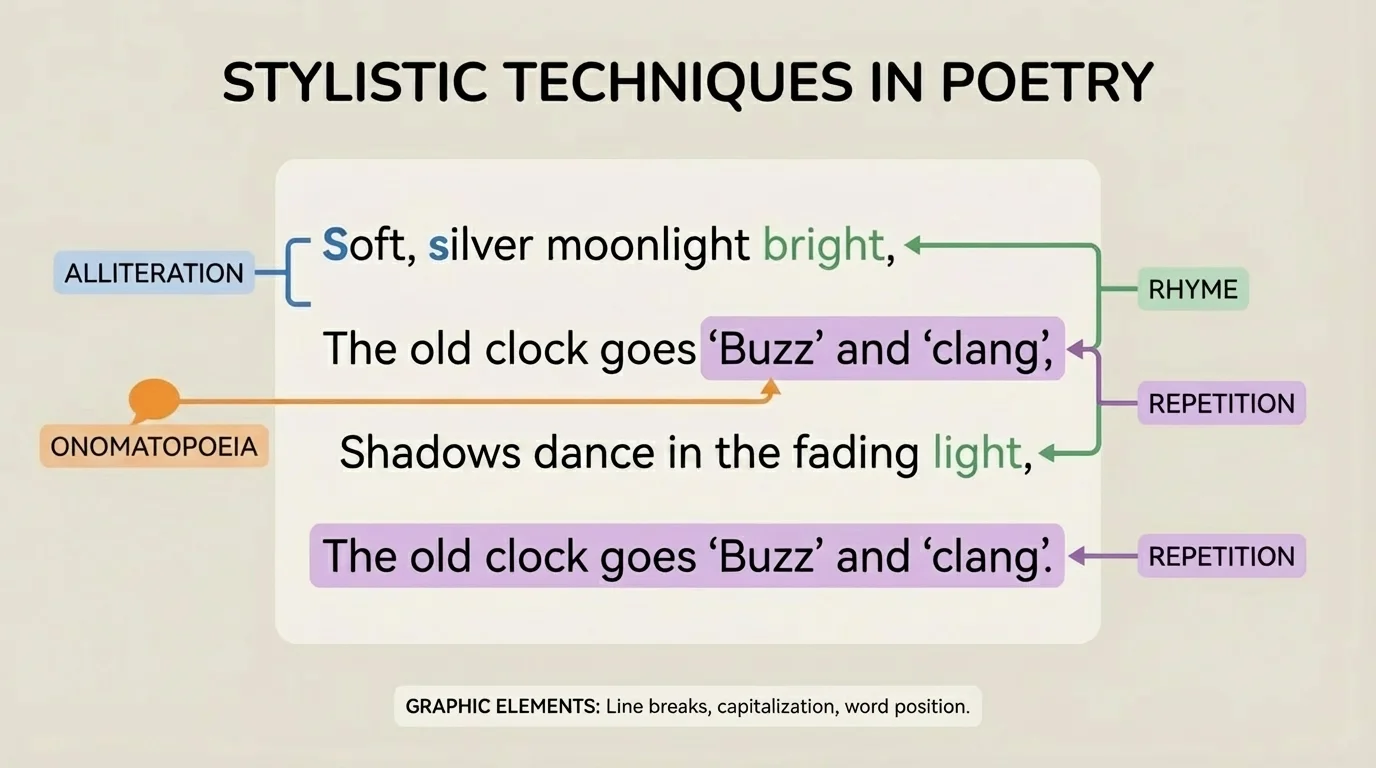
Alliteration, onomatopoeia, rhyme scheme, and repetition are sound and pattern tools that shape the way a piece of writing feels, as [Figure 1] illustrates through an annotated poem. Even before a reader fully analyzes meaning, the ear notices rhythm, echoes, and repeated sounds. Those patterns can make writing feel smooth, sharp, fast, playful, tense, or musical.
Alliteration is the repetition of beginning consonant sounds in nearby words. For example, "The wind whipped across the wide field" repeats the w sound. That repeated sound creates a flowing, windy feeling. In a narrative, alliteration can make a description more memorable. "Silent snow slid from the roof" sounds softer than "Snow fell from the roof," so it better matches a quiet winter mood.
Onomatopoeia is a word that imitates a sound, such as buzz, clang, crash, thud, or hiss. These words help readers hear the scene. In action writing, onomatopoeia can speed up a moment and make it feel immediate: "The locker door slammed shut with a bang." In a suspenseful scene, smaller sounds may matter even more: "Tap. Tap. Tap. The branch scratched the window."
Rhyme scheme is the pattern of end rhymes in lines of poetry, often labeled with letters such as AABB or ABAB. Although rhyme scheme is most common in poetry, understanding it helps writers hear patterns in language. A regular rhyme scheme can make a voice sound playful, songlike, or controlled. An irregular one can sound more natural or unsettled.
Repetition means repeating a word, phrase, sentence pattern, or sound to create emphasis. Repetition is powerful because it tells the reader, "Pay attention to this." In a personal narrative, a repeated phrase can reveal emotion: "I kept waiting. Waiting for the whistle. Waiting for my name. Waiting for my courage to arrive." The repeated word slows the pace and shows tension building.
These techniques are not decorations added at the end. They are part of meaning. The sounds in a sentence can match the action in the scene. Soft sounds may suggest calm or secrecy; harsh sounds may suggest conflict. The pattern of repeated words can suggest obsession, excitement, fear, or determination.
Example: one scene, different sound choices
Notice how each version changes the voice of a similar event.
Version 1: Plain description
"The runner moved down the track."
Version 2: Added alliteration
"The runner raced down the rough red track."
Version 3: Added onomatopoeia and repetition
"Thud, thud, thud—my shoes hammered the track as I ran."
Each sentence describes movement, but the last one has the strongest narrative voice because the reader can hear the action and feel the speaker's presence.
When you choose stylistic techniques, think about purpose. If the scene is quiet and reflective, loud onomatopoeia may feel out of place. If the character is panicking, repetition can sound natural because anxious thoughts often loop. The best writers do not use every technique at once. They choose the ones that match the moment.
Simile, metaphor, and personification allow writers to say more than the literal words alone can express. Figurative language adds comparison, surprise, and emotion. It helps readers understand what something feels like, not just what it is.
A simile compares two unlike things using words such as like or as. For example, "My stomach twisted like a rope" gives a stronger sense of nervousness than "I was nervous." The comparison turns a private feeling into an image the reader can picture.
A metaphor also compares unlike things, but it does so directly, without using like or as. If a narrator says, "The classroom was a pressure cooker," the narrator does not mean the room is literally a kitchen tool. The metaphor suggests heat, stress, and the feeling that something might explode. Metaphors often create a bold, confident voice because they make strong claims.
Personification gives human qualities to nonhuman things. A writer might say, "The old house groaned in the wind," or "The sunlight crept across the floor." Personification can make a setting feel alive. In a narrative, that matters because setting is not just background. A storm can seem angry, a hallway can seem watchful, and a city can seem restless. Those choices shape mood and voice at the same time.
Why figurative language strengthens voice
Literal language gives facts. Figurative language gives experience. When writers compare a feeling, object, or place to something unexpected, readers hear the writer's perspective more clearly. The comparison itself reveals attitude: a hallway described as "a tunnel" feels different from one described as "a stage."
Good figurative language fits the speaker. A basketball player might compare a crowd to thunder. A musician might compare a city siren to a broken note. A student who loves the ocean might describe panic as "a wave rising in my chest." The image should sound believable for that narrator or character.
Figurative language also works best when it is specific. "She was as busy as a bee" is a familiar simile, but it may feel ordinary because readers have heard it many times. "She moved through the kitchen like a drummer keeping perfect time" is more original and reveals a clearer voice.
[Figure 2] The way writing looks can matter almost as much as the words themselves. The page becomes part of the message by comparing the same idea in different layouts. Graphic elements such as capital letters, line length, spacing, punctuation emphasis, and word position can shape pace, stress, and emotion.
Capital letters can create emphasis. In a poem or narrative fragment, a capitalized word can feel louder or more urgent: "And then the lights went OUT." Writers should use this carefully. Too many capital letters can feel distracting, but one well-placed word can communicate shock, anger, or panic.
Line length matters especially in poetry, verse narratives, and experimental writing. Short lines can slow readers down or make each word feel heavier. Long lines can create flow, rush, or buildup. Compare these effects: "I ran." feels abrupt and breathless. "I ran through the wet grass, past the fence, past the shouting crowd, past every reason to stop." feels fast and overflowing.
Word position also creates meaning. A word placed alone on a line stands out. A key phrase at the end of a paragraph can echo in the reader's mind. A pause before a final word can create suspense. Writers often place the most important word where the eye naturally lands: at the beginning or end.
Spacing and punctuation can also act like graphic tools. Dashes can interrupt. Ellipses can trail off. A one-line paragraph can feel dramatic because of the blank space around it. These choices influence how a reader "hears" the voice.
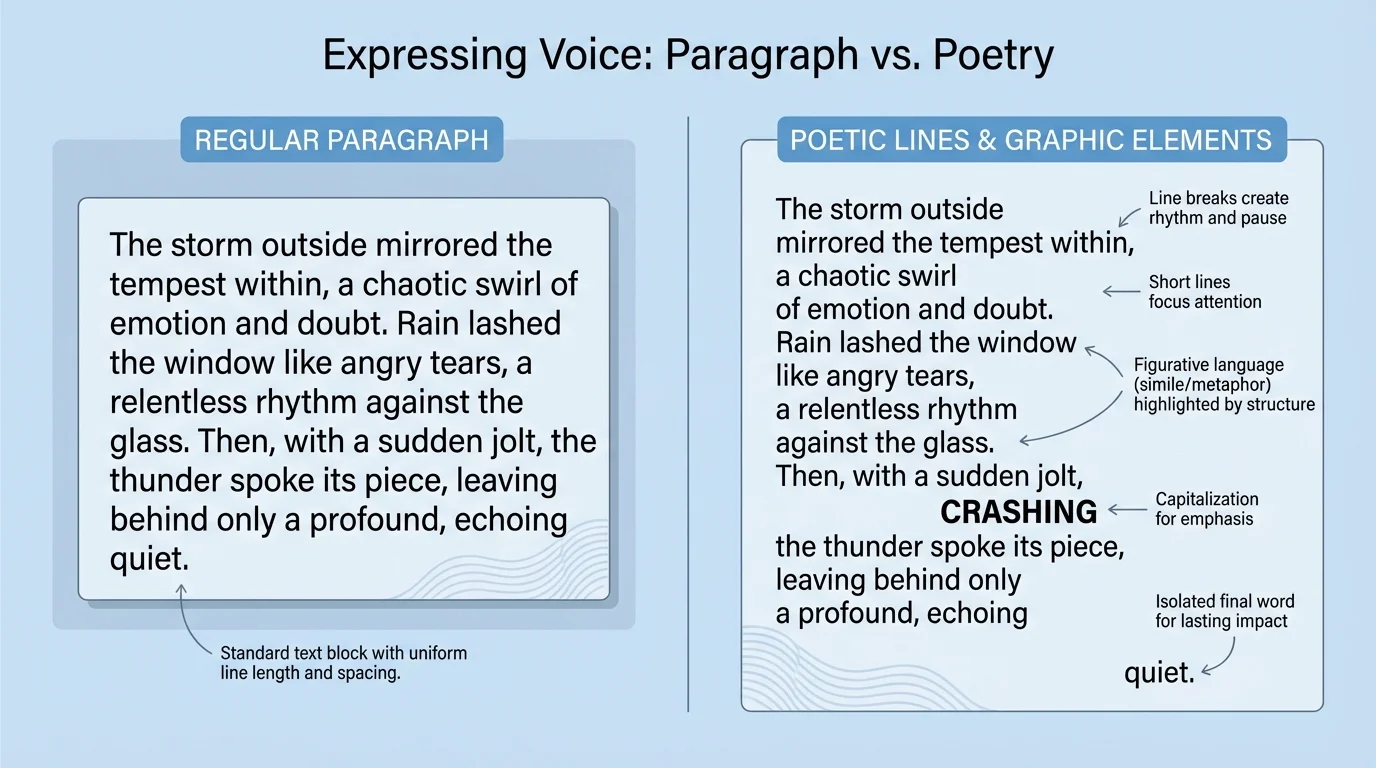
Graphic elements are especially useful when a writer wants the page to reflect emotion. A character who is thinking calmly may speak in balanced sentences and regular paragraphs. A character in shock may think in fragments. Layout changes meaning even when many of the words stay the same.
Poets are not the only writers who use graphic elements. Novelists, speechwriters, songwriters, and even advertisers rely on spacing, line breaks, and emphasis to control how readers react.
Because these choices are powerful, they should be intentional. A random line break is not automatically effective. Ask what the break does. Does it create suspense? Highlight a word? Slow the reader? If it does none of those things, it may not be helping the piece.
Personal voice grows out of your perspective. That means your experiences, opinions, memories, and habits of noticing things should shape the writing. If you are writing about a bus ride to school, one writer may focus on the hiss of the brakes, another on the gray sunrise in the windows, and another on the nervous conversation before a test. All three are truthful, but each creates a different voice.
Relevant descriptive details are essential. Strong narratives do not pile on random adjectives. They choose details that matter. If a narrator feels anxious before a championship game, the writing might notice the squeak of sneakers, the sweaty grip on the ball, and the buzzing lights in the gym. Those details support the emotional center of the scene.
Sensory language strengthens voice by making the experience physical. What does the narrator hear, smell, touch, or taste? "The cafeteria smelled like bleach and tomato sauce" tells more than "The cafeteria smelled bad." Specificity is one of the clearest signs of real voice.
Logical pacing also matters. Important moments should slow down. Less important moments can move quickly. If a character is about to read contest results, the writing might stretch the seconds with repetition, short sentences, and sound details. A trip across town may be covered in one sentence. Voice and pacing work together because the writer decides where the reader should linger.
From earlier narrative writing skills, remember that a strong event sequence gives readers a clear path through the story. Voice does not replace structure. It works best when the reader can follow the action, understand who is speaking, and see why each moment matters.
Dialogue can reveal voice too. A narrator who says, "I'm fine," may sound very different from one who says, "Yeah, sure, totally fine," especially if the scene clearly shows the opposite. Word choice, sentence length, and even pauses in dialogue help build character and tone.
Narrative voice is not only about sounding interesting. It is about sounding right for the story. A suspense scene may use clipped sentences, repeated sounds, and personification of the setting. A joyful memory may use longer, more musical sentences and bright comparisons. The techniques should fit the event.
Consider a storm scene. A flat version might say, "The storm started, and I was scared." A stronger version might say, "Thunder rolled over the roof, and the windows rattled like teeth." The second version uses a simile with like teeth and sound-rich words such as thunder, rolled, and rattled. The voice becomes more vivid and personal.
Now consider a triumphant scene: "I crossed the finish line." That is clear, but it does not yet carry much voice. A more expressive version might be, "I crossed the finish line and the whole world seemed to lift; the noise of the crowd burst open around me." Here, figurative language and sound help communicate relief and excitement.
Example: shaping the same event with different voices
Event: opening the door to a dark room.
Voice 1: curious
"I pushed the door wider, and the room waited, quiet as a held breath."
Voice 2: frightened
"The door creaked. I froze. The dark swallowed the corners first."
Voice 3: annoyed
"Of course the light was out again, and the room sat there like it had planned this."
The event stays the same, but the voice changes because the language choices change.
Writers often return to certain images or phrases to unify a narrative. A repeated phrase can act almost like a heartbeat in the story. If a narrator repeats "not yet" before an important race, performance, or decision, the phrase can build suspense each time it appears. Repetition is especially effective when it changes slightly over time, showing the narrator's growth.
One of the biggest mistakes writers make is overloading a piece with effects. A story packed with alliteration in every sentence, metaphors in every paragraph, and random capital letters can become exhausting. Voice is strongest when the reader notices the feeling of the writing, not just the tricks.
Purposeful writing begins with questions. What emotion should the reader feel here? Whose perspective matters most? Should this moment move quickly or slowly? Is the scene loud, quiet, tense, awkward, hopeful, or reflective? The answers guide your choices.
If you want a scene to feel tense, you might use short sentences, repetition, and sharp sounds. If you want a scene to feel dreamy, you might use longer lines, softer alliteration, and personification. If you want to highlight one powerful idea, you might isolate a key word on its own line.
| Technique | What it does | Possible effect on voice |
|---|---|---|
| Alliteration | Repeats beginning sounds | Musical, smooth, playful, or intense |
| Onomatopoeia | Imitates sound | Immediate, vivid, energetic, suspenseful |
| Rhyme scheme | Creates a pattern of end rhymes | Controlled, lyrical, playful, memorable |
| Repetition | Repeats words or structures | Emphatic, emotional, dramatic |
| Simile | Compares with like or as | Clear, vivid, relatable |
| Metaphor | Makes a direct comparison | Bold, imaginative, intense |
| Personification | Gives human traits to nonhuman things | Atmospheric, emotional, alive |
| Capital letters | Add emphasis visually | Urgent, loud, dramatic |
| Line length and word position | Controls pace and focus | Suspenseful, reflective, forceful |
Table 1. A comparison of major techniques and the effects they can create in voice.
As Table 1 suggests, the same technique can create different effects depending on context. Repetition can sound comforting in one scene and obsessive in another. Personification can make nature feel welcoming or threatening. Context determines impact.
[Figure 3] When you study a short passage closely, you can often see several techniques working together at once in a color-coded excerpt. Skilled writing rarely depends on only one device. Voice grows from a combination of sound, image, structure, and viewpoint.
Read this model: "The hallway stretched ahead of me, bright and empty. My footsteps clicked, clicked, clicked against the tile. At the office door, my hand hovered. Not yet, I thought. Not yet." This short passage uses personification in "the hallway stretched," repetition in "clicked, clicked, clicked" and "Not yet," and careful pacing through short sentences. The voice feels nervous and suspenseful.
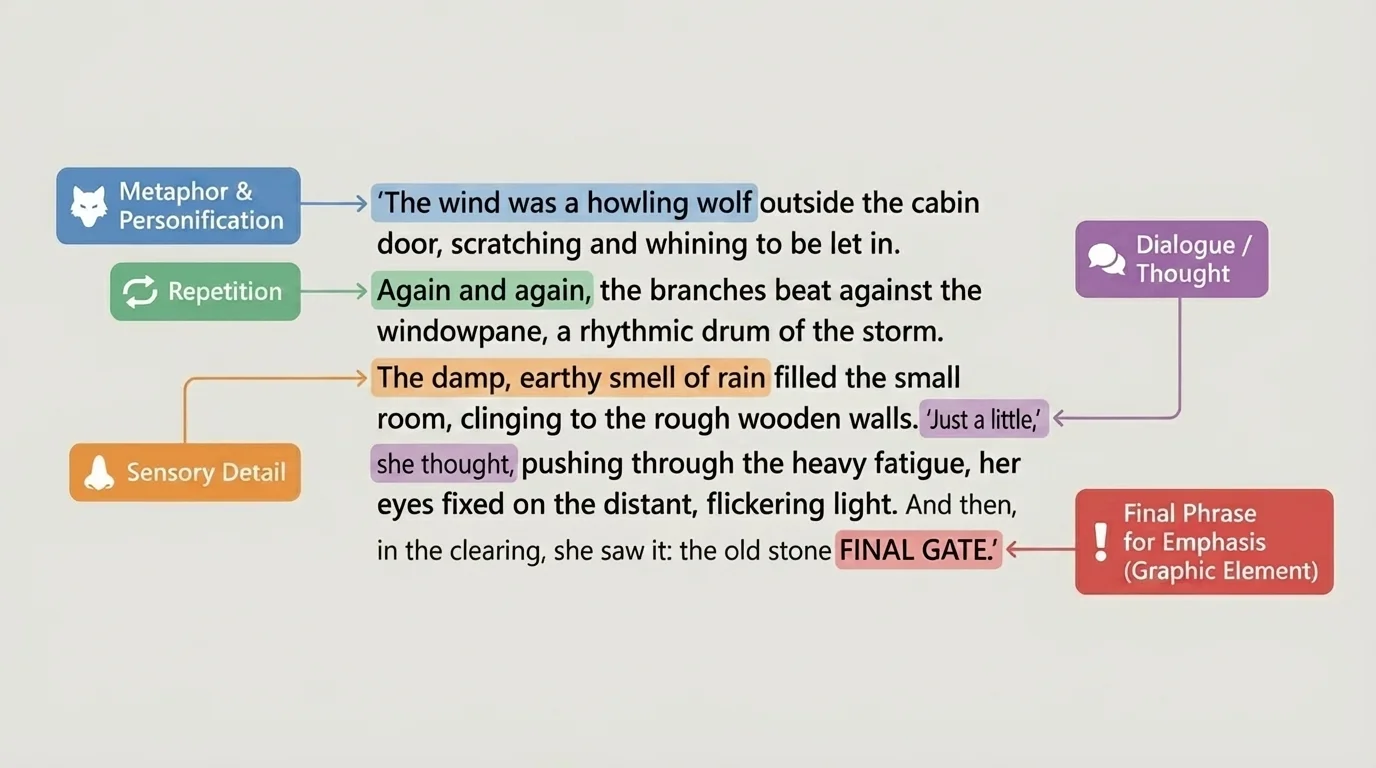
Now read a different model: "Summer sat on the porch with us that evening, warm and golden, while the screen door slapped and the cicadas stitched the dark together." Here, personification appears in "Summer sat on the porch" and "cicadas stitched the dark together." The sounds of slapped and stitched create texture. The voice feels reflective and almost peaceful.
Notice that neither model lists emotions directly. The writers do not simply say "I was afraid" or "I felt calm." Instead, the techniques allow readers to infer emotion. That is often more effective because it invites the reader into the experience.
"The difference between the almost right word and the right word is really a large matter."
— Mark Twain
That idea applies not only to single words but to whole patterns of writing. The right repeated phrase, the right metaphor, or the right line break can completely change the voice of a piece. Multiple choices can combine to create a single emotional effect.
To develop strong personal or narrative voice, make choices that match the speaker, moment, and mood. Start with the heart of the scene. What is the narrator feeling? What should the reader notice first? Then choose techniques that support that purpose.
Use sound devices to help readers hear the scene. Use figurative language to help them feel it. Use graphic elements to help them see emphasis and pacing on the page. Combine these with relevant details, sensory language, dialogue, and clear event order so the writing remains understandable as well as expressive.
Most importantly, be intentional. Strong voice does not mean using the fanciest words or the most techniques. It means creating writing that sounds alive, specific, and true to the story being told.
