A detective does not solve a case by saying, "I just have a feeling." A strong reader works the same way. When you analyze a story, poem, article, or speech, your ideas need proof. That proof comes from the text itself. The skill is not just finding some line that seems relevant. It is choosing the detail, quotation, or moment that supports your idea most powerfully and explaining why it matters.
Middle school reading becomes more interesting when you realize that texts often say two things at once. On the surface, they tell you events, facts, and dialogue. Under that surface, they suggest motives, emotions, themes, and messages. To understand both levels, you need to know how to read carefully and how to cite evidence with precision.
When teachers ask for analysis, they are not asking for random opinions. They are asking for ideas that can be defended. Textual evidence is the exact information from a text that supports a reader's thinking. It may be a direct quotation, a paraphrased detail, or a description of an event in the passage. Without evidence, a response sounds like a guess. With evidence, it becomes a reasoned interpretation.
This matters outside school too. In conversations, news, and online posts, people make claims all the time. Strong readers learn to ask, "What is the proof?" Citing evidence in literature helps build that habit of careful thinking. It teaches you to base conclusions on what is actually there, not just on what you want to believe.
Textual evidence is information from a text that supports a claim or idea. Explicit meaning is what the text states directly. An inference is a conclusion a reader draws by combining text clues with reasoning.
Evidence also helps readers talk about literature more deeply. Instead of saying, "The character is nice," you can say, "The character seems generous because he gives away his lunch even though he is hungry." That second statement points to a specific moment. It shows how analysis grows from details.
Some parts of reading are straightforward. If a story says that the game begins at sunset, then the time is stated directly. That is what the text says explicitly. But many important ideas are not handed to you in one clear sentence. Readers often must notice clues and connect them, as [Figure 1] illustrates. If a character's hands shake, her voice becomes quiet, and she avoids eye contact, the text may never say "she is nervous," but the clues strongly support that inference.
The key is that an inference is not a wild guess. It must come from details in the text. Good readers ask, "What clues lead me to this conclusion?" If you cannot point to those clues, then your inference is probably too weak or too personal.
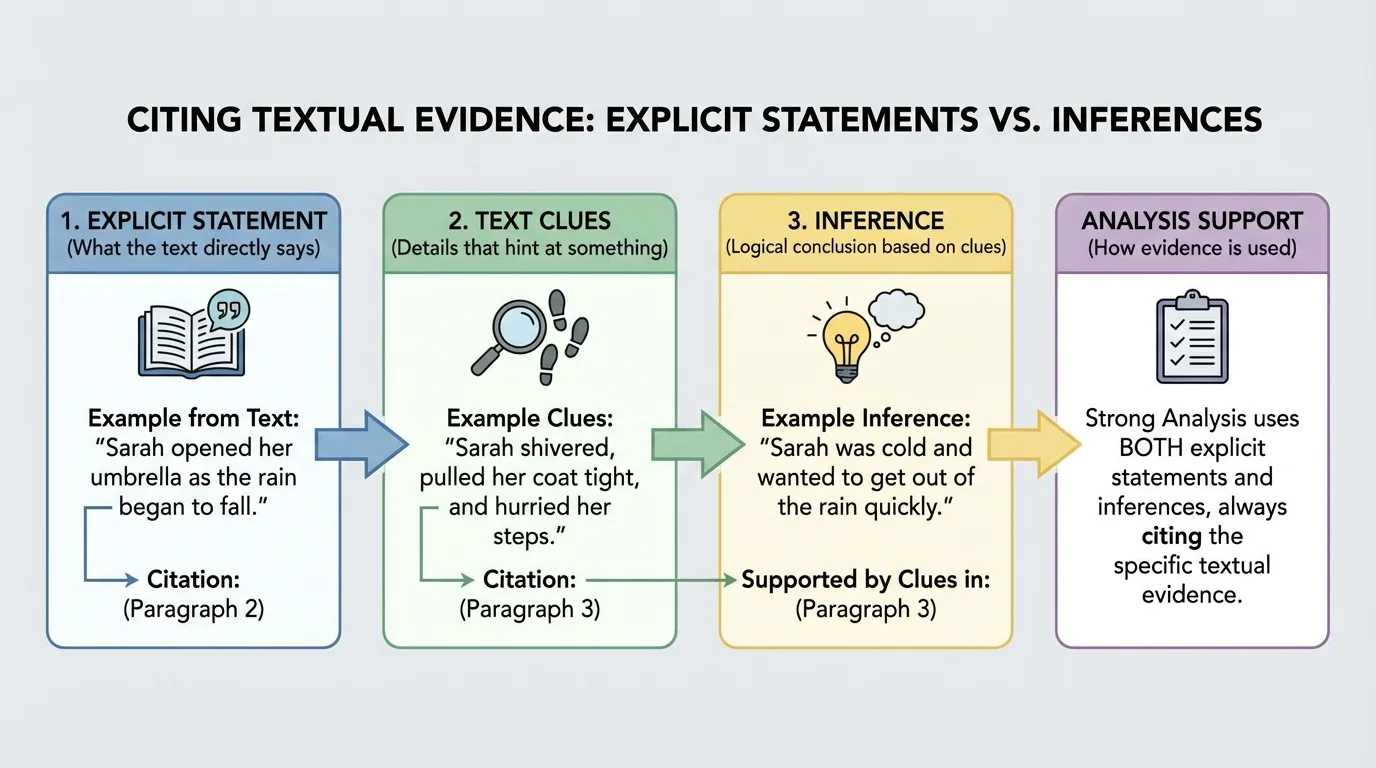
Think about this short example: "Marcus folded the letter three times, slipped it into his pocket, and stared out the window long after the bus had gone." The text does not directly say that Marcus is worried or distracted. However, a reader can infer that something in the letter matters deeply to him because of his careful action and the way he misses the bus. That inference is supported by the details, not invented out of thin air.
When you analyze a text, it helps to ask two separate questions: What does the text directly tell me? and What does the text lead me to conclude? Strong evidence can support both answers. For explicit meaning, evidence usually points to exact facts or statements. For inferences, evidence usually points to several clues that fit together.
Skilled readers often reread short passages more than once, not because the text is too hard, but because strong analysis depends on noticing small details that become important later.
Later in a story, the same clue may take on a different meaning. A line that seems ordinary at first may become powerful after you know the ending. That is one reason why the best evidence is not always the first detail you notice.
Not every detail has the same value. A quotation is often strong because it gives the author's exact words. A paraphrase can also be useful when you want to explain a longer event in your own words. Whether you quote or paraphrase, the evidence should be relevant, specific, and convincing.
Relevant evidence connects directly to your point. If you are explaining that a character feels guilty, a detail about the weather is probably not the best support unless the weather somehow reflects that guilt. Specific evidence points to an exact line, action, or detail. Saying "the story shows this" is vague. Saying "when Alina hides the trophy under her bed instead of celebrating" is specific. Convincing evidence strongly proves the claim, not just weakly relates to it.
Strong evidence often comes from key moments: a turning point, a repeated image, an important piece of dialogue, a character's decision, or a clear description from the narrator. These moments reveal what matters most in the text. If an author repeats an idea, image, or phrase, that repetition may be especially important because authors usually repeat details for a reason.
Context matters too. A single line can be misunderstood if it is taken out of its situation. For example, a character might say, "Fine. Do whatever you want." On paper, that looks calm. In context, it might really show anger, frustration, or surrender. Good readers look at what happens before and after the line before choosing it as evidence.
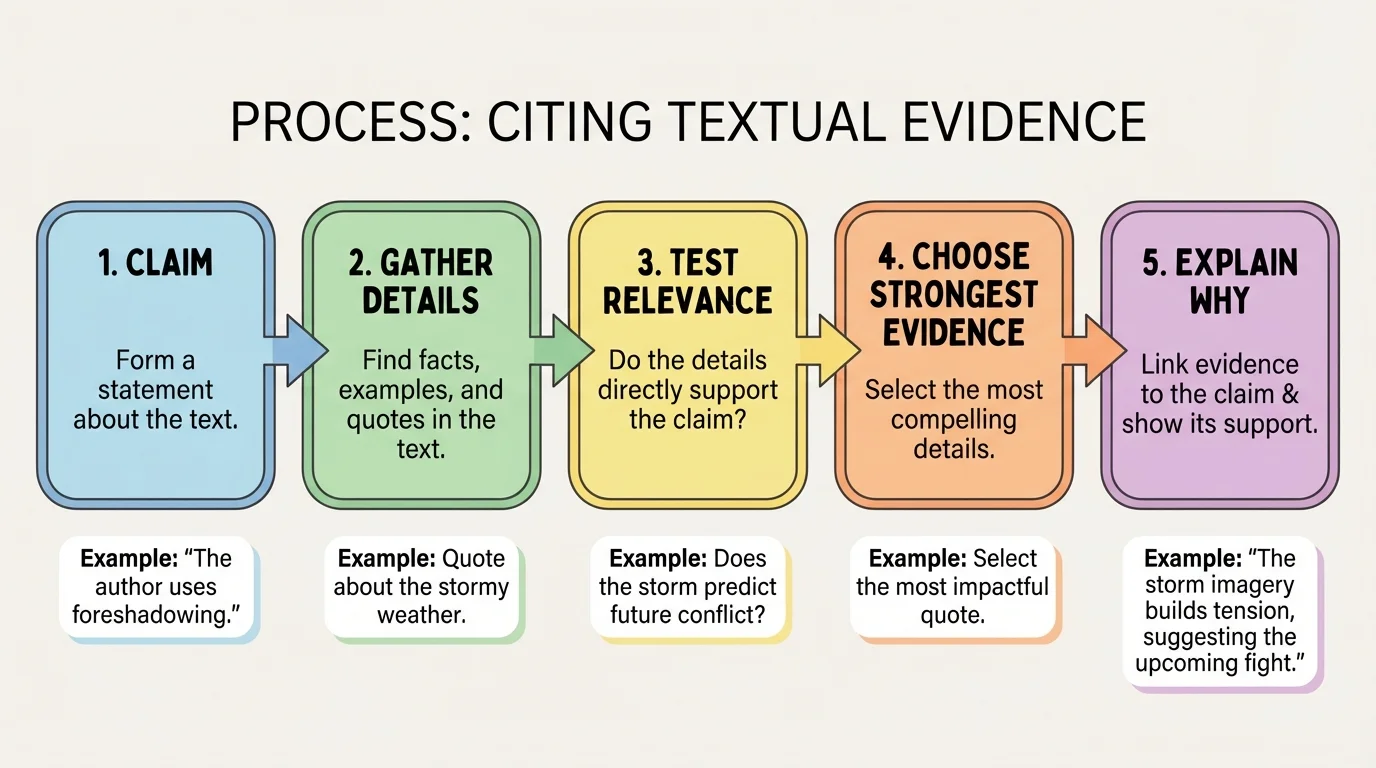
Choosing strong evidence is a process, not a trick. A useful method appears in [Figure 2]: start with a claim, gather possible details, test those details, choose the strongest one or two, and explain the connection. This slows down your thinking in a good way and helps you avoid grabbing the first line that looks related.
Here is a reliable approach you can use with almost any text.
First, make a clear claim. For example: "The author shows that Lena is becoming more confident." A claim gives you something to prove.
Second, gather several possible pieces of evidence. Maybe Lena speaks in class, volunteers to lead a project, and defends a friend. At this stage, do not choose too quickly.
Third, test each detail. Ask: Does this directly support my claim? Is it one of the strongest examples? Would another detail work better? A line that only somewhat fits should be rejected if a stronger one exists.
Fourth, choose the best evidence. Usually, one or two powerful details are better than a pile of weak ones. More evidence is not always better if it becomes repetitive or unfocused.
Fifth, explain the reasoning. This final part is where real analysis happens. You do not just drop in a quotation and move on. You show how the evidence proves the claim.
Example: selecting the strongest evidence
Claim: Nia has changed from being passive to being assertive.
Step 1: Gather possible evidence.
Possible details: Nia sits quietly during lunch; later she asks a question in science class; near the end she tells her brother to stop speaking for her during the meeting.
Step 2: Test the details.
Sitting quietly shows her earlier behavior, but it does not prove the change by itself. Asking one question shows some growth, but it may not be the strongest moment. Telling her brother to stop speaking for her directly shows assertiveness.
Step 3: Choose and explain.
The strongest evidence is the meeting scene because Nia speaks for herself in a public moment. That action clearly supports the claim that she has become assertive.
Notice that the strongest evidence is not just the most dramatic line. It is the detail that best matches the exact idea in the claim. If your claim is about change, evidence from the end of the text may be stronger than evidence from the beginning because it shows what the character has become.
As you continue reading, the process in [Figure 2] still applies: claim first, evidence second, explanation third. That order keeps your analysis organized and prevents summary from taking over.
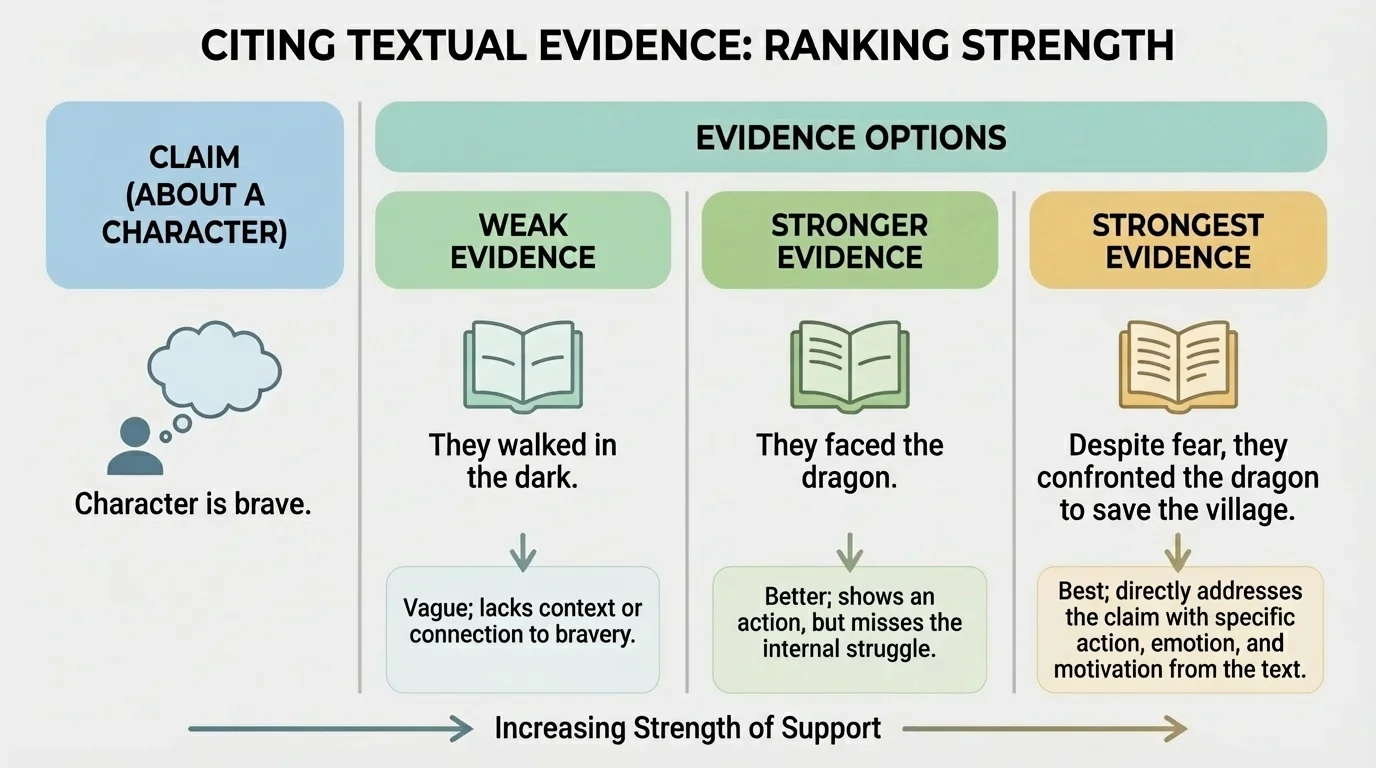
One of the most important reading skills is learning to rank evidence. Some details are weak because they are too general. Others are stronger because they connect more directly to the claim. The strongest details usually fit the claim exactly, as [Figure 3] makes clear through comparison.
Suppose your claim is, "The setting creates a mood of danger." Consider three possible pieces of evidence. Detail one: "It was nighttime." Detail two: "Branches scraped the cabin walls while the wind kept the door half-open." Detail three: "The narrator says the forest was full of trees." All three mention the setting, but they do not work equally well. The nighttime detail helps a little, but it is broad. The forest detail is true but weak because it does not strongly suggest danger. The scraping branches and half-open door create the strongest mood because they produce a tense, threatening image.
Strong evidence often answers the question why this claim is true more directly than weaker evidence does. If a reader has to stretch to explain the connection, the evidence is probably not the best choice.
| Claim | Weak Evidence | Why It Is Weak | Stronger Evidence | Why It Is Stronger |
|---|---|---|---|---|
| The character feels isolated. | She walks home after school. | Many people walk home; the detail is not very revealing. | She watches the class party from the hallway and does not enter. | The detail directly shows separation from others. |
| The author builds suspense. | A door appears in the scene. | The detail is neutral by itself. | The doorknob turns slowly before anyone knocks. | The action creates tension and uncertainty. |
| A conflict is becoming worse. | The brothers talk. | Talking alone does not prove conflict. | Each brother repeats the same accusation and refuses to listen. | The repeated accusation shows the conflict escalating. |
Table 1. Comparison of weak and stronger evidence for different analytical claims.
This kind of comparison helps you understand that the best evidence is usually not the first detail you can point to. It is the one that reveals the most about the claim you are making.
Strong evidence matches the claim exactly. If your claim is about mood, choose language that shapes feeling. If your claim is about character motivation, choose actions, thoughts, or dialogue that reveal motive. If your claim is about theme, choose moments that connect to the larger message of the text.
Later, when you write about a different text, the ranking idea from [Figure 3] still matters. You are always asking not just "Does this connect?" but "Does this connect better than the other options?"
In literary reading, evidence helps you analyze how stories and poems work. If you are writing about characterization, look for dialogue, actions, thoughts, and what other characters say. If you are writing about setting, choose details that shape mood or influence the plot. If you are analyzing theme, look for repeated ideas, important decisions, and the outcome of the conflict.
Consider this brief invented passage: "Grandfather polished the same watch every night, though it had not worked in years." If you claim that the watch symbolizes memory and loss, the strongest evidence might not be just that the watch is old. The stronger evidence is that he polishes it every night even though it no longer works. That repeated action suggests emotional attachment and difficulty letting go.
Author's choices matter as well. A writer may use short sentences to create urgency, vivid imagery to intensify mood, or first-person narration to make a character's thoughts feel immediate. Evidence for those choices often comes from the language itself. If the author writes, "Run. Hide. Breathe later," the short commands support an analysis that the scene feels urgent and panicked.
Poetry especially rewards careful evidence selection. A poem may be short, so every word carries weight. If a poet repeats one image, such as winter, ash, or light, that repetition may reveal tone or theme. In poetry, the strongest evidence is often a word, phrase, or pattern rather than a long quotation.
"A good reader notices not only what happens, but how the author makes it happen."
When you discuss literary elements, remember that evidence should lead to interpretation. Quoting three lines without explaining them is not analysis. The evidence is the starting point; your reasoning is what makes it meaningful.
Although this skill is often practiced with stories and poems, it also works in articles, essays, speeches, and historical documents. In an informational text, explicit meaning may include facts, dates, definitions, or directly stated arguments. Inferences may involve the author's viewpoint, purpose, or what the evidence suggests about a larger issue.
For example, if an article describes a city planting trees, adding reflective roofs, and opening cooling centers during heat waves, you can explicitly state what the city is doing. You can also infer that officials see extreme heat as a serious and growing problem. The strongest evidence would likely include the list of major actions, especially if the article presents them as urgent responses.
This transfer matters because strong readers do not use one method for literature and another for everything else. They look for proof in all kinds of texts. The habit of asking, "Which detail supports this idea most strongly?" works across subjects.
Once you have chosen strong evidence, you need to present it well. Introduce the evidence so your reader knows where it comes from. Then explain it. A common structure is claim, evidence, explanation. Some students know this as a form of paragraph building, but what matters is the logic.
For example: "The author shows that the storm reflects Maya's fear. When Maya steps outside, 'the sky split with white light and the trees bent like they were trying to escape.' This image creates a violent, unstable setting that mirrors Maya's panic." The quotation works because it is followed by explanation. Without that last sentence, the reader might not understand why the evidence matters.
You do not always need long quotations. Short, carefully chosen phrases are often stronger because they let you focus on the most important words. This also helps avoid copying too much of the text. Your goal is to use evidence precisely, not to fill space.
From earlier reading work, remember the difference between summary and analysis. Summary tells what happened. Analysis explains what the details mean and why they matter.
Blending quotations smoothly can make your writing clearer. Instead of dropping in a full sentence with no setup, introduce it: "When the narrator calls the house 'airless and watchful,' the description suggests that the setting feels oppressive." The quote is short, exact, and connected directly to the point.
One common mistake is using evidence that is true but not especially strong. Another is choosing evidence that proves a different claim than the one you are making. A third is giving evidence with no explanation. Readers should not have to do all the interpretive work themselves.
Another mistake is confusing personal reaction with text-based inference. You might say, "I think the character is lonely because I would feel lonely in that situation." That is a personal response, not solid evidence. A better approach is: "The character seems lonely because she eats by herself, avoids eye contact, and watches others talking without joining them."
Sometimes readers also overquote. If almost the entire paragraph is copied from the text, the writer's own thinking disappears. Select the most important words and spend more time explaining than copying.
Misreading context can create errors too. A sarcastic line may sound sincere if you ignore the situation. Always read around the quotation, not just the quotation itself.
Strong evidence selection becomes easier when you annotate as you read. Underline key lines, mark repeated images, note surprising choices, and write short thoughts in the margin. When you return to the text, you will already have a map of possible evidence.
Rereading also helps. On the first read, you may understand the plot. On the second, you notice patterns. On the third, you can judge which evidence is strongest. Careful readers are not slower because they are confused; they are slower because they are paying attention.
As you practice, you will start to hear a useful question in your mind: "What in the text makes me say that?" That question turns reading into investigation. It helps you move from simple answers to thoughtful analysis supported by proof.
