A single word can change everything. Compare these two sentences: "The hallway was quiet" and "The hallway was silent." Both suggest very little sound, but they do not feel exactly the same. Quiet sounds calm. Silent can sound peaceful, but it can also feel tense or eerie. Strong readers notice those differences. They do not just ask, "What does this word mean?" They also ask, "Why did the author choose this word, and what effect does it create?"
When you read literature, essays, articles, speeches, or even song lyrics, words do more than deliver information. They build images, create emotion, reveal a speaker's attitude, and connect one text to another. To understand a text deeply, you need to examine words and phrases as they are actually used in context. That means paying attention to surrounding details, the situation, the speaker, and the overall tone.
Authors almost never choose words randomly. A writer may select a sharper verb, a more emotional adjective, or a phrase with a double meaning because it helps shape the reader's experience. This is often called diction, or an author's choice of words.
For example, look at these three sentences:
"Rain fell on the roof."
"Rain tapped on the roof."
"Rain hammered on the roof."
The basic event is the same, but the verbs change the picture and the feeling. Fell is plain and neutral. Tapped suggests something light and gentle. Hammered suggests loud, forceful rain. That one word affects both meaning and tone.
Readers often begin with dictionary meaning, but strong analysis goes further. A dictionary gives possible meanings. Context helps you decide which meaning fits and what feeling the word carries in that specific passage.
When teachers ask you to analyze a passage, they are not looking only for definitions. They want you to explain how language works. In other words, a reader should be able to say, "This word means this in context, and the author uses it to create this effect."
Sometimes a word has several meanings, and only the context tells you which one is correct. A context clue is a hint in the surrounding text that helps reveal meaning.
Consider the word draft. In one text, "She wrote a first draft of her speech," it means an early version of writing. In another, "A cold draft slipped under the door," it means a current of air. In a sports article, "The team had the first draft pick," it refers to selecting a player. The same word changes meaning depending on the situation.
Context clues can come from definitions, examples, contrasts, synonyms, or the overall situation. If a narrator says, "After hiking for hours with no water, we were desperate for relief from the scorching sun," the word scorching clearly suggests intense heat, even if you have never seen the word before. The clues are the hike, lack of water, and need for relief.
Good readers also pay attention to who is speaking. A character in a novel may use a word sarcastically, affectionately, or bitterly. A phrase like "Nice job" can be sincere praise or sharp criticism depending on the scene.
Meaning depends on use
Words do not carry one fixed meaning in every text. Their meaning shifts based on setting, speaker, audience, subject, and tone. That is why close reading focuses on words as they are used, not just as they appear in isolation.
Another useful habit is to replace a tricky word with a simpler possible meaning and test whether the sentence still makes sense. If it does, you may be close to the correct interpretation. If it does not, keep looking at nearby details.
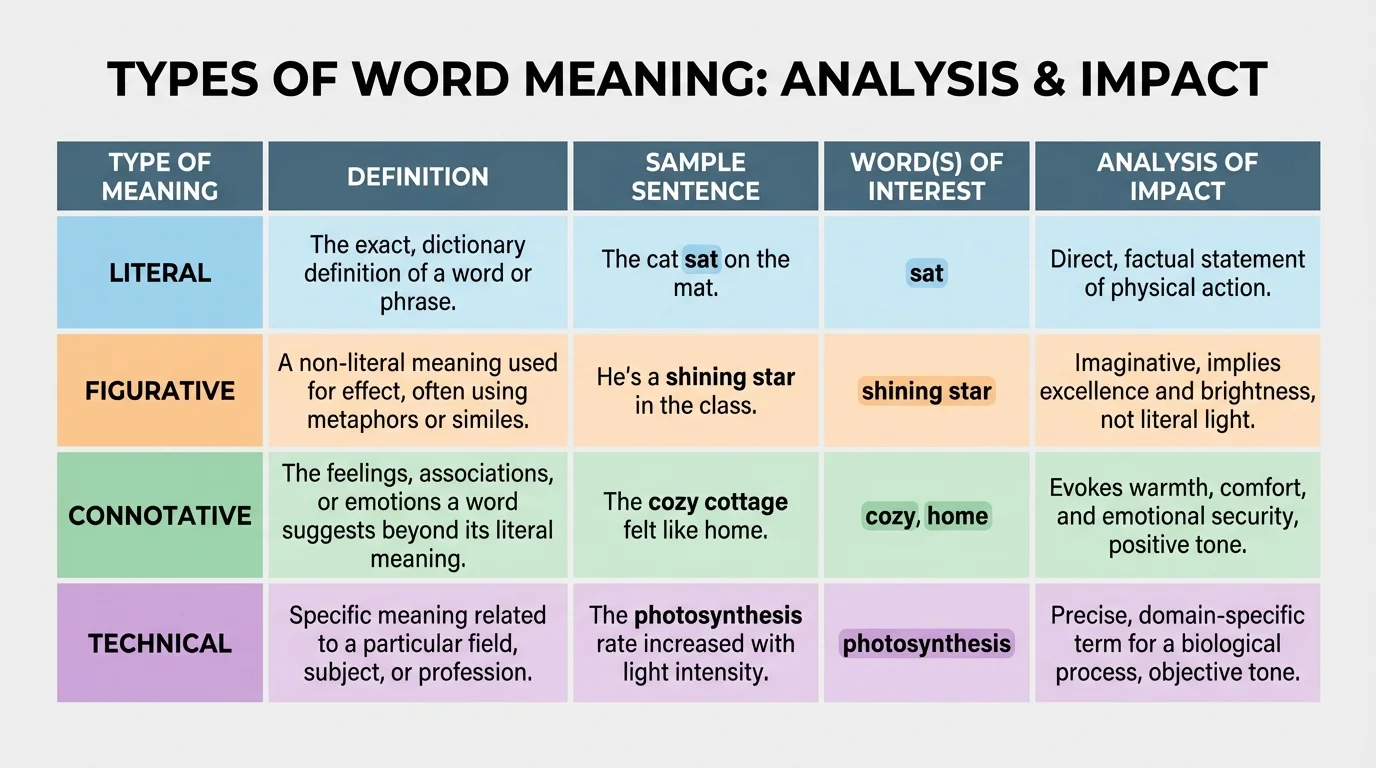
Writers use language in several different ways, and understanding those differences helps you read with more precision. As [Figure 1] shows, the four major kinds of meaning can be compared clearly because the same or similar words may shift depending on how they are used.
Literal meaning is the straightforward, ordinary meaning of a word. If a text says, "The glass shattered on the floor," it literally means the glass broke.
Figurative meaning goes beyond the literal sense to create an image or idea. If a character says, "My heart shattered," no physical glass is involved. The phrase suggests emotional pain.
Connotative meaning includes the feelings or associations attached to a word. Two words may have similar dictionary meanings but very different connotations. Childlike often sounds positive, suggesting wonder or innocence. Childish usually sounds negative, suggesting immaturity.
Technical meaning is the specialized meaning a word has in a particular field or subject. In everyday conversation, volume may mean how loud music is. In math, it refers to the amount of space inside a solid figure. In publishing, it can mean a book in a series.
Learning to separate these kinds of meaning helps you avoid shallow reading. A reader who only sees the literal meaning may miss an important metaphor. A reader who ignores technical meaning may misunderstand an academic passage.
Literal meaning is the direct, ordinary meaning of words.
Figurative meaning is a nonliteral meaning that creates comparison, image, or emphasis.
Connotation is the feeling or association a word carries beyond its dictionary definition.
Technical meaning is a specialized meaning used in a specific subject or field.
Suppose a story says, "The classroom buzzed before the test." Literally, a room does not make the sound of bees. Figuratively, buzzed suggests lively movement, whispering, and nervous energy. The writer could have said "The classroom was noisy," but buzzed is more vivid.
Words can also carry more than one kind of meaning at once. A phrase can be figurative and strongly connotative. A single word in a science article can have a technical meaning but also sound serious or formal because of its connotation.
Figurative language helps writers say more than the literal words alone can express. It creates imagery, strengthens tone, and often reveals a speaker's perspective.
A simile compares two unlike things using words such as like or as. "The lake was like glass" suggests the water was smooth and still. A metaphor makes a direct comparison: "The lake was glass." The metaphor is stronger and more compact.
Personification gives human qualities to nonhuman things. "The wind whispered through the trees" makes the scene feel softer and more alive. Idioms are phrases whose meanings cannot be understood literally, such as "spill the beans," meaning reveal a secret. Symbolism occurs when an object, color, or image stands for a larger idea, such as a storm symbolizing conflict.
These choices matter because they influence the reader's emotional response. "The city was a jungle" does not mean actual vines and wild animals filled the streets. It suggests danger, competition, or chaos. The figurative phrase shapes how the city feels.
Close reading example
Sentence: "By midnight, worry had wrapped itself around him like a tightening rope."
Step 1: Identify the figurative phrase.
The phrase "like a tightening rope" is a simile.
Step 2: Determine the meaning.
The sentence does not mean a real rope is on him. It means his anxiety feels constricting and difficult to escape.
Step 3: Analyze the effect.
The image of a tightening rope creates tension and discomfort, so the tone becomes anxious and intense.
Notice that the writer could simply have said, "He felt worried." Instead, the simile makes the feeling physical and urgent. That is the power of figurative language: it turns an abstract emotion into a vivid experience.
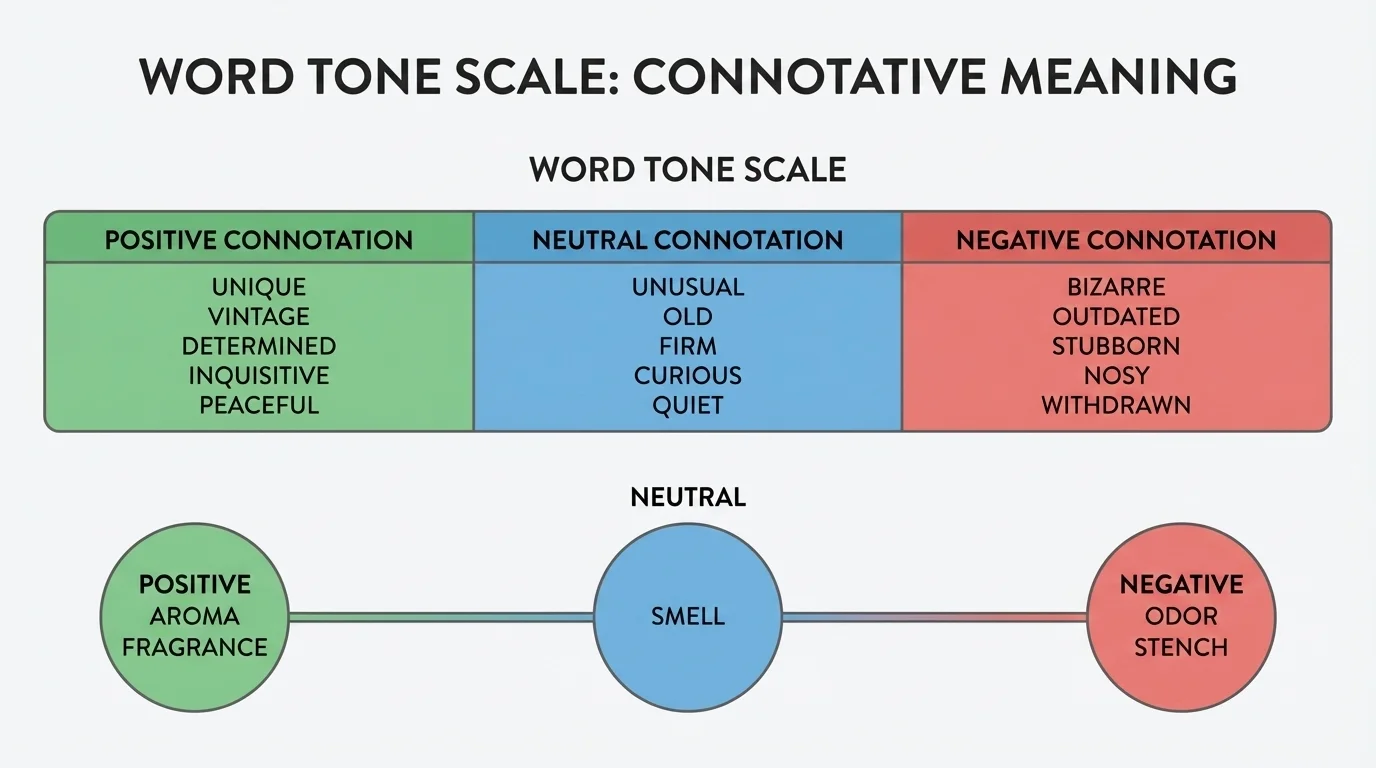
Tone is the author's or speaker's attitude toward the subject, audience, or situation. Word choice is one of the strongest clues to tone. As [Figure 2] illustrates, even words that seem like synonyms can carry very different positive, neutral, or negative shades.
Look at these words for a person who talks a lot: talkative, chatty, gossipy, and noisy. They all connect to speaking often, but they do not sound the same. Chatty may feel friendly. Gossipy suggests sharing unkind or private information. Noisy focuses on disturbance. The connotations guide the tone.
Writers use these shades of meaning carefully. If a narrator describes a house as cozy, the tone may be warm and welcoming. If the same house is described as cramped, the tone may be critical or uncomfortable. The physical size may be similar, but the emotional effect changes.
Connotation matters in nonfiction too. A news article might say a crowd gathered, packed, or swarmed into a plaza. Those verbs suggest very different impressions of the same event. One sounds neutral, one sounds dense, and one may sound aggressive or uncontrolled.
Advertisers, speechwriters, and filmmakers pay close attention to connotation because one word can make a product, person, or event sound trustworthy, exciting, dangerous, or dull.
To analyze tone, ask questions such as these: Are the words formal or casual? Positive or negative? Gentle or harsh? Emotional or detached? Repeated patterns also matter. If a passage keeps using dark, cold, heavy words, the tone may feel gloomy or threatening.
Later in a text, tone can shift. A story may begin with playful language and become serious. A speech may open respectfully and turn forceful. Those changes often appear through new word choices. The contrast is part of the meaning.
We can see the same principle in character description. Calling someone slim sounds approving, while skinny may sound critical. The dictionary meanings overlap, but the tone does not.
A technical meaning appears when a word has a specialized use in a certain field. This is especially important because students often assume a familiar everyday meaning still applies in academic reading.
For example, in science, cell means the basic unit of life. In a prison story, a cell is a small locked room. In technology, people may talk about a cell signal or a cell in a battery. Context tells you which meaning belongs.
Here are several examples:
| Word | Everyday Meaning | Technical Meaning | Field |
|---|---|---|---|
| force | strength or pressure | a push or pull on an object | science |
| plot | a piece of land | the sequence of events in a story | literature |
| degree | a level or amount | a unit for measuring angle or temperature | math/science |
| argument | a disagreement | a claim supported by reasons and evidence | writing |
Table 1. Examples of words that have everyday meanings and specialized technical meanings in academic subjects.
When you read informational text, stop and ask whether the topic suggests a technical use. In a science article, "the organism responded to a stimulus" does not mean an emotional reaction to a fun event. It means the organism reacted to a change in its environment.
This is one reason close reading matters in every class, not only language arts. Understanding technical meanings helps you read science, history, math, and technology more accurately.
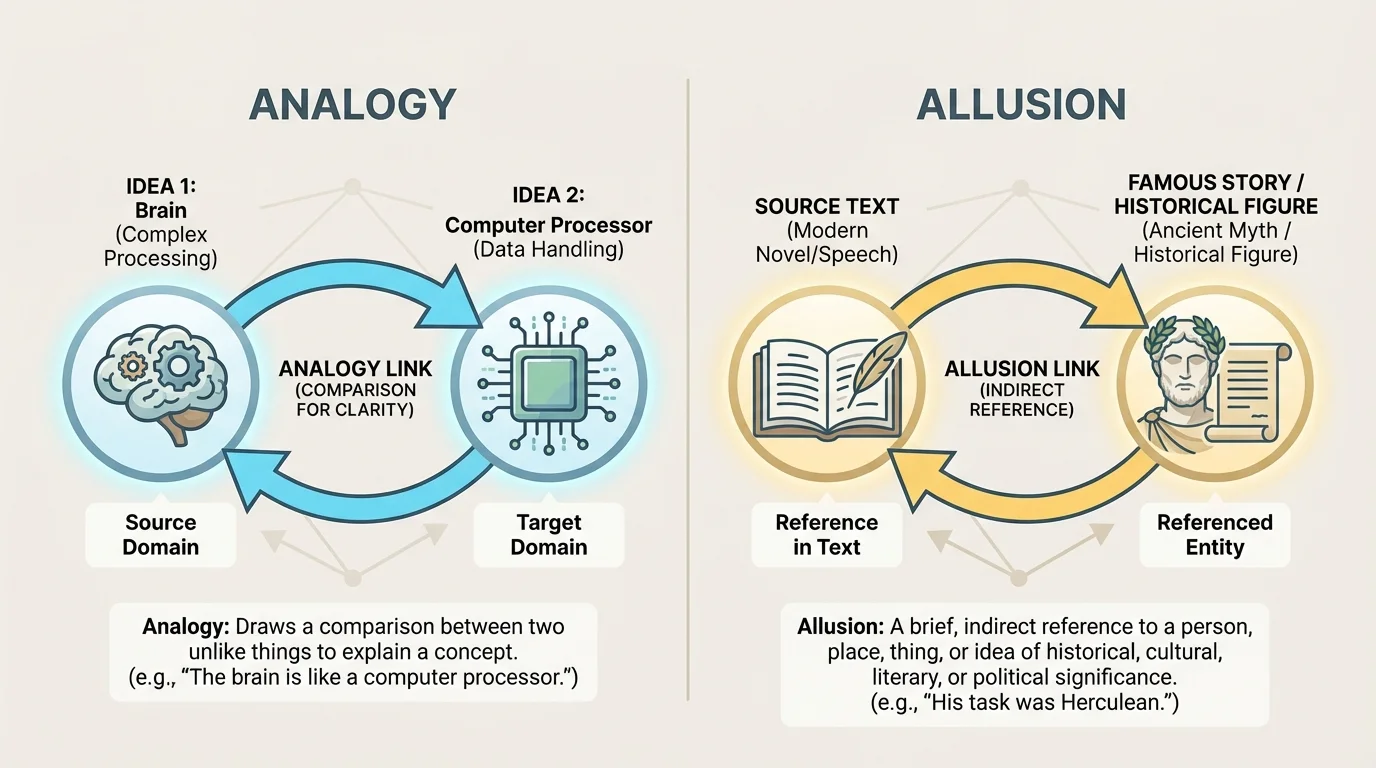
Writers often deepen meaning by connecting one idea to another. Two important tools are the analogy and the allusion. Their relationship becomes easier to see in [Figure 3], which shows that analogies make comparisons while allusions create connections to other texts or shared cultural knowledge.
An analogy explains something by comparing it to something more familiar. For example, a teacher might say, "A thesis statement is like the steering wheel of an essay. It guides the direction." That analogy helps readers understand the job of a thesis.
An allusion is a brief reference to a well-known text, story, person, event, or myth. If a writer describes a difficult puzzle as "a Gordian knot," that alludes to a famous legend about a knot so complicated it seemed impossible to untangle. If a character is called "a Romeo," the text alludes to Shakespeare's romantic hero.
Allusions add meaning quickly because they bring extra ideas with them. Calling someone "an Achilles" may suggest strength with one hidden weakness. Describing a journey as "an odyssey" suggests a long, difficult adventure. The reader's understanding grows if the allusion is recognized.
Analogy and allusion example
Sentence: "Once the rumor spread through the school, it moved like wildfire, and by lunch Marcos felt as if he were wearing an invisible scarlet letter."
Step 1: Find the analogy or comparison.
"Moved like wildfire" is a simile that compares the rumor's spread to a fast-moving fire.
Step 2: Find the allusion.
"Scarlet letter" alludes to a famous work of literature in which a public symbol marks shame.
Step 3: Analyze the effect.
Together, these choices suggest speed, loss of control, and public embarrassment. The tone becomes tense and painful.
Allusions do not always refer to books. They can point to myths, religious stories, historical events, speeches, films, or public figures. However, they are most powerful when the audience is likely to recognize them.
As this comparison suggests, analogies help explain ideas, while allusions enrich meaning. Sometimes a single phrase does both by comparing and also referring to another text at the same time.
Close reading means slowing down and looking carefully at how language operates in a specific passage. Instead of saying, "The author uses good words," a strong analysis names the words and explains their effects.
Read this short passage: "The old amusement park stood at the edge of town, its gates rusting, its signs fading, its roller coaster lifting one broken arm toward the gray sky."
An effective analysis might say this: The words rusting, fading, broken, and gray create a mood of decay and abandonment. The phrase "lifting one broken arm" personifies the roller coaster, making the park seem injured and ghostlike. Together, these word choices produce a gloomy, haunting tone.
Now compare a different passage: "Morning sunlight poured across the field, and the grass flashed with dew as the team ran laughing toward practice." Here the words sunlight, poured, flashed, and laughing create energy and optimism. The tone is bright and hopeful.
Strong analysis uses evidence
When explaining word choice, quote or point to exact words or phrases. Then connect those choices to meaning and tone. The best responses move from evidence to interpretation: "The author uses the word ___, which suggests ___, creating a tone of ___."
You should also watch for repetition. If a speaker repeats words connected to battle, pressure, or survival, the text may frame a challenge as a struggle. If a poet repeats soft, flowing sounds, the language may create calm. Sound and repetition are part of word choice too.
Another key question is this: why this word instead of a simpler one? If an author writes lurched instead of moved, the movement seems sudden and awkward. If a character murmurs instead of says, the speech sounds low, private, or uncertain.
A careful reader notices that words operate at several levels at once. A phrase may describe an object, suggest an emotion, build tone, and echo another text all in one line. That is why literary reading rewards attention.
When you encounter an important word or phrase, pause and consider these questions: What does it mean here? Is it literal or figurative? What feelings or associations does it carry? Does it have a technical meaning in this subject? How does it affect the tone? Does it sound like an analogy or an allusion?
These questions help you move from surface understanding to deeper interpretation. Instead of reading only for plot, you start noticing craft. You see how authors use language to shape readers' ideas and emotions.
That kind of reading matters beyond English class. It helps when reading speeches, editorials, historical documents, scientific writing, and media messages. The more precisely you can interpret words and phrases, the more accurately and thoughtfully you can understand any text.
