A news story, a documentary clip, a website, and a printed article can all explain the exact same event, yet they rarely feel the same. One may seem more trustworthy, another more exciting, and another easier to understand. That difference matters because the way information is presented often shapes what we notice, what we remember, and even what we believe.
When readers evaluate informational text, they do more than gather facts. They also study an author's choices. One of the most important choices is the medium used to present the topic. A medium is the form through which information reaches an audience: a printed page, a digital screen, a video, or a multimedia combination of several forms. Choosing the right medium can make a topic clearer and more powerful. Choosing the wrong one can make even strong information confusing or less convincing.
A medium is not just a container for information. It shapes the message itself. A printed article encourages slow, careful reading. A video can show movement, facial expression, and tone of voice. A digital article can link to other sources instantly. A multimedia presentation may combine text, images, sound, and interaction to help the audience learn in several ways at once.
This means that understanding a topic often requires us to think about both content and presentation. If two authors explain the water cycle, for example, one might use a printed science article full of precise detail, while another creates a short animated video. Both may be accurate, but each one helps the audience in different ways.
Medium means the form used to communicate information or ideas. Audience means the people the message is meant for. Purpose means the reason the author created the message, such as to inform, explain, persuade, or entertain.
When evaluating a medium, students should ask several questions: What does this medium do well? What does it do poorly? Who is supposed to use it? Does it fit the topic? Does it help the audience understand, or does it distract from the main idea?
[Figure 1] Each common medium offers different strengths, and those strengths affect how a topic is understood. Print text usually focuses on words alone. Digital text often includes links, images, and fast updates. Video adds motion and sound. multimedia combines several forms, such as text, visuals, audio, animation, and interaction.
These mediums are not automatically better or worse than one another. Their value depends on the situation. A complex historical argument may need detailed print or digital text. A process such as how a tsunami forms may be easier to understand in video or animation. A health campaign might use multimedia because it needs to catch attention quickly and explain information clearly.
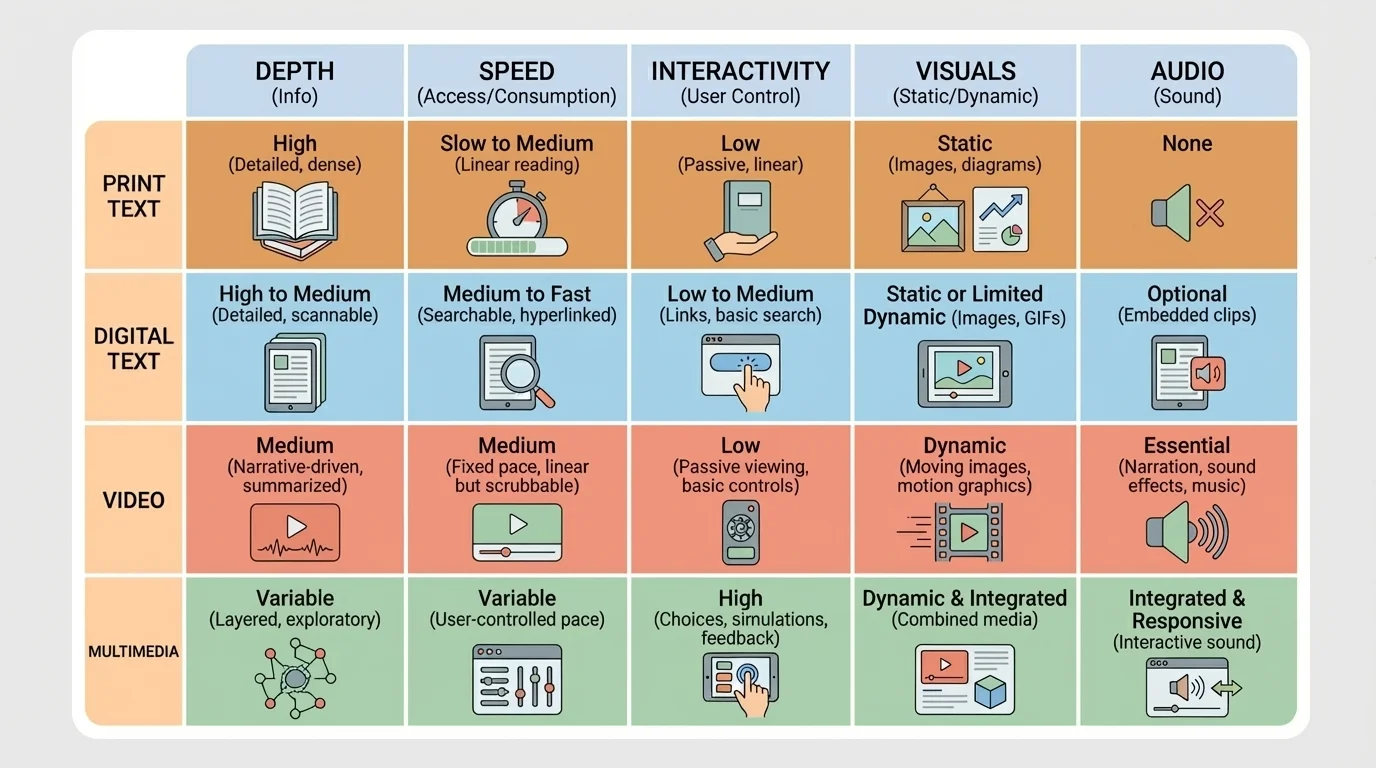
Authors and creators choose mediums based on goals. If they want readers to pause and think, print may help. If they want rapid sharing, digital text may be best. If they want emotional impact, video may be powerful. If they want users to click, explore, and respond, multimedia may be the strongest choice.
Print text includes books, newspapers, magazines, pamphlets, and posters made to be read on paper. One major advantage of print is focus. There are usually fewer distractions than on a screen. Readers can move at their own pace, reread important lines, underline ideas, or take notes in the margins.
Print text is also effective for depth. It often allows more detail and fuller explanation than a short video or poster. A printed article about recycling laws, for example, can explain causes, effects, laws, and statistics in an organized way. Print also feels stable. Once printed, the text does not suddenly change because of an update or broken link.
However, print has disadvantages. It is less flexible than digital forms because it cannot easily include moving images, sound, or clickable links. If information changes quickly, printed material can become outdated. A printed travel guide may still list a museum that has already closed. Print can also be harder to distribute widely because copies must be physically produced and shared.
Another weakness is that print may not work as well for topics that depend on motion or sound. A paragraph can describe how to tie a knot, but a video often makes that process much easier to follow. As we can infer from the comparison in [Figure 1], print tends to support careful reading better than quick demonstration.
Case study: Print text for a historical topic
A printed magazine article about the Montgomery Bus Boycott can be very effective because it gives dates, quotations, background, and explanations of cause and effect.
Step 1: The reader learns the sequence of events in a clear order.
Step 2: The article can include direct quotations from speeches or interviews.
Step 3: The reader can pause, reread, and think carefully about how one event led to another.
The disadvantage is that the article cannot directly show the atmosphere of the protests the way film footage can.
For some audiences, print may also feel less engaging, especially if the text is dense or lengthy. This does not mean print is weak. It means print works best when readers need accuracy, detail, and control over pacing.
Digital text includes websites, online articles, blogs, e-books, and other information read on screens. A major strength of digital text is speed. It can be published, updated, and shared quickly. During a storm or wildfire, online articles can provide current information faster than printed sources.
Digital text can also support learning through links, photos, captions, maps, and interactive features. An article about renewable energy might link to a wind farm map, a scientist interview, and a graph of electricity use. This allows readers to explore beyond the main text.
Still, digital text has weaknesses. Screens can encourage skimming instead of deep reading. Advertisements, pop-ups, notifications, and unrelated links can interrupt attention. Some websites are also designed more to attract clicks than to present reliable information. That means readers must check credibility carefully.
Access is another issue. Digital text depends on devices, electricity, and often internet service. If a student has a weak connection or no device, digital information becomes less useful. In that case, digital text may be technically available but not truly accessible.
Many people read faster on screens when they are searching for one fact, but they often understand complicated ideas more deeply when they slow down with a printed page.
Digital text is often excellent for current events, research, and broad access. It is less effective when distractions are high or when readers need long periods of concentration.
Video layers sound, image, movement, and pacing together, so it can communicate ideas very quickly. A documentary, interview, demonstration, news report, or tutorial can make information feel immediate and vivid.
One of video's greatest strengths is its ability to show action. If the topic is how a heart pumps blood, how a machine works, or how a gymnast performs a skill, moving images can make understanding easier. Tone of voice, music, and facial expression also add emotional meaning. This can make a topic memorable.
[Figure 2] Video can also help students who learn well through listening and watching. Captions can support understanding, and visuals can explain ideas that are hard to picture from words alone. A short science animation may explain plate tectonics more clearly than a dense paragraph.
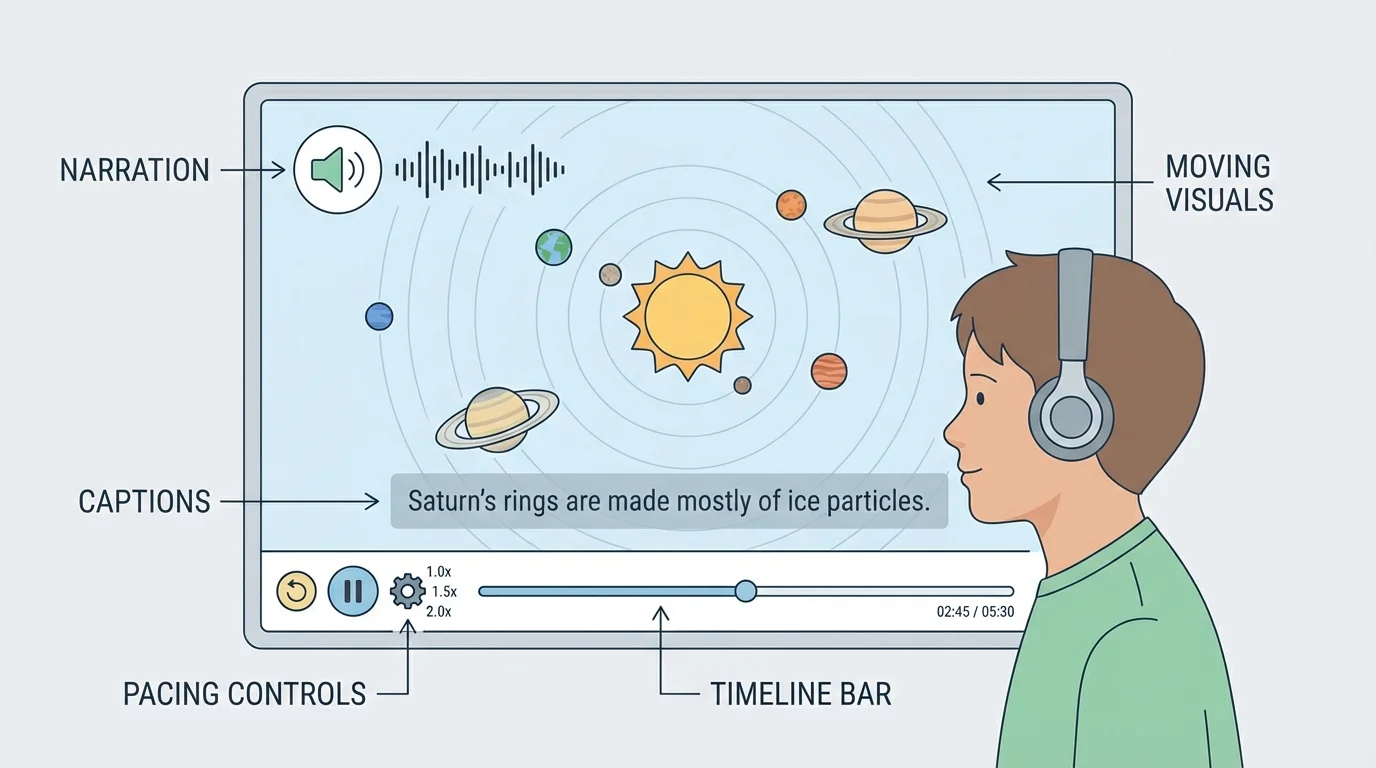
But video also has disadvantages. It often moves at the creator's pace, not the viewer's pace. Even though viewers can pause or rewind, they may miss details if the information passes too quickly. Video sometimes creates strong emotion without enough explanation. Dramatic music and editing can make something seem more convincing than the evidence really is.
Another weakness is that video may simplify too much. A two-minute clip about climate change can raise awareness, but it may leave out scientific detail, counterarguments, or source information. A student who wants depth often needs text alongside the video.
Video can also be less searchable than text. In a written article, readers can scan for a key term. In a long video, they may have to watch large sections to find one specific detail. This limits efficiency in some situations.
When evaluating video, students should pay close attention to editing, music, camera angles, and speaker choice. These are author decisions. Just as word choice matters in writing, visual and sound choices matter in video. The layered design of video can either support understanding or push the audience toward a certain emotional reaction.
Multimedia combines several forms at once, often including text, image, audio, video, animation, and interactive elements. Examples include slide shows, educational websites, museum displays, and interactive news stories. Its biggest advantage is flexibility. It can explain information in more than one way.
For example, a multimedia lesson on earthquakes might include a short written explanation, an animation of tectonic plates, a map of earthquake zones, and recorded expert comments. This allows users to connect ideas across different forms. It can be especially useful when a topic is complex and benefits from several types of evidence.
Multimedia can also increase interactivity. Instead of only reading or watching, users may click, listen, zoom, compare, or answer questions. That can improve engagement and allow learners to move through information in a way that fits their needs.
However, multimedia has disadvantages too. If too many elements appear at once, the result can become overwhelming. Bright graphics, sound effects, side menus, and animations may distract from the main point. Good multimedia requires careful design. More features do not automatically mean better learning.
Multimedia also takes more time, skill, and technology to create. It may load slowly or fail on some devices. If audio is missing captions or images lack descriptions, accessibility problems can appear. A strong multimedia source must balance variety with clarity.
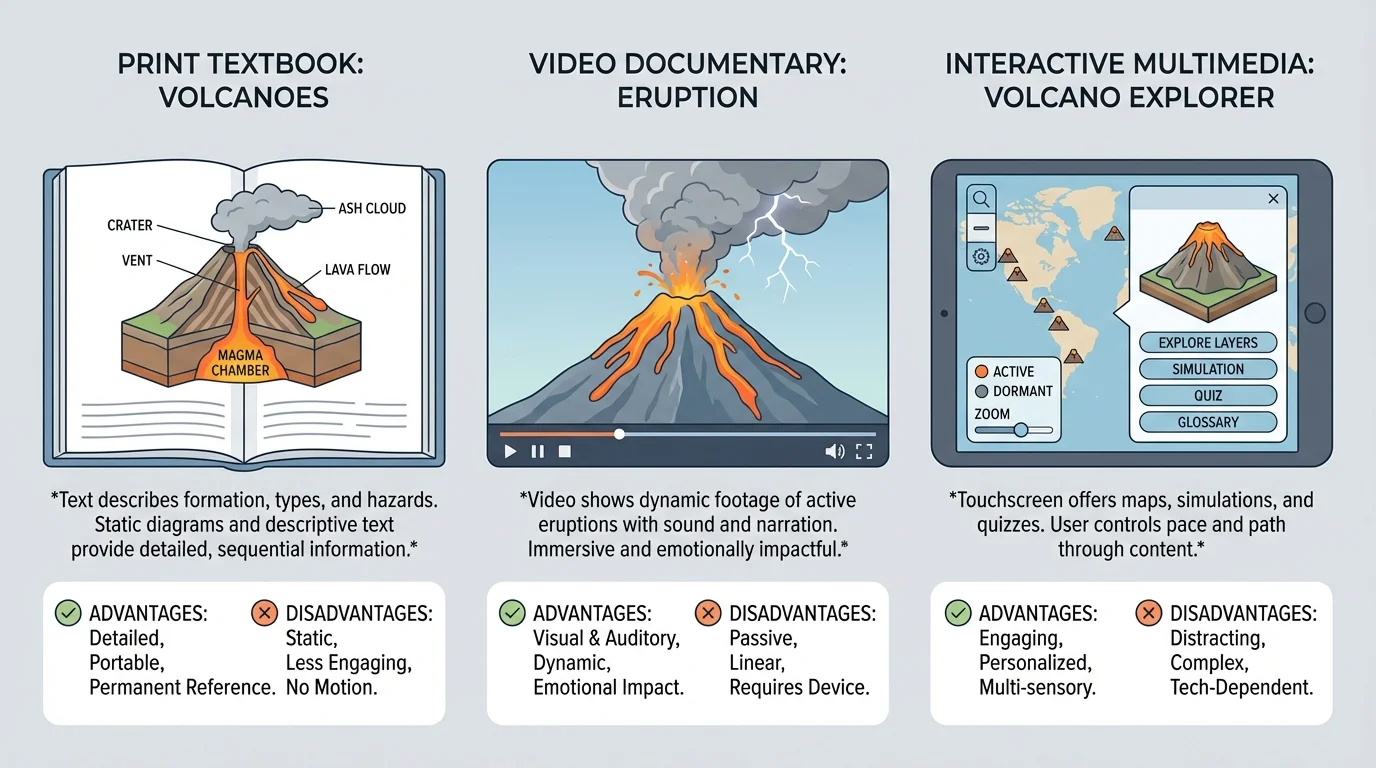
A single topic can look and feel very different depending on format. Suppose the topic is volcanoes. A textbook page may define magma, explain eruption types, and include labeled diagrams. A documentary clip may show lava flowing and ash rising into the sky. An interactive website may let users click different volcanoes on a world map and compare eruption data.
[Figure 3] Each version gives something valuable. The print version may give stronger detail and organization. The video version may create clearer visual understanding of movement and scale. The multimedia version may let users explore and compare information for themselves.
Now consider a historical event such as the building of the Berlin Wall. A printed article may explain the political causes carefully. A video interview with people who lived there may communicate emotion and personal experience. A digital timeline with maps and clips may help students connect events across time and place.
This comparison teaches an important lesson: no medium is perfect for every purpose. The best choice depends on what the audience needs most. If the goal is emotional connection, video may lead. If the goal is detailed explanation, print or digital text may be stronger. If the goal is exploration, multimedia may work best.
Different mediums emphasize different kinds of understanding. Print often supports analytical thinking and detail. Video often supports observation and emotional impact. Digital text often supports speed and connection to other sources. Multimedia often supports exploration and layered learning. Evaluating a source means asking which kind of understanding the author is trying to create.
This is why students should avoid saying only, "Video is better," or "Books are better." A stronger evaluation explains better for what. This comparison makes clear that the same facts can feel very different when the medium changes.
The best medium depends heavily on audience and purpose. A health department trying to warn people quickly about heat danger might use short digital posts and videos. A science journal explaining research results to experts would likely use detailed text and graphs. A museum exhibit for families may use multimedia because visitors need short, visual, interactive information.
Choosing a medium is a decision process. Authors think about who the audience is, what they already know, how much time they have, and what response is wanted. If the audience is new to a topic, video or multimedia may provide a helpful introduction. If the audience already understands the basics, detailed text may be more useful.
[Figure 4] Purpose matters just as much. If the goal is to explain a process step by step, video may help. If the goal is to present evidence and argument, print or digital text may be stronger. If the goal is to persuade through emotion and imagery, video often has great power. If the goal is to combine explanation, evidence, and engagement, multimedia may be the best fit.
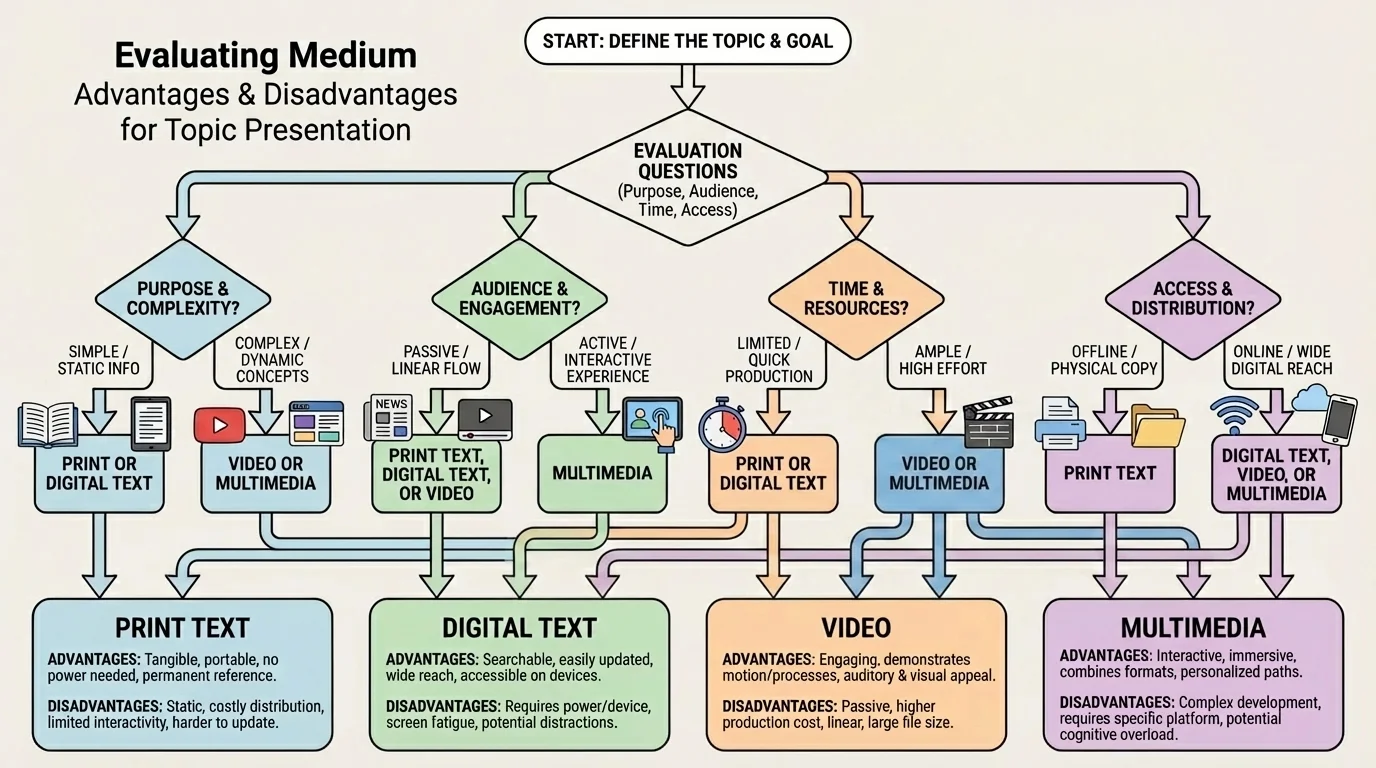
Time and setting matter too. In a classroom with limited internet, print may be more reliable. For a public message shared on phones, digital or video may reach more people. Medium choice is not only about quality; it is also about practical conditions.
When evaluating an author's choice of medium, students should look at effectiveness. Does the medium match the topic? Does it give enough detail? Is it easy to use? Does it create trust, or does it feel manipulative? A good evaluation goes beyond personal preference.
For example, if an author explains the dangers of plastic pollution using a short video filled with powerful ocean images, that may be effective for raising awareness. But if the same source gives no data, no expert voices, and no explanation of solutions, then the medium may create emotion without enough information. In contrast, a long printed report may include excellent evidence but fail to reach a broad audience because few people will read all of it.
Strong evaluation often compares trade-offs. A source may gain speed but lose depth. It may gain emotional impact but lose precision. It may gain interaction but become distracting. Good readers notice both sides.
Evaluating an author's medium choice
Suppose an author wants to teach teens about online safety.
Step 1: Identify the purpose. The goal is to inform students and change behavior.
Step 2: Consider the audience. Teens often use phones and respond quickly to visual content.
Step 3: Evaluate possible mediums. A printed handout may give detail but might be ignored. A short video may grab attention but may oversimplify. An interactive website with short videos, examples, and checklists may balance attention and useful information.
A strong judgment would explain why one medium fits this audience and purpose better than the others.
Evaluating author choices means noticing design, structure, and effect. Medium is one of the author's most powerful design choices.
Medium also affects how bias and reliability appear. A polished video may look professional even if its information is weak. A plain printed article may seem boring but contain strong research. Students should not confuse style with truth. They should check sources, evidence, dates, and expertise no matter what medium is used.
Bias can appear in every medium. In print, it may appear through loaded word choice. In digital text, it may appear through selective links or headlines designed for clicks. In video, it may appear through editing, music, or which clips are included and excluded. In multimedia, it may appear through design paths that push users toward one conclusion.
Accessibility is another key issue. A strong source should work for different users. Print may help some readers but create difficulty for people with certain visual needs. Video may help with demonstration but requires captions for many viewers. Digital text may support adjustable font size and screen readers, but only if designed well. Multimedia can be powerful, but only when all users can navigate it.
Reliable evaluation always includes the source of information, the evidence used, and the intended audience. Medium matters, but it does not replace careful thinking about truth, bias, and support.
When students combine medium analysis with credibility checks, they become much stronger readers of informational texts.
In many real situations, the best answer is not one medium alone but a combination. A science teacher may use a printed article for detail, a video for demonstration, and a multimedia quiz for review. A news organization may publish a written investigation, a short video summary, and an interactive graphic. Each part serves a different purpose.
This does not mean every project should use everything. Too many mediums can become messy. The goal is thoughtful selection. A strong creator asks, "What does my audience most need?" and "Which medium helps that happen most clearly?" The decision process we saw in [Figure 4] helps organize that thinking.
As readers, viewers, and creators, students should learn to judge mediums with evidence. They should notice when a printed source gives needed depth, when digital text improves speed and connection, when video makes a process visible, and when multimedia adds useful interaction. They should also notice when those same mediums create distraction, oversimplification, weak evidence, or access problems.
Evaluating mediums is really about understanding communication. The form of a message influences how people receive it. Once students recognize that, they are better prepared to analyze informational texts critically and make strong choices in their own communication.
