A strong speaker can change what people think, understand, or do. A student presenting science results, a coach explaining a strategy, a lawyer making an argument, and a news reporter sharing facts all rely on the same skill: presenting ideas clearly and convincingly. When you speak in front of others, it is not enough to simply know your topic. You need to choose the right points, support them with proof, and deliver them in a way your audience can actually follow and trust.
Oral presentations are part of school, work, and public life. People present claims when they argue that something is true or should happen. People present findings when they report what they learned from research, reading, observation, or investigation. In both cases, listeners need to understand the main point quickly, follow the logic, and believe that the speaker has good reasons.
If a presentation is confusing, even a smart idea can seem weak. If a speaker mumbles, avoids the audience, or includes too many unimportant facts, the message loses power. Clear speaking helps your ideas sound stronger because your audience can see the connection between your point and your proof.
Claim is a statement a speaker wants the audience to accept as true or reasonable.
Finding is a result or conclusion based on research, data, observation, or experience.
Evidence is the information that supports a claim or finding, such as facts, examples, quotations, statistics, or observations.
Reasoning is the explanation that shows how the evidence supports the claim or finding.
These ideas work together. A claim without evidence sounds like an opinion. Evidence without reasoning can feel random. Strong speaking connects all three so the audience can understand not only what you believe, but why they should believe it too.
Suppose a student says, "Our school should start later in the morning." That is a claim. It expresses a position. Now suppose the same student reports, "In our survey, most students said they get less than eight hours of sleep on school nights." That is a finding. It reports a result.
Claims and findings often appear together. A student might claim that school should start later and use findings from a survey, a sleep study, and expert opinions to support that point. In a history presentation, a student might claim that a certain event changed a nation's future and use findings from documents and historians to support that argument. In a science report, a student might present findings first and then explain the claim that those findings support.
The key is to make your purpose clear. Are you trying to persuade, inform, explain, or report? Your audience should know early what your central idea is.
Good writing skills support good speaking skills. A clear thesis in an essay is similar to a clear central claim in a presentation. Topic sentences in writing are like spoken main points that guide listeners through your ideas.
A presentation also needs a narrow focus. If your topic is too broad, your audience may leave remembering almost nothing. If your topic is focused, your strongest points stand out.
Salient points are the ideas that matter most. They are the points your audience most needs to hear and remember. A common mistake is trying to include every fact you found. Strong speakers do the opposite: they select only the information that best supports the main message.
Think of a presentation as a spotlight, not a floodlight. A floodlight shines everywhere and can make it hard to notice what matters. A spotlight directs attention. If your claim is that community gardens help neighborhoods, your salient points might be that they provide fresh food, bring people together, and improve unused spaces. You would not spend much time on less important details, such as the brand of shovel used in one garden, unless that detail mattered to your purpose.
To choose salient points, ask three questions: What is my main message? What evidence best supports it? What does my audience need most? If a fact is interesting but does not help answer these questions, leave it out.
Professional speakers often cut large amounts of material before presenting. What makes a talk powerful is usually not how much information it includes, but how carefully the speaker selects the most meaningful parts.
Salient does not mean dramatic only. A quiet fact can be more important than a flashy one if it directly supports your point. The strongest presentations are not stuffed with facts; they are shaped by judgment.
As [Figure 1] shows, a coherent presentation moves in a clear, logical order from the main idea to supporting parts. Listeners should not have to guess how one idea connects to the next. Each section should build naturally on the one before it.
Most effective presentations have three main parts: an introduction, a body, and a conclusion. The introduction grabs attention, introduces the topic, and states the main claim or purpose. The body develops the key points with evidence and explanation. The conclusion reinforces the most important idea and leaves the audience with a final thought.
Within the body, organize points in a logical way. You might use order of importance, cause and effect, problem and solution, compare and contrast, or chronological order. The best pattern depends on your purpose. If you are explaining why recycling programs matter, problem and solution may work well. If you are reporting the stages of an experiment, chronological order may be best.
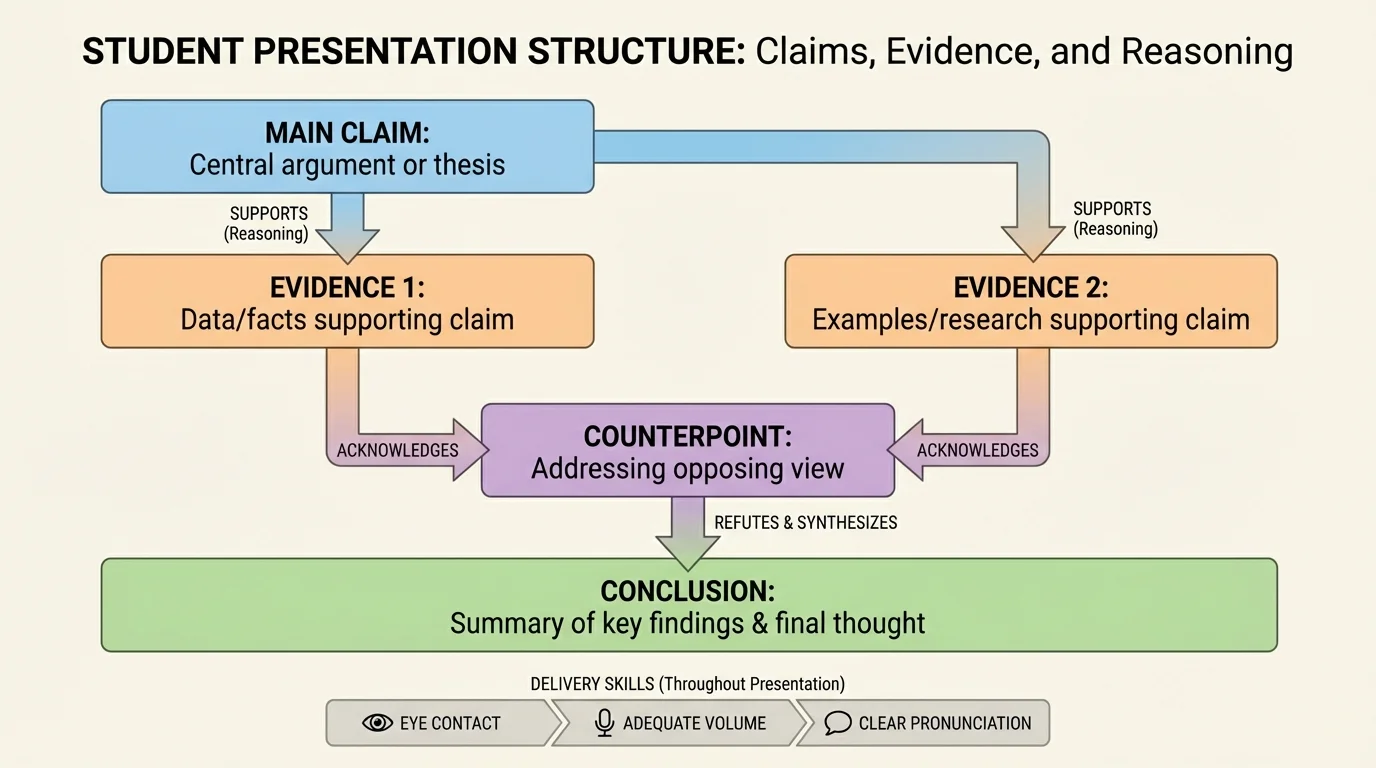
Transitions are words or phrases that connect ideas. They help your audience follow your thinking. Phrases such as "first," "for example," "in contrast," "as a result," and "most importantly" signal how ideas relate. Without transitions, a presentation can sound like a pile of separate sentences.
Suppose a student is speaking about reducing plastic waste. A coherent structure might sound like this: first, explain the problem of plastic pollution; next, present evidence about how much single-use plastic is thrown away; then, offer solutions such as reusable containers and school policies; finally, end by explaining why small changes can lead to larger community impact. That order makes sense to listeners.
Later, when you are revising a presentation, use this structure as a reminder that every part should support the central point instead of wandering away from it.
Focus and coherence work together. Focus means you stay centered on the main message. Coherence means your ideas connect smoothly and logically. A presentation can be focused but still confusing if the points are out of order. It can be organized but still weak if the speaker includes too many side topics. Strong speaking requires both.
One useful test is this: if someone heard only your introduction, your transitions, and your conclusion, would they still understand the path of your thinking? If the answer is yes, your structure is probably strong.
Evidence gives your presentation credibility. It shows that your ideas are based on something more than personal preference. Relevant evidence connects directly to the point you are making. If your claim is about the health benefits of exercise, evidence about favorite sports teams may be interesting but not relevant unless it supports your point.
Different types of evidence can be effective. Facts and statistics can show scale or frequency. Expert quotations can add authority. Examples can make an idea concrete. Observations and survey results can show patterns. Historical documents can support a claim in social studies. The best evidence depends on the subject and audience.
Reasoning is what turns evidence into an argument. It explains the link between your proof and your point. If you say, "Students who read regularly often improve vocabulary," that is a claim. If you add data from a reading study, that is evidence. But you still need to explain why reading improves vocabulary, such as repeated exposure to words in context. That explanation is reasoning.
Valid reasoning means the logic makes sense. It avoids errors such as jumping to conclusions, using weak comparisons, or assuming that one example proves everything. For instance, saying "One student improved after joining band, so band always improves grades" is weak reasoning. One case is not enough to prove a broad claim.
Example: weak support vs. strong support
Claim: School gardens should be expanded.
Step 1: Weak version
"Gardens are nice, and many people like plants."
Step 2: Stronger evidence
"Students in schools with garden programs reported more interest in nutrition lessons, and teachers used gardens for science activities."
Step 3: Stronger reasoning
"Because gardens connect classroom learning to real experiences, they can improve both student engagement and understanding."
The stronger version gives proof and explains why that proof matters.
Evidence should also be accurate and trustworthy. Reliable sources include respected books, articles, interviews with experts, school-approved databases, and firsthand observations when appropriate. If a source seems extreme, unclear, or unsupported, it may weaken your presentation instead of helping it.
Effective details make ideas vivid and believable, but only when they fit the purpose. Audience matters. A presentation for classmates may use familiar school examples. A presentation for a community group may need local examples and more background information. A presentation for younger students would need simpler language and shorter explanations.
Well-chosen details are specific enough to help the audience understand, but not so numerous that they bury the main point. If you are explaining why storms can become dangerous, one clear example of flooding in a nearby area may help more than a long list of weather terms the audience does not know.
Purpose matters too. If your purpose is to persuade, choose details that strongly support your claim and address likely questions. If your purpose is to inform, choose details that explain clearly and accurately. If your purpose is to report findings, choose details that help the audience understand what was discovered and why it matters.
| Situation | Effective Detail Choice | Less Effective Detail Choice |
|---|---|---|
| Presenting to classmates | Examples from school schedules, homework, clubs | Technical information with no explanation |
| Presenting findings from a survey | Main results, sample size, important patterns | Every single response in full detail |
| Persuading an audience | Strong facts, clear examples, likely counterarguments | Emotional statements with little proof |
| Explaining a process | Steps in order, key vocabulary, simple examples | Skipping steps or overloading with side facts |
Table 1. Examples of choosing details based on purpose and audience.
Skilled speakers think from the listener's side. They ask, "What will help this audience understand and care?" That question improves both content and delivery.
As [Figure 2] illustrates, even strong ideas can be lost if the delivery is weak. Delivery affects how your message is received by showing the difference between engaged speaking and disconnected reading. Your words matter, but so do your voice, posture, and connection with listeners.
Eye contact helps create trust and attention. It shows confidence and helps the audience feel included. Good eye contact does not mean staring at one person. Instead, look at different parts of the room for a few seconds at a time. If you only look at your notes or the screen, the audience may feel ignored and may stop listening.
Your posture also supports effective delivery. Stand upright, keep your body open, and avoid fidgeting as much as possible. Calm movement can support a point, but repeated shifting, tapping, or playing with objects can distract listeners.
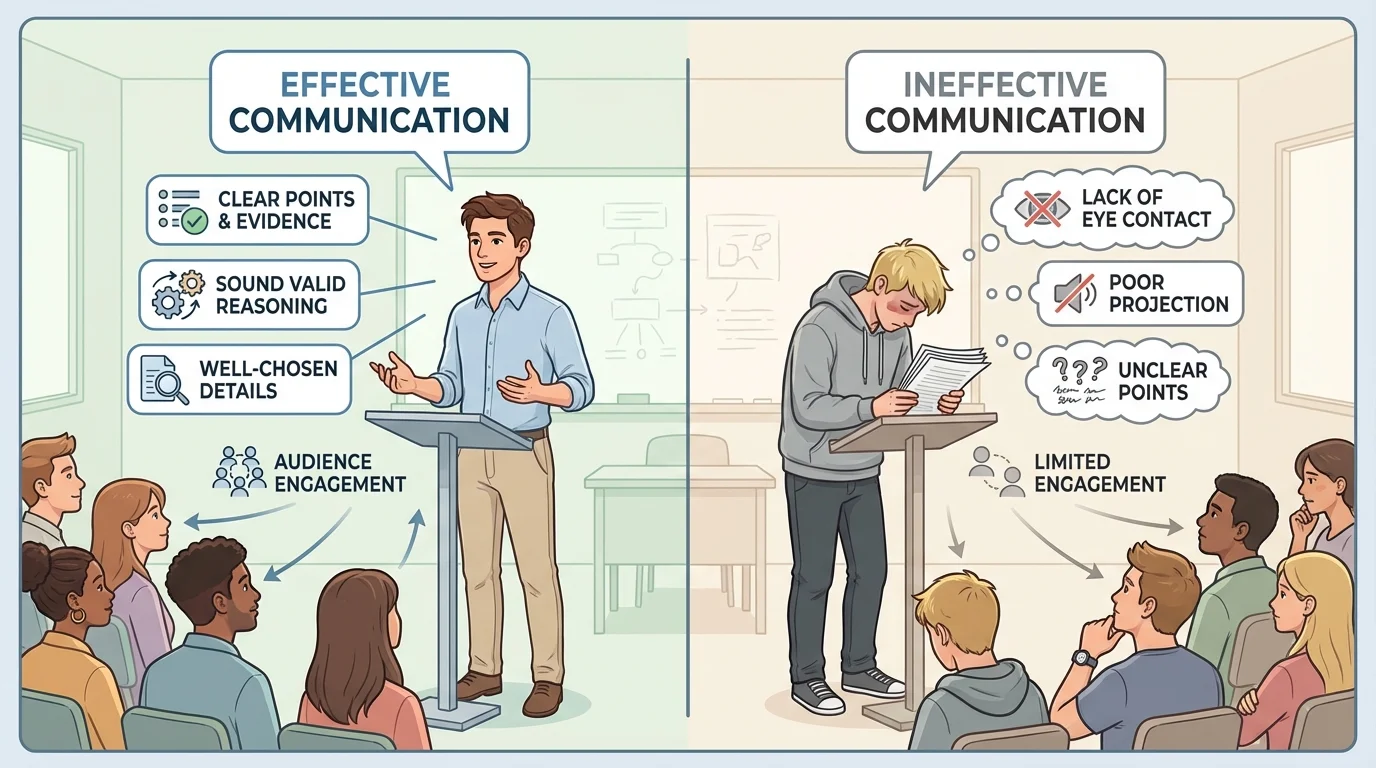
Adequate volume means speaking loudly enough for everyone to hear, not shouting. A volume that is too soft forces listeners to work too hard. A volume that is too loud can feel harsh. Good speakers adjust based on room size, background noise, and audience distance.
Clear pronunciation means saying words distinctly so listeners can understand them. This includes pronouncing key vocabulary carefully, not rushing, and pausing between ideas. Speaking too fast often causes slurred words and lost meaning. Slowing down slightly usually improves both clarity and confidence.
Pacing matters. If you race through a presentation, your audience cannot process your points. If you pause after an important idea, listeners have time to absorb it. Pauses are not a sign of weakness. They are a tool of strong speaking.
When preparing, practice aloud rather than only reading silently. Hearing your own voice helps you notice unclear words, awkward phrasing, and spots where your volume drops. This contrast shows that effective delivery is not just about words on a page; it is about how those words reach people.
"Say it so people can hear it, understand it, and remember it."
Notes can help, but they should support you, not replace you. Use short cue words or phrases instead of full paragraphs when possible. That keeps you from reading in a flat voice and losing contact with your audience.
Many presentations weaken for predictable reasons. One problem is too much information. A student may research well but then include every fact. The fix is to return to the central claim and remove points that do not directly support it.
Another problem is weak evidence. If your proof is vague, outdated, or unrelated, your argument becomes less convincing. Replace weak support with clearer examples, stronger facts, or more trustworthy sources.
A third problem is unclear organization. If listeners cannot tell where the presentation is going, they may stop following. Use clear transitions and a logical pattern. Say your points in an order that makes sense.
A fourth problem is reading instead of speaking. Reading every word often lowers eye contact, expression, and audience connection. Practice enough to speak naturally from notes.
A fifth problem is unclear delivery. Mumbling, speaking too fast, or failing to project can hide good ideas. Rehearsal, breathing, and slower pacing can improve this quickly.
Revision is part of speaking. Strong presentations are usually revised. Speakers cut unnecessary details, improve evidence, sharpen transitions, and practice delivery. Speaking well often looks natural because the speaker prepared carefully.
Fixing these issues does not require perfection. It requires attention. Small changes in organization and delivery can make a large difference in how clearly your message reaches others.
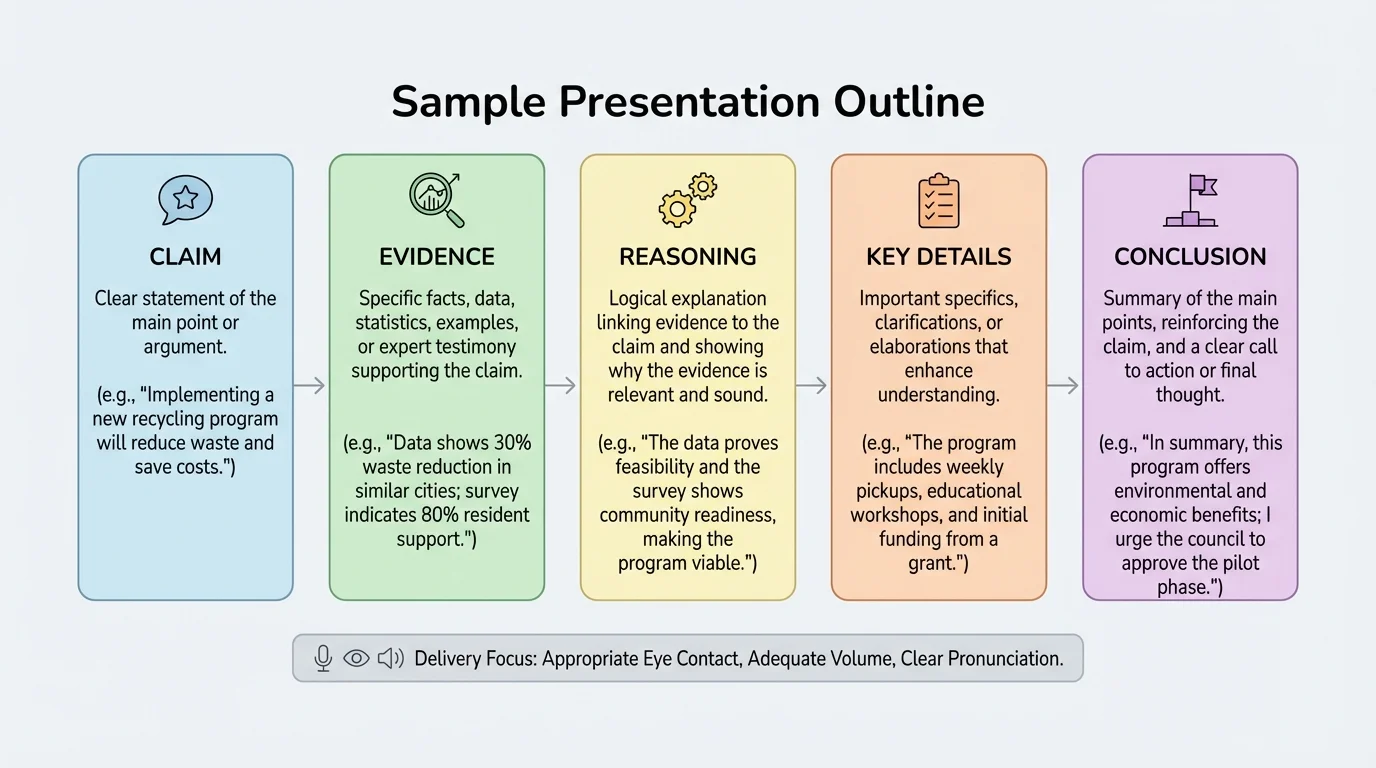
As [Figure 3] shows, a model can make the parts of strong speaking easier to see. The outline maps a short presentation so you can notice where the claim, evidence, reasoning, and conclusion each appear. Seeing those parts separately helps you build them more intentionally in your own speaking.
Consider this short example: "Our school should create a phone-free lunch period twice a week. In a student poll, many respondents said they wanted more face-to-face conversation during lunch. Research on attention and social interaction also suggests that constant phone use can reduce direct communication. Because lunch is one of the main times students can interact informally, setting aside two phone-free days could help build stronger social connections without banning phones entirely."
This short presentation works because it is focused. The claim is clear: create a phone-free lunch period twice a week. The evidence includes both a student poll and outside research. The reasoning explains why lunch is the right time for this change. The detail "twice a week" is specific and practical, which makes the claim sound more thoughtful.
Notice also what the speaker does not do. The speaker does not list every opinion from the poll, describe every study about phones, or drift into unrelated complaints about school rules. That restraint keeps the presentation strong.
Later, when building your own presentation, use this outline as a checklist: Is the claim obvious? Is the evidence relevant? Does the reasoning explain the connection? Are the details specific but selective?
Case study: turning a rough idea into a stronger presentation
Rough version: "Recess should be longer because students like it."
Step 1: Sharpen the claim
"Middle school students should have a slightly longer break during the day."
Step 2: Add relevant evidence
"Some studies link short movement breaks to improved focus, and many students spend long hours sitting in class."
Step 3: Add reasoning
"If students have time to move and reset, they may return to class more ready to pay attention."
Step 4: Add a well-chosen detail
"Even an added break of a few minutes could make a difference without taking much time from instruction."
The improved version is more persuasive because it is specific, supported, and logical.
Strong speaking is often the result of asking good questions about your own message. What is the point? What supports it best? What should the audience remember most?
Confidence does not mean acting perfectly calm or never feeling nervous. It means being prepared enough to speak with control. Most speakers feel some nervousness. Preparation reduces that feeling because it gives you a clear plan.
Integrity matters too. Present information honestly. Do not twist evidence to make it say more than it can. If a source is limited, say so. If there is another side to the issue, acknowledge it fairly. That kind of honesty makes your presentation more trustworthy, not less.
Respect also matters in oral communication. When speaking about serious issues, avoid mocking people or oversimplifying different views. A strong speaker can disagree firmly while still speaking responsibly.
When all these skills come together, your presentation becomes more than a speech assignment. It becomes an act of communication that informs, persuades, and connects. Your goal is not to sound fancy. Your goal is to make your ideas clear, meaningful, and hard to ignore.
