Have you ever watched a movie based on a book and said, "That is not how I pictured it"? That reaction is the start of real literary analysis. A story on a page and a story on a stage or screen are not exactly the same kind of art. A written text uses words to help readers imagine events. A production uses faces, voices, movement, lighting, sound, costumes, and sometimes camera angles. When we analyze a production, we do more than notice differences. We ask why those differences exist and whether the choices made by the director and actors help or harm the story.
Comparing a text with a performance is an important skill because it teaches careful reading and careful viewing at the same time. It also helps us understand that literary works are open to interpretation. Two directors can use the same script and create very different experiences. Two actors can say the same line and make it sound tender, threatening, or sarcastic. That means a production is not just a copy of a text. It is a reading of the text, shaped by artistic choices.
A filmed or live production is often called an adaptation when it transforms a story, novel, or drama into another form. Some adaptations stay very close to the original. Others make large changes. Neither approach is automatically better. A faithful version may preserve the author's ideas clearly, but it may also feel slow or limited if it copies the text without considering what works best on stage or screen. A version that departs from the text may lose important meaning, but it may also make the story more powerful for a new audience.
For that reason, strong analysis avoids simple statements such as "the movie changed the book, so it is bad." A better evaluation asks questions like these: Which parts stayed the same? Which parts changed? What effect do those changes have on character, conflict, mood, theme, or audience understanding? Were the choices thoughtful and effective?
Adaptation is a version of a story or drama changed into another form, such as a film or stage production.
Faithful means staying close to the original text in important ways, such as plot, characters, and themes.
Departure means a change from the original text, such as cutting scenes, altering a setting, or changing dialogue.
Script is the written text for a play, movie, or show, including dialogue and often directions for performance.
Staging is the way action is arranged in a live performance, including movement, position, and use of space.
When you compare a text and a production, it helps to remember that not every difference matters equally. If a film changes the color of a character's jacket, that may not affect the story much. But if it changes the reason a character betrays a friend, that can completely reshape the meaning of the story. Good evaluation focuses on the most important choices, not every tiny detail.
A production can be considered faithful in several ways, as [Figure 1] shows through the main categories readers and viewers should compare. It may keep the same plot, meaning the major events happen in the same order with the same main conflicts. It may preserve characterization, so the characters' motives, values, and personalities feel true to the text. It may also keep the same tone, such as humorous, suspenseful, tragic, or serious.
Faithfulness can also appear in setting, theme, and dialogue. For example, if a play script presents a scene as tense and private, a faithful production would likely preserve that mood instead of turning it into a loud comic moment. If a novel's main theme is the danger of pride, a film that changes events but still highlights that warning may still be faithful in a deeper way.
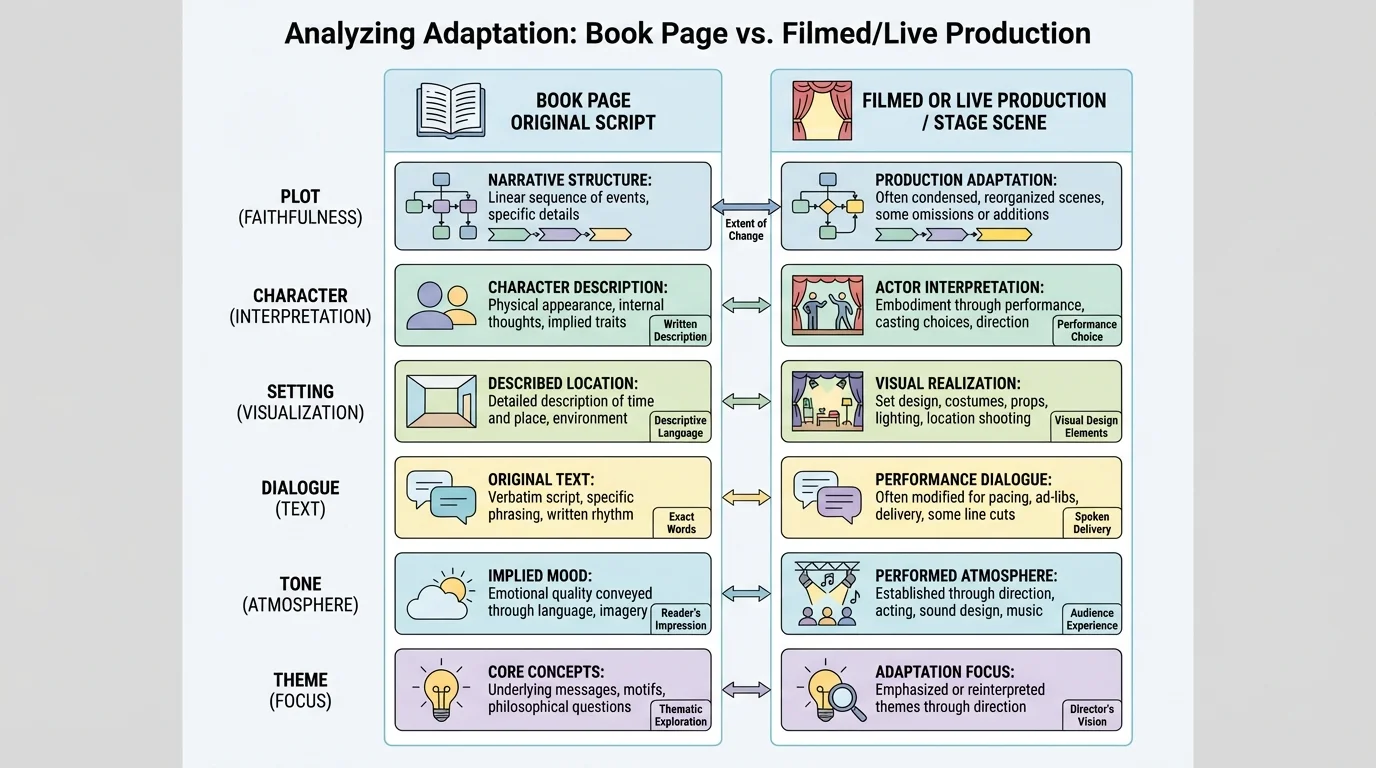
Sometimes students think faithfulness means copying every line exactly. That is too narrow. In many cases, a production cannot include every word from a long novel or every stage direction from a script. Time limits matter. Visual storytelling matters. Audiences also understand some things faster when they can see them instead of hearing them explained. A production may cut details and still remain faithful to the heart of the work.
This idea becomes clearer when you think about theme. A story's theme is its central message or insight about life. A production may shorten scenes, combine minor characters, or trim descriptions, yet still communicate the same theme. In that case, it departs from the text in some surface details while staying faithful in its deeper meaning, much like the categories in [Figure 1] separate major elements from minor ones.
Some famous film versions of Shakespeare cut hundreds of lines from the original plays. Even so, many are still praised because they preserve the central conflicts, emotions, and themes that matter most.
That is why analysis should include both literal faithfulness and essential faithfulness. Literal faithfulness asks, "Is it almost exactly the same?" Essential faithfulness asks, "Does it still capture the spirit, purpose, and meaning of the original?"
Productions often depart from a text for practical and artistic reasons. A director may cut scenes to fit a normal movie length or a school performance schedule. A screenplay may combine two small characters into one larger role so the audience can follow the story more easily. A live performance may simplify a complicated setting because stage space is limited.
Some departures are more creative. A director might move a Shakespeare play from a royal court to a modern city. A classic novel might become a science-fiction film. A story set in the past might be updated to the present day so modern viewers connect with the issues more quickly. These changes can be effective if they keep the conflict and meaning clear. As [Figure 2] suggests, production choices such as visual framing, staging, and sound can strongly influence that effect. They can be damaging if they confuse the story or weaken important ideas.
Other common departures include changing the ending, adding scenes that were not in the original, removing narration, or altering the order of events. Films especially may add action scenes or visual effects to create excitement. Theater productions may use symbolic sets instead of realistic ones. In each case, the important question is not only what changed, but what the change does.
| Type of Change | Example | Possible Effect |
|---|---|---|
| Cutting scenes | Removing a long conversation | Faster pace, but less character depth |
| Changing setting | Moving a story from the past to today | Makes ideas feel modern, but may change context |
| Adding dialogue | Creating lines not in the text | Clarifies motives, but may distort character |
| Reordering events | Starting with the ending, then flashing back | Builds suspense, but changes audience understanding |
| Changing tone | Making a serious scene comic | May entertain, but may weaken theme |
Table 1. Common ways productions depart from texts and some of their possible effects.
Not all departures are mistakes. In fact, some are necessary because written and performed storytelling work differently. A novel can spend pages describing a room. A film can show it in seconds. A play can create tension through silence and actor movement in ways a page cannot. Evaluating a departure means deciding whether it serves the story well.
The director guides the overall vision of a production, and that vision affects what the audience notices first and how a scene feels. In film, the director works with camera distance, angle, editing, lighting, music, and pacing. In live theater, the director shapes staging, actor movement, set design, lighting, and the rhythm of scenes. These choices help turn written words into a physical experience.
Suppose a script describes a confrontation between two friends. One director might stage them close together in a dim room, using silence between lines to show tension. Another might place them far apart, under bright light, with quick delivery that makes the scene feel angry instead of sad. Both productions may use the same words, but the meaning changes because the emotional focus changes.
Directors also influence which parts of the story seem most important. Soft music can make a scene feel nostalgic. Harsh lighting can make it feel frightening. A close-up in film can reveal emotion on a character's face that readers only infer from text. On stage, a spotlight can isolate a character and suggest loneliness. These are not random choices. They are forms of interpretation.
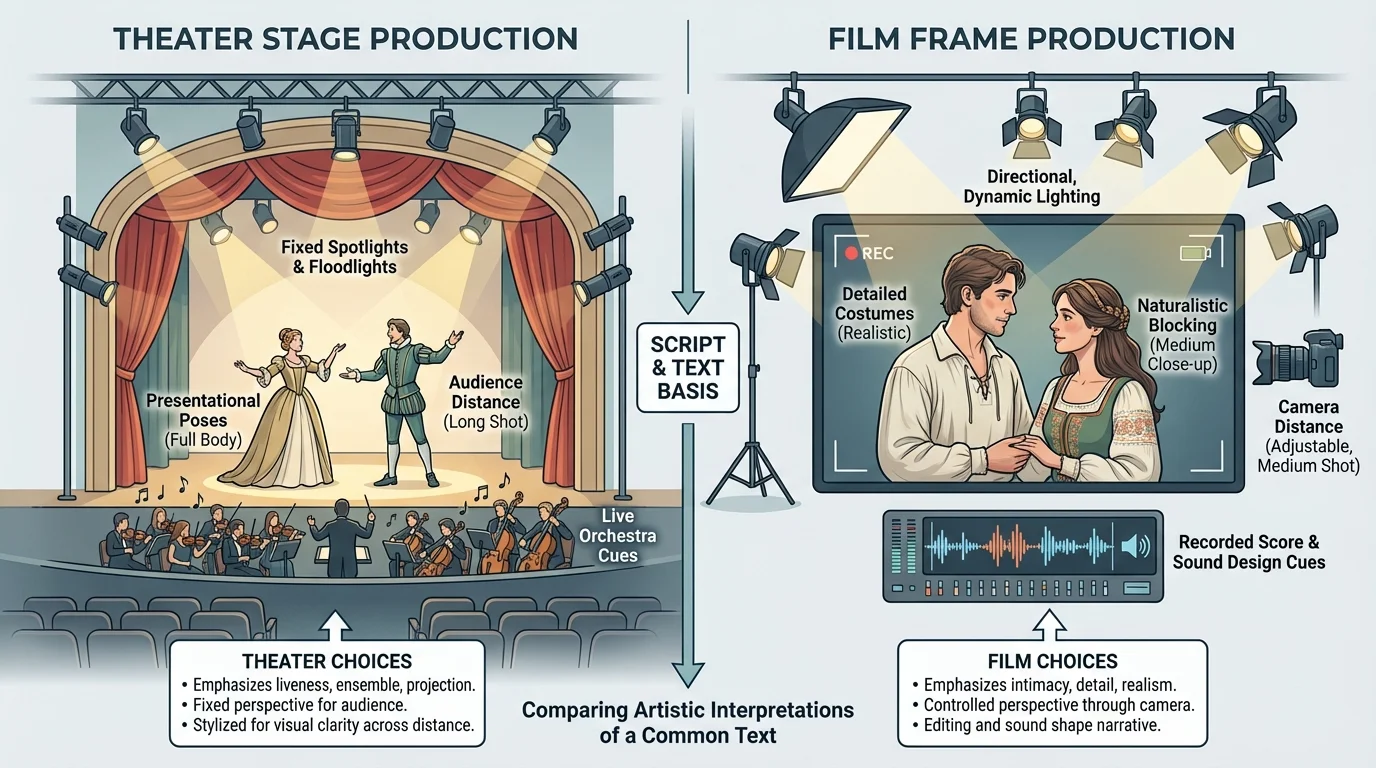
When evaluating a director's choices, ask whether they support the original text's meaning or pull away from it. If a tragic scene is directed almost like a joke, the production may lose the seriousness the author intended. On the other hand, a director may emphasize a theme that readers miss at first. A choice can be different from the text and still insightful.
How direction shapes meaning
A director does not simply "show" the story. A director decides what to emphasize, what to reduce, and how the audience experiences each moment. In literature, readers imagine scenes privately. In performance, the director helps control that imagination by choosing visuals, sound, pacing, and focus.
This is why students should be specific. Instead of saying, "The direction was good," explain which choice was effective. For example: "The director's use of shadow and silence during the argument made the scene feel more threatening, which matched the script's tone." Specific analysis is always stronger than general opinion.
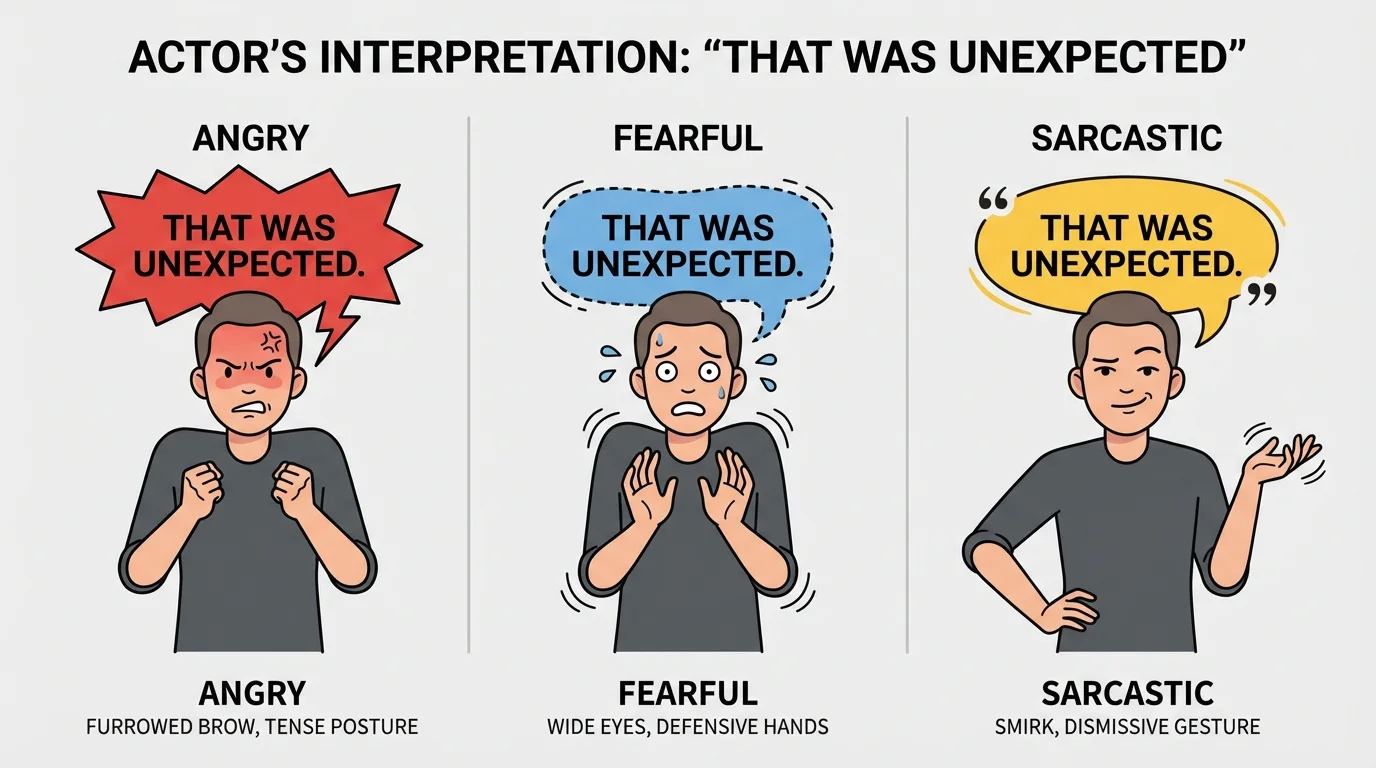
Actors interpret the script through voice, expression, and movement. A line on the page may seem simple, but in performance it gains force through volume, pacing, pause, stress, facial expression, and gesture. An actor can reveal confidence, fear, guilt, or dishonesty even before finishing a sentence.
This matters because characterization in a production depends heavily on performance. As [Figure 3] shows, even the same line can suggest different emotions depending on delivery. If a written character seems brave but thoughtful, an actor who plays the role with nonstop shouting may flatten the character into someone less complex. If the actor uses calm posture and a trembling voice, the audience may sense hidden fear and understand the character more deeply.
Actors also affect relationships between characters. In drama, meaning often depends on subtext, the feelings or ideas suggested beneath the spoken words. Two characters might politely say, "It is good to see you," while their body language shows distrust. Skilled actors communicate this hidden layer. That can make a production richer and more faithful to the script's complexity.
As we see again in [Figure 3], delivery changes interpretation. A sarcastic line, a whispered confession, and an angry accusation may use similar words but create very different meanings. When evaluating actors, consider whether their choices fit the character and support the tone and themes of the original work.
When you studied characterization in reading, you looked at what characters say, do, think, and how others react to them. In a production, those same clues still matter, but now you can also analyze facial expression, gesture, posture, and vocal tone.
A strong actor does not merely recite lines. A strong actor makes the audience believe a character's inner life. That is one of the biggest reasons a performance may feel powerful even when it departs from some details of the text.
Fair evaluation means balancing two ideas at once. First, you compare the production to the original text or script. Second, you judge the production as its own artistic work. If you only focus on differences, you may miss brilliant choices. If you ignore the original, you may fail to notice when a production weakens key ideas.
One useful method is to examine several major elements: plot, character, setting, tone, theme, and dialogue. Then ask whether the changes are minor or major, and whether they improve clarity, emotional impact, or meaning. Your final judgment should explain the extent of faithfulness or departure. For example, a production might be "mostly faithful in plot and theme but departs significantly in setting and tone."
Notice that this kind of claim is more accurate than saying "faithful" or "unfaithful" with no explanation. Most productions are mixed. They preserve some parts and change others. Strong literary analysis recognizes that complexity.
Evaluation model
Consider a production of a mystery story in which the ending remains the same, but the setting changes from a quiet country house to a crowded modern hotel.
Step 1: Identify what stayed the same.
The main conflict, clues, and final solution remain unchanged.
Step 2: Identify what changed.
The setting, costumes, technology, and some dialogue are updated.
Step 3: Evaluate the effect.
The modern setting makes the story feel faster and more familiar, but it may reduce the isolation and suspense that the original country house setting created.
Step 4: Form a judgment.
The production is faithful to the plot but departs from the atmosphere. Whether that change is successful depends on how important the original mood is to the story's meaning.
A fair evaluation always includes evidence. Mention a specific scene, line, gesture, camera choice, or staging decision. Then explain its effect. Analysis is not just noticing. It is explaining.
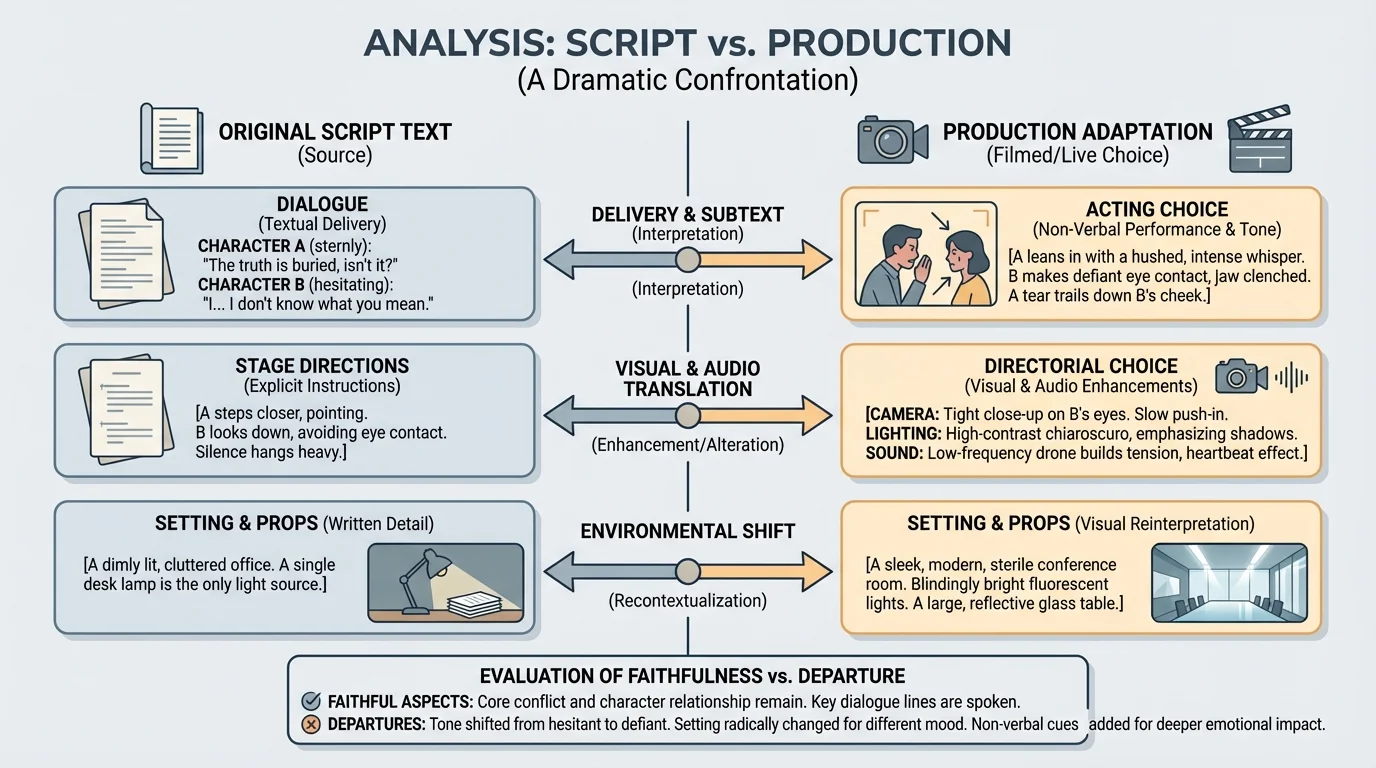
A single scene can reveal a great deal about adaptation, and [Figure 4] helps organize how a written confrontation may keep the same conflict while changing the mood in performance. Think of a drama scene in which a daughter confronts her father after discovering a painful secret. On the page, the script may contain short lines, pauses, and one stage direction such as "She turns away." The reader imagines the anger, hurt, and hesitation.
Now imagine the same scene in performance. The actor playing the daughter may pause for several seconds before speaking. The father may sit instead of stand, making him seem weaker than the text first suggests. The lighting may isolate the daughter while the father remains partly in shadow. None of these choices changes the basic conflict, but all of them shape how the audience understands power, guilt, and emotion.
Case study: evaluating a confrontation scene
Text version: The dialogue is brief and tense. The daughter appears controlled, and the father avoids direct answers.
Production choice: The director slows the scene, adds long silences, and places the characters far apart on stage.
Actor choice: The father speaks softly and looks downward, while the daughter's voice shakes even when her words sound firm.
Evaluation: The production remains faithful to the conflict and emotional pain of the script, but it deepens the father's vulnerability and the daughter's struggle. This departure in emphasis may strengthen the audience's sympathy for both characters.
If, however, the actors performed the same scene with exaggerated shouting and quick movement, the mood might shift from painful tension to open anger. That could still be effective, but it would be a stronger departure from the text's quieter emotional style. The key question is whether that new mood supports or weakens the story's deeper meaning.
Later in a full production, the comparison chart in [Figure 4] remains useful because it reminds us to separate what changed in the surface details from what changed in the emotional core. Students often become stronger critics when they learn to make that distinction.
When you write or speak about a production, begin with a clear claim. State the extent to which it stays faithful to or departs from the text. Then organize your evidence. You might discuss plot first, then character, then tone and theme. Or you might focus on one especially important scene.
Use precise language. Words such as preserves, alters, emphasizes, weakens, clarifies, compresses, and intensifies help explain exactly what a production does. These words are better than vague comments like "changed" or "different" because they describe the effect of the choice.
It also helps to connect your observations directly to meaning. For example, instead of saying, "The actor was sad," say, "The actor's slowed delivery and lowered gaze emphasized the character's guilt, making the scene more tragic than it appears on the page." That is analysis because it links evidence to interpretation.
"A performance is not just what the story says. It is how the story is made to live in front of an audience."
Remember that evaluation includes judgment. You are allowed to decide that a change is effective or ineffective, but your opinion must be supported. The best responses explain both sides: what was gained and what was lost.
Live theater and film each have strengths and limits. Theater gives the audience the energy of real people performing in real time. It can make dialogue and movement feel immediate and intense. But stage productions may have limited sets, fewer locations, and less visual realism. Film can shift locations quickly, use close-ups, and shape emotion through editing and sound, as we also saw with directorial control in [Figure 2]. Yet film may lose some of the shared, live intensity of theater.
These differences matter when judging faithfulness. A stage version may cut action scenes because they are hard to perform safely and clearly. A film version may reduce long speeches because close-up visuals can express the same feeling more efficiently. What seems like a departure may sometimes be the smartest way to adapt the story to a new medium.
That is why the best evaluations are thoughtful rather than rigid. They respect the original text while also understanding that every medium tells stories differently.
A successful adaptation understands what matters most in the original work. Sometimes that means preserving exact dialogue. Sometimes it means protecting a character's motivation, a theme, or a mood even while changing surface details. The strongest productions usually make deliberate choices rather than random ones.
When you analyze a filmed or live production, look for the relationship between the original and the new version. Ask how the director shapes meaning. Ask how the actors bring hidden emotions to life. Ask whether the changes help the audience understand the story more deeply or whether they distort what made the text powerful in the first place.
That kind of evaluation turns you from a viewer who simply reacts into a critic who can explain. And that is one of the most important goals of literary study: not only to enjoy stories, but to understand how art is made and how choices create meaning.
