Have you ever finished reading something and realized you could remember lots of details but not the point? That happens to many readers. A text can include characters, facts, events, descriptions, and examples, but strong readers ask one big question: What is the author really saying about this subject? Answering that question helps you understand articles, speeches, stories, essays, and even documentaries. It also helps you avoid being distracted by details that seem interesting but are not actually the main point.
When readers determine a central idea, they identify the most important message, insight, or understanding a text develops. Then they track how that idea grows from the beginning to the middle to the end. Finally, they explain how smaller points and details support it and turn that understanding into an accurate summary. This is one of the most powerful reading skills because it moves you from simply noticing information to actually understanding meaning.
Finding the central idea is useful far beyond English class. In science, you may read an article about climate change and need to tell whether the article's main point is that oceans are warming, that human activity is a major cause, or that coastal cities face increasing risk. In history, you may read a speech and need to decide whether it mainly argues for freedom, unity, or resistance. In everyday life, social media posts and videos often throw many details at you quickly. If you can identify the main idea and separate it from extra noise, you become a more careful thinker.
This skill also matters because authors do not always state their main point in one clear sentence. Sometimes the central idea is stated directly. Sometimes the reader has to infer it by combining clues from the whole text. That means readers must pay attention not only to what appears, but also to how those parts fit together.
Central idea is the main point, message, or understanding that a text develops. Supporting ideas are the smaller points that help explain, prove, or deepen the central idea. An objective summary is a brief retelling of the text's most important ideas without personal opinion or unnecessary detail.
One reason students sometimes struggle is that they confuse central idea with other terms that sound similar. To read closely, you need to separate these ideas clearly.
A topic is the general subject of a text, such as friendship, technology, survival, or injustice. A central idea is what the text says about that topic. The comparison in [Figure 1] makes this difference easier to see: the topic is broad, while the central idea is more specific and is developed through the text. For example, if the topic is social media, the central idea might be that social media connects people quickly but can also pressure users to create false versions of themselves.
A theme is closely related but usually appears in literary texts. Theme is often a broader truth or insight about life, human nature, or society. For example, in a novel, a central idea might be that a character's dishonesty destroys trust in her family. The theme might be that lies often damage the relationships people most want to protect. Central idea is often tied more directly to one specific text, while theme can sound more universal.
Here is a simple way to separate them: the topic is one or two words, the central idea is a clear statement, and the theme is a broader life lesson. If a reader says the central idea of a text is just "war," "family," or "nature," that reader has named a topic, not a developed idea.
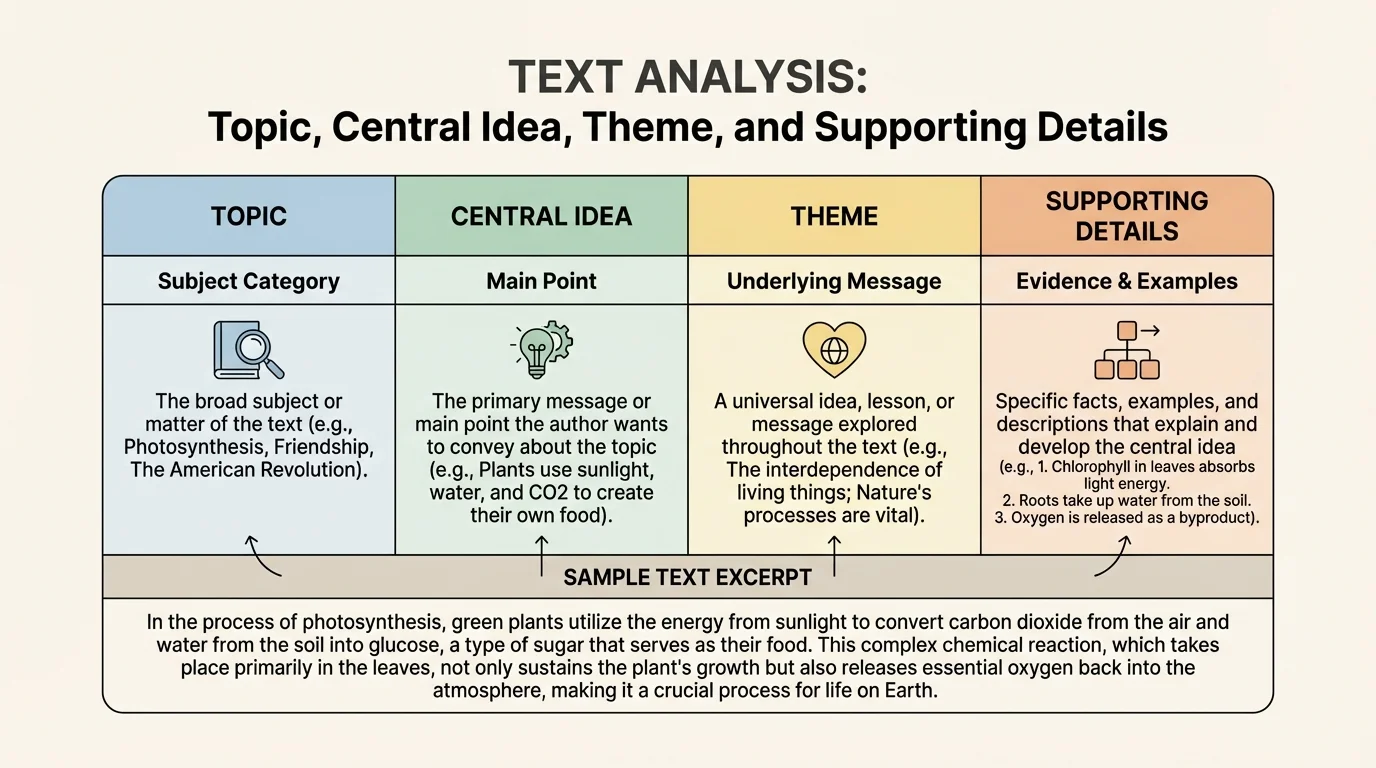
Suppose a story is about a boy training for a marathon after an injury. The topic could be perseverance. The central idea could be that recovering from failure requires patience, discipline, and support from others. A possible theme could be that real strength grows through struggle. These are related, but they are not the same.
Strong readers do not stop after naming the central idea. They also trace its development. That means they examine how the idea is introduced, expanded, shaped, and sometimes changed over the course of the text. As [Figure 2] shows, a central idea often begins as a clue in the opening, becomes clearer through examples or conflicts, and reaches its fullest form by the end.
At the beginning of a text, the author may introduce a setting, situation, problem, or claim. In the middle, the author adds details, evidence, scenes, or events that deepen the reader's understanding. By the end, the text may confirm the central idea, complicate it, or reveal it more fully. This means a good answer does more than name the idea once. It explains how the text builds that idea step by step.
For example, imagine an article about urban gardens. The first paragraph describes empty city lots being turned into gardens. The middle explains how those gardens provide fresh food, create community spaces, and teach students about nutrition. The end argues that urban gardens can improve both health and neighborhood pride. The central idea develops from a simple description into a larger claim: community gardens do more than grow food; they strengthen communities.
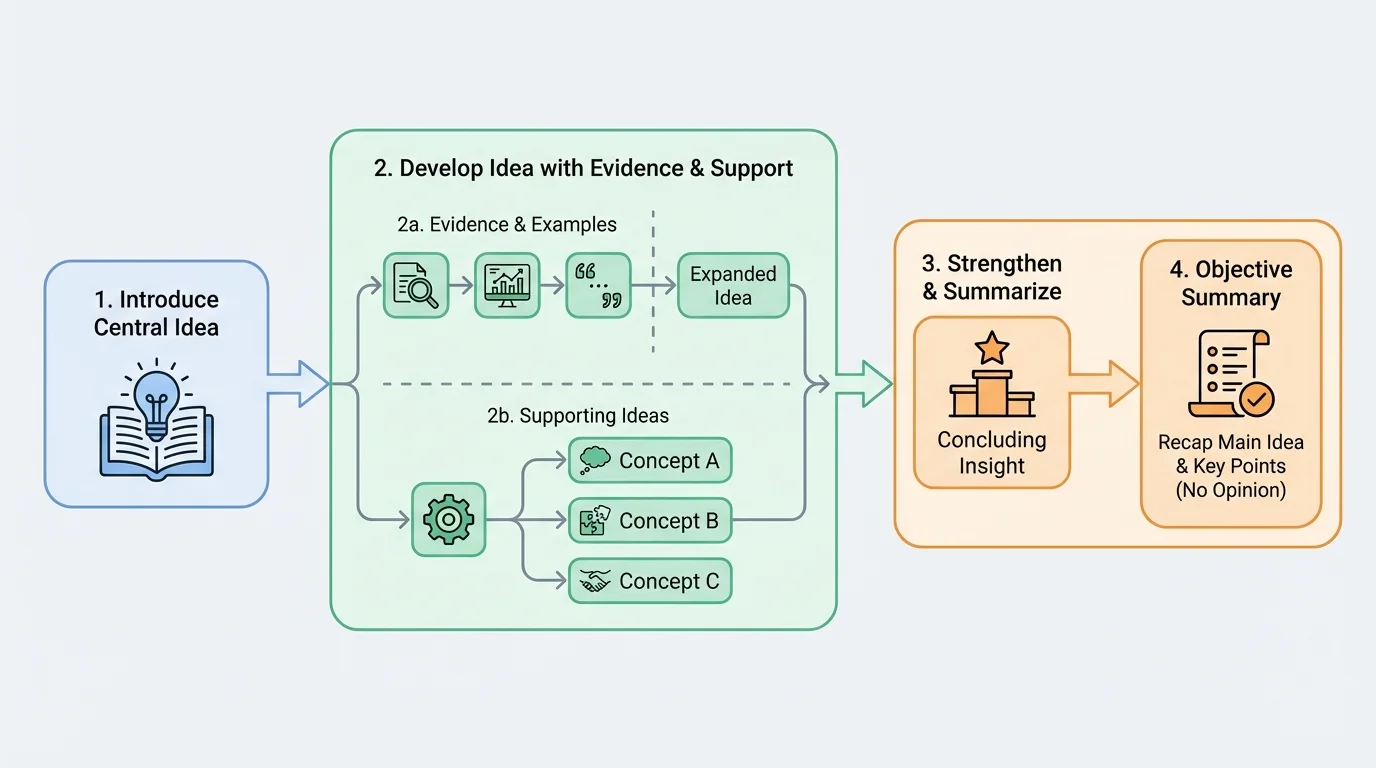
In a story, development can happen through character choices and conflict. A character may begin by acting selfishly, then experience consequences, then finally learn to value other people. In that case, the central idea may grow along with the character. Later, when you refer back to [Figure 2], notice that development is not random. The author carefully places scenes and details so the idea becomes clearer over time.
Development is a pattern, not a pile. A text is not just a collection of details. Authors choose and arrange information so readers move toward a clearer understanding. When you analyze development, look for what changes, what repeats, what gets emphasized, and what the ending helps you understand that the beginning did not.
Some texts even develop more than one important idea. When that happens, one idea may be the strongest central idea while others act as supporting or connected ideas. Your job is to decide which idea the text builds most fully.
Once you know the central idea, the next step is to examine its relationship to supporting ideas. The structure in [Figure 3] helps show that the central idea sits at the center, while supporting ideas branch outward to explain different parts of it. Supporting ideas are not random facts. They are the smaller points that make the main idea believable, clearer, or more complete.
Suppose the central idea of an article is that sleep is essential for teen health and learning. Supporting ideas might include that sleep improves memory, helps emotional balance, and supports physical growth. Each supporting idea can then be backed by details such as studies, examples, expert opinions, or statistics. Those details are the evidence that makes the supporting ideas strong.
When analyzing a text, ask: Which details matter most? Which details repeat or connect? Which details help prove the author's point? A single vivid detail may be memorable, but if it does not connect to the larger point, it should not control your understanding of the text.
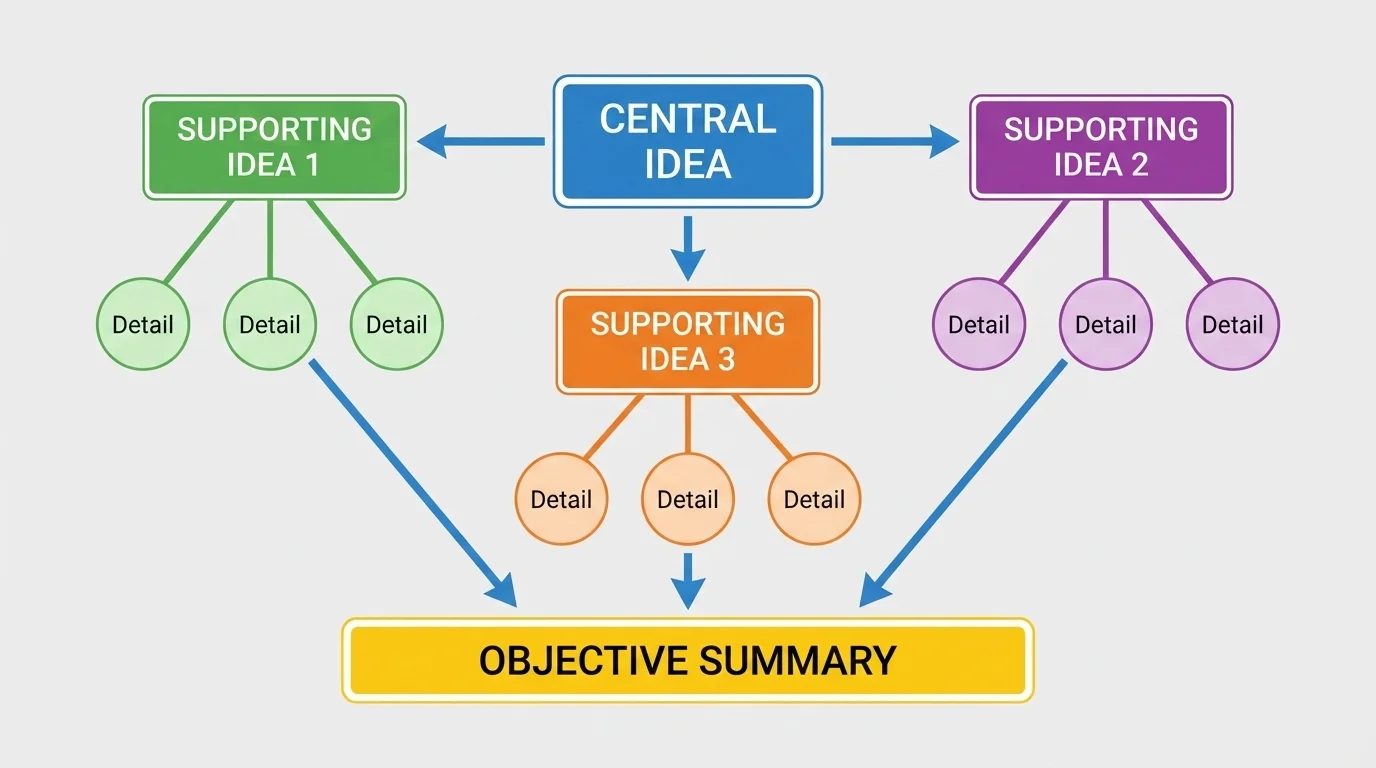
Think of the text like a tree. The central idea is the trunk. Supporting ideas are the large branches. Specific details are the leaves. Leaves matter, but they only make sense because they are attached to branches, and branches only stand because of the trunk. Looking back at [Figure 3], you can see why listing details without connecting them to a central idea is not enough for deep reading.
In literature, supporting ideas might include repeated images, important conversations, symbols, or turning points. In informational text, they might include reasons, explanations, categories, and examples. In both cases, the question is the same: how does this part help develop the text's main point?
Authors use different methods depending on the kind of text they are writing. In a short story, a central idea may emerge through plot, conflict, setting, dialogue, and character growth. In an article or essay, it may develop through claims, reasons, examples, and evidence. In a speech, repetition and emotional language may strengthen the central idea. In a memoir, reflection and personal experience may shape it.
Notice that the same skill still applies. Whether you are reading fiction or nonfiction, you are tracing how an author builds meaning. In a poem, repeated images might slowly reveal a central idea about loss. In a biography, the order of events may show that one person's persistence changed history. The form changes, but the reading job stays similar.
| Type of text | How the central idea may develop | Common supporting elements |
|---|---|---|
| Short story | Through conflict and character change | Dialogue, actions, turning points, symbols |
| Article | Through explanation and evidence | Facts, examples, reasons, expert views |
| Speech | Through repeated claims and emotional appeal | Repetition, anecdotes, persuasive language |
| Memoir | Through lived experience and reflection | Memories, lessons learned, personal details |
Table 1. Ways central ideas are commonly developed in different kinds of texts.
Being aware of the text type helps you notice where to look for clues. Still, do not assume the answer before you read. Let the text itself guide your understanding.
A useful reading process starts with noticing what appears most often or most strongly. Look for repeated words, repeated concerns, major conflicts, or the author's strongest claims. Then ask what those parts add up to. If several important details point in the same direction, they probably connect to the central idea.
Next, pay attention to the beginning and ending. Introductions often signal the issue or focus. Conclusions often reveal what the author most wants the reader to understand. If the ending changes your understanding of earlier parts, that is a clue that the central idea has developed.
Then try writing the central idea as one clear sentence. A strong sentence is specific enough to say something meaningful, but broad enough to cover the whole text. For example, instead of saying "The article is about recycling," say "The article argues that recycling alone is not enough and that reducing waste matters even more."
Good readers already know how to identify important details. This skill adds a new layer: instead of collecting details one by one, you connect them and ask what larger meaning they build together.
Finally, test your sentence. Does it fit the beginning, middle, and end? Can most major details connect to it? If not, revise it. Sometimes your first idea is too broad, too narrow, or too focused on one section of the text.
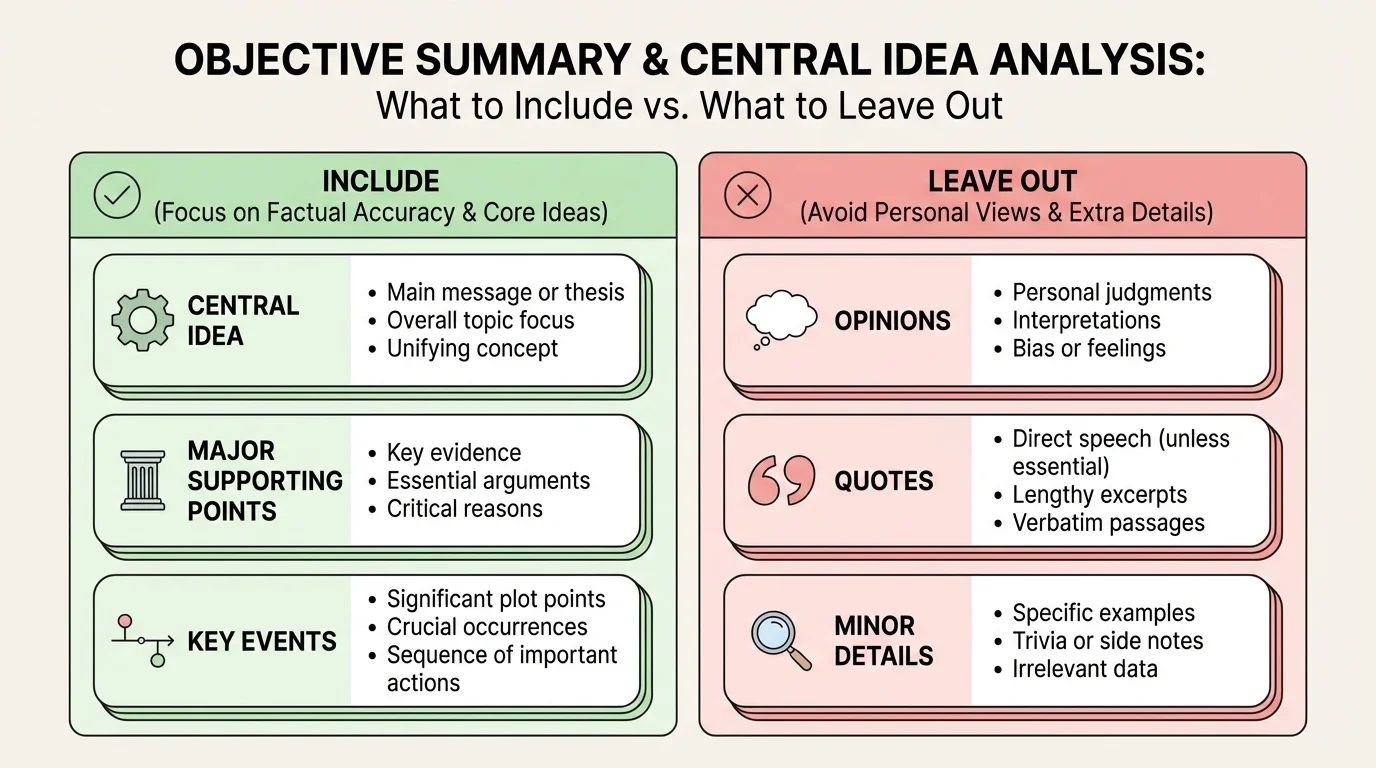
After analyzing the text, you are ready to write an objective summary. The guide in [Figure 4] separates what belongs in a summary from what should stay out. An objective summary includes the central idea and the most important supporting points. It does not include your opinion, extra commentary, or tiny details that do not matter to the whole text.
Objective means fair, neutral, and based on the text rather than your feelings. If you write, "This article proves that schools are way too strict," you are adding judgment. If the text itself argues that strict rules can hurt student trust, then your summary should report that idea clearly without sounding emotional or exaggerated.
A strong summary is shorter than the original text, but it still covers the key ideas. It usually answers these questions: What is the text mainly about? What major points develop that idea? How does the text end or what final understanding does it leave the reader with?
Suppose a text explains how athletes use visualization to improve performance. An objective summary might say: "The text explains that visualization helps athletes prepare mentally for competition. It describes how imagining successful actions can improve focus, confidence, and decision-making. The text concludes that mental practice can strengthen physical performance when combined with training." That summary stays focused, accurate, and neutral.
Notice what it does not include. It does not say, "I think this is amazing," or "The swimmer in paragraph three was my favorite example." Those reactions may be interesting in a response paragraph, but they do not belong in an objective summary. When you look again at [Figure 4], the difference between important content and extra commentary becomes even clearer.
Example 1: Informational text analysis
A text describes how bee populations are declining and why that matters.
Step 1: Identify the likely central idea.
The text's central idea is that declining bee populations threaten ecosystems and food production because bees are important pollinators.
Step 2: Track development.
The beginning introduces the decline in bee numbers. The middle explains causes such as pesticides, habitat loss, and disease. The end shows why the decline affects crops and biodiversity.
Step 3: Connect supporting ideas.
Causes of bee decline and effects on agriculture are supporting ideas because they explain and deepen the central idea.
Step 4: Write an objective summary.
The text explains that bee populations are decreasing in many places. It describes several causes, including pesticide use, loss of habitat, and disease. The text also shows that this decline matters because bees pollinate plants that ecosystems and human food supplies depend on.
This example shows that a summary should include the major cause-and-effect chain, not every single fact. If the article listed ten crops affected by bee decline, you would not need all ten in the summary.
One common mistake is choosing a topic instead of a central idea. Saying "The text is about courage" is too broad. Ask yourself: what does the text say about courage? Another mistake is focusing on a single detail that stands out emotionally but does not represent the whole text. Readers often remember dramatic moments, but summaries must stay balanced.
A third mistake is confusing summary with response. A response includes your opinions, agreements, questions, or connections. A summary reports what the text says. Both are valuable, but they are not the same. If your writing includes phrases like "I think," "I liked," or "This reminded me," you are probably moving out of summary and into response.
Professional researchers, journalists, and lawyers all rely on objective summary. They often read long, complex texts and must explain the key ideas clearly without changing the meaning.
Another mistake is leaving out development. If you simply state the central idea without showing how the text builds it, your analysis remains incomplete. Strong analysis explains the path the text takes, not just the destination.
Consider a brief fictional example: A girl named Nia is embarrassed that her grandfather still repairs old radios instead of buying new devices. At first she sees his hobby as outdated. Later, when a storm knocks out internet service and power is limited, neighbors gather around one of his battery-powered radios to hear emergency updates. By the end, Nia understands that his knowledge connects the community to both the past and the present.
The topic is technology or family. The central idea is more specific: practical knowledge that seems old-fashioned can still be valuable in modern life. The development is clear. At first, Nia dismisses the radios. In the middle, the storm changes the situation. By the end, she sees their real worth. Supporting ideas include preparedness, respect for older generations, and community connection.
Example 2: Literary text analysis
Use the Nia story to create an objective summary.
Step 1: Focus on the whole text.
The summary should include Nia's changing attitude, the storm, and the value of her grandfather's skill.
Step 2: Remove minor details.
You do not need to mention the exact model of radio, every neighbor present, or Nia's specific jokes at the beginning.
Step 3: Write objectively.
The story shows that Nia first views her grandfather's habit of repairing old radios as unnecessary. When a storm disrupts modern communication, his radios become an important source of information for the neighborhood. By the end, Nia realizes that skills from the past can still have real value in the present.
Now consider a nonfiction example. A text begins by describing how fast fashion makes trendy clothes cheap and easy to buy. It then explains that many garments are worn only a few times before being thrown away. Next, it examines environmental costs such as water use, pollution, and textile waste. Finally, it argues that buying fewer, longer-lasting clothes can reduce harm.
The central idea is not just "clothes" or even "fashion." It is that fast fashion encourages wasteful consumption with serious environmental consequences. Supporting ideas include short clothing lifespans, pollution, and consumer choices. The text develops the idea by moving from appealing convenience to hidden costs and then to a possible solution.
Example 3: Building analysis from details
Question: How do the supporting ideas relate to the central idea in the fast fashion text?
Step 1: Name the central idea.
Fast fashion creates environmental harm by encouraging frequent and wasteful clothing consumption.
Step 2: Identify supporting ideas.
Cheap prices encourage overbuying, clothing is quickly discarded, and manufacturing damages the environment.
Step 3: Explain the relationship.
Each supporting idea reveals one part of the problem. Together they show that the issue is not only shopping habits but also the larger environmental cost behind the clothing industry.
Step 4: Write a brief objective summary.
The text explains that fast fashion makes clothing inexpensive and easy to replace, which leads many people to buy and discard garments quickly. It describes the environmental damage linked to this cycle, including waste and pollution. The text concludes that consumers can reduce harm by choosing fewer, better-made clothes.
As these examples show, the strongest readers keep asking the same connected questions: What is the text really saying? How does it build that point over time? Which ideas support it? What would an accurate, neutral summary sound like?
"The main idea is not what a text is about. It is what the text says about what it is about."
That sentence is worth remembering because it helps prevent a very common error. Once you move from subject to message, your reading becomes more precise. You stop collecting scattered facts and start seeing the design of the whole text.
