One powerful sentence can grab your attention, but one well-built paragraph can change your understanding. Think about a news article explaining climate change, a science text describing vaccines, or a history article analyzing a turning point in a war. In each case, the author does more than list facts. The author arranges sentences carefully so that each one adds something new, sharpens an idea, or guides the reader toward a deeper understanding. Learning to analyze that structure helps you read with more control and insight.
When you study a paragraph closely, you are not only asking what it says. You are also asking how it says it. That means noticing which sentence introduces the idea, which one adds evidence, which one explains the evidence, and which one narrows or adjusts the idea. This kind of reading helps you understand an author's craft, or the deliberate choices the writer makes to shape meaning.
In informational text, a paragraph usually focuses on one central idea or one part of a larger argument. That central idea is often a key concept, meaning an important idea that the author wants the reader to understand clearly. A paragraph might explain how something works, compare two ideas, describe a cause and an effect, or present a claim with supporting reasons.
A strong paragraph is not just a group of related sentences. It is a sequence. The order matters. If the author places a definition before an example, the reader understands the example better. If the author gives evidence before stating the main point, the paragraph may feel confusing or dramatic, depending on the writer's purpose. Structure shapes meaning.
Paragraph structure is the arrangement of sentences within a paragraph so that each sentence plays a role in building meaning.
Sentence role means the job a sentence does, such as introducing a claim, giving evidence, explaining details, or refining an idea.
[Figure 1] Readers who analyze structure pay attention to both content and function. Content is the information itself. Function is what that information is doing in that exact place. Two sentences may both contain facts, but one fact may introduce a topic while another fact may prove a point already made.
Paragraph structure becomes easier to notice when you can label the roles sentences often play. Not every paragraph uses every part in the same way, but many effective paragraphs include similar building blocks.
A paragraph often begins with a topic sentence. This sentence introduces the main focus of the paragraph. It does not always tell everything, but it gives the reader a direction. After that, supporting sentences may provide reasons, facts, examples, definitions, comparisons, or details. Some sentences act as evidence, while others explain why that evidence matters. Near the end, a sentence may connect the ideas together, show significance, or slightly narrow the claim so it becomes more precise.
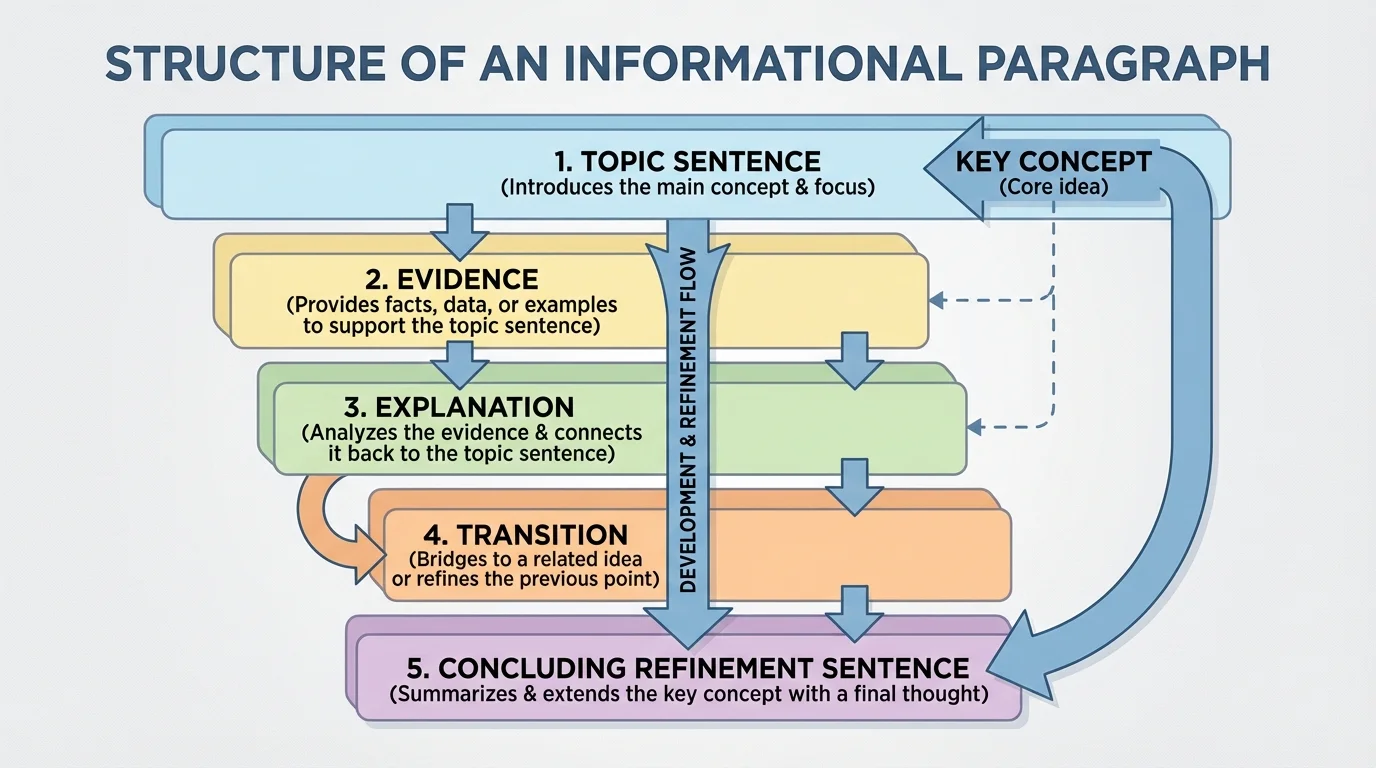
Here are several common sentence roles in informational writing:
A refining sentence is especially important. Young readers sometimes think the last sentence of a paragraph only repeats the first sentence. Strong writers often do more than repeat. They sharpen the idea. For example, a paragraph may begin with a broad claim like "Social media affects communication," but end with a more refined idea such as "Social media speeds communication, but it can reduce careful listening in serious discussions." That final sentence does not merely restate the point. It improves it.
Development and refinement
When authors develop a key concept, they add information that helps readers understand it more fully. When authors refine a key concept, they make it more precise by limiting it, qualifying it, or showing a more accurate version of the original idea. Development expands understanding; refinement sharpens it.
The paragraph structure in [Figure 1] also reminds us that not all support is equal. A fact alone may seem important, but until the writer explains its connection to the main point, the paragraph may still feel incomplete. Good informational writing often alternates between giving information and interpreting it.
To analyze a specific paragraph, ask what each sentence contributes, as shown in [Figure 2]. Does it introduce the subject? Define a term? Present a problem? Offer proof? Compare one idea to another? Show an exception? The answer reveals how the paragraph works as a unit.
Suppose a paragraph in a science article says that sleep improves learning. One sentence may state the claim. The next may explain that the brain organizes memories during sleep. Another may cite a study. A later sentence may explain that the effect is strongest after consistent sleep, not just one good night. That last sentence refines the concept by preventing an oversimplified conclusion.
Writers also use sentence position strategically. Early sentences often establish context. Middle sentences usually build support. Final sentences often emphasize significance or complexity. If a sentence appears in the middle, that placement may show it is meant to connect ideas rather than introduce or conclude them.
Professional journalists and science writers often revise individual paragraphs many times, not because the facts change, but because the order of sentences changes how clearly readers understand the facts.
Another important clue is repetition with change. An author may repeat a key word or idea in different forms across a paragraph. This creates coherence, meaning the paragraph holds together as one piece. But if the repeated idea becomes more exact each time, that signals refinement rather than simple repetition.
The diagram illustrates how each sentence in a specific informational paragraph serves a different role in building one idea about city life and the environment. Now consider that paragraph and trace its structure sentence by sentence.
Urban trees do more than make neighborhoods look attractive. They lower surface temperatures by providing shade and releasing moisture into the air. In cities with large areas of pavement, this cooling effect can reduce the urban heat island problem, in which built surfaces absorb and hold heat. Researchers have found that neighborhoods with more tree cover are often several degrees cooler than nearby areas with fewer trees. Because of this, planting trees is not only a visual improvement but also a practical public health strategy, especially in places that face extreme summer heat.
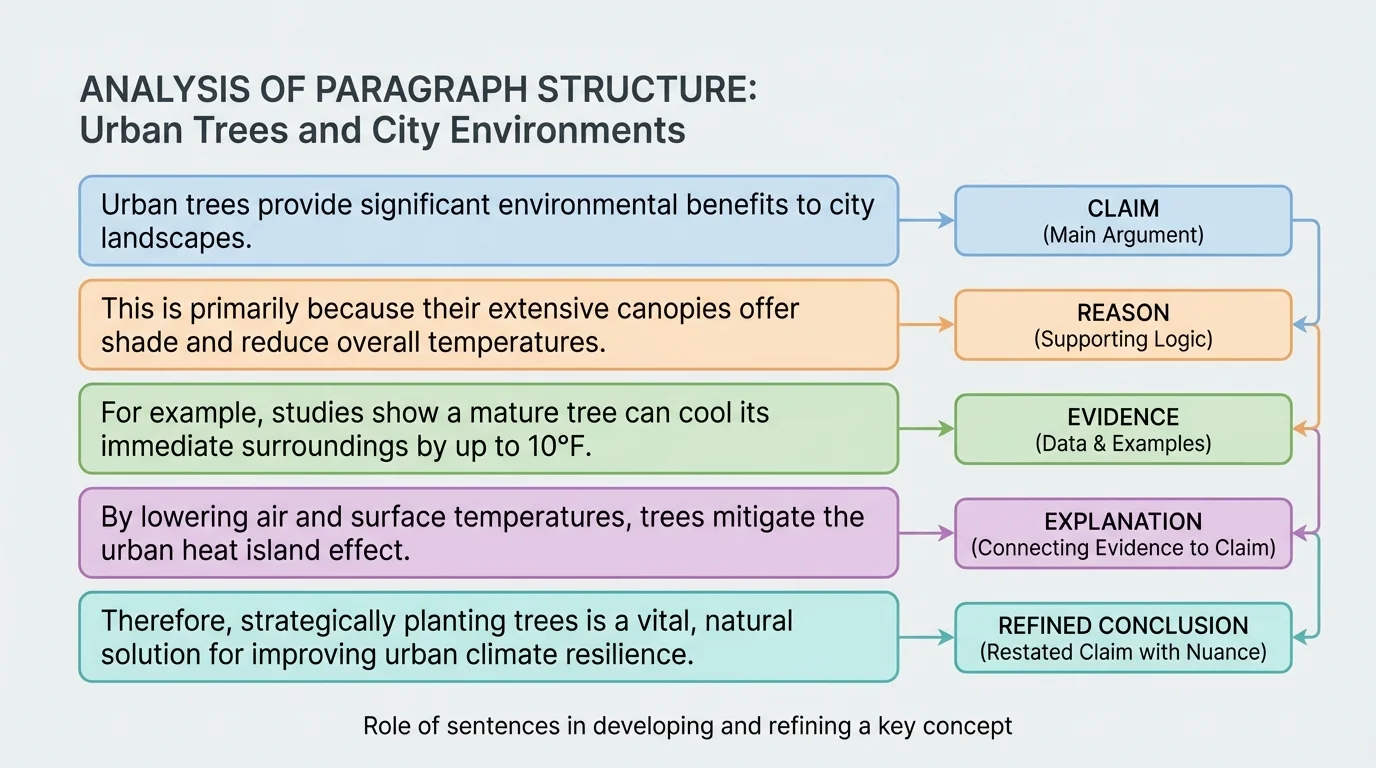
This paragraph centers on one key concept: urban trees have an important practical value, not just a decorative one. Notice how the paragraph develops that idea in stages.
Sentence 1: "Urban trees do more than make neighborhoods look attractive." This opening sentence introduces the topic and hints at a contrast. It suggests that many people may think trees are mostly decorative, but the paragraph will go beyond that. This sentence functions as a topic sentence because it sets up the central idea.
Sentence 2: "They lower surface temperatures by providing shade and releasing moisture into the air." This sentence begins development. It explains how trees help. Instead of staying broad, the author gives a mechanism. That makes the concept clearer and more informative.
Sentence 3: "In cities with large areas of pavement, this cooling effect can reduce the urban heat island problem, in which built surfaces absorb and hold heat." Here the paragraph expands the idea by naming a specific phenomenon: the urban heat island. The sentence also includes a brief definition, which helps the reader understand a possibly unfamiliar term without leaving the paragraph.
Sentence 4: "Researchers have found that neighborhoods with more tree cover are often several degrees cooler than nearby areas with fewer trees." This sentence provides evidence. The wording "Researchers have found" signals that the statement is based on study rather than opinion. The paragraph becomes more convincing because the author supports the claim with research.
Sentence 5: "Because of this, planting trees is not only a visual improvement but also a practical public health strategy, especially in places that face extreme summer heat." This final sentence does more than conclude. It refines the key concept. The paragraph began with appearance versus usefulness. It ends by identifying the usefulness more precisely: trees are part of a public health strategy, especially where heat is dangerous. The idea is now sharper, more serious, and more specific than it was at the start.
Sentence-by-sentence analysis of the paragraph about urban trees
Step 1: Identify the central idea.
The paragraph argues that urban trees have practical benefits beyond beauty.
Step 2: Track how the paragraph develops that idea.
The author moves from a broad claim to explanation, then to definition, then to research-based evidence.
Step 3: Notice how the paragraph refines the concept at the end.
The final sentence narrows the point by connecting trees to public health and extreme heat, making the idea more exact and more significant.
The color-coded design in [Figure 2] and the comparison in [Figure 3] make an important truth visible: a strong paragraph is often like a chain. If one sentence were removed, the paragraph might still exist, but it would lose clarity, logic, or force. For example, without sentence 3, the term "urban heat island" would never be explained. Without sentence 4, the claim would have less credibility. Without sentence 5, the larger importance of the idea would be weaker.
Authors refine ideas in several ways. They may add a limitation, such as "in most cases" or "especially in dry climates." They may shift from a general claim to a more precise one. They may introduce an exception, compare two situations, or define a term carefully so the reader does not misunderstand the concept.
For example, consider the difference between these two endings to a paragraph about exercise: "Exercise is good for people" and "Regular exercise improves both physical health and mood, especially when it becomes a consistent habit rather than an occasional activity." The second ending is more refined because it is more precise. It names the kinds of benefits and adds an important condition.
Writers also refine a concept by correcting what a reader might assume. A paragraph may begin with a common belief, then reshape it. In history writing, an author might begin with the idea that an invention changed society instantly, then refine that point by showing that the change happened gradually and unevenly across regions. That refinement creates a truer understanding.
From earlier reading work, remember that authors make choices about organization, word choice, and evidence. Paragraph analysis brings those skills together on a smaller scale by asking how those choices work sentence by sentence.
When you analyze refinement, look for words that narrow meaning: often, in some cases, especially, however, rather than, and although. These words are clues that the author is shaping the idea carefully instead of leaving it broad or vague.
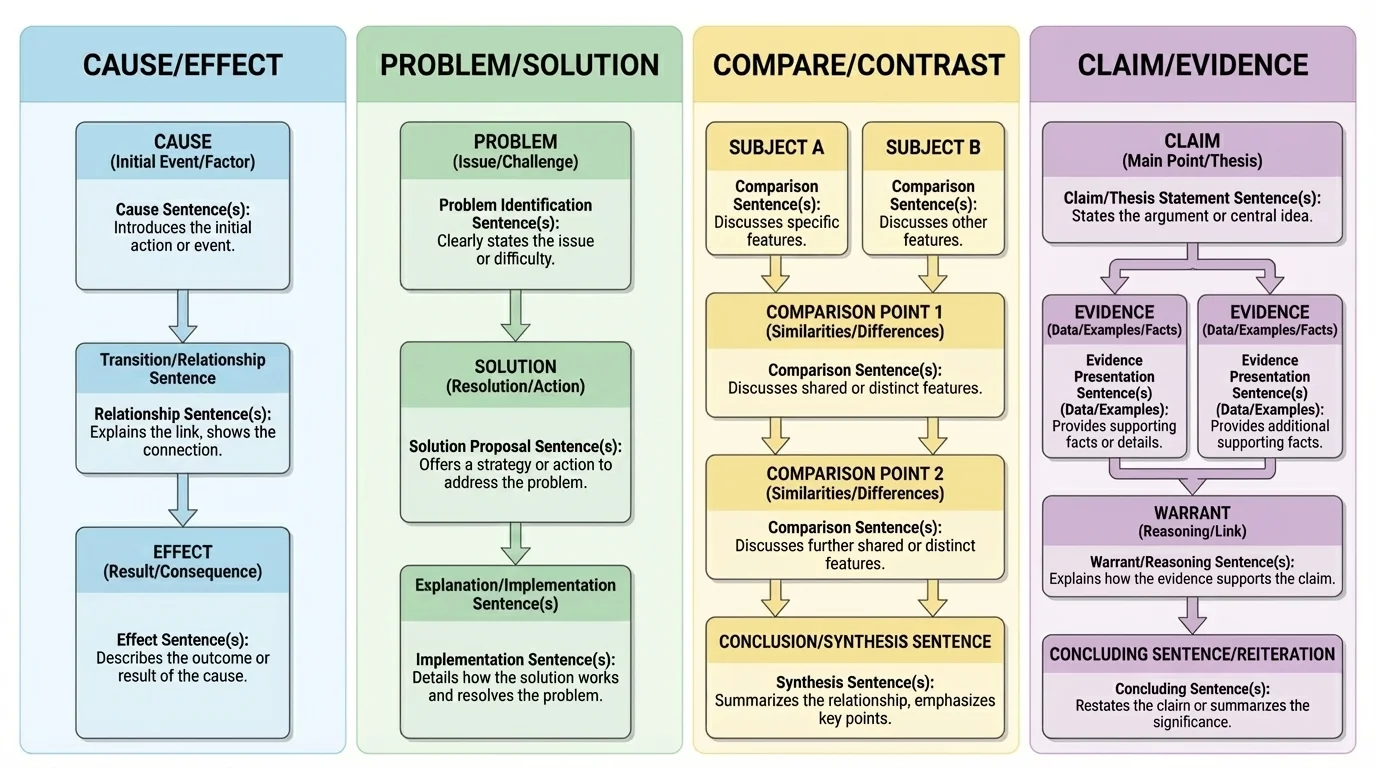
Several organizational patterns appear often in informational text. These common patterns help readers predict what a sentence is doing. Even when the subject changes, the sentence roles may follow familiar structures.
Here are some common patterns:
| Pattern | What the paragraph does | Typical sentence roles |
|---|---|---|
| Cause and effect | Explains why something happens and what results from it | Cause statement, explanation, effect, significance |
| Problem and solution | Introduces an issue and presents a response | Problem, impact, proposed solution, evaluation |
| Compare and contrast | Shows similarities and differences | Subject A, Subject B, comparison point, conclusion |
| Claim and evidence | States an argument and supports it | Claim, evidence, explanation, refinement |
Table 1. Common informational paragraph patterns and the sentence roles often found in each one.
In a cause-and-effect paragraph, a sentence may introduce a cause, while the next sentence explains the effect. In a problem-and-solution paragraph, one sentence may describe the challenge and another may evaluate whether the solution is realistic. In a compare-and-contrast paragraph, a sentence may shift the focus using transition words like however or similarly. These structures influence how readers build meaning.
The comparison in [Figure 3] also shows that sentence roles are flexible. A final sentence in one pattern may act as a conclusion, while in another pattern it may qualify the solution or reveal a limitation. The key is to ask what the sentence does in that exact paragraph.
When reading a paragraph closely, strong readers ask purposeful questions. What is the main point of this paragraph? Which sentence first introduces that point? Which sentence adds evidence? Which sentence explains why the evidence matters? Does the final sentence simply restate the idea, or does it refine it?
Another useful question is this: what would be lost if a sentence were removed? If removing a sentence makes the paragraph less convincing, that sentence may provide evidence. If removing it creates confusion, it may define or clarify an idea. If removing it makes the ending weaker, it may be the sentence that refines the concept.
"How a paragraph is built often reveals why it is persuasive."
You should also notice transitions and signal words. Words such as because, for example, however, as a result, and especially often reveal relationships between sentences. These words act like signs on a road. They tell the reader whether the author is adding, contrasting, explaining, or narrowing an idea.
Analyzing paragraph structure is not just an English class skill. In science, it helps you see how an author moves from observation to explanation to conclusion. In history, it helps you tell the difference between a fact, an interpretation, and an evaluation of importance. In news and media, it helps you judge whether a writer supports a claim responsibly or relies on vague statements.
This skill also matters when you write. If you understand how a paragraph develops and refines a concept, you can build clearer paragraphs yourself. You can choose where to place a definition, when to include evidence, and how to end with a sentence that sharpens your point instead of merely repeating it.
Close reading shows that good writing is rarely accidental. Sentence by sentence, authors guide readers toward understanding. When you notice those choices, you become a stronger reader, a more thoughtful thinker, and a more effective writer.
