Every day, people try to convince you of something. A video claims a new study trick is the best. An advertisement says one product is healthier. A classmate argues that lunch should be longer. A news clip presents a debate about a community issue. The important question is not just what the message says. The real question is: Does the argument actually hold up? Learning to answer that question makes you a stronger reader, listener, speaker, and thinker.
When you evaluate an argument, you do more than agree or disagree. You examine how the argument is built. You identify the writer's or speaker's point, the reasons given, the evidence used, and the logic connecting them. Then you decide whether the support is strong enough. This skill matters in English class, science class, social studies, online research, and everyday conversations.
An argument is not the same as a fight. In reading and speaking, an argument is a set of statements meant to persuade an audience that an idea is true, reasonable, or worth supporting. Good arguments help people make informed choices. Weak arguments can mislead people, especially when they sound confident but do not provide solid support.
Suppose someone says, "Our school should ban homework because students are tired." That may sound convincing at first. But a careful reader or listener asks questions: Is tiredness the only issue? What evidence shows homework causes the problem? Are there other causes, such as sports schedules or screen time? Are there better solutions than banning homework completely? Argument analysis teaches you to slow down and test the thinking.
Professional fact-checkers often separate a speaker's exact claim from the evidence offered before judging whether the statement is believable. That same habit can help students avoid being persuaded by dramatic but weak arguments.
This kind of close attention also improves classroom discussion. When students can point to a specific claim, identify strong support, and question weak logic respectfully, conversations become clearer and more thoughtful.
A strong argument has connected parts working together, as [Figure 1] shows in a simple structure. The first part is the claim, which is the main point or position. A claim answers the question, "What is the writer or speaker trying to get me to believe?"
Next come reasons. Reasons explain why the claim should be accepted. If the claim is "School uniforms should be required," one reason might be "Uniforms reduce pressure to wear expensive clothes." Reasons must connect clearly to the claim.
Then comes evidence, which includes facts, statistics, examples, quotations, observations, or research used to support a reason. If a writer says uniforms reduce pressure, evidence might include survey results from students or research from schools that adopted uniforms.
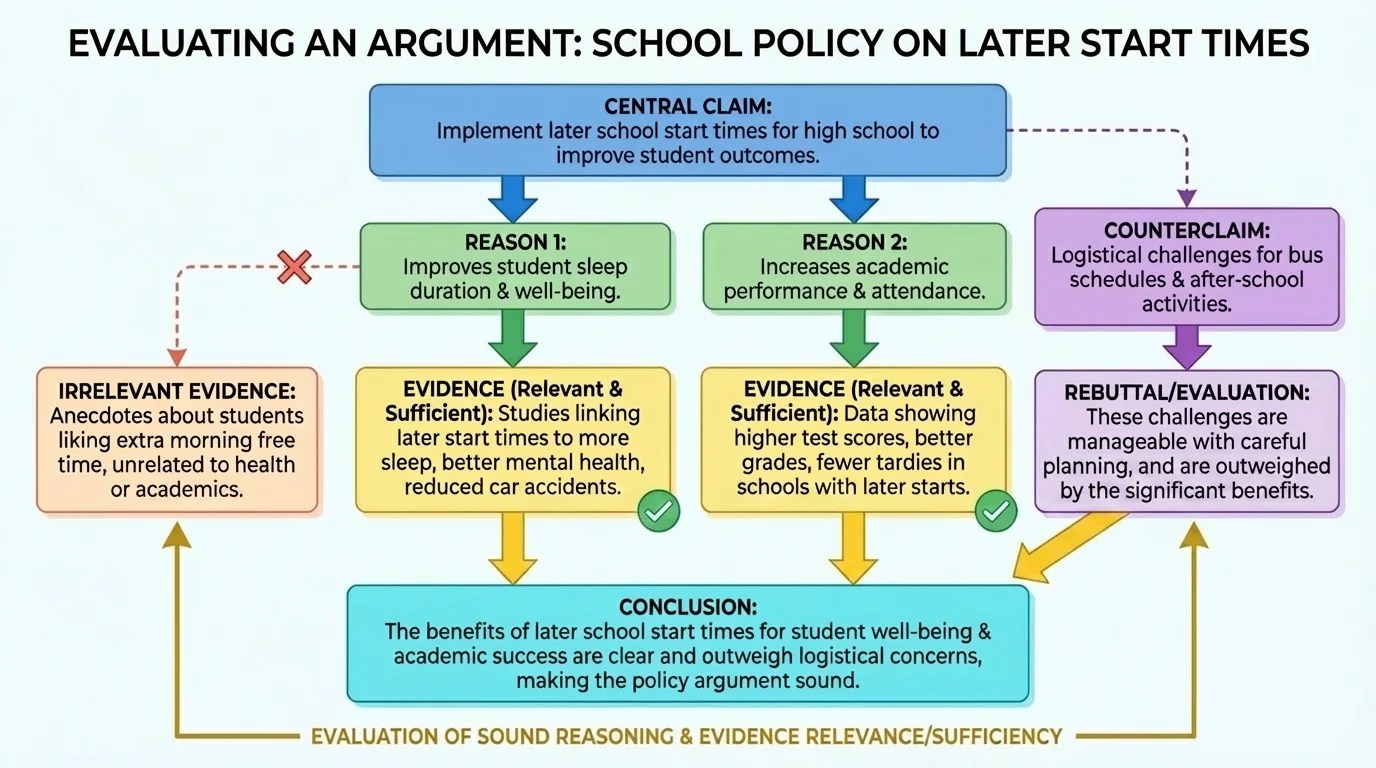
Some arguments also include a counterclaim, which is an opposing viewpoint. Strong writers often address counterclaims because doing so shows they understand other perspectives. They may then respond by explaining why their own position is stronger.
A conclusion ties the ideas together and leaves the audience with the writer's final judgment. However, a powerful conclusion cannot rescue a weak argument. If the reasons and evidence are poor, the conclusion will still be weak.
Claim is the main point an author or speaker wants the audience to accept. Reason is an explanation that supports the claim. Evidence is the proof used to support a reason. Counterclaim is an opposing viewpoint that a writer or speaker addresses.
When you read or listen, it helps to ask: What is the claim? What reasons are given? What evidence supports those reasons? Is a counterclaim included? These questions help you delineate the argument instead of getting lost in extra details.
To delineate an argument means to trace its shape clearly. You are mapping the writer's or speaker's thinking step by step. This does not mean copying every sentence. It means identifying the important parts and showing how they connect.
Start by locating the central claim. Sometimes it appears near the beginning. Sometimes it appears after a story, a question, or a background explanation. Then find the reasons that support it. After that, look for the evidence under each reason. A useful mental pattern is: claim, reason, evidence, reason, evidence, counterclaim, response, conclusion.
For example, consider this short argument: "Our town should build more bike lanes. Bike lanes make streets safer for cyclists. In cities that added protected bike lanes, cycling injuries decreased. Bike lanes also encourage more people to ride instead of drive, which can reduce traffic." Delineating this argument would reveal one claim, two reasons, and evidence tied to at least one of those reasons.
Tracing a simple argument
Text: "The school library should stay open one hour later after school. Many students need a quiet place to work before going home. A survey of students showed that over half would use the library after school at least twice a week. Some people argue that staying open later would cost too much, but the school could rotate existing staff members on different days."
Step 1: Identify the claim.
The claim is: "The school library should stay open one hour later after school."
Step 2: Identify the reason.
The reason is: "Many students need a quiet place to work before going home."
Step 3: Identify the evidence.
The evidence is the survey showing that over half of students would use the library after school at least twice a week.
Step 4: Identify the counterclaim and response.
The counterclaim is that staying open later would cost too much. The response is that the school could rotate existing staff members on different days.
Delineating is especially important when arguments are longer. In a long article or speech, strong readers and listeners keep track of what is central and what is supporting detail. Without that skill, a text can sound impressive while actually making a weak case.
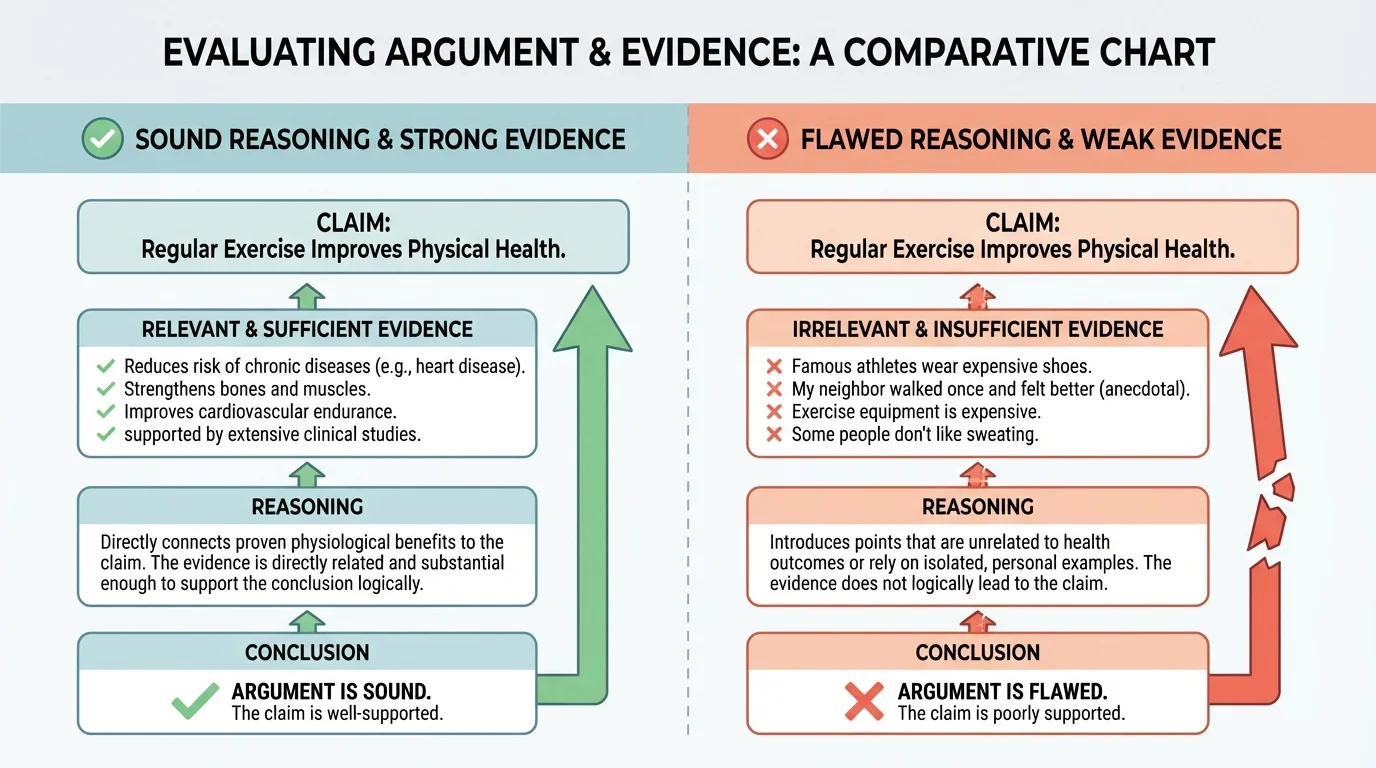
Once you have mapped the argument, the next step is to judge whether the argument demonstrates sound reasoning. Reasoning is sound when the reasons truly support the claim and the logic makes sense. As [Figure 2] shows, even a strong claim can fail if the path from reason to conclusion is weak.
Here is an example of weak reasoning: "Two students who get excellent grades listen to music while studying. Therefore, listening to music causes high grades." This reasoning is weak because the evidence does not prove the cause. Maybe those students would earn excellent grades anyway. Maybe they already have strong study habits. The argument jumps too quickly from a small observation to a broad conclusion.
Here is a stronger version: "Some students focus better with instrumental music, but study conditions vary. A school survey and a learning study suggest that quiet background music helps certain students concentrate during repetitive tasks." This version is more careful. It avoids claiming that music always causes high grades. It connects the claim to the evidence more responsibly.
Unsound reasoning often includes overgeneralizations. Words like "always," "never," "everyone," or "no one" can be warning signs when the evidence is limited. If one cafeteria meal was bad, it does not prove that school lunches are always bad. If one athlete succeeded with a certain routine, it does not prove the routine works for everyone.
Another sign of weak reasoning is a false comparison. Suppose someone argues, "Students should be allowed unlimited phone use in class because adults use phones at work." That comparison ignores important differences. Many adults use phones for job tasks, while students may be distracted from learning. A comparison is only useful if the situations are similar in the right way.
Testing reasoning
A helpful test is to ask, "If the reason is true, does it actually make the claim more believable?" If the answer is weak, unclear, or based on a leap in logic, the reasoning may not be sound. Strong reasoning builds a clear bridge from support to conclusion.
When you participate in discussion, you can question reasoning respectfully. You might say, "I see your point, but how does that example prove the larger claim?" or "Is that enough information to draw that conclusion?" Those questions focus on the logic rather than attacking the person.
Not all evidence is equal. Evidence should be relevant evidence, meaning it directly relates to the claim or reason being supported. It should also be sufficient, meaning there is enough of it to make the support convincing. A single example can be interesting, but one example alone often is not enough to prove a broad claim.
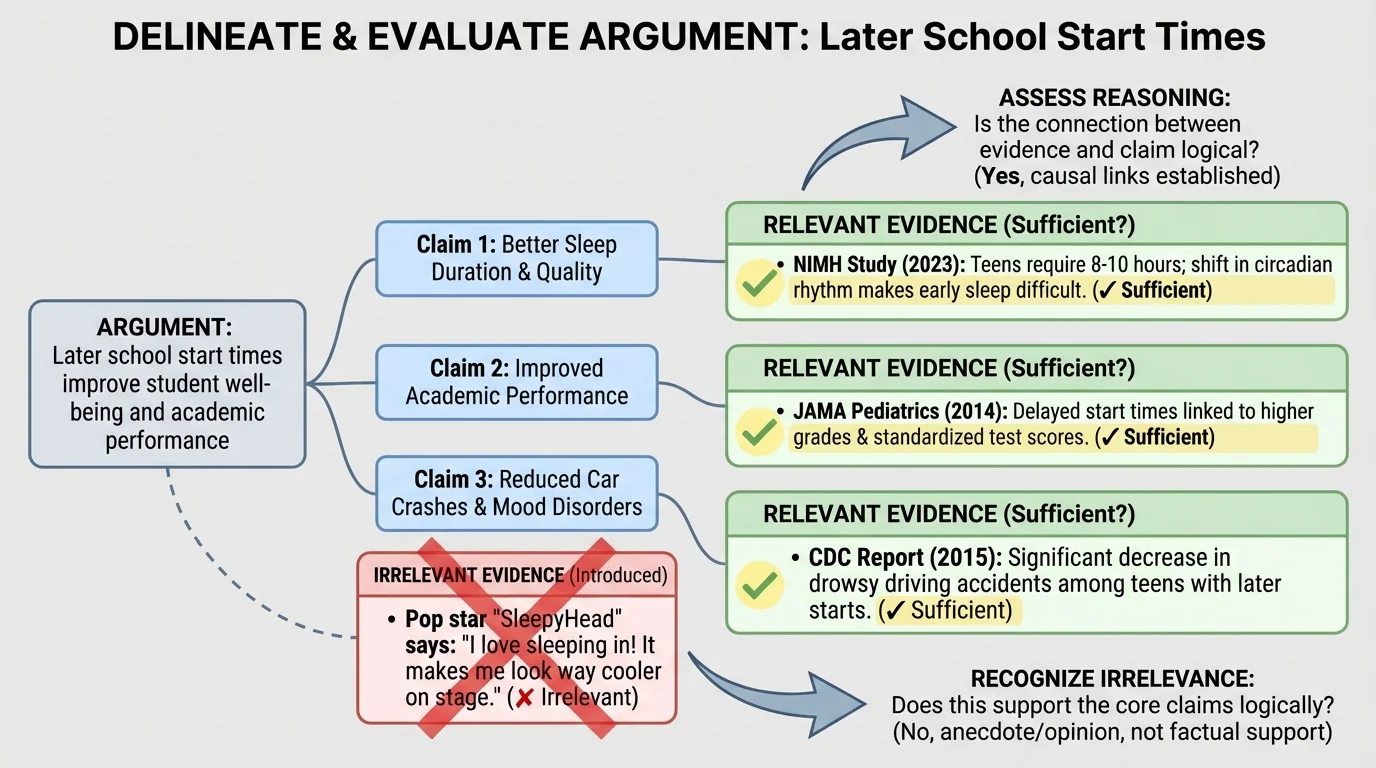
Consider the claim: "Later school start times improve student alertness." Relevant evidence might include sleep research, attendance data, or student surveys about fatigue. Irrelevant evidence would be something like, "A famous actor said mornings are annoying." That statement may be entertaining, but it does not directly support the claim.
Sufficient evidence usually comes from more than one source or from a source that is especially strong. A scientific study with a large sample may provide stronger support than one person's opinion. Multiple surveys, observations, and statistics together often create a more convincing case than a single dramatic story.
Credibility matters too. Ask where the evidence comes from. Is it from a trustworthy source? Is the data current? Was the study conducted carefully? A website with no author and no source information may be less reliable than a report from a research group, a news organization that cites sources, or a published study.
| Type of support | How useful it can be | What to check |
|---|---|---|
| Fact or statistic | Often strong | Is it accurate, current, and from a credible source? |
| Example | Helpful | Is it typical, or just one unusual case? |
| Expert quotation | Can be strong | Is the expert qualified in this topic? |
| Personal opinion | Usually limited | Does it need stronger evidence to support it? |
| Story or anecdote | Engaging but limited | Does it represent the larger issue fairly? |
Table 1. Comparison of common types of support and the questions readers should ask about each type.
As you saw earlier in [Figure 2], the same claim can sound very different depending on the quality of the evidence behind it. Strong evidence does not just add information; it directly strengthens the reason and makes the claim more believable.
Evaluating evidence in a short claim
Claim: "Students learn better when they take short movement breaks during long classes."
Step 1: Look for relevance.
If the writer includes a study on attention after short exercise breaks, that evidence is relevant because it connects to learning and focus.
Step 2: Look for sufficiency.
If the writer gives only one student's opinion, the evidence is probably insufficient for such a broad claim.
Step 3: Look for credibility.
If the study comes from a recognized education or health source, it is more credible than an unsupported social media post.
Step 4: Judge the overall support.
If the argument includes several reliable studies and school observations, the evidence becomes much stronger.
One of the most important skills in argument analysis is spotting irrelevant evidence. Irrelevant evidence does not really support the claim, even if it sounds impressive or emotional, as [Figure 3] makes clear by separating useful support from distracting support.
Suppose the claim is "The city should add more shaded bus stops because heat can be dangerous for riders." Relevant evidence would include temperature data, health information about heat exposure, or rider surveys. Irrelevant evidence might be "The mayor likes the color blue, and many shaded bus stops use blue roofs." That detail has nothing to do with whether shaded stops improve safety or comfort.
Writers and speakers sometimes use emotional stories to distract from weak support. A story can be powerful and still not prove the larger point. If one person had a bad experience with online learning, that story matters, but it does not automatically prove that online learning never works. You still need broader evidence.
Another misleading move is changing the subject. In a debate about recycling at school, a speaker might be challenged on whether recycling bins reduce waste. Instead of answering, the speaker might start talking about how beautiful the school mascot is. That detail may create enthusiasm, but it does not address the claim.
Sometimes irrelevant evidence appears because people confuse a side detail with the main issue. For example, if the claim is "Water bottles should be refillable to reduce plastic waste," then the color, brand popularity, or trendiness of a bottle may be irrelevant unless the argument is specifically about student use patterns.
Remember the difference between a topic and a claim. A topic is a broad subject, such as school lunches or phone use. A claim is a specific position about that topic. Evidence must support the claim, not merely relate loosely to the general topic.
When you detect irrelevant evidence, name the problem clearly. You might say, "That detail is related to the topic, but it does not support the claim," or "This example is interesting, but it does not prove the point being argued." That kind of response is precise and respectful.
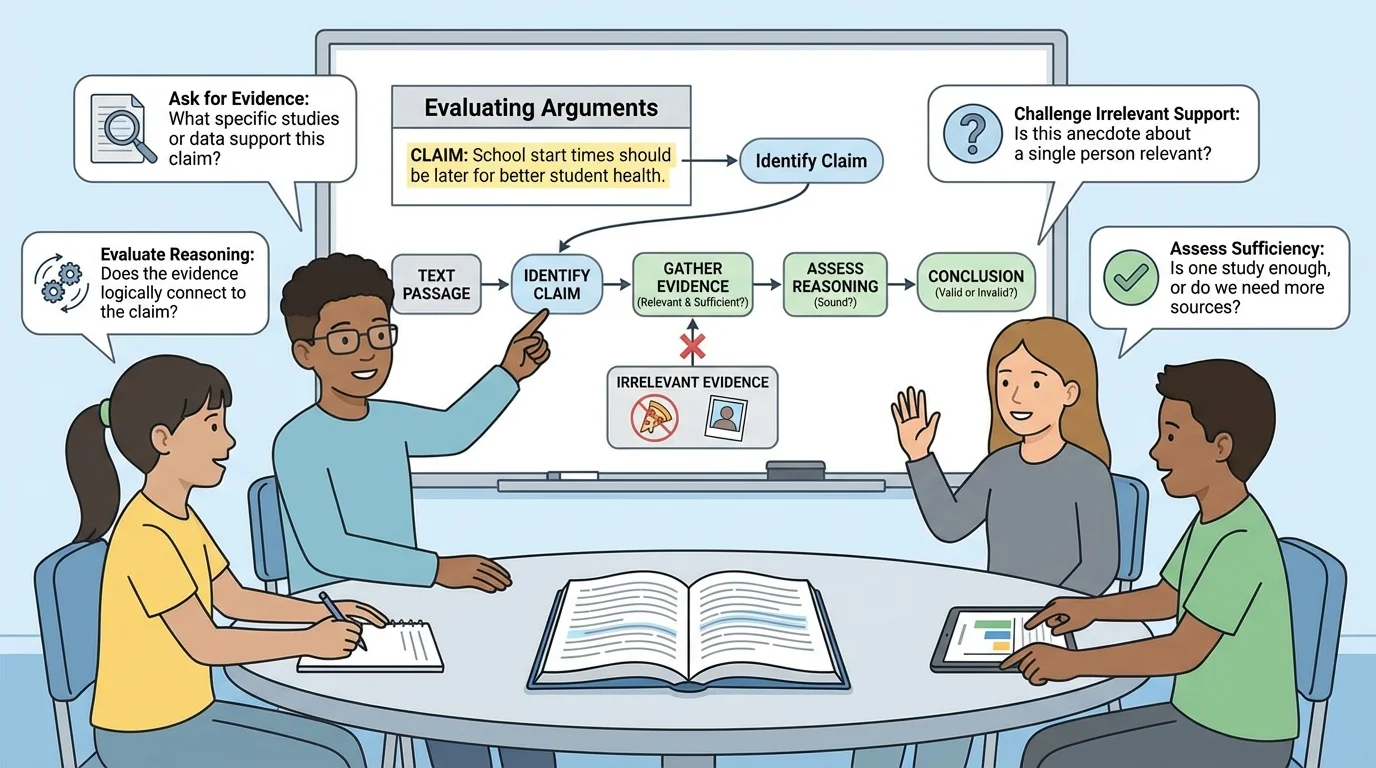
These skills matter not only when reading but also when listening to speakers and participating in group conversations, as [Figure 4] illustrates in a classroom discussion. During collaborative discussions, students often hear claims made quickly. To respond thoughtfully, they need to separate the claim from the support and test whether the support is strong.
If a classmate says, "Our school should have more outdoor classes because nature improves mood," you can listen for reasons and evidence. Did the speaker provide research? Did they give only a personal preference? Did they answer concerns about weather, noise, or scheduling? Careful listening turns discussion into analysis, not just reaction.
Good discussion habits include asking clarifying questions, building on others' ideas, and challenging weak support respectfully. You might ask, "What evidence supports that claim?" "How does that example connect to the main point?" or "Is that information relevant to the issue we are discussing?" These questions keep the conversation focused.
Being able to evaluate spoken arguments is especially important in a world full of podcasts, videos, speeches, and interviews. A speaker's confidence, humor, or dramatic storytelling can make an argument sound strong even when the evidence is weak. Your job is to listen beneath the style and examine the structure.
Later, when you speak in class, these same standards apply to your own argument. You should make your claim clear, support it with relevant and sufficient evidence, and avoid adding details that do not help your point. As seen earlier in [Figure 4], strong discussion depends on both clear speaking and careful listening.
Consider this argument: "School cafeterias should serve more fresh fruit because students need healthy options. A nutrition report shows that many teens do not eat enough fruit each day. At one nearby school, fruit sales increased when sliced fruit was offered. Therefore, our school should expand fruit choices." This argument is fairly strong. The claim is clear. The evidence is relevant because it connects directly to nutrition and student choices. It may still need more evidence about cost or waste, but the support makes sense.
Now consider this version: "School cafeterias should serve more fresh fruit because apples are red, and red is an exciting color. Also, one basketball player said fruit is cool." This argument is weak. The color of apples does not support the policy claim, and the athlete's opinion is not enough evidence. Both pieces of support are weak or irrelevant.
Case study: evaluating a technology argument
Argument: "Students should use tablets instead of paper textbooks because digital tools are more efficient. Tablets can store many books in one device. A district report found that students carried lighter backpacks after switching to tablets. However, some families worry about screen time, so schools could combine tablets with printed materials for longer reading tasks."
Step 1: Identify the claim.
The claim is that students should use tablets instead of paper textbooks.
Step 2: Evaluate the reasons.
One reason is efficiency: tablets store many books in one place. That reason connects logically to the claim.
Step 3: Evaluate the evidence.
The district report about lighter backpacks is relevant evidence because it supports the efficiency reason.
Step 4: Evaluate the counterclaim.
The concern about screen time is a real counterclaim. The response is reasonable because it suggests a balanced solution instead of ignoring the problem.
Step 5: Judge the overall argument.
The argument is fairly strong, though it would be stronger with more evidence about learning outcomes, cost, and device reliability.
Here is another example: "After our class used a review game, everyone did well on the quiz. Therefore, games are the best way to learn all subjects." This argument has a clear claim, but the reasoning is too broad. One class and one quiz do not prove that games are the best method for all subjects. The evidence is too limited, so it is insufficient.
Strong evaluators notice both strengths and weaknesses. An argument does not have to be perfect to have value. You may conclude that a text has a reasonable claim and some good evidence, but still needs stronger support in certain areas. That kind of balanced judgment is more thoughtful than simply saying "good" or "bad."
As you become a more skilled analyst of arguments, develop a routine. First, identify the claim. Second, trace the reasons. Third, examine the evidence. Fourth, test whether the reasoning is sound. Fifth, look for irrelevant evidence or gaps in support. This routine works for articles, speeches, debates, editorials, presentations, and even everyday conversations.
It also helps to keep your language precise. Instead of saying, "I just don't agree," say, "The evidence is not sufficient," or "That example is not relevant to the claim," or "The reasoning makes a leap from one case to a broad conclusion." Precise language shows clear thinking.
Over time, these skills make you less likely to be misled by strong tone, emotional stories, or flashy details. They also help you become a better communicator. When you know how to judge arguments well, you also learn how to build stronger ones yourself.
"A strong opinion becomes a strong argument only when it is supported by clear reasons and solid evidence."
Whether you are reading an article, listening to a presentation, or joining a discussion, the goal is the same: understand the argument clearly, examine how it works, and judge whether it truly deserves your trust.
