Two articles can give the same facts and still leave readers with very different ideas. One article might describe two inventors as rivals. Another might present them as part of the same movement. One history text might group events into "causes" and "effects." Another might divide them into "political," "economic," and "social" categories. That difference matters because authors do not just deliver information. They organize it. To read closely, you need to notice how a text links things together and how it separates them.
Informational texts are built from relationships. Authors connect details so readers can see patterns, and they make distinctions so readers do not confuse important differences. A science article might connect drought, heat, and crop failure to show a chain of effects. A biography might distinguish between a leader's public image and private struggles. A news report might compare two policies to help readers understand a debate.
When you analyze these choices, you move beyond asking "What does the text say?" and begin asking "How does the text organize meaning?" That deeper reading helps you understand the author's message, purpose, and point of view.
Connection is a relationship the author creates among people, ideas, or events. A connection may show similarity, cause and effect, sequence, influence, or shared category.
Distinction is a meaningful difference the author highlights. A distinction may involve different goals, methods, results, perspectives, or characteristics.
Informational text is nonfiction writing that explains, describes, argues, or informs using facts, examples, and analysis.
Strong readers notice both kinds of moves. If an author compares electric cars with gas-powered cars, that is a connection through comparison. If the author then separates them by cost, pollution, and convenience, that is also a distinction. Often, a text does both at the same time, as [Figure 1] shows.
Authors use several common methods to show relationships. The most common are comparison, contrast, analogy, and category. They may also use cause and effect, sequence, examples, and classification to shape how readers understand a topic.
A comparison shows how two or more things are alike. For example, a text about social media and television might explain that both influence public opinion. A contrast shows how they differ, such as the speed of online sharing compared with scheduled TV broadcasting. Together, comparison and contrast help readers see both connections and distinctions clearly.
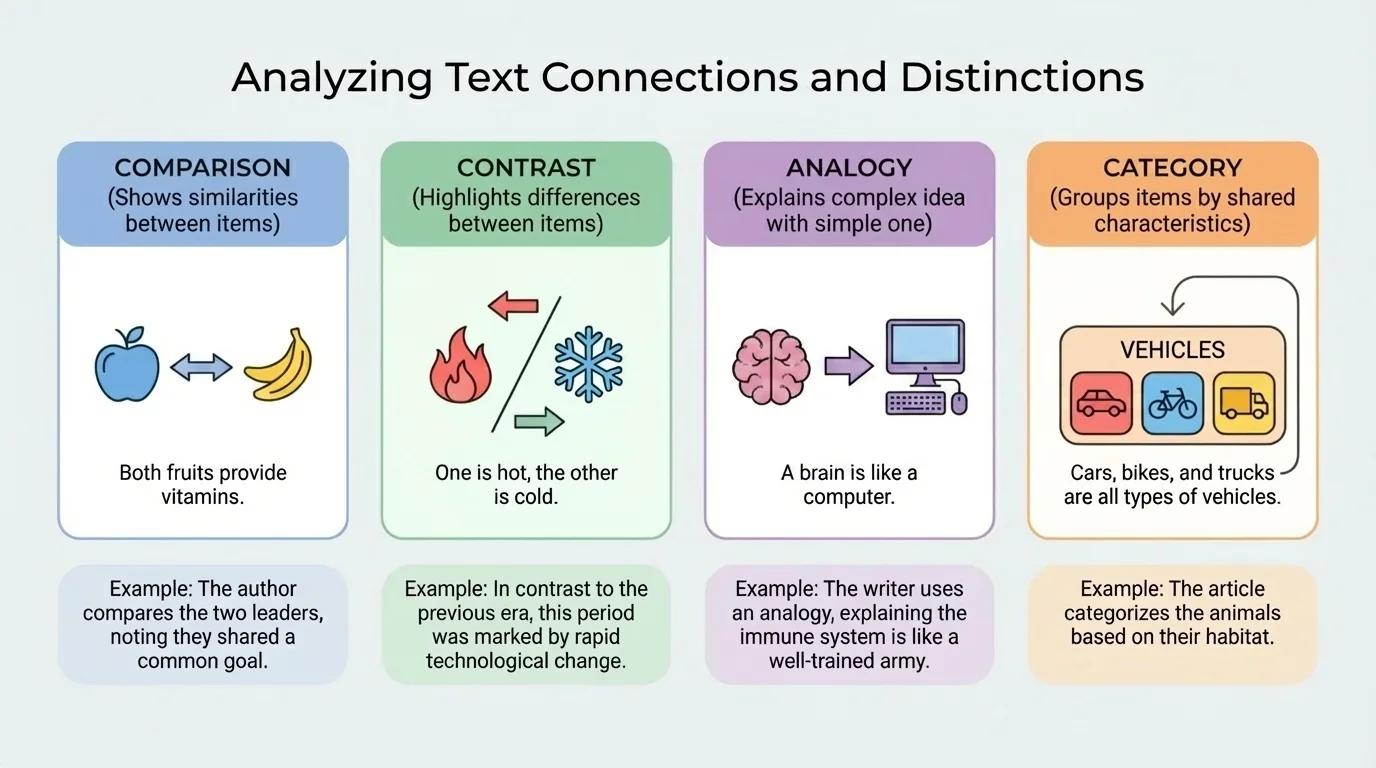
An analogy explains something unfamiliar by comparing it to something more familiar. For example, an article may explain computer memory by comparing it to a student's notebook: both store information so it can be used later. Analogies are useful, but they are not perfect matches. A careful reader asks which parts of the analogy fit and which parts do not.
A category is a group created by shared features. An author might sort energy sources into renewable and nonrenewable categories. A historian might classify causes of a war as political, economic, and cultural. Categories help simplify complex information, but they also show what the author thinks matters most. If a writer groups inventions by purpose instead of by date, that choice changes how the reader thinks about them.
Many textbooks use categories so often that readers stop noticing them. But categories are not neutral labels; they are author choices that shape what seems connected and what seems separate.
Other connections matter too. A text may place events in sequence to show development over time, or link one event to another through cause and effect. It may connect a general idea to a specific example, or a problem to a proposed solution. Every one of these choices guides the reader's thinking.
Informational texts often discuss individuals such as scientists, activists, athletes, inventors, or political leaders. Authors may connect individuals by shared goals, similar backgrounds, or common challenges. They may distinguish them by methods, beliefs, achievements, or impact.
Suppose a text compares two explorers. As [Figure 2] shows in a visual comparison model, the author might connect them by noting that both traveled into unknown regions and relied on local knowledge. At the same time, the author might distinguish them by motive: one sought trade routes, while the other pursued scientific discovery. The connection helps you see a broader pattern; the distinction keeps the people from blending into one simplified story.
Authors also connect people through roles. A passage about public health might discuss a doctor, a researcher, and a policymaker. These individuals are distinct, but the text can connect them as part of one effort to fight disease. A skilled reader tracks both the shared mission and the separate responsibilities.
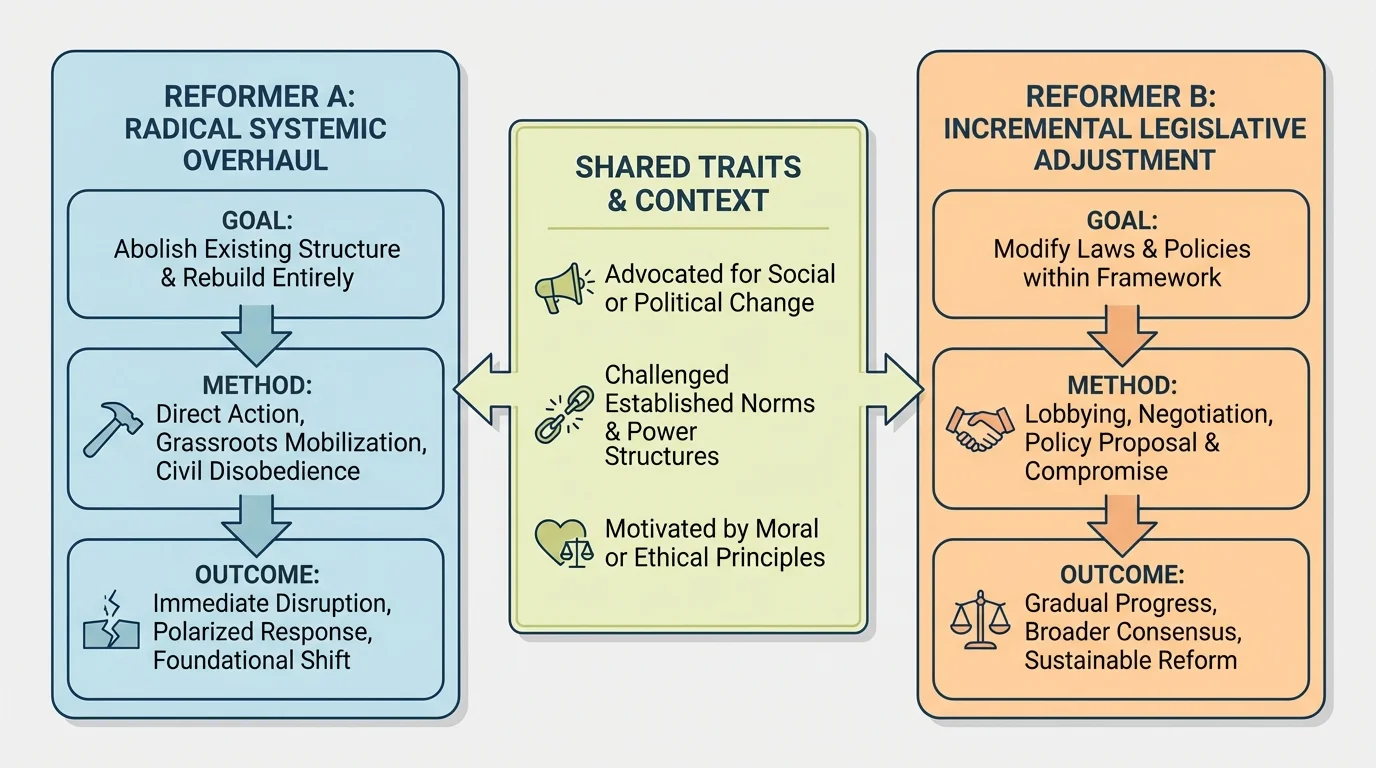
In biography and history, distinctions are especially important. Two leaders may both support change, but one may use peaceful protest while the other uses armed resistance. If a reader notices only the connection, the analysis is incomplete. If the reader notices only the difference, the larger historical pattern may be missed. Strong analysis includes both.
Case study: comparing two inventors in an informational passage
A passage explains that both inventors improved communication technology, but one focused on long-distance transmission while the other focused on everyday consumer use.
Step 1: Identify the connection
The author connects the inventors through a shared field: both changed how people communicate.
Step 2: Identify the distinction
The author separates them by purpose and audience. One inventor's work solves a technical problem, while the other adapts technology for wider public use.
Step 3: Explain the effect of the choice
By organizing the information this way, the author shows that innovation can happen in different forms. Readers see both cooperation within a field and individual differences in contribution.
Noticing shared traits in the center is not enough. You must also pay attention to the side details, because those differences often reveal the author's deeper point.
Authors do not only connect people. They also build relationships among ideas. A text about nutrition might connect sleep, exercise, and diet as parts of overall health. It may distinguish them by showing that each affects the body in a different way. A civic article might connect freedom and responsibility while also distinguishing rights from privileges.
Sometimes authors compare competing ideas. For example, a passage on city planning might contrast building more highways with investing in public transportation. The text may connect both ideas as attempts to reduce traffic, but distinguish them by cost, environmental impact, and long-term results. This structure helps readers understand a debate instead of seeing isolated facts.
Analogies are especially common when authors explain difficult ideas. A writer may compare the human immune system to a security team. That analogy connects the unfamiliar idea of body defense to a familiar system of detection and response. But the author may then distinguish the two by pointing out that immune cells react automatically, while security guards make conscious decisions. Good readers understand both the helpful comparison and the limits of the analogy.
Why analogies help and why they can mislead
An analogy works by transferring understanding from one situation to another. It helps readers quickly grasp a complex idea, but it always simplifies. When analyzing an analogy, ask: What exactly is being compared? What feature is the author emphasizing? What important differences remain?
Categories also shape the way ideas are understood. If a text groups forms of government into democracies, monarchies, and dictatorships, it highlights one type of distinction. If the same topic is organized instead by how power is shared, then different connections appear. Category systems are useful, but they are never the only possible system.
Events can be linked by time, cause, consequence, location, or theme. In history, an author may connect protests in different cities to show a national movement. In science, an author may connect a volcanic eruption, a drop in temperature, and crop damage to show cause and effect. In current events, a writer may compare two storms to explain how geography changes their impact.
When authors distinguish events, they often want readers to avoid false comparisons. Two revolutions may both begin with public anger, but one may lead to democratic reform while the other leads to military rule. A careful writer highlights those distinctions so the reader does not assume that similar beginnings produce identical outcomes.
Some texts connect events across long stretches of time. An article about space exploration might relate the first moon landing to current Mars missions. The events are not identical, but the author may connect them through shared goals such as discovery, technology, and national ambition. The distinction may come in the tools used, risks faced, or international cooperation involved.
Earlier reading skills still matter here: identify the main idea, track supporting details, and notice text structure. Analysis of relationships depends on accurate understanding of what the text actually says.
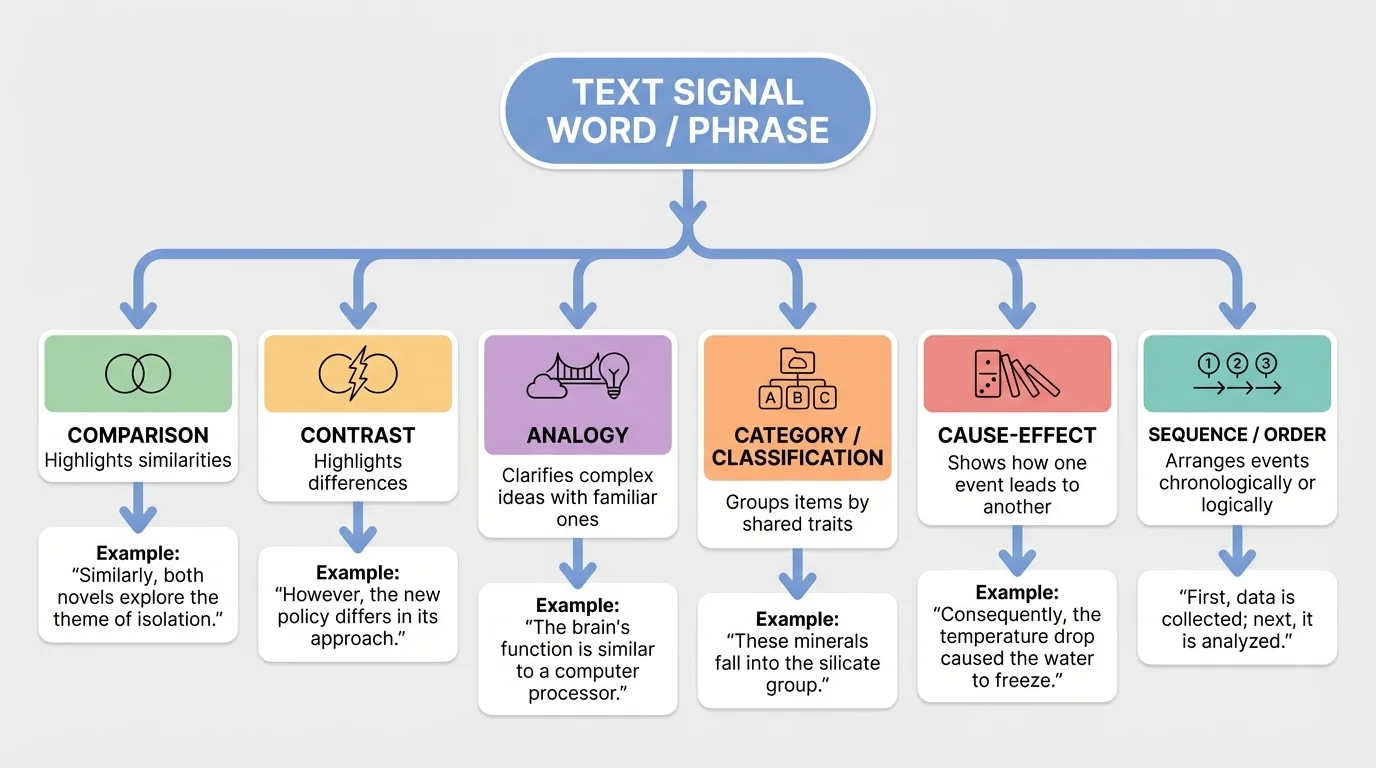
Writers also use event connections to create arguments. If a text links rising sea levels, severe flooding, and costly repairs, it is not just listing facts. It is arranging events to show urgency and persuade readers that action is needed. [Figure 3] previews how signal words can help readers identify these relationships.
One of the fastest ways to find relationships is to notice signal words. These clues often reveal whether the author is comparing, contrasting, classifying, sequencing, or explaining causes and effects.
Words such as similarly, also, and in the same way often signal comparison. Words like however, unlike, on the other hand, and in contrast often signal distinction. Terms such as for example and for instance can connect a broad idea to a specific detail. Words like because, therefore, and as a result often signal cause and effect.
| Relationship | Common Signal Words | What It Suggests |
|---|---|---|
| Comparison | similarly, likewise, also | Two things share features |
| Contrast | however, unlike, in contrast | Important differences matter |
| Category | types, kinds, groups, classified as | Information is being sorted |
| Analogy | like, as if, similar to | An unfamiliar idea is explained through a familiar one |
| Cause and effect | because, so, therefore, as a result | One event or condition leads to another |
| Sequence | first, next, later, finally | Events are arranged in order |
Table 1. Common signal words that help readers identify how a text connects or distinguishes information.
Signal words are helpful, but they are not magic. Sometimes an author implies a relationship without using obvious clue words. For example, a paragraph may place two case studies side by side without saying similarly or however. In that case, the organization itself creates the connection or distinction. That is why readers must pay attention to both wording and structure.
Later, when you analyze a passage, the pathway in [Figure 3] helps you move from clue words to relationship type. But always confirm the relationship with the details of the passage, not with a single word alone.
Finding a relationship is only the first step. Analysis asks why the author chose that relationship and what effect it has. If a writer compares two energy sources, ask why those two were selected. Is the author trying to argue that one is more efficient? More affordable? Less harmful to the environment?
Think about emphasis. What gets grouped together? What gets separated? What appears first? What receives the most detail? If a text spends three paragraphs on the dangers of one option and one sentence on the benefits, the organization is influencing how the reader judges the topic.
Also examine what is left out. A category can simplify information, but it can also hide complexity. A comparison can reveal important similarities, but it can also ignore major differences. An analogy can make learning easier, but it can also oversimplify. Careful readers do not just follow the author's structure; they evaluate it.
"The way information is arranged is part of the meaning."
That principle matters in every subject. In science, organization can reveal systems and processes. In history, it can show patterns and turning points. In social studies and current events, it can shape arguments and influence opinion.
Consider a passage about renewable energy. The author groups solar, wind, and hydroelectric power into one category because all are renewable. That connection helps the reader see a shared trait: these sources can be replenished naturally. But the author then distinguishes them by cost, land use, and reliability. Solar power depends on sunlight, wind power depends on air movement, and hydroelectric power depends on water systems. The point is not just that all three are "green." The point is that each has strengths and limits.
Case study: analyzing a history paragraph
A paragraph explains that both the printing press and the internet transformed how ideas spread, but it also stresses their different speeds and audiences.
Step 1: Spot the connection
The author links the two inventions because both expand access to information.
Step 2: Spot the distinction
The printing press spreads information more slowly and physically, while the internet spreads it almost instantly and digitally.
Step 3: Analyze the author's purpose
The comparison helps readers understand the internet through a historical parallel. The distinction prevents the analogy from becoming too simple.
Now consider a medical article describing viruses and bacteria. The text may connect them as causes of illness, which helps the reader see why both matter in public health. But it must distinguish them clearly because antibiotics work on bacteria, not viruses. If a reader misses that distinction, the central information of the article is lost.
A sports article can also use these structures. It may compare two athletes with similar records, then distinguish one by leadership, consistency, or playoff performance. That organization shapes the argument about which athlete had the greater impact. The same reading skill applies whether the topic is medicine, history, technology, or sports journalism.
One common mistake is text structure blindness: reading the facts but not noticing how they are organized. Another is summarizing instead of analyzing. If you say, "The paragraph is about two scientists," that is only summary. Analysis would say, "The author connects the scientists through shared research goals but distinguishes them by method, which highlights two different approaches to solving the same problem."
A second mistake is treating all similarities as equally important. Some comparisons are central to the author's point; others are minor. You need to decide which details carry the main meaning. A third mistake is ignoring implied distinctions. Sometimes the author never says "these are different," but the examples, sequence, or category labels make that clear.
Summary versus analysis
Summary tells what the text says. Analysis explains how the text builds meaning. When you identify relationships among individuals, ideas, or events, always add the effect of that choice on the reader's understanding.
Finally, avoid assuming that a category is naturally true just because it appears in a text. Categories are useful tools, but they are created by people. Ask why the author chose that system and what it helps the reader notice.
Every day, people meet informational texts that try to shape understanding: news articles, documentaries, science reports, websites, biographies, and opinion pieces. A report may connect crime rates and policy changes. A health article may compare two treatments. A technology review may group devices into categories such as budget, performance, and battery life. Reading carefully means recognizing those organizing choices.
This skill also helps you resist weak arguments. If a writer uses an analogy that sounds clever but ignores major differences, you can challenge it. If an article compares two events that only seem similar on the surface, you can question the comparison. If a text leaves out key distinctions, you can detect that weakness.
Strong readers notice patterns, categories, comparisons, and contrasts not as decorations but as tools of meaning. When you identify how a text connects and distinguishes individuals, ideas, and events, you understand not only the information but also the author's design.
