Two articles can discuss the exact same topic and leave readers with completely different ideas. One article about school uniforms might make them sound like a smart solution; another might make them seem unfair and outdated. The difference often comes from the author's point of view, purpose, and the way the author handles information that does not fully agree with the main argument. Learning to notice those choices is one of the most powerful reading skills you can build, especially in a world full of news stories, blogs, reviews, and online posts.
When you read informational text, you are not just collecting facts. You are also paying attention to how those facts are presented. An author may include certain details, leave out others, use careful or emotional language, or mention opposing ideas only briefly. Strong readers notice these choices and ask: What does the author want me to think? Why was this text written? Does the author deal honestly with other perspectives?
If you can identify why a text was written, you can understand it more deeply. A scientist writing a lab report usually aims to explain findings clearly. A columnist may want to persuade readers to support a new policy. A public health article might try to warn people about a danger while also giving practical advice. The author's purpose affects the evidence chosen, the tone, and the organization of the text.
This matters in everyday life. When you scroll through headlines, hear claims in advertisements, or read arguments on social media, you are surrounded by texts that try to shape your thinking. Some are balanced and careful. Others are one-sided. Recognizing purpose and point of view helps you become a more thoughtful reader instead of a reader who accepts every claim automatically.
Point of view is the author's position, attitude, or perspective on a topic.
Purpose is the reason the author wrote the text, such as to inform, explain, persuade, warn, or argue.
Conflicting evidence is information that challenges or weakens the author's main claim.
Conflicting viewpoints are opinions or positions that differ from the author's own.
Although point of view and purpose are related, they are not the same. The topic of a text might be school lunches, but the purpose might be to persuade readers that lunches should include fresher food. The author's point of view might be that current lunches are too processed and should be improved.
An author's point of view can be strong and obvious, or it can be subtle. Sometimes an author directly states an opinion: Students need more outdoor time because it improves focus and health. Other times, the point of view is implied through examples, details, and tone. Even if the author never says, "I believe this," the choice of what to include often makes the stance clear.
Purpose can usually be described with an action word. An author may want to inform, explain, argue, persuade, criticize, warn, or call readers to action. Some texts have more than one purpose. For example, an article about plastic pollution may inform readers about the problem and also persuade them to change their habits.
As you read, it helps to separate three ideas: the topic, the purpose, and the point of view. The topic tells what the text is about. The purpose tells why it was written. The point of view tells what the author thinks or how the author sees the issue.
Informational texts are not all neutral. Some mainly provide background knowledge. Others are clearly trying to shape opinion. Here are several common purposes you may notice.
To inform: The author gives facts, definitions, and explanations so readers can understand a topic. A textbook section about hurricanes usually has this purpose.
To explain or analyze: The author breaks down causes, effects, or relationships. An article about why sleep affects memory may explain scientific research and analyze patterns.
To persuade or argue: The author wants readers to accept a claim. A piece arguing that schools should begin later is doing more than informing; it is trying to convince.
To warn or advise: The author alerts readers to risks or recommends choices. A public safety article about heat stroke may both inform and warn.
To inspire action: Some texts ask readers to do something, such as recycle more, sign a petition, or support a community project.
Finding the purpose helps you judge the text fairly. A persuasive editorial does not need to sound exactly like a science report, but it does need to use evidence honestly if it wants to be credible.
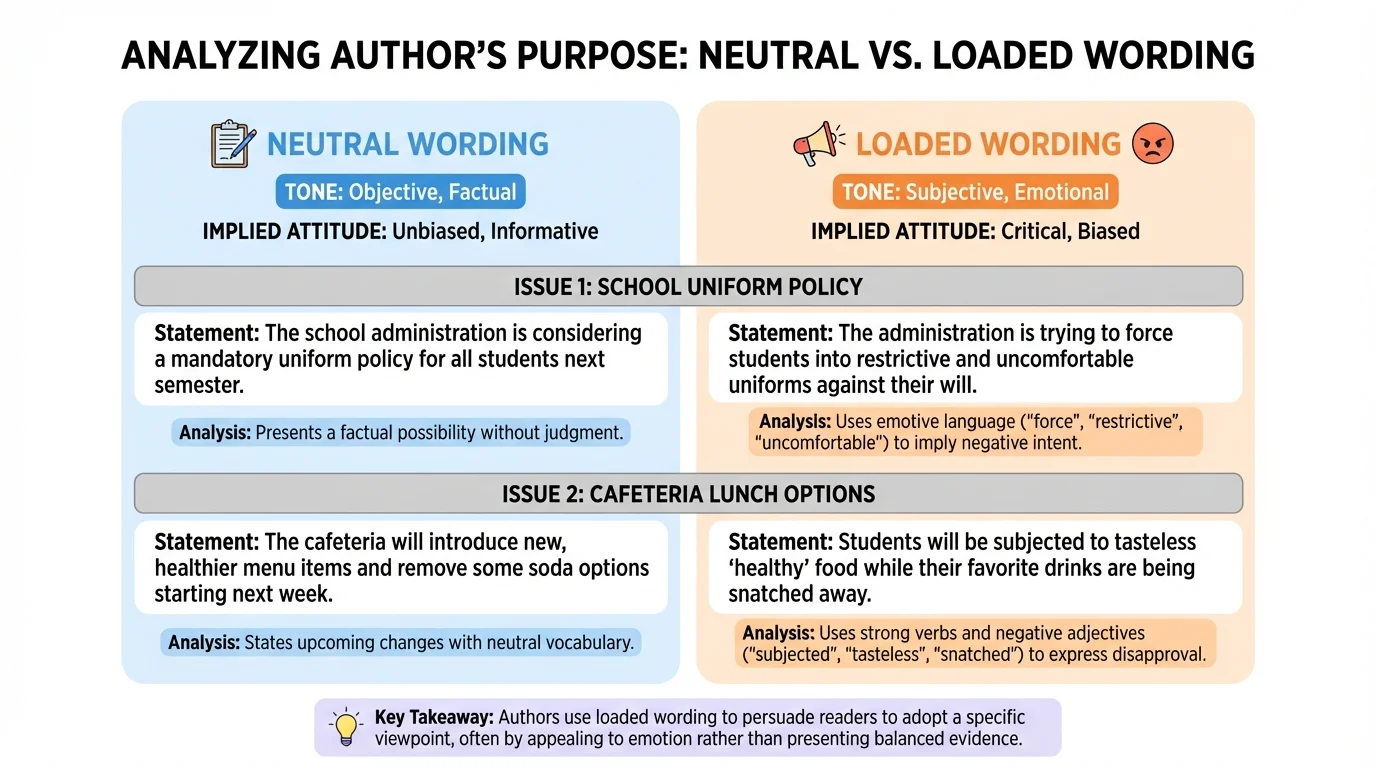
An author's diction, or word choice, often reveals attitude quickly, as [Figure 1] makes clear through the difference between neutral and loaded wording. Compare these two sentences: The city approved a new traffic plan and The city pushed through a confusing traffic plan. Both refer to the same event, but the second sentence suggests criticism.
Tone also matters. A serious, respectful tone may suggest careful analysis, while a sarcastic tone may show that the author dismisses another side. Readers should also notice patterns in the evidence. Does the author include only studies that support one side? Does the author quote only experts who agree? The selection of evidence can reveal point of view just as strongly as direct opinion statements.
Another clue is emphasis. Authors decide what to highlight, what to mention briefly, and what to leave out. If an article about video games spends five paragraphs on possible harms and only one sentence on possible benefits, that imbalance tells you something about the author's stance.
You can also examine what kind of facts are used. Statistics, expert quotations, personal stories, and examples all affect readers differently. A personal story can make an issue feel emotional and urgent. A statistic can make it feel broad and measurable. When an author chooses one kind of evidence over another, that choice helps shape the text's point of view.
Even punctuation can hint at attitude. A headline ending with an exclamation point feels more urgent or opinionated than one using a period.
For example, imagine a text about homework. If the author writes, Students already face overloaded evenings packed with sports, family duties, and jobs, the phrase overloaded evenings suggests sympathy for students. If the author writes, Homework remains an essential tool for building discipline, the phrase essential tool signals approval.
Not every issue has one obvious answer. In many informational texts, especially arguments, there are other perspectives that challenge the author's main idea. These may come in the form of counterarguments, alternative explanations, or facts that do not fully support the author's claim.
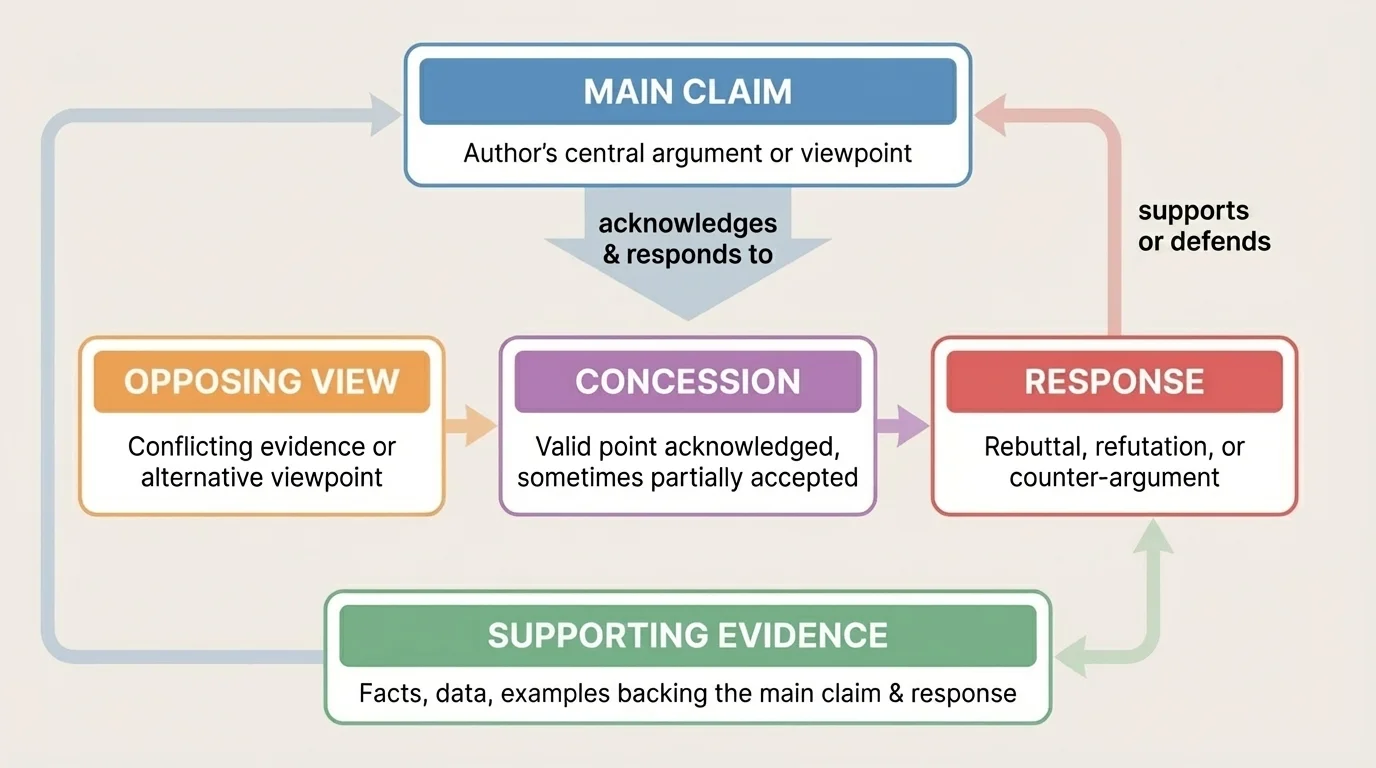
[Figure 2] For example, suppose an author argues that school should start later because teens need more sleep. Conflicting evidence might include transportation problems, after-school scheduling concerns, or data showing that later start times do not automatically improve grades in every district. Conflicting viewpoints might come from parents, coaches, bus drivers, or students with part-time jobs.
Strong writers do not pretend these other perspectives do not exist. Instead, they acknowledge them and respond. That response may strengthen the text if it is fair and well supported. If the author ignores important evidence or misrepresents the other side, the argument becomes weaker.
Why conflicting evidence matters
A convincing informational text is not just one that gives support for its own claim. It also shows awareness that real issues are complicated. When authors recognize limits, answer objections, and respond to evidence that challenges them, readers are more likely to trust the argument.
Conflicting evidence does not always destroy an author's claim. Sometimes it simply forces the author to qualify the claim. Instead of saying, This solution works in every case, a careful author may say, This solution works in many situations, though not all. That kind of adjustment can actually make a text more believable.
Authors often follow a recognizable pattern when presenting an argument: main claim, acknowledgment of another view, and response. They may introduce another side with phrases such as some critics argue, opponents claim, it is true that, or admittedly. These signals tell readers that the author is stepping aside for a moment to address an alternative view.
One important technique is a concession. A concession happens when an author admits that the opposing side has at least one valid point. For example: It is true that later school start times can create transportation challenges. This sentence shows acknowledgment rather than denial.
Acknowledging another viewpoint can make the author sound more fair-minded. It shows the author has considered the issue seriously instead of pretending no disagreement exists. However, simply mentioning the other side is not enough. Readers should still ask whether the author explains that side accurately and completely.
Sometimes authors acknowledge opposing views only to dismiss them quickly. For example, an author might write, Some people complain about the cost, but they are exaggerating. This does mention the other side, but it may not explain the concern fairly. A better response would describe the concern clearly and then answer it with evidence.
After acknowledging another side, authors usually respond in one of several ways. They may rebut it by arguing that the objection is wrong. They may refute it with stronger evidence. They may qualify their own claim by admitting limits. Or they may integrate part of the opposing view into a more balanced conclusion.
Suppose an author argues that reusable water bottles should replace disposable plastic bottles in schools. A thoughtful response to conflicting evidence might look like this: Some students forget to bring reusable bottles, which can make the policy inconvenient at first. However, schools that install refill stations and keep a small supply of low-cost reusable bottles reduce that problem significantly. This response does three things: it acknowledges the problem, gives evidence, and explains a solution.
A weaker response would simply say, That problem does not matter. Such a reply may sound confident, but it does not help readers understand the issue. Strong responses depend on evidence, logic, and fair explanation.
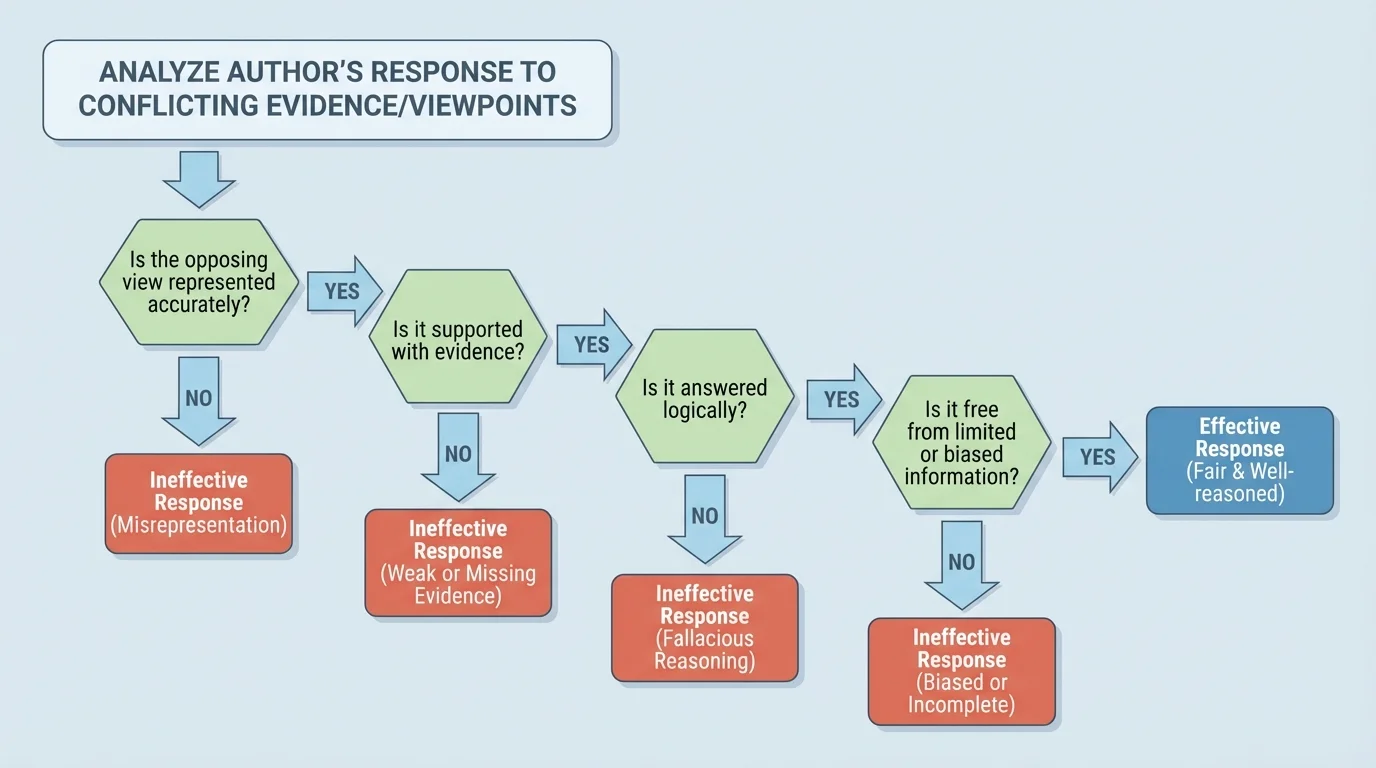
[Figure 3] Authors also respond through organization. They might place the opposing view early and then spend several paragraphs answering it. Or they may save it for later to strengthen a final conclusion. The placement can affect how persuasive the text feels.
To judge an author's response, readers should use clear criteria. Ask: Does the author describe the other side accurately? Does the author use relevant evidence? Does the response answer the strongest opposing point or only a weak version of it? Is the tone respectful or dismissive? Does the author ignore major facts that would challenge the claim?
A fair response does not twist the opposing side into something silly or extreme. For example, if critics of a new rule are mainly worried about cost, it would be unfair to describe them as people who simply hate change. That would be a distorted version of their viewpoint.
Effective responses usually include strong evidence, such as research findings, expert opinions, examples, or clear reasoning. They also avoid overstatement. A sentence like This proves the issue forever often sounds less trustworthy than a more careful statement like This evidence suggests the policy can work under the right conditions.
Fairness and effectiveness are not exactly the same. An author may represent the other side honestly but still fail to answer it convincingly. On the other hand, an author may sound persuasive while being unfair. Good readers look for both qualities.
When evaluating evidence, remember that not all evidence has the same strength. A personal story may be powerful, but a broad study or multiple sources often provide stronger support for a general claim.
This is why careful reading matters. As you saw earlier in [Figure 1], language can quietly shape attitude. Even if an author mentions another side, loaded words can still reveal bias. And the structure shown in [Figure 2] helps you check whether the acknowledgment is followed by a real response or just a quick dismissal.
Consider this claim from a student editorial: Schools should limit phone use during class because constant notifications make focused learning harder. The author's purpose is to persuade. The point of view is that phone limits support learning. If the editorial adds, Some students use phones responsibly for calendars and research, but teachers can still allow specific academic uses while preventing distractions, the author is acknowledging an opposing viewpoint and responding with a compromise-based argument.
Case study: later school start times
Read this short passage: Research shows that teenagers need more sleep than many younger children. For that reason, middle and high schools should begin later in the morning. Critics point out that changing start times can complicate bus routes and after-school activities. Those concerns are real, but districts that phased in later start times reported fewer first-period absences and better student alertness.
Step 1: Identify the purpose.
The passage aims to persuade readers that later start times are a good idea.
Step 2: Identify the point of view.
The author supports later school start times for teenagers.
Step 3: Find the conflicting viewpoint.
The conflicting viewpoint is that later starts create transportation and activity problems.
Step 4: Analyze the response.
The author acknowledges the concern as real, then responds with reported benefits such as fewer absences and better alertness.
The response is fairly effective because it does not ignore the criticism. It admits the concern and answers it with evidence.
Now consider a weaker example: Recycling programs should be mandatory in every school. Some people disagree, but they do not care about the planet. This author clearly has a persuasive purpose and a strong point of view. However, the response to the opposing side is weak and unfair. It does not explain why people disagree. Maybe some schools face funding problems or lack local recycling services. By attacking motives instead of addressing real concerns, the author weakens the argument.
Here is a more balanced version: Recycling programs should be mandatory in every school. Some administrators worry that bins, pickup, and supervision cost money. That concern matters, but schools can reduce costs by partnering with local waste services and student environmental clubs. This version is stronger because it addresses a real obstacle instead of insulting the opposition.
When you use the evaluation questions from [Figure 3], you can see why the second version works better. It represents the other side more accurately, responds with practical evidence, and keeps a respectful tone.
One useful strategy is to annotate while reading. Circle or note strong opinion words. Underline evidence. Mark places where the author introduces another viewpoint. Then ask what happens next: Does the author answer the point carefully, partly, or not at all?
Another strategy is to use sentence frames in your thinking. You might say: The author's purpose is to ___ because ___. Or: The author acknowledges the opposing view that ___, then responds by ___. These frames help turn observations into analysis.
You can also compare texts on the same topic. If two articles discuss the same issue but use different evidence and different tones, their purposes and points of view may become easier to spot. One may be trying to inform neutrally while the other is pushing readers toward a specific conclusion.
As you analyze, remember that a strong author does not always "win" by crushing the other side. Sometimes the most effective writing shows complexity. It may admit that the issue has trade-offs and still argue that one choice is best overall.
One common mistake is confusing the topic with the purpose. If a text is about renewable energy, that is the topic. If the author wants readers to support solar panels in schools, that is the purpose.
Another mistake is assuming that any mention of another viewpoint means the author is fair. Authors can mention opposing views in misleading ways. The important question is whether those views are represented accurately and answered with real evidence.
A third mistake is relying only on obvious opinion words. Some texts appear calm and factual but still reveal point of view through selective evidence, missing details, or the order in which information is presented.
Finally, do not assume that a text without the word I has no point of view. Informational writing often sounds objective, but authors still make choices about emphasis, examples, tone, and evidence. Those choices shape meaning.
"The most persuasive writers are often the ones who understand the other side well enough to answer it honestly."
When you read with these ideas in mind, informational text becomes more than a set of facts. You begin to see argument structure, evidence choices, and the careful or careless ways authors deal with disagreement. That is the heart of critical reading.
