Have you ever watched a movie scene where you wanted to shout at the screen because a character was about to make a terrible mistake? That reaction is not an accident. Writers and directors often build stories so that the audience knows something a character does not. That gap in knowledge can make your heart race, make you laugh, or make a scene feel emotionally painful and unforgettable. Learning how that gap works helps you read literature more deeply.
Stories are not only about what happens. They are also about who knows what, when they know it, and how that knowledge changes the reader's experience. An author can let one character misunderstand a situation while the audience sees the truth. An author can hide facts from readers and reveal them later. These choices shape mood, tension, and meaning.
When reading literature, it is important to notice that a story can contain more than one point of view. A narrator may describe events one way, one character may interpret them differently, and the reader may understand even more than either of them. These differences are not mistakes. They are deliberate author choices.
If every character and every reader knew exactly the same thing at the same time, many stories would feel flat. There would be fewer surprises, fewer misunderstandings, and less emotional power. Authors create interest by controlling information. They decide what to reveal, what to hide, and whose thoughts or feelings the audience can access.
Point of view is the position from which a story is told or understood. It can refer to the narrator's perspective, a character's perspective, or the reader's position in relation to the story.
Dramatic irony happens when the audience or reader knows something important that one or more characters do not know.
Suspense is the feeling of tension, uncertainty, or anxious curiosity about what will happen next.
Humor in literature is amusement created by language, actions, misunderstandings, surprise, or contrast.
These ideas connect closely. When readers know more than characters, the result is often suspense or humor. When readers know less than characters, the result may be mystery. The key is that authors shape readers' reactions by managing differences in perspective.
[Figure 1] Authors can give different amounts of information to different people in a story through separate layers of knowledge. A character may know his secret plan, another character may only see suspicious behavior, and the reader may know both the plan and the misunderstanding it causes.
This is why literary analysis should ask more than "What happened?" A stronger question is "Who understands what is happening?" That question helps reveal how the author builds a scene's effect. A nervous scene often works because one person is unaware of danger. A funny scene often works because someone misunderstands a situation that readers understand clearly.
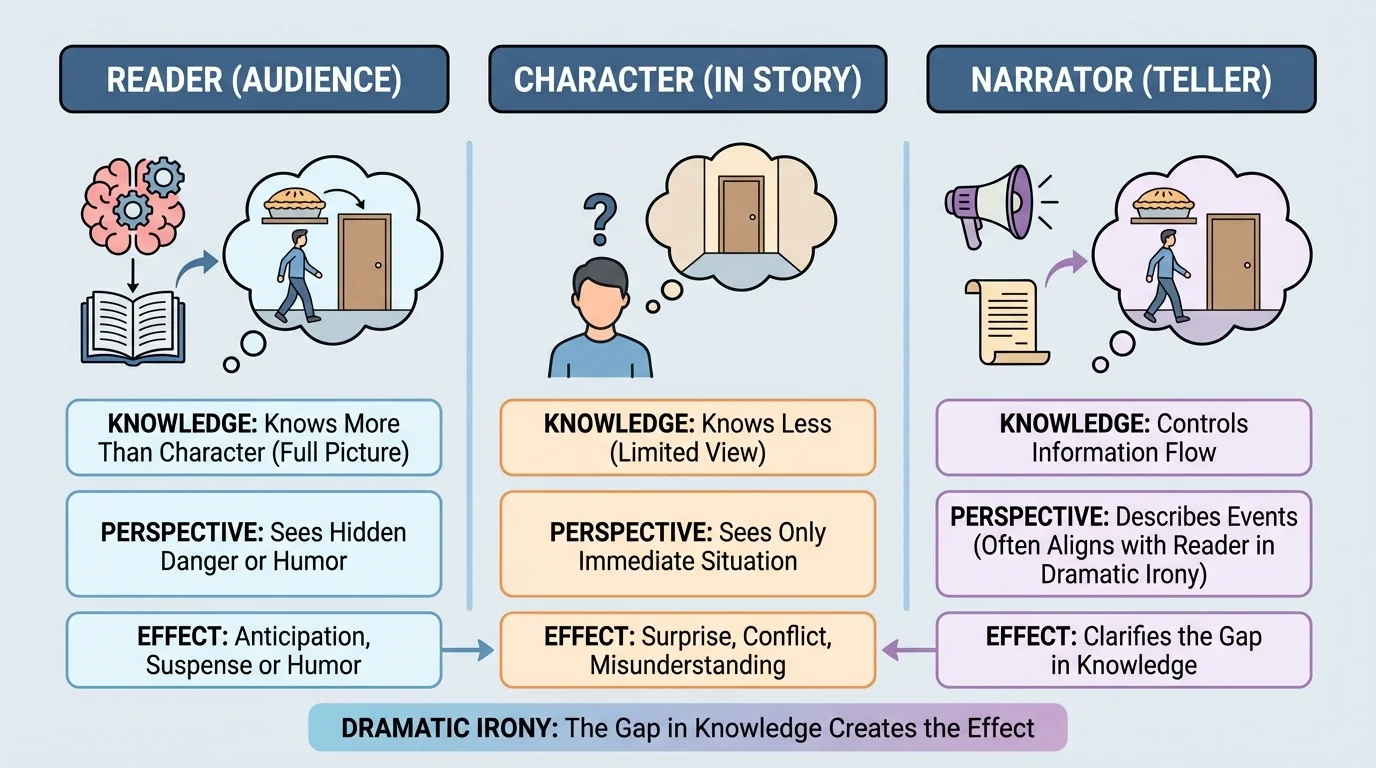
Sometimes the narrator is limited and only shows what one character knows. In other stories, the narrator is more omniscient and can reveal facts that no single character fully understands. Either way, the reader's experience depends on the flow of information.
You should also remember that point of view does not only mean first person or third person. Those are narrative forms. In analysis, point of view can also mean a character's beliefs, experiences, and understanding. Two characters can witness the same event but interpret it differently because of fear, pride, jealousy, or hope.
Information control in literature is one of the author's most powerful tools. By deciding what the audience knows before, during, or after a character learns it, the author shapes emotional response. The same event can feel funny, frightening, shocking, or tragic depending on who has the information first.
That is why readers should pay close attention to clues, dialogue, and what is left unsaid. Silence, misunderstanding, and partial knowledge are often as important as direct action.
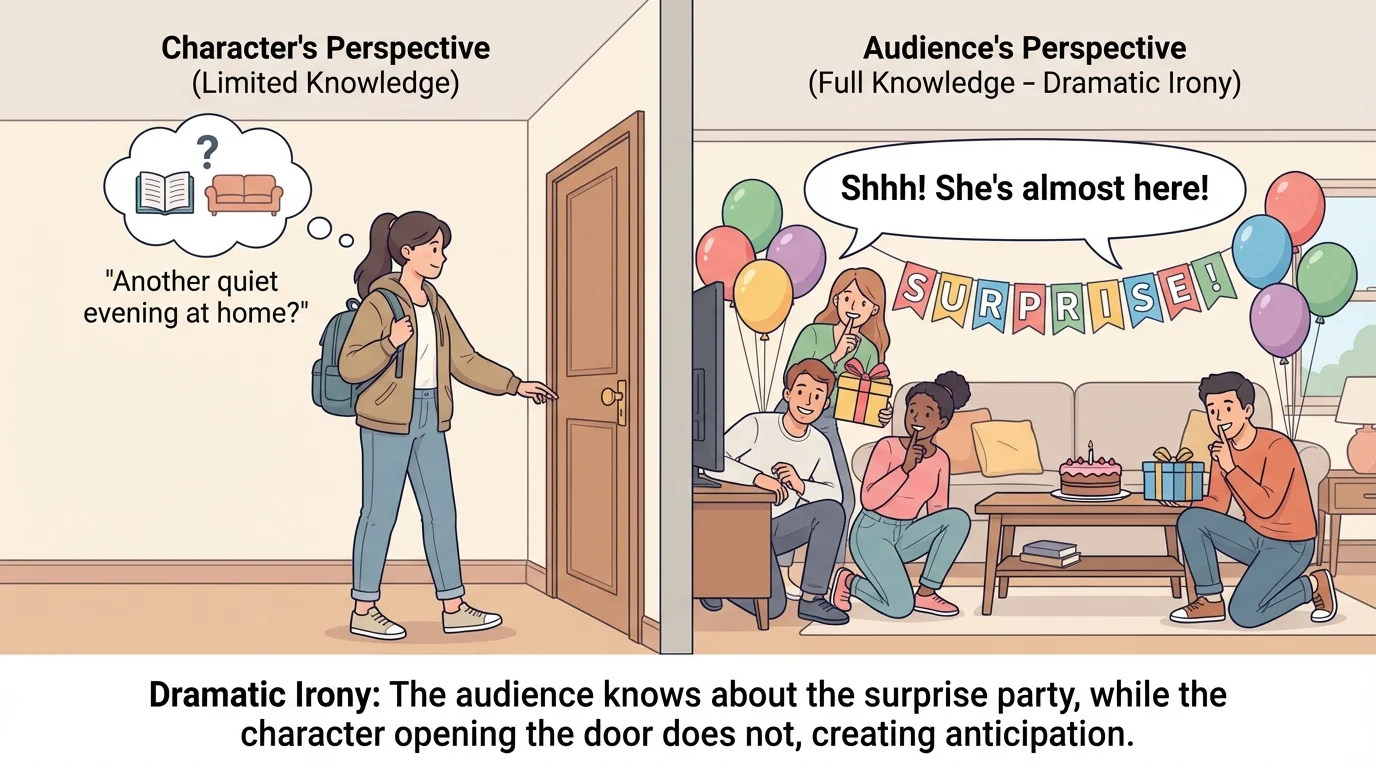
[Figure 2] Dramatic irony is one of the clearest examples of a difference between character perspective and reader perspective, shown through a situation where the audience understands the truth first. The character speaks or acts with confidence, but the reader can already see the mistake, danger, or misunderstanding.
This creates a powerful double meaning. A simple line of dialogue may sound harmless to the character saying it, but the audience hears something much more serious or much more amusing. The line carries one meaning inside the scene and another meaning from the audience's wider knowledge.
This visual example shows how the audience's extra knowledge shapes the meaning of the character's actions and words.
A classic example appears in Romeo and Juliet. Near the end of the play, Juliet is not truly dead, but Romeo believes she is. The audience understands the terrible mistake before Romeo acts on it. Because readers and viewers know more than Romeo, the scene becomes painfully tense and tragic. Every word matters more because the audience can see the disaster coming.
Dramatic irony does not always lead to tragedy. It can also produce comedy. Suppose a character thinks she has ruined a friendship because she saw a private message out of context. The audience, however, already knows the message was about planning a birthday gift for her. As she apologizes dramatically, readers may laugh—not because her feelings are unimportant, but because they can see the misunderstanding clearly.
Many comedies and horror stories use the same basic technique: the audience knows something a character does not. The difference is the effect. In comedy, the gap often feels harmless and playful. In horror, the same gap feels dangerous.
Much later in a story, authors may close this gap by letting the character discover the truth. That moment of realization can be satisfying, heartbreaking, or funny depending on how long the misunderstanding lasted and what consequences followed.
[Figure 3] Suspense often grows when the reader knows a threat, secret, or problem is present, illustrated through a chain of delayed discovery. Instead of asking only "What will happen?" the reader begins asking "When will the character realize it?" and "Will they realize it in time?"
Think about a mystery scene in which a reader sees that a note warning of danger has slipped out of a character's pocket. The character walks into an important meeting without the note. The reader now waits nervously for the moment when the missing warning matters. The author builds suspense by delaying that moment.
Suspense can also happen when readers know less than characters, but the kind discussed here depends on the audience knowing more. In that case, suspense comes from anticipation. Readers are not confused; they are worried. They can already sense the possible result.
This sequence highlights how delayed discovery keeps readers focused on when the character will notice the danger.
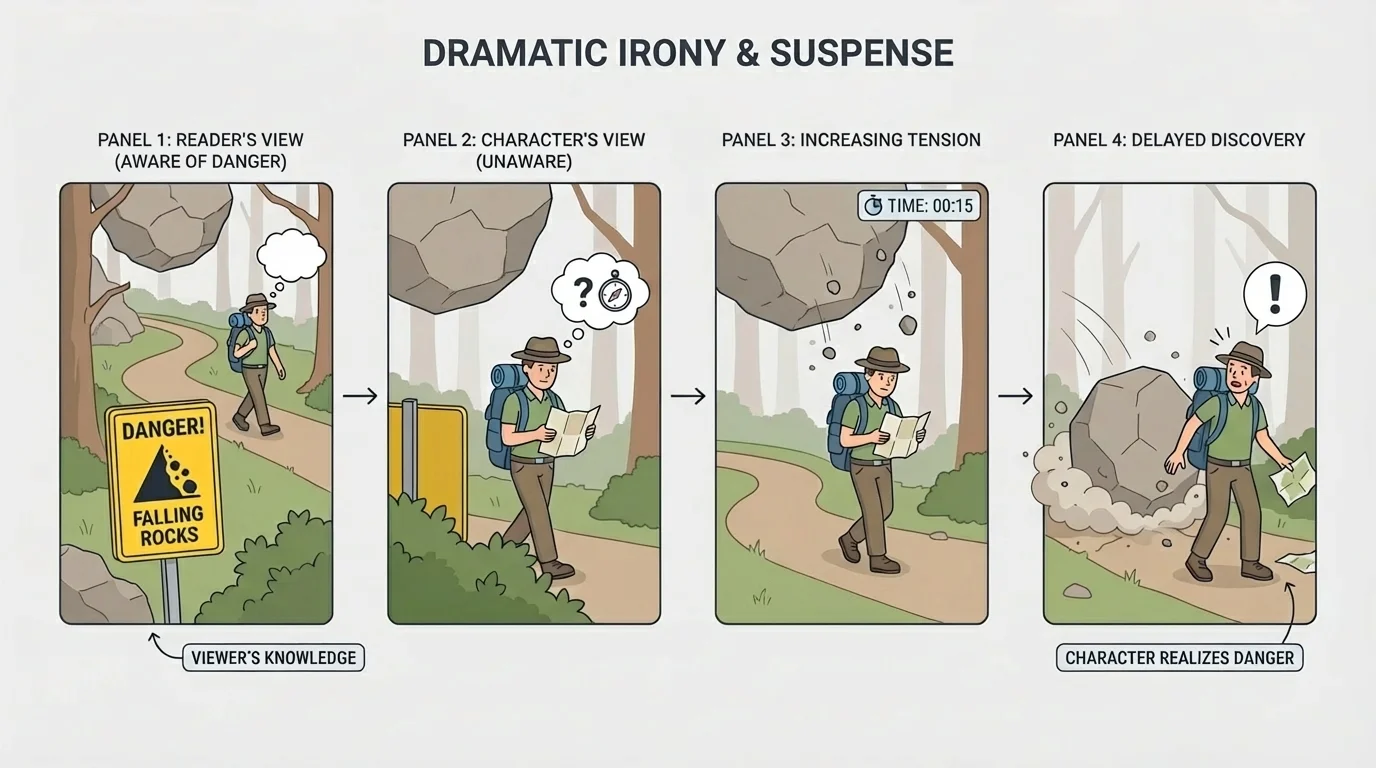
The pacing of the writing matters too. Short sentences, pauses in dialogue, sudden sounds, and interrupted actions can stretch the reader's anxiety. The author may focus on small details—a doorknob turning, footsteps in a hallway, a phone buzzing without answer—to make the audience feel the pressure of what the character does not yet understand.
As we saw earlier in [Figure 2], dramatic irony often works by placing the audience ahead of the character. In suspenseful scenes, that head start makes readers fear the coming moment of discovery or disaster.
Case study: a suspenseful scene
A story shows Maya studying alone in the school library after hours. Earlier, readers learned that someone has been hiding in the building.
Step 1: The author gives the reader extra knowledge.
Readers know a danger exists in the building, but Maya does not.
Step 2: The author lets Maya behave normally.
She puts on headphones, ignores a distant noise, and walks into a dark aisle between shelves.
Step 3: The gap in knowledge creates the effect.
Because readers know more, ordinary actions feel tense. The scene becomes suspenseful, not because of fast action, but because of delayed realization.
The author's choice to separate Maya's knowledge from the reader's knowledge is what creates the tension.
Suspense is stronger when the reader cares about the character. If the audience is emotionally invested, the difference in point of view makes the scene feel personal. Readers are not just observing a mistake; they are fearing its consequences.
[Figure 4] Humor often comes from a mismatch between what seems true to a character and what is actually true, presented through a harmless misunderstanding. Readers enjoy the gap because they can see both sides at once.
One common comic pattern is mistaken identity. A character may think a new student is a famous athlete because of rumors and because everyone else is acting excited. The audience already knows the truth: the student is only carrying sports equipment for someone else. Every overly respectful comment becomes funnier because readers understand the mistake before the characters do.
This kind of visual example helps show how a harmless misunderstanding can create comedy when readers know more than the character.
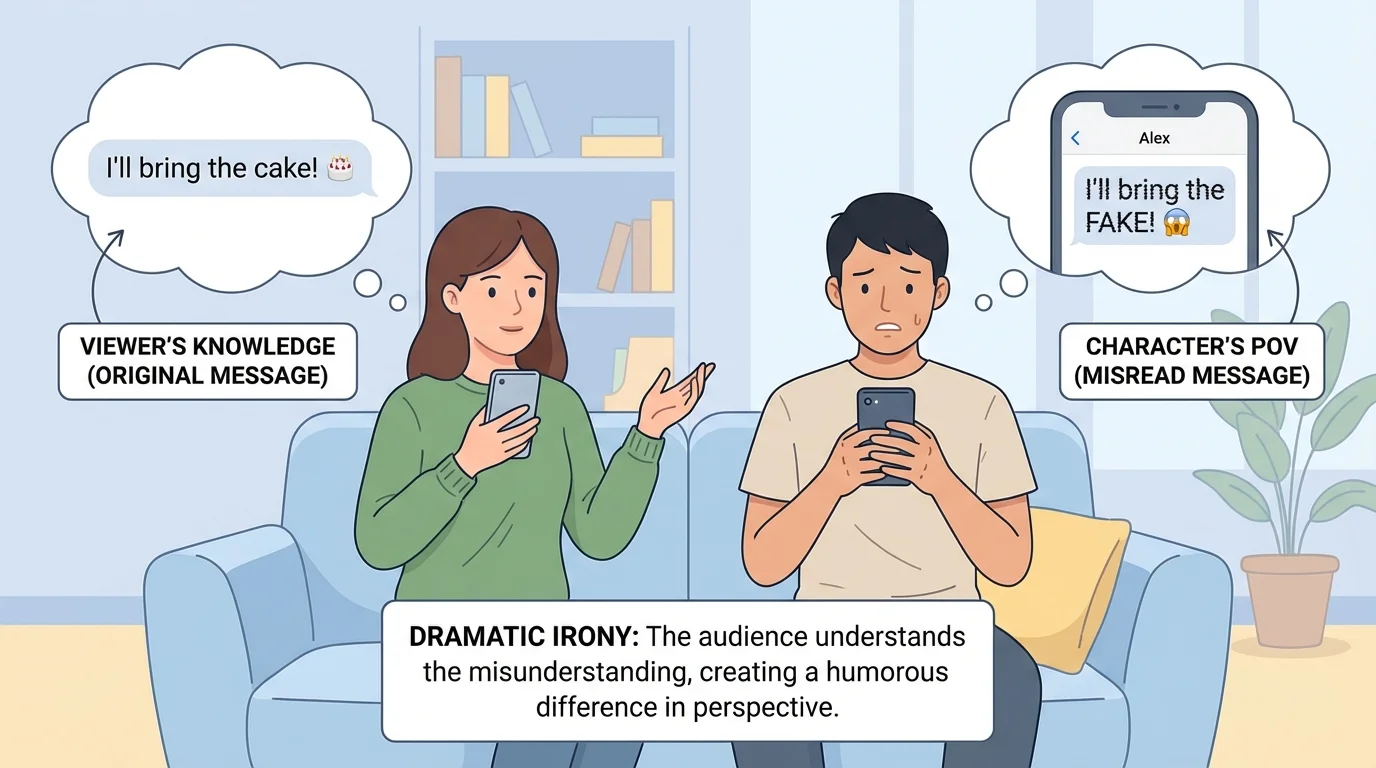
Another comic pattern comes from overheard conversation. A character hears one sentence and jumps to the wrong conclusion. The reader, who has heard the whole conversation, sees the misunderstanding clearly. The character may then act in an exaggerated, serious, or awkward way, and the contrast creates comedy.
Humor through point of view often depends on timing. If the truth is revealed too early, the joke disappears. If it is delayed too long, the scene may become frustrating instead of funny. Skilled authors control the exact moment of revelation so that the misunderstanding lasts long enough to be entertaining.
We can connect this back to [Figure 1]: when different people in a story hold different pieces of information, the same event can produce very different reactions. A text message, a glance, or a line of dialogue may seem serious to one character and obviously silly to the reader.
Case study: a humorous scene
Jordan hears his friends say, "We need to hide it before he gets here." He believes they are hiding something terrible.
Step 1: The reader gets context.
The audience already knows the friends are hiding a cake for Jordan's birthday.
Step 2: Jordan misunderstands.
He begins speaking dramatically and accusing everyone of secrecy.
Step 3: The author creates humor through contrast.
Jordan's serious behavior clashes with the harmless reality the audience understands.
The humor comes from the difference between Jordan's point of view and the audience's point of view.
Not all humor is kind. Sometimes authors use this technique to reveal pride, foolishness, or self-importance. In those cases, laughter can also carry criticism.
A useful way to analyze literature is to compare what each party knows. The chart below shows common patterns.
| Situation | What the character knows | What the reader knows | Likely effect |
|---|---|---|---|
| Dramatic irony in tragedy | Incomplete or mistaken information | Important truth about danger or consequences | Suspense, fear, sadness |
| Dramatic irony in comedy | Incomplete or mistaken information | Harmless truth behind misunderstanding | Humor, amusement |
| Mystery | May know little | May also know little | Curiosity, surprise |
| Direct explanation | Knows the truth | Also knows the truth | Clarity, less tension from hidden knowledge |
Table 1. Comparison of how differences between character knowledge and reader knowledge affect literary experience.
This comparison reminds us that suspense and humor are not random. They come from structure. The author positions the reader in a specific relationship to the characters.
In Romeo and Juliet, the audience's extra knowledge creates tragic suspense. Romeo thinks Juliet is dead. The audience knows she is alive but unconscious. That difference in perspective makes Romeo's grief more painful to watch because the audience understands the mistake before he does.
In O. Henry's The Gift of the Magi, the effect is more bittersweet than suspenseful. Jim and Della each sacrifice something valuable to buy a gift for the other. Readers gradually understand the irony of the situation as the gifts are revealed. The meaning depends on seeing both characters' loving intentions and the unexpected result.
In a modern school story, a student might think a teacher's serious face means anger, while readers know the teacher is actually trying not to spoil an award announcement. The scene can become humorous because the student reacts to a false assumption while the reader already understands the truth.
"The right word may be effective, but no word was ever as effective as a rightly timed pause."
— Mark Twain
This idea about timing matters in literature. A pause before revelation can increase suspense. A pause before a harmless truth is revealed can increase humor. Timing and perspective work together.
When you analyze a story, begin by asking four questions. Who knows the truth? Who does not? When does the reader learn key information? What feeling does that difference create? These questions lead to stronger interpretation than simply retelling events.
Next, look for the author's choices. Pay attention to dialogue, foreshadowing, scene order, and what the narrator reveals. If the author lets readers hear a private conversation but keeps one character unaware of it, that is a clue that dramatic irony may be shaping the scene.
When analyzing literature, always connect a technique to an effect. Do not stop at identifying dramatic irony. Explain what it does: it may build suspense, create humor, deepen tragedy, reveal a character's misunderstanding, or make the reader feel more involved.
A strong analysis statement might sound like this: The author creates suspense by letting readers know about the hidden danger before the main character enters the room. Because the character remains unaware, each action feels tense and risky.
Or it might sound like this: The author creates humor through dramatic irony because the audience understands the real meaning of the conversation, while the character reacts to a misunderstanding.
One common mistake is confusing narrator point of view with differences in perspective. A story may be told in third person, but dramatic irony can still happen inside it. The important question is not only grammatical form. It is the relationship between what the audience knows and what the characters know.
Another mistake is naming suspense or humor without explaining how it is created. Always trace the effect back to an author's decision about information. Ask what was revealed, what was hidden, and why that mattered.
A third mistake is assuming dramatic irony always means something funny. It can be funny, but it can also be frightening, sad, or tragic. The effect depends on the situation and the consequences.
When you read carefully, you start to see that stories are built out of perspective. Readers are guided to know, guess, fear, or laugh at exactly the right moment. That design is part of literary craft.
By noticing how characters and readers experience the same events differently, you become a more thoughtful reader. You move beyond plot and into interpretation, where the author's choices become visible.
