One sentence can change everything. In real life, a text message, a warning, or one unexpected comment can start an argument, save a friendship, or make someone take a risk. Literature works the same way. A single line of speech or one important event can push the plot in a new direction, uncover what a character is really like, or pressure someone into making a choice they cannot take back.
When readers analyze literature closely, they do more than say that a moment is "important." They ask how it is important. Does the line create a new problem? Does it expose fear, pride, jealousy, or courage? Does an accident, discovery, or conversation force a character to act? Strong analysis connects a small moment to a larger effect.
Stories and dramas are built from many parts, but not all parts matter equally. Some moments are like hinges on a door: they seem small, yet the whole story turns on them. A character may hear a secret, miss a train, refuse an apology, or make a joke at the wrong time. That single moment can lead to consequences far beyond itself.
Writers choose these moments carefully. They know that readers pay attention when words and actions have effects. If a line of dialogue appears in a text, it is often doing more than filling space. It may add conflict, sharpen suspense, reveal relationships, or make later events believable. In the same way, an event is not just something that happens; it often acts as a trigger for later action.
Dialogue is the spoken conversation between characters. An incident is a specific event or happening in the plot. The action is the movement of the plot forward. A decision is a choice a character makes, often in response to conflict or pressure. Characterization is the way an author reveals what a character is like.
To analyze well, keep asking questions such as: What changed here? What did this line or event cause? What does it show about the character? What choice follows from it? Those questions turn basic reading into close reading.
Several ideas help readers discuss these moments clearly. A character's motivation is the reason behind actions or choices. Tone in dialogue refers to the feeling or attitude behind the words: sarcastic, angry, nervous, calm, or playful. Subtext is what is meant but not directly said. In many strong scenes, the most important meaning is hidden under the surface.
Another useful term is turning point, the moment when the direction of the story changes. Some turning points are created by speech, such as a confession or threat. Others come from incidents, such as losing an object, finding evidence, or witnessing an accident. In both cases, what matters is not only the moment itself but also its effect.
Readers should also notice dramatic irony, especially in drama. This happens when the audience knows something a character does not know. A line of dialogue may sound innocent to one character but alarming to the audience, which changes the meaning and increases tension.
Dialogue can move the plot forward by creating new situations, as [Figure 1] illustrates through a chain of cause and effect. A warning, challenge, confession, lie, promise, or accusation can begin a sequence of events. In many texts, characters do not simply talk; their words make things happen.
Suppose a character says, "If you leave tonight, don't come back." That line does several things at once. It raises the stakes, reveals tension in a relationship, and may push another character to leave anyway. Once that happens, the story changes direction. The action is propelled because the dialogue creates a consequence.
Dialogue can also speed up action by delivering crucial information quickly. If one character says, "The bridge is out," the plot may suddenly shift from a peaceful journey to a dangerous problem. A line can interrupt plans, create urgency, or start a race against time. On the other hand, dialogue can delay action too. A character may argue, deny, stall, or distract, increasing suspense before something finally happens.
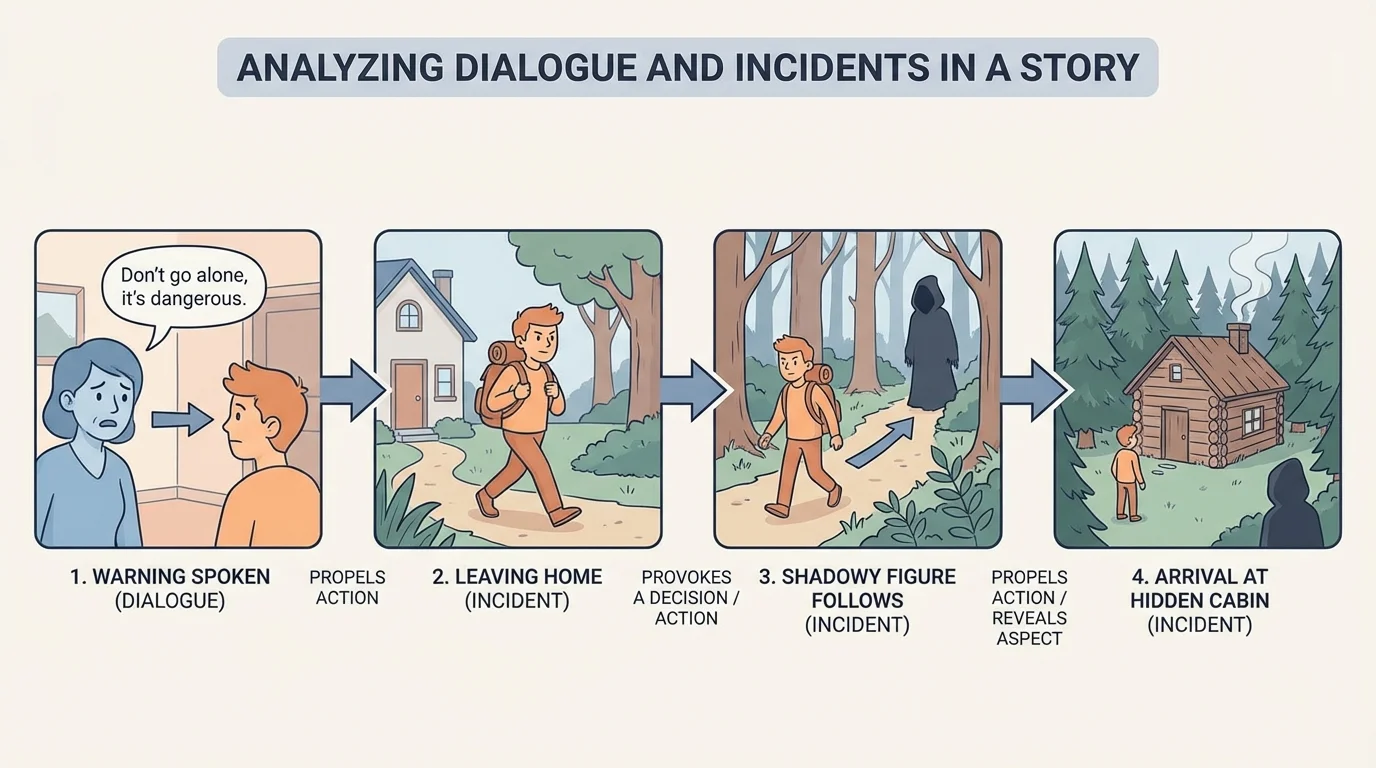
Consider this short example: "I saw your name in the principal's office," Maya whispered. Until this moment, the scene may have been calm. But now the action changes. The person hearing this line may panic, investigate, deny the accusation, or confront someone else. The line acts like the first push in a row of falling dominoes.
Case study: dialogue as action
Read this invented exchange:
"Don't open the locker," Ben said.
"Why?" Ava asked.
"Because whatever's inside was left for you."
Step 1: Identify the key line.
The key line is "Because whatever's inside was left for you." It introduces mystery and danger.
Step 2: Explain the immediate effect on the plot.
The conversation changes an ordinary moment in a hallway into a tense situation. Now Ava must decide whether to trust Ben or open the locker.
Step 3: Connect the line to future action.
This line may lead to discovery, confrontation, or escape. It propels the action because it creates a problem that demands a response.
When you analyze dialogue, avoid retelling the conversation only. Focus on the result. Ask what the line causes characters to do next. As the chain in [Figure 1] makes clear, a spoken warning or challenge can send the plot into motion immediately.
People reveal themselves by how they speak, and characters do too. The same basic message can sound brave, rude, insecure, caring, or manipulative depending on word choice, tone, and timing, as [Figure 2] shows in a side-by-side comparison. Dialogue helps readers infer traits instead of receiving them as a list.
If a character says, "I'm fine," that may not actually mean the character is fine. A reader must look at context. Is the character trembling? Is the line short and cold? Was there an argument just before? Dialogue often reveals emotion through what is avoided as much as through what is spoken directly.
Writers also reveal character through patterns in speech. One character may speak in complete, careful sentences, suggesting self-control or formality. Another may interrupt constantly, suggesting impatience or nervous energy. A character who jokes during serious moments might be confident, insensitive, or trying to hide fear.
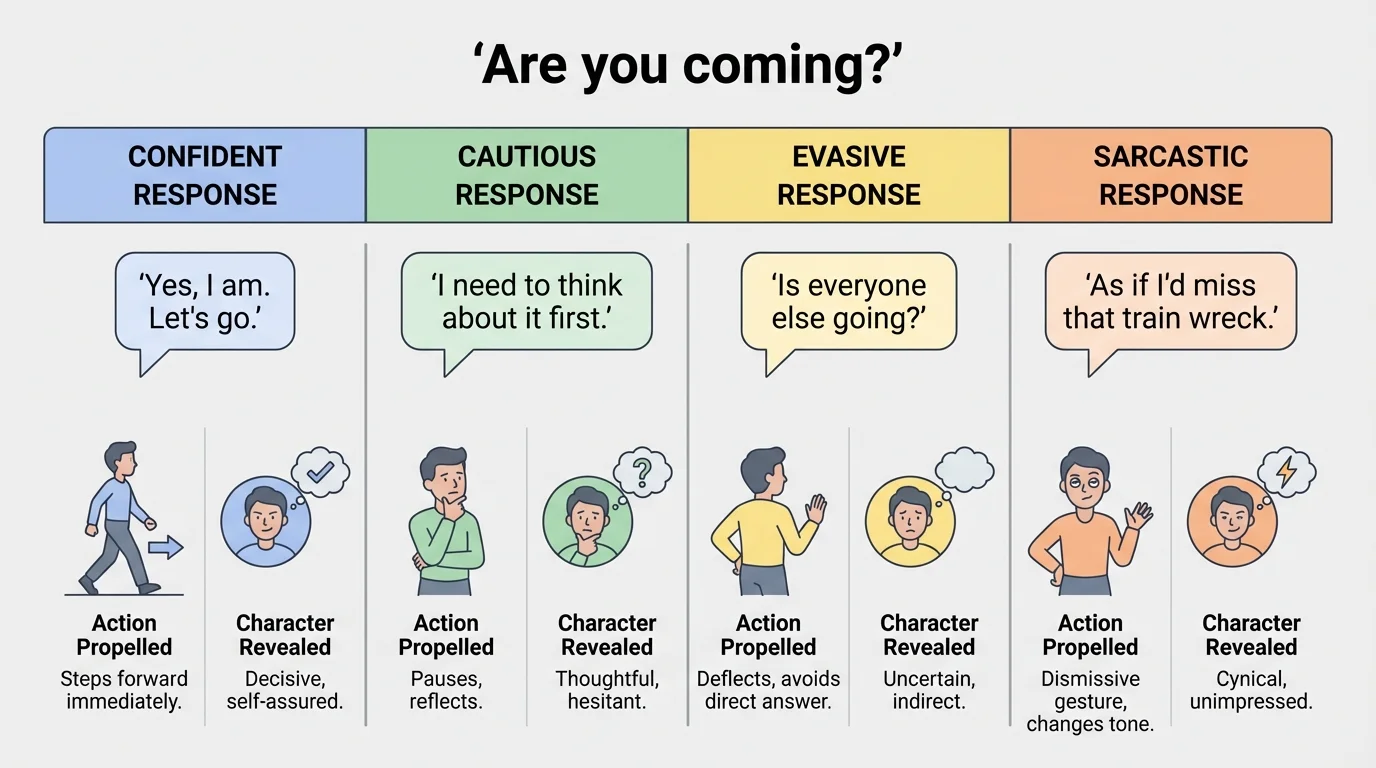
Silence matters too. In drama especially, a pause before a reply can show hesitation, guilt, shock, or resistance. A character who refuses to answer may reveal more than one who gives a long speech. Readers and audiences must pay attention not only to the meaning of words but also to the way those words are delivered.
For example, imagine two responses to the question, "Are you coming with us?" One character says, "Of course. Someone has to make sure you don't ruin everything." Another says, "Maybe. I should stay here." The first response may suggest confidence, sarcasm, or protectiveness. The second may suggest worry, caution, or lack of trust. The contrast in [Figure 2] highlights how small differences in wording can reveal very different personalities.
Dialogue reveals character through more than content. Readers should listen for how something is said. Word choice, length of response, tone, repetition, interruptions, and silence all contribute to characterization. A line may reveal honesty, insecurity, pride, kindness, jealousy, or hidden fear even when the character never names those traits directly.
This kind of analysis is stronger than saying, "The character is mean" or "The character is shy." Instead, explain what in the dialogue creates that impression. A careful reader supports ideas with exact words and details from the text.
Sometimes dialogue does not just reveal a character; it pushes that character toward a choice. A dare may provoke reckless action. A warning may cause retreat. A confession may force forgiveness or revenge. A challenge may awaken pride. In literature, decisions often happen because someone says the right thing at the right moment, or the wrong thing at the worst possible time.
Think about pressure in everyday life. Being told "You won't do it" can make someone act just to prove others wrong. Stories use that same truth about human behavior. Characters respond to persuasion, guilt, threats, encouragement, and emotional appeals. Dialogue becomes the spark for decision-making.
For example, in a drama a parent might say, "If you tell the truth now, I will stand beside you." That line can provoke a decision toward honesty. But if another character says, "Say nothing, and no one will ever know," the decision may go the other way. The important point is that dialogue creates a mental and emotional crossroads.
Good analysis explains not only that a character decides something but also why the line matters. Which feeling does it trigger: fear, anger, shame, hope, loyalty? The answer helps explain the choice.
Some of the most memorable scenes in plays are built around a decision made in only a few spoken lines. On stage, there may be very little narration, so dialogue carries an even heavier burden: it reveals feeling, creates tension, and launches action almost all at once.
When analyzing, it helps to trace the sequence clearly: line of dialogue, emotional response, decision, consequence. That chain shows how a writer turns speech into story movement.
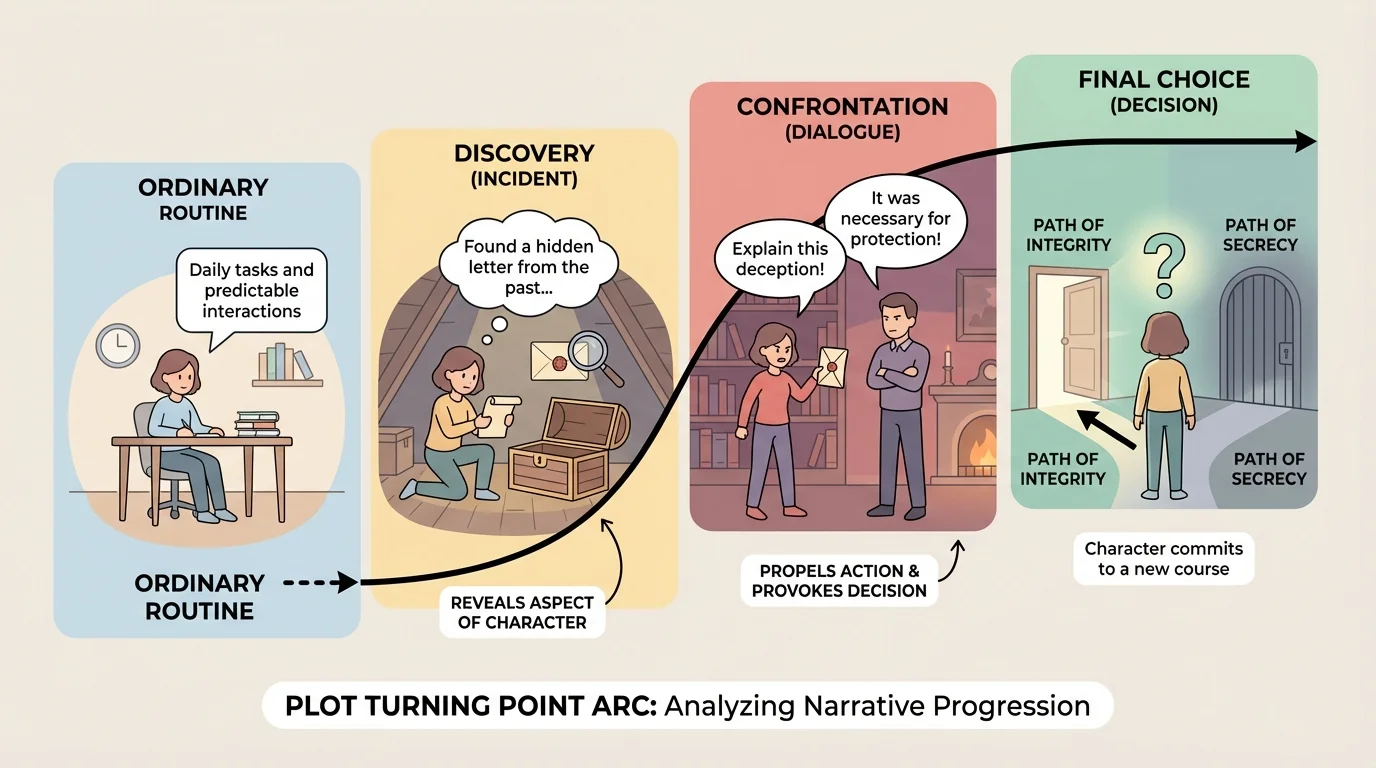
[Figure 3] An incident can transform a plot just as powerfully as dialogue. A storm begins, a letter is discovered, a phone is lost, a stranger arrives, or a friend betrays someone in public. These events matter because they disturb the normal pattern of the story, and one event can bend the plot into a new path.
Incidents often serve as turning points. [Figure 3] Before the event, a character may feel secure, confused, or undecided. After the event, the character must adapt. A lost map can turn confidence into panic. A found photograph can turn suspicion into certainty. An unexpected injury can turn rivalry into responsibility.
Not every incident is dramatic in a loud way. Some are quiet but powerful. A character may overhear a private conversation or notice a missing ring on someone's finger. These small events can shift understanding and provoke major choices. In realistic fiction especially, subtle incidents often have large emotional effects.
Incidents also reveal character by showing how people react. Two characters may experience the same event but respond differently. One might take responsibility, while another blames others. The incident itself matters, but the response matters just as much.
Case study: incident as turning point
Consider this situation: A student finds a folded note in a library book. The note says that someone cheated on a scholarship exam.
Step 1: Identify the incident.
The incident is the discovery of the note.
Step 2: Explain how it changes the action.
The story shifts from an ordinary school setting to an ethical conflict. Now the character has information that may hurt someone or reveal the truth.
Step 3: Explain how it may reveal character or provoke a decision.
If the student hides the note, that may reveal fear or loyalty. If the student turns it in, that may reveal honesty or courage. The incident forces a choice.
As the turning-point shape in [Figure 3] makes clear, one event can split the story into a "before" and an "after." Strong literary analysis identifies that split and explains its importance.
Stories and dramas both use dialogue and incidents, but they present them differently. In a short story or novel, the author can describe thoughts, settings, and narration around the dialogue. Readers may be told exactly what a character feels after hearing certain words. In a drama, much of that information must come through speech, action, stage directions, and actors' delivery.
Because of this difference, dialogue in drama often does even more work. It must reveal character, build conflict, and move the plot with fewer explanations. A stage direction such as "She steps back" or "He tears the letter" can act like a powerful incident because the audience sees the event happen in real time.
| Text Type | How Dialogue Works | How Incidents Work |
|---|---|---|
| Story or novel | Often supported by narration and inner thoughts | Can be explained in detail with background and reflection |
| Drama or play | Often carries more of the plot and characterization directly | Often appears through visible stage action and immediate reactions |
Table 1. Comparison of how dialogue and incidents function in stories and dramas.
Even though the forms differ, the reader's job stays similar: connect the moment to its effect. Ask what changes because of the line or event and what that change teaches you about the characters.
Close reading becomes easier when you use a method. First, identify the exact line of dialogue or the exact incident. Second, place it in context. What is happening just before this moment? Third, explain the effect. Does it intensify conflict, reveal feelings, or trigger a choice? Fourth, connect it to a larger pattern in the text, such as trust, identity, power, or loyalty.
A useful sentence frame is: "This line/incident matters because it ________, which leads to ________ and reveals ________." That structure helps keep analysis focused on cause and effect instead of drifting into summary.
Evidence and explanation work together. A quoted line or described incident is the evidence. Your reasoning about what it causes, shows, or provokes is the explanation. Strong analysis always includes both.
Another strong move is to notice whether the moment has more than one effect. A single line might both reveal jealousy and provoke a confrontation. A single incident might both move the action and test a friendship. Literature is often powerful because one detail performs several jobs at once.
Consider a familiar pattern from many adventure stories: a character says, "I'm going alone." That line may propel the action because it separates the group. It may reveal character by showing independence, stubbornness, or protectiveness. It may provoke a decision because another character now has to choose whether to obey, argue, or secretly follow.
In many mysteries, an incident such as a broken watch, muddy footprints, or a missing key does more than add detail. It changes how characters understand the situation. The incident may prove someone lied about where they were, which redirects suspicion and forces new choices. A small object can reshape a whole plot.
In a school drama, one line such as "I told them it was me" can completely transform the scene. It propels the action because now others must react to the confession. It reveals character because the speaker may be brave, guilty, loyal, or desperate. It provokes decisions because another person must decide whether to accept the sacrifice, tell the truth, or stay silent.
"The smallest action is often more powerful than the longest explanation."
— A principle of dramatic writing
These examples show why close reading matters. A line or event should not be treated as isolated. It belongs to a chain of causes, responses, and consequences.
One common mistake is mere summary. Summary says what happened: "The character finds a note." Analysis explains significance: "The note acts as a turning point because it gives the character secret information that creates an ethical choice."
Another mistake is making a claim without evidence. If you say a line reveals jealousy, point to the exact words, tone, or context that support that idea. Also avoid oversimplifying. Characters are often mixed and complicated. A line may reveal both anger and hurt, or both courage and fear.
A third mistake is ignoring consequences. If a student notices a strong line of dialogue but does not explain what happens next, the analysis remains incomplete. Literature is dynamic. What matters is the connection between moment and outcome.
Strong analysis uses precise verbs. Instead of saying a line is "important," say it triggers, intensifies, reveals, foreshadows, pressures, provokes, or redirects. Those verbs show exactly how the moment functions.
A strong analytical statement might sound like this: "When the character says, 'Keep the money,' the dialogue redirects the conflict by surprising the other characters and revealing that he values pride more than comfort." Notice how this statement does three things at once: names the evidence, explains the effect on the action, and interprets the character.
Another strong statement might be: "The discovery of the torn photograph serves as a turning point because it confirms the character's suspicion and pushes her to confront her brother." This connects the incident to both understanding and action.
When readers pay attention to specific lines and incidents, literature becomes more vivid. Conversations stop being just talk. Events stop being random. Each moment becomes part of a carefully designed pattern that moves the plot, shapes character, and forces meaningful decisions.
