Stories do not really disappear. A hero leaving home, a dangerous temptation, a sacrifice that saves others, a journey through darkness, a battle between good and evil—these patterns can appear in an ancient myth and then show up again in a novel, a movie, or even a video game released this year. When readers notice those connections, they begin to see literature as one long conversation across time.
Modern fiction often borrows from the past, but strong writers do not simply copy old stories. They reshape them. They may take a Greek hero and turn him into a modern teenager, or use a Biblical pattern of sacrifice and redemption in a fantasy series, or remake a traditional folktale in a futuristic setting. The key skill is to notice both the similarities and the changes.
When you analyze this kind of relationship, you are asking two questions at once: What old story is this work drawing from? and How has the author made that old material new? A strong analysis always answers both.
Ancient stories last because they deal with problems that humans still face: fear, loyalty, pride, loss, courage, injustice, identity, and hope. A reader in the present may not fight a monster from myth, but that reader may still understand what it feels like to face something overwhelming.
Authors also borrow older material because it gives their work extra depth. If a modern character resembles Odysseus, Moses, Eve, or a trickster from folklore, that connection adds meaning. Readers who recognize the older pattern bring extra knowledge to the newer story. It is almost like hearing a modern song sample an older melody: the new version stands on its own, but the earlier version enriches it.
That is why literary analysis matters. It helps you see layers in a text. Instead of saying, "This story is about a hero," you can say, "This story reworks the ancient hero journey, but changes the hero into a flawed, modern character who struggles with self-doubt." That is a much deeper insight.
Allusion is a brief reference to a well-known person, story, event, or text. Archetype is a common character type, image, or story pattern that appears in many cultures and time periods. Adaptation is a retelling or reshaping of an earlier work. Theme is a central idea or message in a text.
Some connections are direct and obvious. A book like Percy Jackson and the Olympians clearly announces its relationship to Greek mythology. Other connections are less direct. A fantasy novel might never mention the Bible by name, but still echo a fall from innocence, a struggle with temptation, or a sacrificial act that brings renewal.
When authors draw on older stories, they usually borrow from one or more of three major areas: themes, patterns of events, and character types.
A theme is the big idea beneath the plot. For example, many stories explore whether power corrupts, whether sacrifice is worth the cost, or whether identity comes from birth or choice. These ideas appear in ancient and modern works alike.
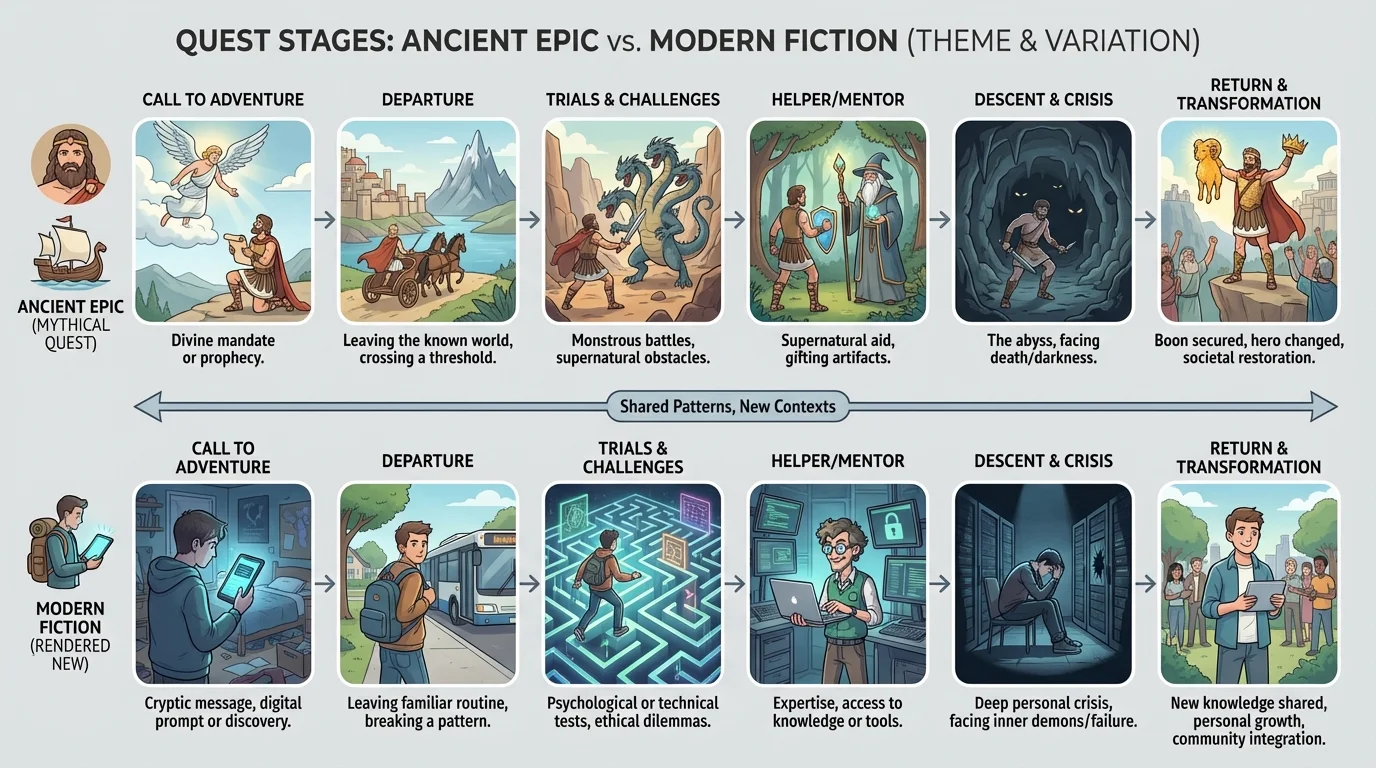
A plot pattern or pattern of events is a repeated sequence in a story. A hero may receive a call to adventure, leave home, face trials, gain help, descend into danger, and return changed. That structure appears in myths, epics, fantasy novels, and superhero stories.
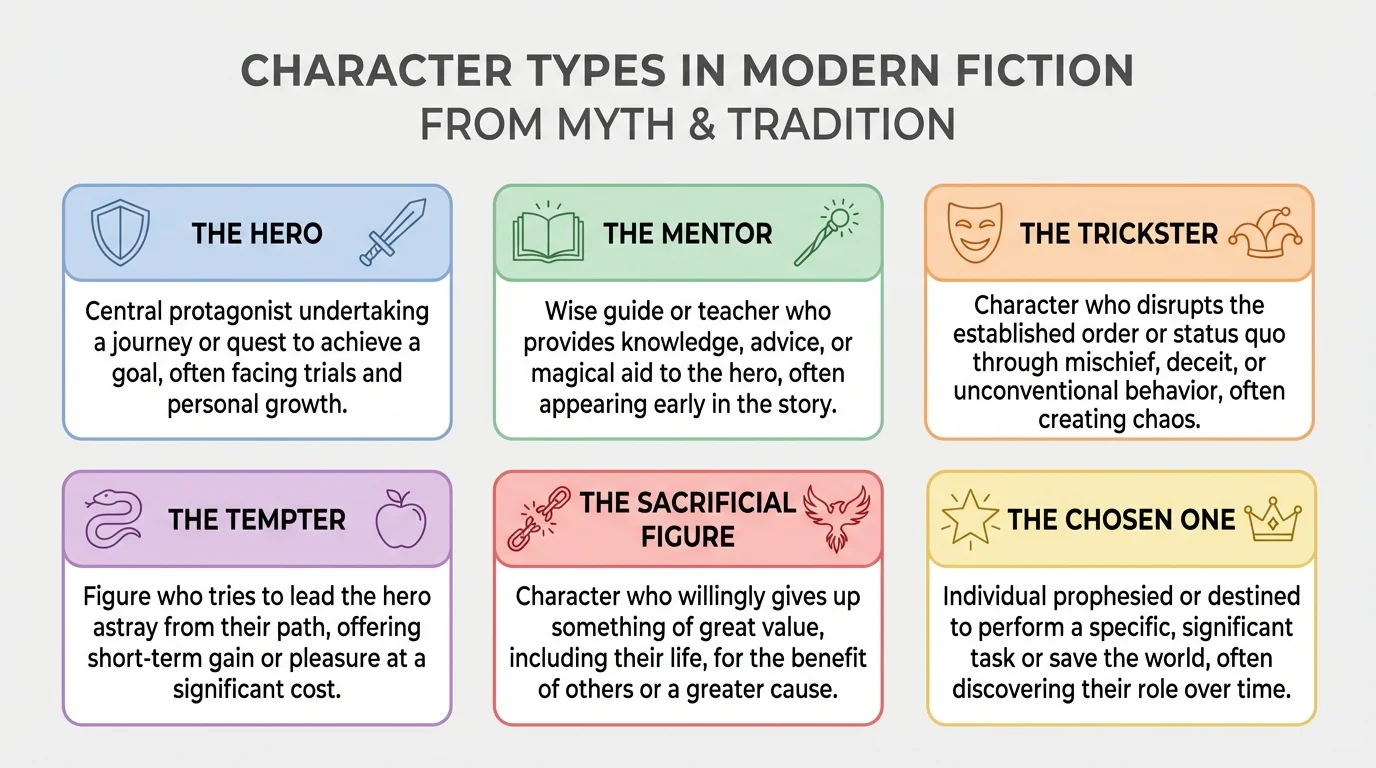
A recurring archetype is a recognizable character type. The wise mentor, the chosen one, the trickster, the tempter, and the sacrificial hero all come from very old storytelling traditions and still appear in current fiction.
A myth is a traditional story, often involving gods, supernatural forces, or the origins of the world, that helps explain beliefs, values, or natural events. Greek myths are one famous example, but many cultures have myths.
A folktale or traditional story usually comes from oral storytelling. These stories may teach lessons, explain customs, or entertain. They often include repeated patterns, stock characters, and clear conflicts.
A religious text is a sacred text connected to a faith tradition. Stories from the Bible, for example, have influenced countless works of literature. Writers may draw on Biblical characters, symbols, conflicts, or themes such as exile, forgiveness, temptation, prophecy, sacrifice, and redemption.
These categories can overlap. A modern novel might combine the quest pattern of myth, the moral structure of a folktale, and the symbolic power of a religious story. Good analysis does not force the text into only one box. Instead, it identifies the strongest and most useful connections.
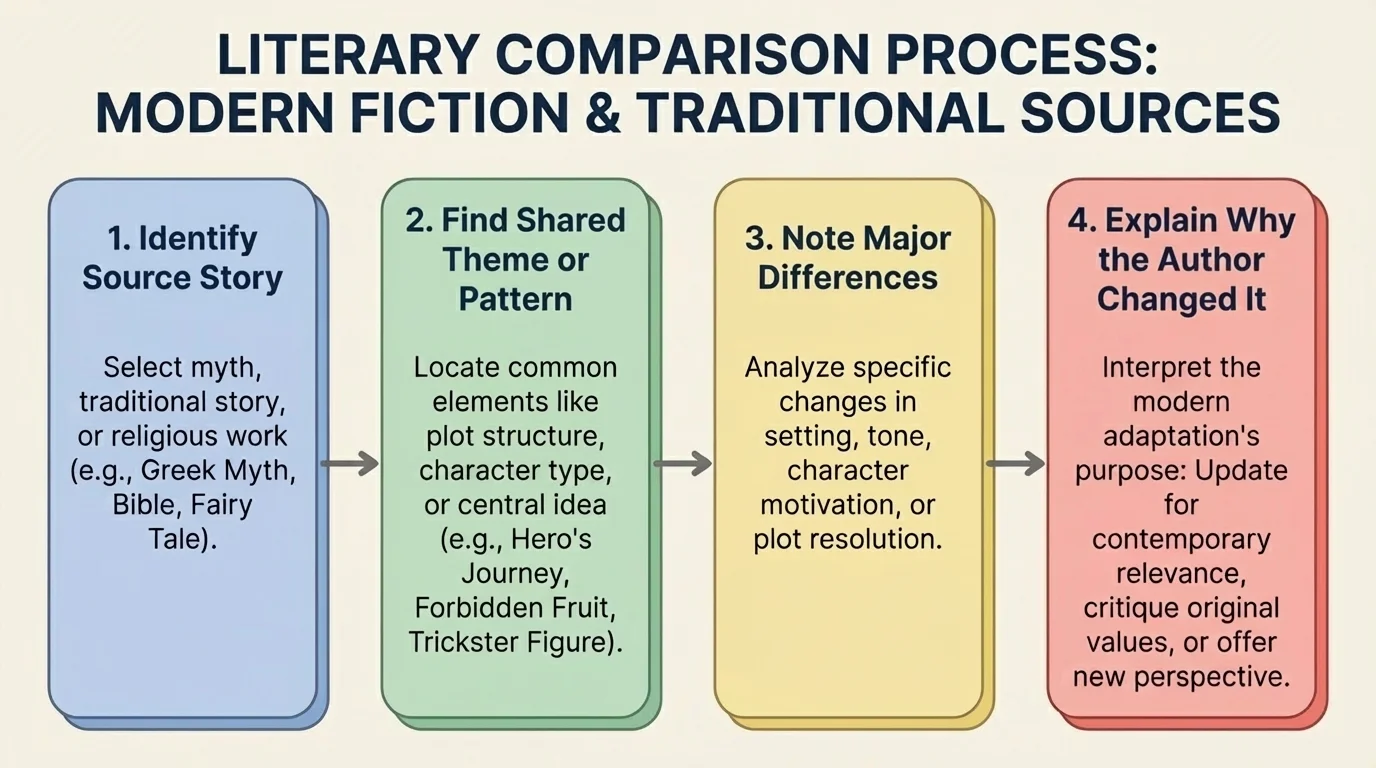
There is a clear way to analyze literary borrowing through a simple comparison process. First, identify the older story or tradition that seems important. Next, notice the shared elements. Then, look carefully at what has changed. Finally, explain why those changes matter.
[Figure 1] Suppose you think a modern novel draws on the story of Theseus and the Minotaur. You would look for details such as a dangerous maze, a tribute of young people, a monster, a test of courage, or a mission to free others. But you would not stop there. You would also ask what the newer story does differently. Maybe the "maze" becomes a political system instead of a literal labyrinth. Maybe the monster becomes human cruelty rather than a beast.
The strongest comparisons use text evidence. You should point to scenes, conflicts, symbols, or character choices in both texts. Without evidence, a comparison is only a guess.
It also helps to think about audience and context. Ancient stories were shaped by the beliefs and problems of their own cultures. Modern authors write for readers with different concerns. A writer today may update an old story to explore technology, inequality, war, environmental damage, or personal identity.
A strong literary comparison does more than match details. It explains purpose. If two works both include a heroic journey, that matters only when you can explain how the modern author uses that journey to create a new meaning, question an old value, or speak to a modern audience.
For that reason, an analysis should avoid shallow statements like "Both stories have a hero." Many stories have heroes. A better statement would be: "Both stories use a hero tested by dangerous trials, but the modern novel makes the hero emotionally uncertain, which highlights the pressure young people feel when others expect them to be extraordinary."
Some themes reappear so often that they connect works written thousands of years apart. One major theme is the struggle between good and evil. In myths and religious stories, this conflict may appear through gods, demons, monsters, or moral choices. In modern fiction, it might appear in dystopian governments, inner conflict, or ordinary people deciding whether to act bravely.
Another common theme is sacrifice. Many older stories honor characters who give something up for others. Modern works often keep this theme but make it more emotionally complex. A character may sacrifice safety, reputation, friendship, or even life. The old theme remains, but the new version may focus more deeply on the cost.
Temptation is another lasting theme. Religious stories often show people being tested by power, pride, or forbidden knowledge. Modern fiction uses the same idea when characters must decide whether to use dangerous technology, accept corrupt power, or betray others for personal gain.
Identity and destiny also travel through time. Myths often ask whether a person can escape fate. Modern fiction may turn that question into something more personal: Does who you were born to be define you, or can your choices create your identity?
Many popular fantasy and science fiction series feel familiar because they use very old themes beneath futuristic settings. A spaceship crew, for example, can still follow the same moral and emotional patterns as travelers in an ancient epic.
When you analyze theme, focus on the idea beneath the surface action. A dragon battle may look completely different from a courtroom scene or a rebellion in a dystopian city, but all three could explore courage, justice, or the abuse of power.
Stories often repeat not just ideas but also structures through a quest pattern that appears in both ancient and modern works. One of the most famous patterns is the hero's journey, in which a main character leaves the ordinary world, enters danger, faces tests, receives help, undergoes change, and returns.
[Figure 2] This pattern appears in myths such as the adventures of Odysseus and in many modern novels and films. However, modern writers may reshape the pattern by making the hero reluctant, morally conflicted, or part of a team instead of acting alone.
Another repeated pattern is the fall and redemption arc. A character makes a serious mistake, suffers the consequences, and then seeks forgiveness, repair, or transformation. This pattern appears in religious stories and in modern fiction that explores guilt, healing, and second chances.
A third pattern is the chosen one pattern: a character is singled out by prophecy, destiny, or unusual ability and must decide whether to accept that role. Ancient stories often treat destiny as fixed. Modern fiction may question whether being "chosen" is a gift, a burden, or even a trap.
Writers also reuse patterns involving journeys into wilderness, floods or destruction followed by renewal, contests for leadership, descents into darkness, and returns to a damaged home. As you continue reading, you will notice that many plots are not entirely new inventions. Instead, they are powerful rearrangements of old designs.
Recognizing a repeated pattern does not reduce a modern story's originality. In fact, it often highlights the author's creativity. The question is not whether an author borrowed a pattern, but how the author transformed it.
Writers also draw on recurring character roles, and several of the most common ones can be organized clearly. These roles help readers quickly understand a character's purpose in a story, but modern fiction often complicates them.
[Figure 3] The hero may resemble ancient champions, yet modern heroes are often more vulnerable and doubtful. The mentor guides the hero, like wise elders in myth, but may be flawed or secretive. The trickster creates confusion, breaks rules, and exposes weakness in powerful systems. The tempter offers shortcuts, power, or forbidden knowledge. The sacrificial figure chooses suffering or loss to help others.
These types matter because they connect one story to many others. If a character clearly acts like a trickster, for instance, readers may expect mischief, cleverness, and disruption. But a modern author can surprise readers by changing that expectation. A trickster might become a hero. A mentor might fail. A chosen one might reject the role entirely.
When you studied characterization, you learned that authors reveal characters through actions, dialogue, thoughts, and relationships. Use those same clues here. To identify an archetype, do not rely on labels alone; look at what the character actually does in the story.
That combination of the familiar and the unexpected is often what makes a modern retelling feel alive. Readers recognize the old pattern, but the author prevents the story from becoming predictable.
The most important part of analysis is not just spotting the old source. It is explaining how the author makes it feel new. Writers do this in several ways.
One method is changing the setting. A mythic quest can become a road trip, a school story, a space mission, or a dystopian rebellion. The pattern survives, but the world around it changes.
Another method is changing the point of view. An old tale may focus on a celebrated hero, while a modern retelling shifts attention to a side character, a villain, or someone previously ignored. This can challenge the values of the original story.
Writers also create freshness by increasing moral complexity. Older stories sometimes divide characters clearly into good and evil. Modern fiction often keeps the ancient conflict but gives each side mixed motives, making readers think harder about justice and blame.
Some authors update old material to address modern concerns such as gender roles, race, inequality, trauma, environmental issues, or political power. The borrowed story becomes a tool for examining present-day questions.
Case study: making an old pattern new
A modern author uses the basic quest structure from myth.
Step 1: Keep the familiar structure
The protagonist leaves home, enters danger, receives help, and returns changed.
Step 2: Change the hero
Instead of a confident warrior, the author creates a nervous teenager who doubts whether leadership should belong to one person.
Step 3: Update the conflict
The monster is no longer a creature in a cave. It becomes a violent system that treats people as disposable.
Step 4: Shift the message
The new story is not just about bravery. It also questions power, media, and public spectacle.
The result is a story that feels both ancient and modern.
When you write about how material is rendered new, use verbs like reshapes, recasts, updates, complicates, subverts, and transforms. Those words help show that literature is dynamic, not static.
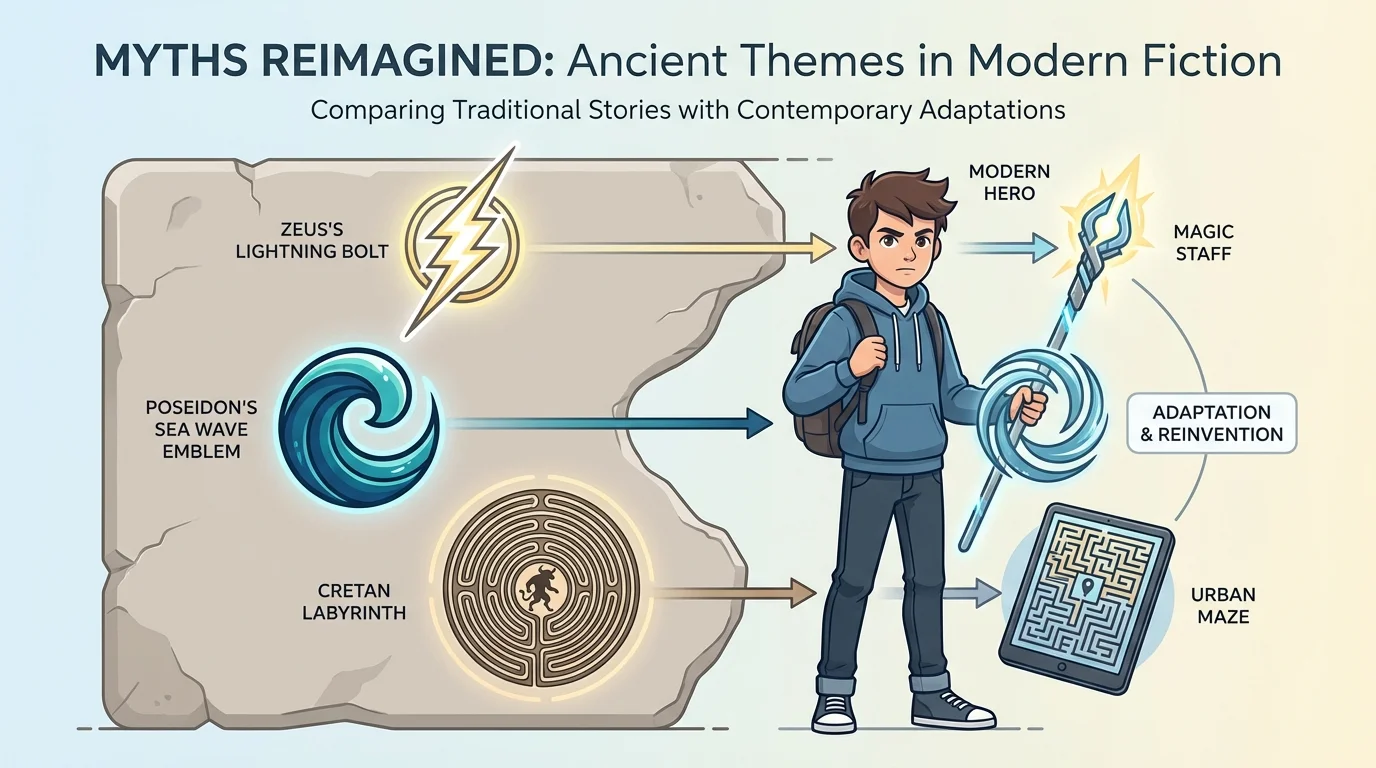
Percy Jackson and the Olympians offers one of the clearest examples of modern fiction drawing on older material by placing mythic elements inside a modern adolescent world. Rick Riordan uses Greek gods, monsters, quests, prophecies, and heroic trials. Percy resembles mythic heroes because he has unusual parentage, faces dangerous tasks, and must grow through conflict.
[Figure 4] But Riordan makes the material new by setting it in the contemporary United States, giving the story humor, and focusing on problems that matter to modern young readers: school, friendship, family confusion, identity, and feeling out of place. Ancient myth becomes accessible, fast-moving, and emotionally recognizable.
The Hunger Games can be connected to older stories in more than one way. It echoes the myth of Theseus because young people are sent as a tribute into deadly conflict tied to the power of a ruling center. It also recalls ancient public spectacles in which human suffering becomes entertainment. Yet Suzanne Collins makes the material new by focusing on media manipulation, authoritarian control, and the psychological damage of survival.
Harry Potter draws on mythic and religious patterns through prophecy, a chosen hero, descents into danger, symbolic death and return, and sacrificial love. However, the series feels new because it places these patterns in a detailed school setting, builds a long story of friendship and moral growth, and explores how ordinary choices matter as much as destiny.
The Lion King is not a direct myth retelling, but it uses old patterns of exile, rightful return, moral testing, and restoration. It also echoes the broad structure of stories in which a young heir must confront guilt and reclaim responsibility. The familiar pattern gives the story emotional force, while the animal kingdom setting and modern style make it distinct.
"The old stories are not dead. They are waiting for someone to tell them again in a new voice."
Notice that these examples are not valuable only because we can name a source. They matter because they show how authors combine inheritance and invention. As we saw earlier in [Figure 2], a plot pattern can stay recognizable even while the details, themes, and emotional focus shift in major ways.
A strong literary analysis usually includes four parts: a clear claim, evidence from the modern work, evidence from the older source, and an explanation of what the comparison reveals.
For example, a weak claim might be: "The Hunger Games is like Greek myth." A stronger claim would be: "The Hunger Games draws on the tribute-and-monster pattern associated with Theseus, but it transforms the story into a critique of political oppression and public entertainment built on violence."
Notice the difference. The stronger claim identifies a shared pattern and then explains how the modern work changes the meaning. That second part is essential.
Model analytical statement
"Riordan borrows the hero pattern and divine family background of Greek myth, but he renders them new by placing them in a modern school-age world where identity struggles and humor matter as much as combat."
This statement works because it names the borrowed material and explains the author's creative transformation.
You should also be precise with evidence. Instead of saying "the character is heroic," describe the trial, decision, or sacrifice that shows the connection. Instead of saying "the story is Biblical," point to the specific pattern of temptation, exile, sacrifice, or renewal that supports the comparison.
One common mistake is assuming that any similarity proves a direct connection. Not every battle, journey, or mentor comes from the same source. Some patterns are widespread across many traditions. That is why your evidence and explanation must be careful.
Another mistake is stopping at plot. If you only list matching events, your analysis stays shallow. You need to examine meaning. Ask what the borrowed element does in the modern work. Does it honor the original, question it, reverse it, or modernize it?
A third mistake is ignoring differences. Differences are not a problem; they are often the most important part of the analysis. They show how the author turns familiar material into something fresh.
Finally, avoid saying a text is "copied" unless there is clear reason. Most literary borrowing is not plagiarism. It is part of how literature grows. Writers build on earlier stories, and readers gain insight by noticing how those stories are changed.
When you read with this lens, you begin to see fiction in a richer way. A modern novel is not just a single isolated text. It may be speaking to mythology, folklore, sacred stories, and earlier literature all at once. Recognizing that conversation allows you to understand both the old story and the new one more deeply.
