A reader decides very quickly whether to trust a story. If the opening is confusing, the reader feels lost. If the opening is clear but dull, the reader may stop caring. Strong narrative writing does something harder: it makes the reader curious and grounded at the same time. That is why the beginning of a narrative matters so much. It must draw the reader in while also helping the reader understand what kind of world, voice, and situation the reader is entering.
When writers engage and orient the reader, they are doing several jobs at once. They establish context. They choose a perspective. They introduce a narrator and/or characters. They set events in motion. And they organize those events so the story feels natural instead of random. Good narratives may be real or imagined, but either way, they need structure.
Context is the background a reader needs to understand the story situation, such as time, place, relationships, and what is happening. Point of view is the perspective from which the story is told. A narrator is the voice telling the story. An event sequence is the order in which actions happen in a narrative.
Think about watching the first five minutes of a movie with no sound, no labels, and no clue who anyone is. You might see movement, but you would not fully understand the meaning. Writing works the same way. Readers need enough information to follow the action, but they do not need every detail all at once. The skill is in giving the right details at the right time.
The opening of a narrative creates a contract with the reader. It signals tone, introduces a situation, and builds expectations. A beginning can be quiet or dramatic, but it should not feel directionless. Even if the writer starts in the middle of action, the reader still needs clues about what is happening and why it matters.
A strong opening often answers several silent reader questions: Who is this about? Where are we? What is happening right now? Why should I care? These answers do not need to be given like a list. Instead, they can be woven into description, action, or dialogue.
Many professional authors revise their first paragraph again and again because the opening must do more work than almost any other part of the story. It has to create interest, establish clarity, and begin shaping the reader's expectations.
For example, compare these openings:
Weak: Jason went somewhere and saw something surprising.
Stronger: Jason skidded to a stop at the entrance of the science wing, staring at the yellow caution tape stretched across the lab door.
The second version creates immediate questions and gives useful context. The reader knows a character, a place, and a strange situation. That is orientation with tension.
Context gives the reader a starting point by answering key opening questions: who, where, when, what is happening, and what mood surrounds the moment. Without context, even exciting action can feel empty because readers do not know what the action means.
At the start of a narrative, context usually includes some combination of setting, situation, and stakes. Setting is where and when the story takes place. Situation is what is happening at the beginning. Stakes are what might be gained, lost, or changed. The reader does not need a complete history of everything. The reader needs enough information to enter the story with confidence.
Suppose you are writing about a student about to compete in a championship game. You could establish context in a few lines: the gym is packed, the clock is nearly at zero, the student has missed every shot so far, and the team is down by one point. In just a few details, the reader understands place, time, pressure, and conflict.
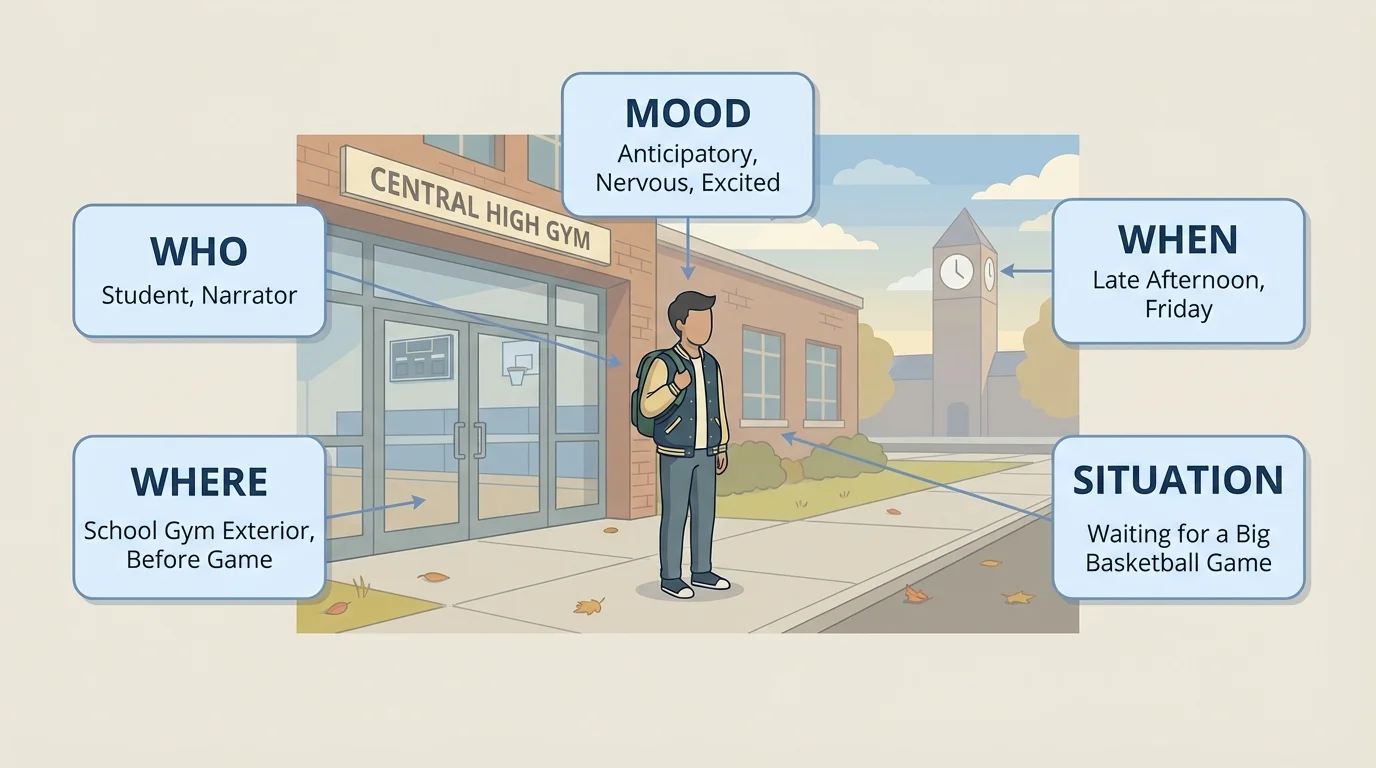
Context can be built in different ways. A writer might begin with action, then layer in background. Another writer might begin with a reflective sentence, then shift into the scene. Either method can work if the reader is not left confused for too long.
Consider this example: By the time the storm siren began its second warning, Elena had already broken into the old greenhouse behind her grandmother's house. This sentence gives a reader several clues. There is danger. There is a character. There is a place. There is an action that raises questions. The context is not complete, but it is enough to create direction.
Writers also choose which details matter most. Specific details are more effective than vague ones. The hallway smelled like bleach and wet sneakers does more than the school smelled bad. Specificity helps readers picture the world and trust the narrator's observations.
Point of view controls what the reader can know, notice, and feel, as [Figure 2] illustrates by comparing the same event through different perspectives. Choosing a point of view is not just a grammar decision. It shapes the whole experience of the narrative.
Common choices include first person, third person limited, and third person omniscient. In first person, the narrator says I and tells the story from personal experience. In third person limited, the story uses he, she, or they but stays close to one character's thoughts and feelings. In third person omniscient, the narrator can reveal the thoughts of multiple characters.
Grade 8 narratives often work best in first person or third person limited because these perspectives create focus. They help writers stay centered on one experience instead of trying to explain everything. That focus often makes the story clearer and more emotionally powerful.
Here is the same moment in two different points of view:
First person: I knew the text from Maya was bad news the second my phone lit up at lunch. She never used all caps unless something had gone seriously wrong.
Third person limited: Noah saw Maya's name flash across his screen during lunch and felt his stomach tighten. She never texted in all caps unless something was wrong.
Both versions work, but they feel different. The first person version sounds immediate and personal. The third person limited version gives a little more distance. A writer should choose the one that best fits the kind of story being told.
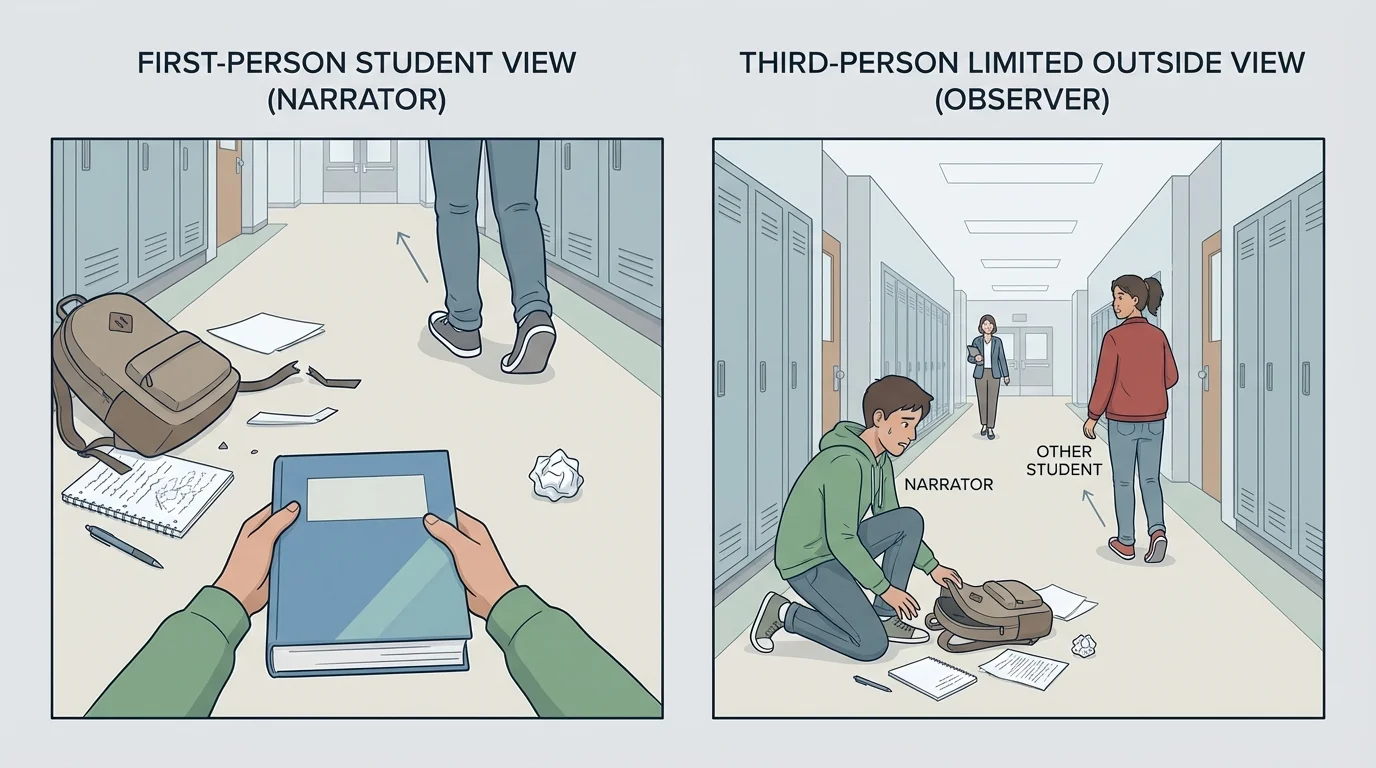
One important rule is to stay consistent. Sudden, unplanned shifts in point of view confuse readers. If the story begins inside one character's mind, it should not suddenly reveal another character's private thoughts unless the writer has intentionally chosen a broader narrative perspective from the start.
How point of view affects trust and tension
A limited point of view can increase suspense because the reader only knows what the narrator or focal character knows. An omniscient point of view can create dramatic irony because the reader may know more than the characters. A first-person point of view can feel especially believable when the voice sounds specific, honest, and consistent.
The narrator's voice also matters. Voice includes word choice, attitude, rhythm, and personality. A nervous narrator notices different details than a confident one. A sarcastic narrator tells events differently than a serious one. Point of view and voice work together to shape the reader's experience.
A character introduction should do more than provide a name and hair color. Strong introductions reveal something meaningful: a desire, a problem, a habit, a fear, or a contradiction. Readers remember characters who appear to be living people, not lists of traits.
One effective method is to introduce a character through action. Instead of saying, Lena was careless, a writer might show Lena jogging across the parking lot with one untied shoe, balancing a trumpet case, a backpack, and a half-zipped binder spilling papers behind her. The action reveals character more naturally than direct labeling.
Dialogue can also help introduce characters. A single line can reveal attitude, relationship, and conflict. For example: "If you say 'trust me' one more time," my brother whispered, "I'm leaving you on that roof by yourself." Immediately, the reader senses tension, personality, and a shared situation.
Physical description still matters, but it should be purposeful. Instead of listing every feature, choose details that contribute to mood or meaning. A trembling hand, a grass-stained uniform, or a carefully folded note can tell readers more than a long catalog of appearance.
Writers should also introduce only the characters the reader needs at the moment. Flooding the opening with too many names makes the story harder to follow. It is usually better to introduce a few people clearly than many people vaguely.
Character introduction example
Compare these two versions of an opening sentence.
Step 1: General introduction
My friend Tasha was funny and smart.
Step 2: More vivid introduction
Tasha leaned across the cafeteria table, stole three of my fries without asking, and announced the answer to a math problem nobody else had solved yet.
The second version introduces character through behavior. Readers learn that Tasha is bold, quick-thinking, and comfortable taking up space.
As the narrative continues, characters should keep developing. Their choices, reactions, and changes over time matter more than their introductions alone. Still, the opening introduction matters because it gives the reader someone to follow.
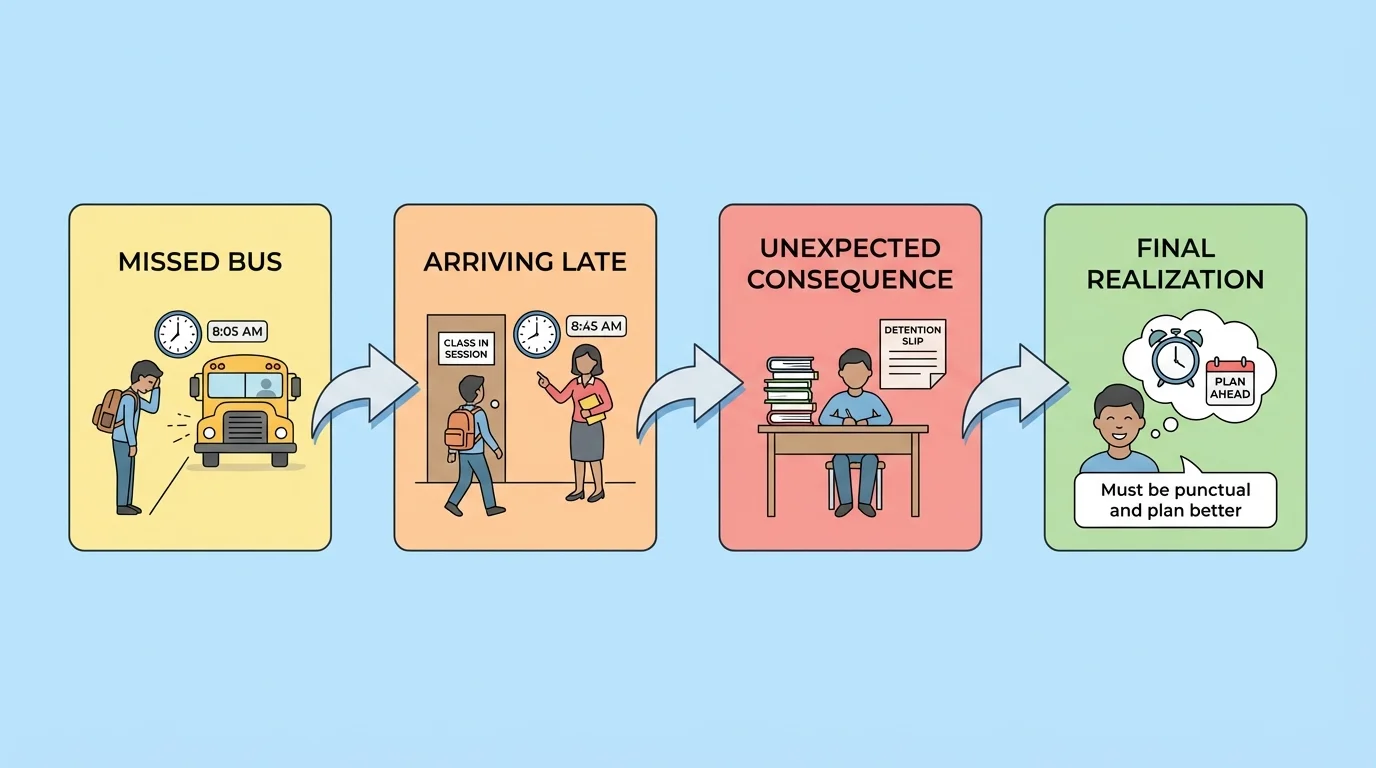
A event sequence unfolds naturally when each moment leads logically to the next, as [Figure 3] demonstrates with a chain of causes and consequences. Readers should not feel that scenes are randomly stacked together. They should feel motion, connection, and progress.
Most narratives follow a basic movement: a beginning that establishes the situation, a middle that develops the conflict or complication, and an ending that shows the result, change, or realization. This does not mean every story must be predictable. It means the reader should be able to follow the path.
Logical sequencing often depends on cause and effect. One event should influence the next. If a character misses the bus, that might cause them to be late. Being late might cause them to miss an important announcement. Missing the announcement might lead to a misunderstanding. Each step grows from the one before it.
Transitions help guide readers through that sequence. Words and phrases such as later that afternoon, after a few minutes, meanwhile, before I could answer, and by the time signal changes in time or action. Good transitions are subtle but important. They prevent the story from feeling jumpy.
Writers should also pay attention to pacing. Some moments deserve slow, detailed treatment because they are emotionally intense or important to the plot. Other moments can move faster. A ten-minute conversation might need a full scene, while a three-hour bus ride may only need one sentence. Strong pacing helps the event sequence feel believable instead of rushed or dragged out.
Chronological order is common, but writers can also begin in the middle and then include earlier information through a flashback. If they do, the time shift must be clear. Otherwise, readers can lose track of when events are happening.
For instance, a narrative might begin with a character standing outside the principal's office, then shift back to the morning to explain how they got there. That can be effective because it creates curiosity. But the writer must signal the shift clearly with wording such as Two hours earlier or by using a paragraph transition that makes the change in time obvious.
| Technique | What it does | When to use it |
|---|---|---|
| Chronological order | Presents events in the order they happen | When clarity and steady flow matter most |
| Flashback | Moves back to an earlier event | When past events explain present action |
| Scene | Slows down and shows details, dialogue, and action | For important moments |
| Summary | Speeds through less important time | For transitions or long stretches of action |
| Reflection | Shows what the narrator thinks or realizes | To deepen meaning and response |
Table 1. Narrative techniques that help writers organize events clearly and effectively.
Later in a narrative, the same principle from [Figure 3] still matters: each new event should feel earned by what came before it. Surprises are welcome, but they should make sense once they happen.
Not every part of a narrative should be written in the same way. Writers often combine scene, summary, and reflection. A scene lets the reader experience a moment almost as if it is happening live. It often includes dialogue, action, and sensory details. Summary compresses time. Reflection shows the narrator's thoughts, feelings, or understanding.
Suppose a story is about a runner preparing for a race. The week of practice might be summarized in a few sentences. The race itself might be shown as a full scene with detailed pacing, sounds, and thoughts. Afterward, the narrator might reflect on what the race meant. This combination creates structure and emotional depth.
From earlier writing work, remember that narratives are stronger when details are relevant. Sensory language, dialogue, and description should support the story's purpose, not distract from it.
Reflection is especially important in personal narratives. It helps the reader understand why the event matters, not just what happened. Reflection can be brief, but it should feel honest. A line like I finally understood why my sister had been so quiet all week adds meaning beyond action alone.
At the same time, reflection should not interrupt every moment. If writers stop the action too often to explain feelings, the story may lose momentum. Balance matters.
One common problem is beginning too far from the real story. Some writers spend a full page on background before anything happens. If the opening contains information the reader does not yet care about, the story may feel slow. Often, it is stronger to begin closer to the moment of change or conflict and add background as needed.
Another problem is giving too little orientation. A writer may know exactly what is happening, but the reader does not. If names, places, or events appear without explanation, the reader feels shut out. The solution is to reread the opening and ask: What would a first-time reader need here?
A third problem is random sequencing. If events happen without clear cause, the story feels disconnected. Writers can fix this by checking whether each scene leads to the next. Asking Why does this happen now? and What does this cause? can reveal missing links.
Point-of-view drift is another frequent issue. A first-person narrator cannot suddenly know another person's exact thoughts unless those thoughts are shown through words or behavior. To fix this, writers should identify who is telling the story and stay faithful to that perspective.
Revision example: fixing a confusing opening
Original version: It was weird. Everything had changed. I ran fast and then there was yelling and my mom was there.
Step 1: Add context
Who is speaking? Where is this happening? What has changed?
Step 2: Clarify sequence
What happened first, then next, then after that?
Step 3: Revise with specifics
When I turned the corner into our apartment courtyard, I nearly crashed into a police officer blocking the front steps. My mother was shouting from the second-floor balcony, and for one confused second, I thought the fire had started in our building.
The revision orients the reader, creates tension, and organizes events more clearly.
These fixes are not about making writing sound fancy. They are about making writing understandable, vivid, and purposeful.
A short model can help show how all the pieces work together. The same opening can be labeled for context, point of view, character detail, and rising action so each craft move is easier to notice.
By the time I reached the bus stop, the rain had soaked through my hoodie and blurred the ink on the envelope in my hand. Across the street, the courthouse steps shone under the streetlights, and my father stood at the top, scanning every passing car. He had told me not to come. I crossed anyway.
This opening engages the reader quickly. It establishes context: it is raining, it is evening, and the setting includes a bus stop and courthouse. It establishes point of view: first person. It introduces a relationship: the narrator and the father. It creates tension: the father said not to come, but the narrator crosses anyway. The event sequence is already moving forward.
Notice how the character is introduced through action and detail rather than a biography. We do not get a list of age, appearance, and hobbies. Instead, we see the narrator in motion with a soaked hoodie and a blurred envelope. Those details suggest urgency and emotion. They also make the reader ask questions. What is in the envelope? Why is the father at the courthouse? Why was the narrator told to stay away?
The final sentence is especially effective because it shows a decision. As [Figure 4] highlights, narratives become interesting when characters choose, resist, risk, or change. A decision pushes the sequence into its next stage.
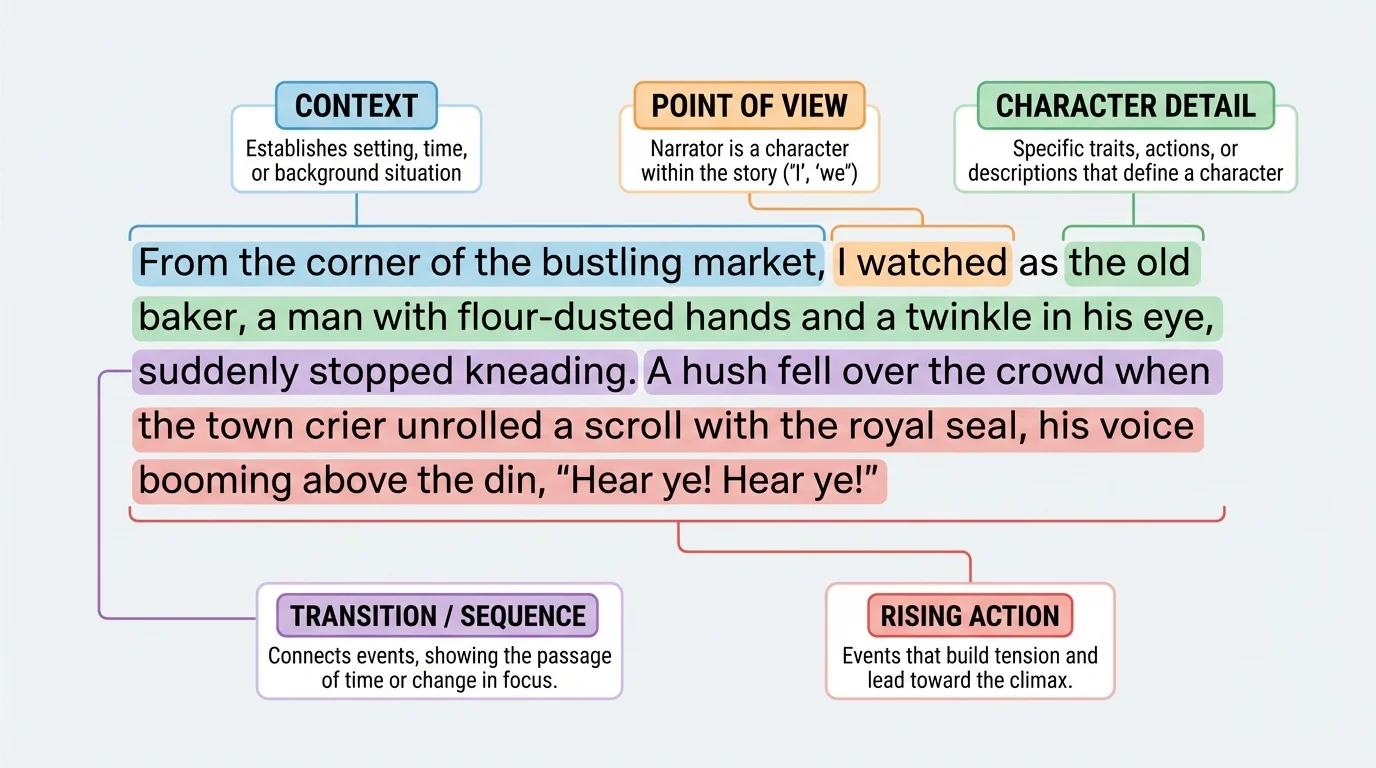
When students draft their own narratives, they can return to the pattern visible here: establish the situation, reveal perspective, introduce a meaningful character detail, and move into action without delay.
One useful strategy is to picture the reader as arriving at the door of your story. What does the reader need immediately? What can wait? Writers who answer those questions tend to create openings that are both engaging and clear.
Another strategy is to track the narrative in simple terms: beginning situation, key complication, response, consequence, change. If you can explain that path clearly, your reader is more likely to follow it easily.
Read your opening aloud. If you stumble because the sequence is unclear, the reader probably will too. If the voice sounds flat, you may need sharper details or a stronger perspective. If nothing is at stake, the story may need a clearer problem or desire.
"Readers do not keep turning pages because writing is complicated. They keep turning pages because they want to know what happens next."
Strong narrative writing is not about decorating sentences. It is about guiding a reader through an experience. Establish the world. Choose the lens. Introduce people who matter. Let events unfold in an order that makes sense. When those parts work together, the story does not just inform the reader. It carries the reader forward.
