A powerful nonfiction text can change how people think about war, justice, nature, sports, or technology. But strong writing is not the same as strong thinking. An author may sound confident, use vivid stories, and choose emotional details, yet still make a weak argument. As a reader, your job is not just to follow the words. It is to test them.
In grade 8, reading literary nonfiction means going beyond basic comprehension. You are expected to figure out what the author is arguing, identify the specific points that support that argument, and judge whether the thinking holds up. This matters in memoirs, speeches, essays, articles, and historical reflections because these texts often try to shape your opinion as well as inform you.
Literary nonfiction includes true writing that uses some of the techniques of literature, such as vivid description, narrative structure, voice, dialogue, and reflection. A memoir chapter, a personal essay, a historical speech, and a magazine feature can all fit into this category. Even when the writing feels personal or artistic, it can still contain an argument.
Argument is the author's overall position or point of view on an issue. A claim is a smaller statement that supports the argument. Reasoning is the thinking that connects the claims to the evidence. Evidence is the support the author uses, such as facts, examples, quotations, details, or statistics.
When you read literary nonfiction carefully, you ask questions such as: What is the author trying to convince me of? What claims are used to build that case? What proof is offered? Does the proof actually match the claim? Are there gaps, exaggerations, or distractions? These questions turn reading into investigation.
Literary nonfiction often blends storytelling and analysis. A writer may describe a childhood experience, then use that experience to make a broader point about education, identity, or fairness. Because the writing can be moving and memorable, readers sometimes accept its message too quickly. Strong readers slow down and separate style from support.
For example, suppose an essayist writes about growing up near a polluted river and argues that cities must protect green spaces. The personal story may be vivid and meaningful, but you still need to ask whether the larger claim is backed by enough strong evidence. One person's experience can be important, but it may not be enough by itself to prove a broad point.
Remember that nonfiction can have both ideas and craft. You may study tone, word choice, and structure, but you also need to examine how well the author's ideas are supported.
This is where reading standards connect to research skills. In research, you pose questions, find sources, evaluate them, and synthesize information. When reading literary nonfiction, you use many of the same habits: you identify the main issue, locate supporting details, test the credibility of evidence, and build your own response from the text.
An author's argument is the central idea the writer wants readers to accept. In many texts, the argument is not stated in one simple sentence, but readers can still map the relationship between the main idea and supporting points. Look for repeated ideas, strong opinions, and conclusions the author returns to more than once.
Specific claims are the smaller reasons that hold up the larger argument. If an author argues that public libraries remain essential, the supporting claims might include these: libraries provide free access to information, libraries create safe community spaces, and libraries help reduce inequality. Each claim works like a pillar under the main argument.
One helpful strategy is to ask, "If I had to finish this sentence, what would it be?" The sentence is: The author wants readers to believe that... Your answer gives the argument. Then ask: Why does the author think that? The answers to that second question are often the claims, as [Figure 1] illustrates.
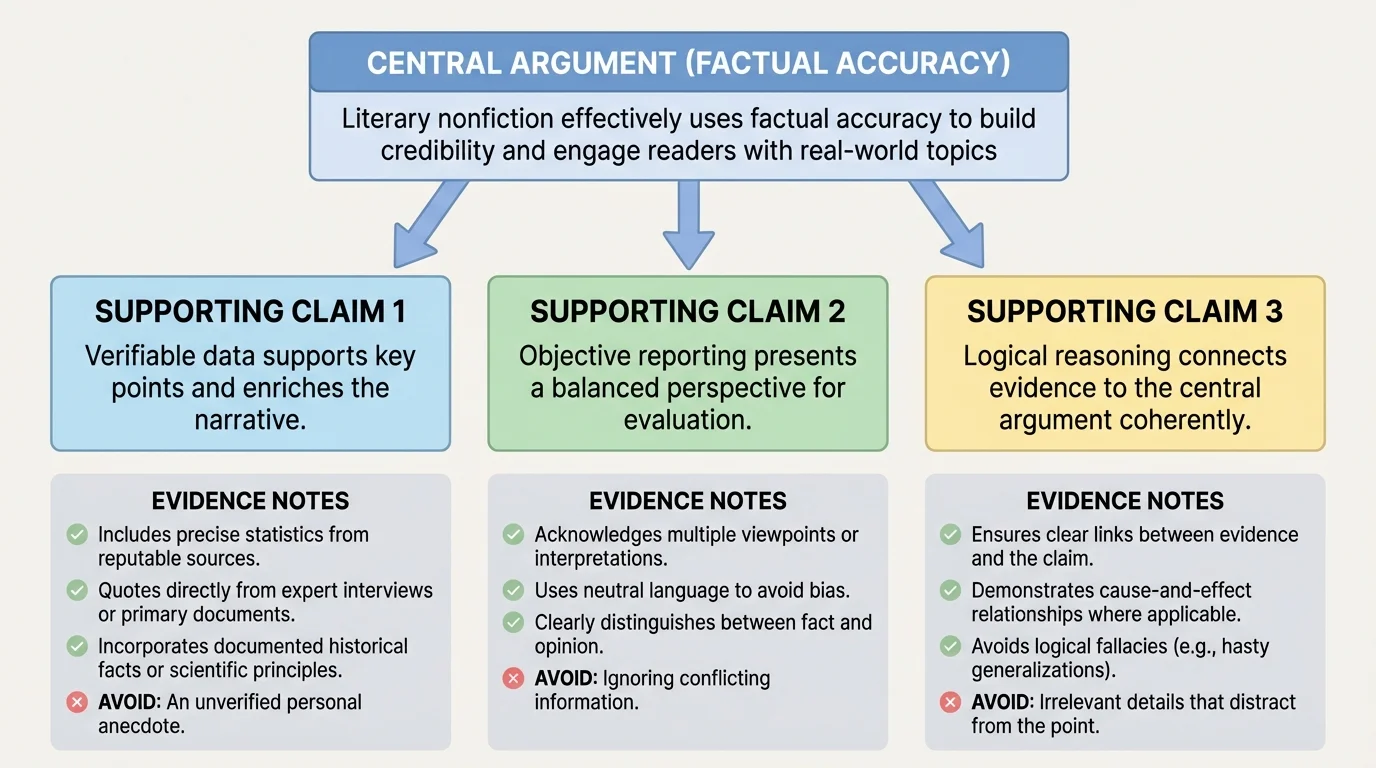
Sometimes writers state claims directly with signal phrases such as because, therefore, this shows, or for this reason. Other times, claims are implied. In a memoir, for instance, the author may not say, "Schools should value creativity," but the stories and reflections may clearly push readers toward that conclusion.
Not every important sentence is a claim. Some sentences are background information. Others are examples, emotional reflections, or transitions. A claim is a statement that can be supported, questioned, or challenged. It makes an assertion, not just a description.
Reasoning is the logic that connects evidence to a claim. Good reasoning answers the question, "How does this proof support this point?" If a writer gives evidence without explaining its meaning, readers may have to guess how the pieces connect.
Suppose an author claims that later school start times improve student learning. If the author explains that teens often need more sleep, and more sleep improves attention and memory, that is a chain of reasoning. The logic connects the policy to the result. Sound reasoning usually follows a clear path.
Weak reasoning appears when the connection is shaky, incomplete, or based on assumptions. For example, if a writer says, "One successful athlete trained before dawn, so all students learn better when school starts early," the logic is weak. A single athlete's routine does not prove what works best for all students.
What makes reasoning sound?
Sound reasoning is clear, logical, and supported by accurate thinking. It avoids big jumps. It does not confuse coincidence with cause, and it does not treat one example as proof of a universal rule. Strong reasoning often explains why the evidence matters, not just what the evidence is.
Readers should also watch for common logic problems. One is generalization, when a writer draws a broad conclusion from too few examples. Another is false cause, when a writer assumes that because one event happened before another, the first event caused the second. Another problem is oversimplification, when a complicated issue is reduced to one easy answer.
Authors do not always use poor reasoning on purpose. Sometimes they care deeply about a topic and rush from experience to conclusion. That is why close reading matters. You are not attacking the author. You are evaluating the strength of the thinking.
Once you identify a claim, test the evidence. Three key questions help: Is the evidence relevant? Is it sufficient? Is it reliable?
Relevant evidence directly connects to the claim. If a writer argues that a city needs more bike lanes, data about traffic safety, commuting patterns, and pollution are relevant. A long description of the mayor's favorite restaurant is not relevant, even if it is interesting. Readers can compare strong and weak support for the same claim in [Figure 2].
Sufficient evidence means there is enough support to make the claim believable. One example might help illustrate a point, but major claims usually need more than one detail. Strong support can include a mix of examples, expert quotations, historical facts, observations, and trustworthy statistics.
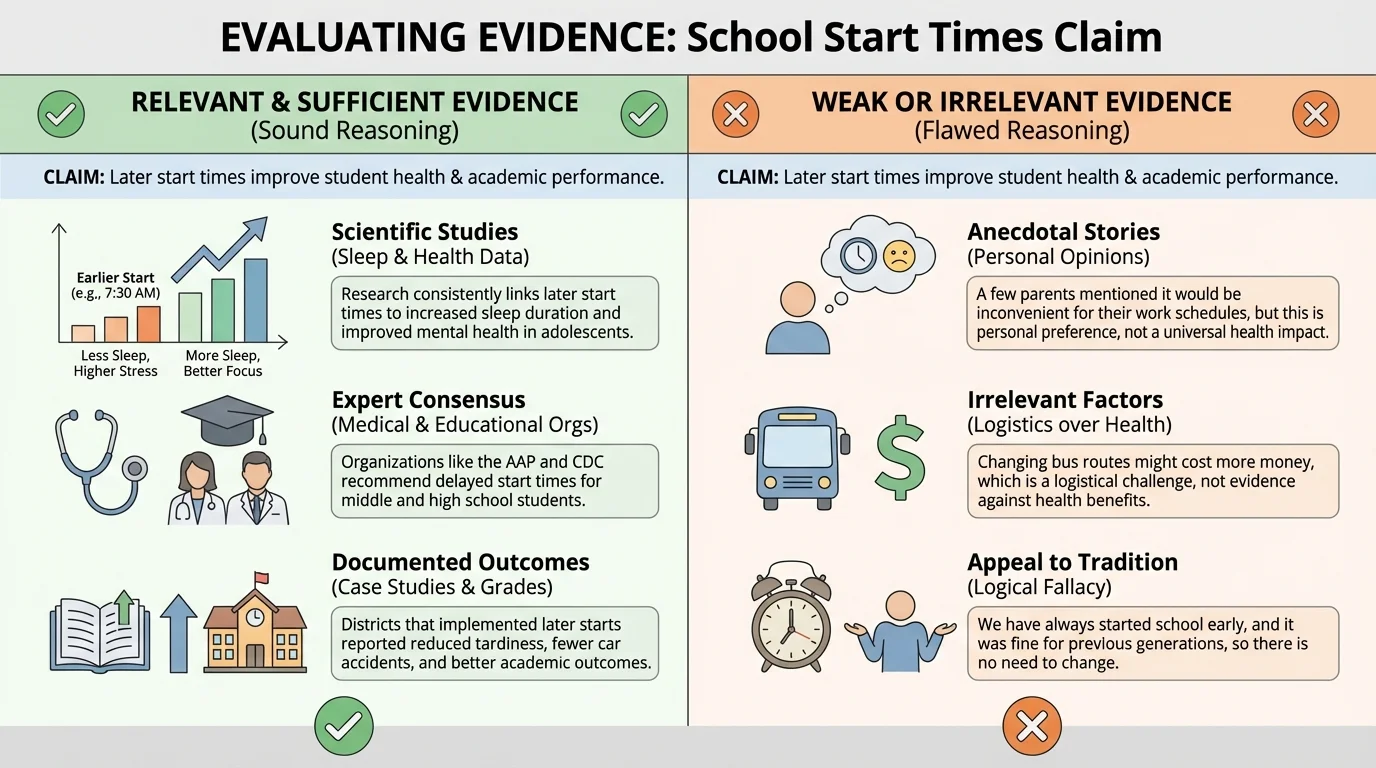
Reliable evidence comes from trustworthy sources or accurate firsthand observation. In literary nonfiction, some evidence may come from the author's own experience. That can be valuable, especially in memoir or personal essay. Still, for broad public claims, personal experience is usually stronger when combined with outside information.
Think about the difference between these two supports for the claim that community gardens improve neighborhoods. First support: "I like walking past flowers." Second support: "Residents reported more neighborhood interaction after the garden opened, and local volunteers maintained it weekly." The first is a personal reaction. The second gives more useful, relevant evidence.
| Type of support | How useful it is | Why |
|---|---|---|
| Personal anecdote | Sometimes useful | Can make a point vivid, but may be limited |
| Fact from a trusted source | Very useful | Provides verifiable information |
| Expert quotation | Useful | Adds informed perspective if the expert is qualified |
| Statistic with no source | Weak | Cannot be checked for accuracy |
| Off-topic detail | Not useful | Does not support the claim |
Table 1. Comparison of common types of support and how well they strengthen a claim.
Students sometimes assume that any detail counts as evidence. It does not. Evidence must do real work. It must help prove something. A detail can be vivid and still be weak if it does not connect clearly to the claim.
Irrelevant evidence is information that does not actually support the claim being discussed. Writers may include it accidentally, or they may use it to distract readers from a weak point. Strong readers notice when the spotlight moves away from the real issue.
Suppose a writer argues that a town should restore an old theater because it is historically important. Relevant evidence might include the theater's age, role in local history, and cultural impact. Irrelevant evidence might include the writer's opinion that the snack stand once sold excellent popcorn. That detail may be fun, but it does not prove historical importance.
Writers sometimes persuade by making readers feel impressed, angry, or nostalgic even when the support is weak. Emotional language can strengthen writing, but emotion alone is not the same as evidence.
Another distraction is the side issue. A writer may face a difficult question and shift to an easier one. For example, if readers ask whether a new rule is effective, the author may answer by discussing whether the people who created the rule had good intentions. Good intentions do not automatically prove good results.
Ask yourself: If I remove this detail, does the claim become less supported? If the answer is no, the detail may be irrelevant. This test helps you separate evidence from decoration.
Evaluating argument does not end with silent judgment in your head. You must be able to explain your analysis clearly using evidence from the text. That means quoting, paraphrasing, or summarizing the parts of the passage that led you to your conclusion.
If you say, "The author's reasoning is weak," you should follow with text-based support. You might write: The author claims that all students benefit from competition, but only gives one personal example from middle school and does not explain how that example applies more broadly. This kind of response names the claim, points to the evidence, and evaluates the reasoning.
Text-based analysis example
Claim: The author argues that neighborhood murals improve public safety.
Step 1: Identify the evidence
The writer describes one block where a mural appeared and neighbors spent more time outside.
Step 2: Evaluate relevance
This evidence is relevant because it connects art to community presence.
Step 3: Evaluate sufficiency
The evidence is limited because the author gives only one example and no broader data.
Step 4: Form a conclusion
A strong response would say that the claim is partly supported, but the evidence is not sufficient to prove that murals generally improve safety.
Notice that this response does not simply agree or disagree. It evaluates how well the text works. That is an important difference. Literary nonfiction asks you to be both a reader and a critic.
Drawing evidence also matters in research. If you are comparing two articles or linking a memoir to a historical speech, you should choose the most relevant details from each text. Good synthesis means bringing together information that actually helps answer your question.
Reading standards connect closely to research practices. When you investigate a topic, you begin by asking an important question. Then you identify sources, locate information, and decide which material deserves trust. These same skills make you a better reader of literary nonfiction.
A source may be interesting but still weak. A personal blog post about nutrition may be engaging, but an article by a medical organization may be more reliable for health claims. In literary nonfiction, the author may quote sources. You should still ask whether those sources are informed, current, and connected to the issue.
Good readers notice when an author relies too much on one kind of source. If an essay about climate policy includes only emotional stories and no scientific information, the evidence may be incomplete. If it includes only technical data and no human impact, the argument may feel narrow. Strong writing often balances different types of support.
"The important thing is not to stop questioning."
— Albert Einstein
Questioning does not mean rejecting everything. It means testing claims carefully. In school, in media, and in everyday life, this habit protects you from being misled by polished language or dramatic stories that lack real support.
A literary nonfiction passage can be broken into parts for analysis. Consider this shortened passage: Our neighborhood park should be protected from commercial development. For thirty years, families have gathered there for concerts, games, and community celebrations. In a recent town survey, most residents said the park is one of the few free public spaces where all age groups mix. Developers promise jobs, but a coffee shop can be built elsewhere. My grandfather also taught me to ride a bike near the old fountain, and every spring the tulips are beautiful.
The central argument is that the park should be protected from commercial development. One supporting claim is that the park serves an important community function. Evidence for that claim includes the long history of public events and the town survey reporting that residents value the park as a free shared space, as [Figure 3] shows.
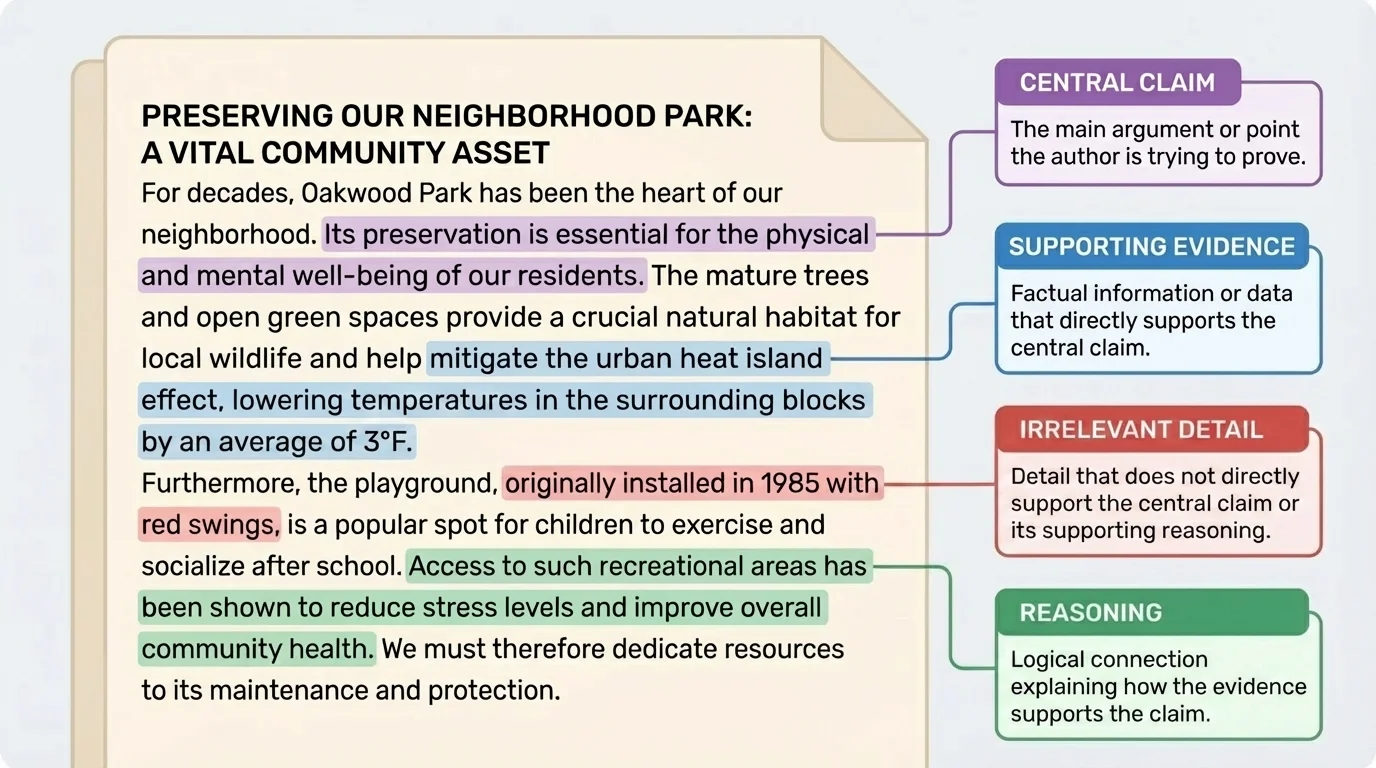
The reasoning is mostly sound because the author connects public value to the need for protection. If a place serves many people and offers something rare, such as free access for all ages, that supports the idea that losing it would matter. The survey strengthens the claim because it extends beyond one person's opinion.
However, not every detail is equally strong. The memory about learning to ride a bike adds emotional power, but by itself it does not prove the park should be protected. The sentence about beautiful tulips is even less useful. It creates imagery, yet it does little to support the policy argument. As we see again in [Figure 3], some details enrich the writing without serving as strong evidence.
This does not mean personal details never belong in argument. In literary nonfiction, they often matter because they show lived experience. But readers must distinguish between details that illustrate the issue and details that actually prove the point.
When you write or speak about a literary nonfiction text, organize your response clearly. State the author's argument. Identify one or more specific claims. Evaluate the reasoning. Then judge the evidence for relevance and sufficiency. This structure keeps your analysis focused.
A useful sentence frame is: The author argues that... Then continue: This claim is supported by... After that, add evaluation: This evidence is relevant because... or The reasoning is weak because... These patterns help turn observations into clear academic analysis.
You can also compare texts. One author may use personal narrative as the main support, while another relies on expert testimony and historical examples. Comparing these choices helps you decide which text is more convincing and why. The argument map from [Figure 1] remains useful here because it helps you separate central ideas from supporting claims before you compare authors.
Strong readers communicate findings appropriately for the task. In a class discussion, that may mean referring directly to key lines. In a short analytical paragraph, it may mean choosing one quotation and explaining it well. In research writing, it may mean synthesizing several sources into one clear conclusion.
The more carefully you evaluate argument, reasoning, and evidence, the more independent you become as a thinker. That skill matters far beyond English class. It matters when you hear a speech, read an article, watch a documentary, or decide whether a claim online deserves your trust.
