A surprising number of school projects fail for the same reason many real-world projects fail: people talk, but they do not truly collaborate. A team can have smart ideas, good materials, and enough time, yet still struggle if no one knows the rules for discussion, the goal, the deadline, or each person's job. Strong group work is not just about being friendly. It is about being organized, respectful, and purposeful.
In grade 8, collaborative discussions become more important because you are expected to exchange ideas, analyze information, make decisions, and solve problems together. Whether you are discussing a novel, planning a science presentation, preparing a debate, or designing a community service project, you need more than opinions. You need a system that helps everyone participate and helps the group move forward.
A good discussion allows a group to combine different strengths. One student may notice details, another may ask strong questions, and another may explain ideas clearly. When people work well together, the final result is often stronger than what any one person could do alone. This is one reason schools, workplaces, sports teams, and community organizations all depend on collaboration.
But collaboration is not automatic. Without structure, a discussion can become confusing or unfair. A few people may talk too much. Others may stay silent. The group may rush into a decision without enough evidence. Or everyone may leave the meeting with different ideas about what to do next. That is why effective collaboration depends on clear expectations.
Collegial discussion is a respectful, cooperative conversation in which people listen carefully, respond thoughtfully, and work toward understanding or a shared decision.
Decision-making is the process of choosing a course of action after considering ideas, evidence, and possible outcomes.
Deadline is the final time or date by which work must be completed.
When a group understands how to discuss, decide, plan, and follow through, members are more likely to trust one another. That trust matters because students are more willing to share ideas when they know they will be heard respectfully.
Every effective group needs discussion norms, or shared rules. A discussion norm is a behavior the group agrees to follow so the conversation stays respectful and productive. In a strong discussion, students listen actively, wait their turn, refer to evidence, and respond to the actual idea being shared. These habits help the group focus on solving the problem instead of struggling with behavior.
[Figure 1] One important rule is active listening. This means paying close attention to the speaker instead of planning what you want to say next. Active listening includes making eye contact when appropriate, facing the speaker, noticing key points, and asking clarifying questions. It also means not interrupting. Interrupting may seem small, but it can make others feel that their ideas do not matter.
Another rule is to speak one at a time and stay on topic. Group time is limited. If the conversation jumps from idea to idea without focus, the group may run out of time before making a decision. Staying on topic does not mean being rigid; it means connecting your comment to the task the group is working on.
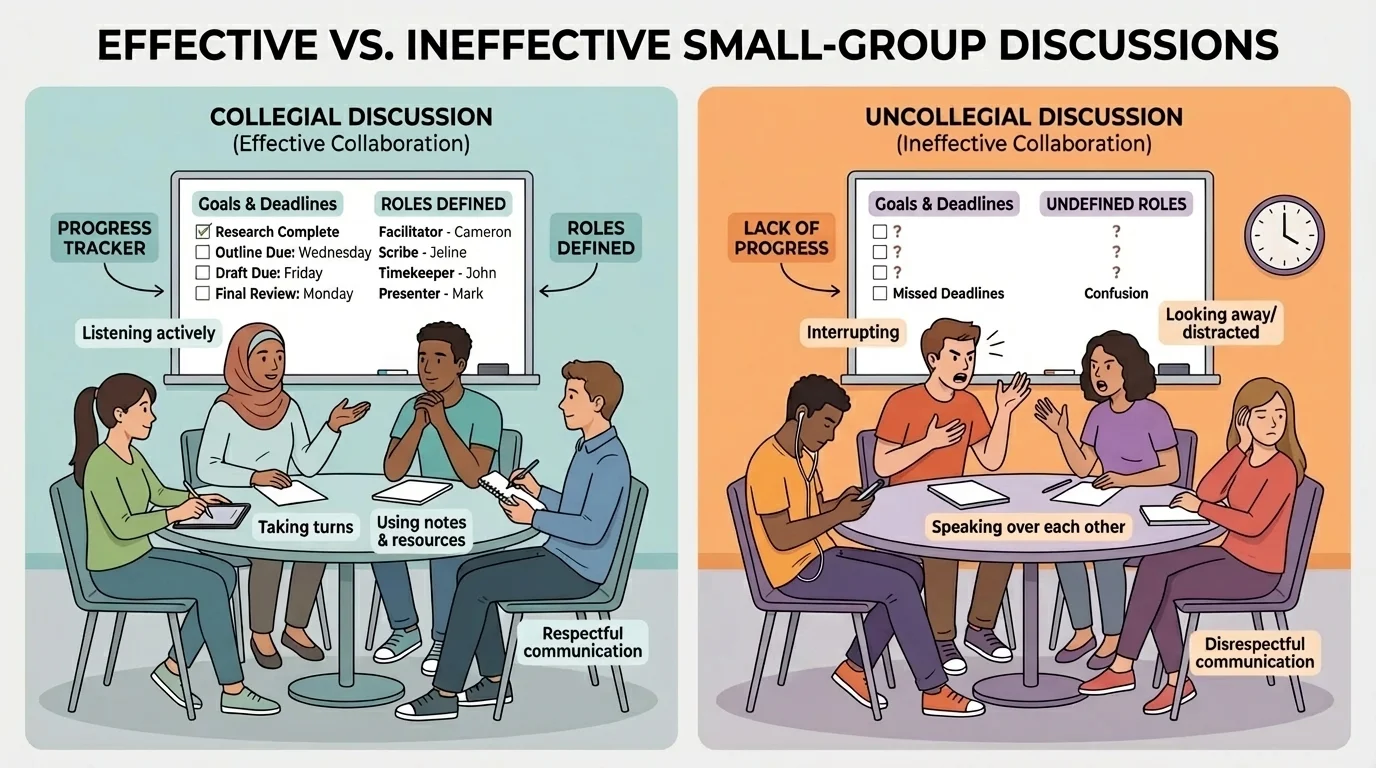
Respectful disagreement is also essential. In strong collaboration, people do not have to agree all the time. In fact, thoughtful disagreement often improves a group's final decision. The key is to challenge the idea, not attack the person. Compare these two responses: "That idea is wrong" and "I see your point, but the evidence from our article suggests a different conclusion." The second response keeps the discussion academic and respectful.
Using evidence is another major rule. Opinions matter, but in school discussions, opinions should be supported by reasons, facts, examples, or text details. If your group is discussing a historical event, a science question, or a novel, your best contribution is not just "I think so." It is "I think so because the source says..." or "The experiment results show..." or "In paragraph two, the author explains..." That kind of speaking makes the conversation stronger.
Later, when groups face disagreement, the contrast shown in [Figure 1] still matters. Productive groups focus on listening and evidence, while unproductive groups let interruptions and frustration take control.
"The strongest teams are not the ones that never disagree. They are the ones that know how to disagree with respect."
Finally, collegial discussion includes making space for everyone. A balanced conversation is not one where every student says the exact same amount, but it is one where all members have a real chance to contribute. Good collaborators invite quieter members in by asking, "What do you think?" or "Do you see another option?"
Discussion and decision-making are connected, but they are not the same. A discussion explores ideas. A decision chooses a direction. Groups need to know when they are still exploring and when they are ready to decide.
There are several common ways groups make decisions. One is consensus, which means the group reaches a decision everyone can support, even if it is not every person's first choice. Consensus often leads to strong commitment because everyone has been heard. However, it can take time.
Another method is voting. Voting is useful when the group has a few clear choices and needs a quick, fair way to decide. For example, a group choosing between three presentation formats may vote after discussing the pros and cons of each. Voting is efficient, but it should not replace discussion. If people vote before the ideas are fully explained, the choice may be weak.
A third method is compromise. In a compromise, each side gives up part of what it wanted so the group can move forward. This is helpful when the group is divided but still wants a practical solution. For example, one student may want a slideshow and another may want a poster, so the group may decide to create a slideshow with a printed display board.
The best groups choose a decision-making method that fits the task. If the choice affects the whole group deeply, consensus may be best. If time is short and the options are simple, voting may work. If two strong ideas both have value, compromise may be smartest.
Good decisions come from clear thinking. Before deciding, a group should identify the question, review the evidence, compare possible choices, and think about consequences. A rushed decision may feel quick, but it often creates more work later because the group has to fix mistakes or redo tasks.
Good decision-making also requires clarity at the end. Once a decision is made, someone should state it clearly: what the group decided, why it chose that option, and what happens next. If this step is skipped, members may leave with different understandings.
A group cannot track progress unless it knows exactly what it is trying to accomplish. That is why a specific goal matters. A weak goal is vague, such as "finish the project soon." A stronger goal names the exact task, the quality expected, and the deadline.
For example, suppose a group must create a five-minute presentation about water conservation. A vague goal would be "work on the presentation." A specific goal would be "By Thursday, complete the introduction, choose three facts from reliable sources, and divide the speaking parts." The second goal is clearer because everyone knows what success looks like.
Specific goals often work best when broken into smaller parts. Large tasks can feel stressful because they hide many smaller jobs inside them. Breaking work into steps makes the project more manageable. Research must happen before slides are created. Slides must be drafted before they are revised. The presentation must be organized before it is rehearsed.
[Figure 2] Deadlines should also be realistic. If a project is due in one week, a group should not wait until the night before to meet. Internal deadlines help groups avoid last-minute panic. An internal deadline is an earlier target date set by the group to keep the final deadline safe.
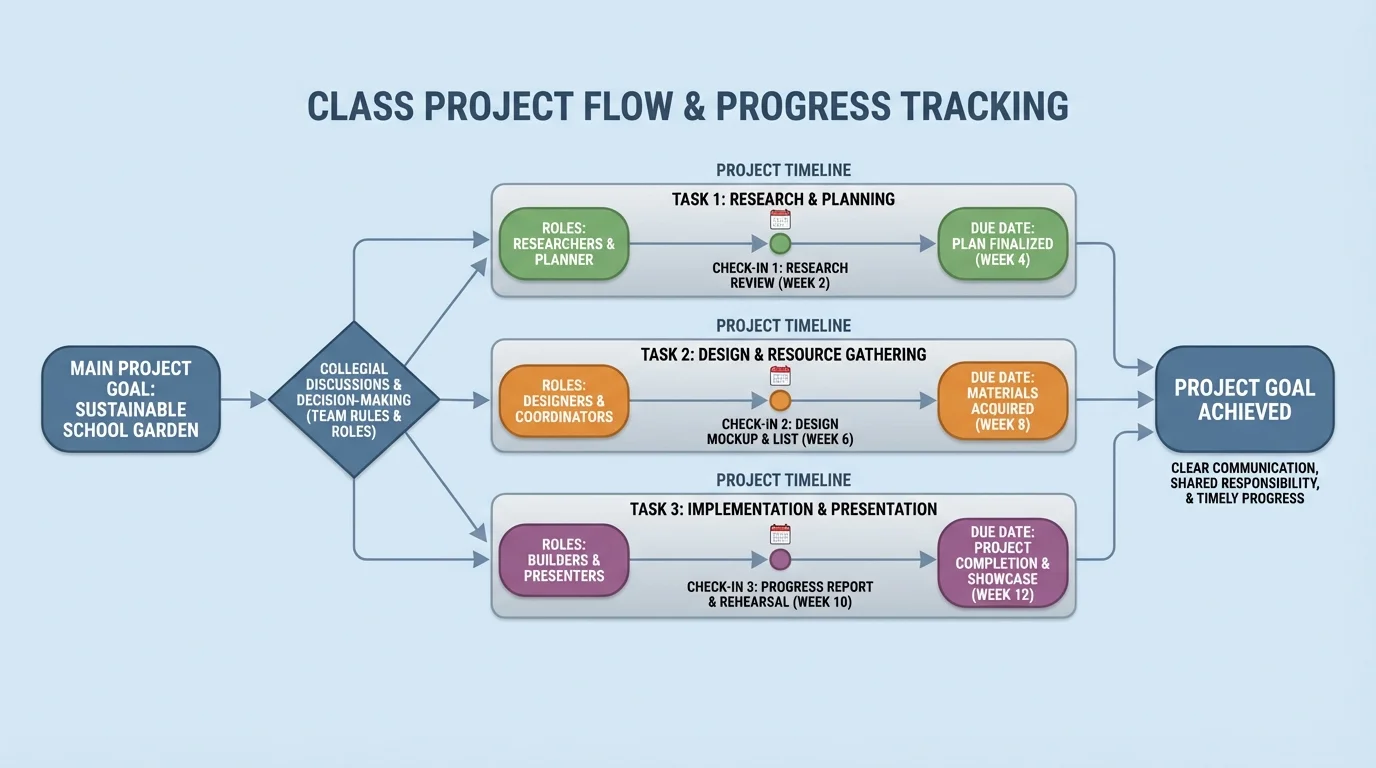
For instance, if the final presentation is due Friday, the group might set these internal deadlines: research by Monday, outline by Tuesday, slides by Wednesday, rehearsal by Thursday. That schedule gives the group time to adjust if something goes wrong.
Notice how the planning pattern turns one big job into a sequence of smaller decisions. This makes it easier to see what should happen first and what can wait.
| Weak Goal | Better Goal | Why It Is Better |
|---|---|---|
| Work on the poster | Finish the title, headings, and two visuals by Tuesday | It names exact tasks and a due date |
| Research the topic | Find three reliable sources and record notes by the end of class | It gives a clear amount and time limit |
| Practice later | Rehearse the full presentation twice on Thursday | It is measurable and specific |
Table 1. Comparison of vague goals and specific goals in group work.
When groups set clear goals, members are less likely to assume someone else is handling an important task. Clarity saves time, reduces stress, and improves accountability.
Even a strong plan needs monitoring. Progress monitoring means checking how much has been completed, what still needs work, and whether the group is on time. Without progress checks, groups may think they are doing fine until it is too late.
A simple way to track progress is through regular check-ins. At the beginning or end of each meeting, the group can answer three questions: What have we finished? What is our next step? What problems are slowing us down? These short conversations help everyone stay informed.
Written notes also help. A recorder or shared document can list tasks, deadlines, and who is responsible for each job. This is especially useful when a project lasts several days. Memory is not always reliable, especially when students are balancing several classes and assignments.
Sometimes groups fall behind. That does not mean failure. It means the group must adjust. Maybe the research took longer than expected. Maybe a student was absent. Maybe one task turned out to be harder than the group thought. In that case, the group should talk honestly, update the timeline, and redistribute tasks if needed.
Professional teams in business, engineering, and medicine often use short status meetings for the same reason student groups do: small check-ins prevent small problems from becoming big ones.
Tracking progress also means noticing quality, not just completion. A group may "finish" slides quickly, but if the information is inaccurate or unclear, the work is not truly ready. Effective collaboration includes both speed and care.
Groups often work better when members have clearly assigned jobs. A role is a particular responsibility a person takes on in order to help the team succeed. Roles create structure, reduce confusion, and make it easier to see whether work is being shared fairly.
One common role is the facilitator. The facilitator helps the group stay focused, encourages balanced participation, and guides the discussion back to the goal when it drifts. Another role is the recorder, who writes down decisions, notes important ideas, and keeps track of what the group agreed to do.
[Figure 3] A timekeeper watches the clock and reminds the group how much time remains. This role matters because even excellent discussions can fail if they use all their time talking and leave none for action. A researcher may gather information from reliable sources, while a presenter may help organize and deliver the final speaking portion.
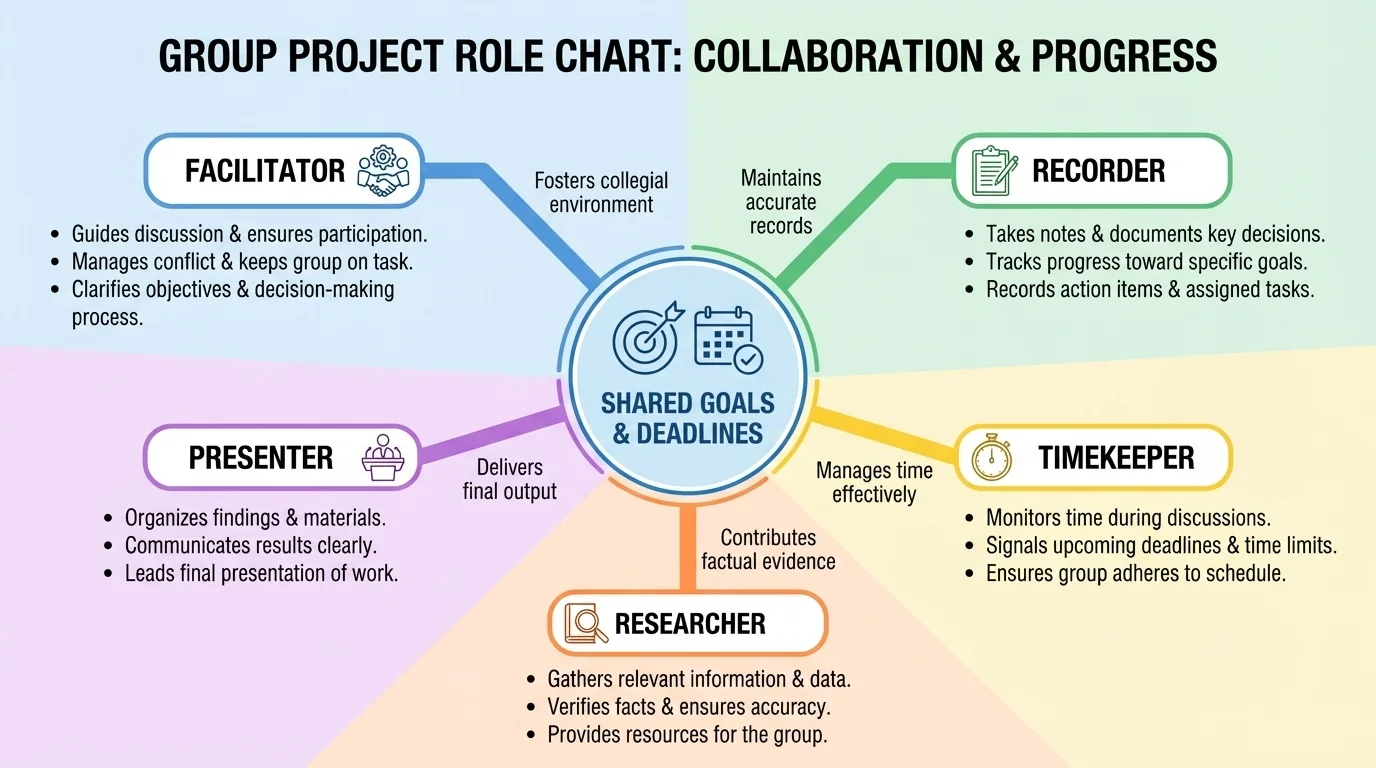
Roles do not mean one person does everything in that area forever. In many groups, members share or rotate responsibilities. For example, one student may record notes in the first meeting, and another may do it in the next. The goal is not to lock people into narrow jobs. The goal is to make sure every important task has an owner.
When groups begin to lose focus or forget who is responsible for what, the role structure becomes especially helpful. It reminds members that collaboration works best when responsibility is visible.
Example: Assigning roles in a history project
A group is creating a presentation about how a historical event affected different communities.
Step 1: Identify the main needs
The group needs research, note-taking, time management, design, and speaking preparation.
Step 2: Match strengths to tasks
One student is organized and becomes the recorder. One likes speaking and becomes the presenter. One works well under time pressure and becomes the timekeeper.
Step 3: Make responsibilities clear
The recorder writes decisions, the presenter leads rehearsal, the timekeeper watches internal deadlines, and all members still contribute ideas and evidence.
The group becomes more efficient because responsibilities are clear, but the final project still belongs to everyone.
A useful rule is that roles should support fairness, not excuse unequal effort. No one should hide behind a title to avoid participating in the real thinking of the group.
Consider a group assigned to create a public service announcement about reducing food waste at school. At the first meeting, the students agree on discussion norms: listen without interrupting, use evidence from research, disagree respectfully, and make sure each member speaks. They decide that their final product will be a short video and poster campaign.
Next, they set goals and deadlines. By Monday, they will gather facts about food waste. By Tuesday, they will write the script. By Wednesday, they will film. By Thursday, they will edit and rehearse their explanation for the class. These goals are specific because they name tasks and dates.
Then the group assigns roles. One student facilitates discussion, one records notes, one manages time, one gathers research, and one leads technical editing. During each meeting, they check progress. If the filming takes too long, they shorten one scene and move editing tasks around. Because they monitor progress, the group can adapt without falling apart.
This example shows that successful collaboration is not one big skill. It is a set of connected habits: discuss respectfully, decide clearly, plan specifically, track honestly, and share responsibility fairly.
Many group problems can be solved early if students recognize them. If one person dominates the conversation, the facilitator can invite other voices in. If the group keeps drifting off topic, the timekeeper can remind everyone of the agenda. If no one understands the assignment, the group should pause and ask the teacher clarifying questions instead of guessing.
Another common problem is unequal effort. Sometimes one student ends up doing too much while others do too little. Clear goals, written task lists, and defined roles help prevent this. If the problem continues, the group should address it directly and respectfully: name the missing task, explain why it matters, and set a new plan.
Missed deadlines are also common. The best response is not blame; it is problem-solving. What caused the delay? Is the schedule unrealistic? Does someone need help? Should the group simplify part of the project? Honest discussion allows the group to recover.
You already know from earlier speaking and listening work that strong communication includes eye contact, clear volume, relevant ideas, and attentive listening. Collaborative discussion builds on those same skills but adds planning, shared decision-making, and accountability.
Conflict is not always a sign that a group is failing. Sometimes conflict appears because people care about the outcome and have different ideas. Productive groups manage conflict by returning to evidence, goals, and agreed-upon norms.
Strong collaboration depends on both listening and speaking. Students should express their own ideas clearly, but they should also connect those ideas to what others have said. This is what it means to build on others' thinking.
Useful sentence starters can help. A student might say, "I want to add to your point..." or "I agree with part of that idea because..." or "Can you explain what you mean by...?" or "The evidence suggests another possibility..." These moves keep the conversation moving forward instead of turning it into disconnected comments.
Clear speech also means being precise. Avoid vague comments like "This is better" unless you explain better in what way. Better speaking sounds like: "This source is better because it gives current data and names the organization that collected it." Specific language improves understanding.
When students follow discussion rules, use thoughtful decision-making, monitor goals, and define roles, they do more than complete assignments. They learn how to work with others in a way that is respectful, efficient, and effective. Those skills matter in school now, and they matter long after school as well.
