A true story can be exciting in real life and still sound flat on the page. Why? Because a narrative is not just a list of things that happened. It is a crafted telling of an experience. Writers choose what to zoom in on, what to summarize, what characters say, what details readers notice, and what thoughts give the event meaning. That is how an ordinary missed bus, a tense basketball game, or an awkward lunch table conversation becomes a story worth reading.
A narrative is a piece of writing that tells about real or imagined events. Strong narratives do more than report actions in order. They help readers feel present in the moment, understand the people involved, and see why events matter. Narrative techniques are the tools writers use to make that happen.
If a writer says, "I went to the gym. We played. My team won. I was happy," the reader gets the facts, but not much else. Compare that with: "The scoreboard flickered with six seconds left. 'Pass it!' Jalen shouted. My hands were so sweaty the ball almost slipped, but when the shot hit the backboard and dropped through, our bench exploded." The second version uses action, dialogue, pacing, and description to create an experience instead of a plain report.
Dialogue is spoken conversation between characters. Pacing is the speed at which a story moves. Description is language that helps readers imagine people, places, and events. Reflection is the narrator's or character's thinking about what an experience means.
These techniques are powerful because they work together. Dialogue can reveal character. Pacing can build suspense. Description can create mood. Reflection can show change. When writers use them with care, readers do not just learn what happened; they understand how it felt and why it mattered.
An effective narrative has a clear event sequence. That means events are arranged in a way readers can follow. Usually, one event leads logically to the next. This does not mean every narrative must be told in exact time order, but it does mean the reader should not be confused about what happened, when it happened, or why it mattered.
Strong narratives also use point of view consistently. A first-person narrator uses words like I and we, while a third-person narrator uses he, she, or they. Point of view affects what readers know and how close they feel to the character's thoughts and emotions.
Another important quality is relevance. Not every detail belongs in a narrative. A writer must choose details that help develop the experience, event, or character. If a detail does not build the setting, reveal personality, strengthen the mood, or move the action forward, it may distract more than it helps.
From earlier writing lessons, you already know that a strong paragraph stays focused on a main idea. Narrative writing follows that same principle. Even when a story includes many moments, each part should contribute to the larger experience the writer wants the reader to understand.
Finally, effective narratives sound intentional. They do not feel rushed, random, or overloaded. Instead, they guide the reader through a meaningful experience with a balance of action, detail, and insight.
Dialogue makes characters sound human, and it often reveals personality more clearly than direct explanation. The exact words a character chooses, along with body language and tone, can suggest confidence, fear, impatience, kindness, or embarrassment. A character who says, "Move," sounds very different from one who says, "Sorry, can I squeeze by?"
As [Figure 1] shows, dialogue also helps move the plot. Instead of the narrator explaining everything, characters can reveal information naturally through conversation. For example, "You never told Coach about your ankle, did you?" tells the reader that there is a coach, an injury, and possibly a secret.
Good dialogue is purposeful. Real conversation often includes repetition, filler words, and random comments. In a narrative, dialogue should sound natural without copying every part of real speech. Writers usually keep only the parts that reveal something important or advance the scene.
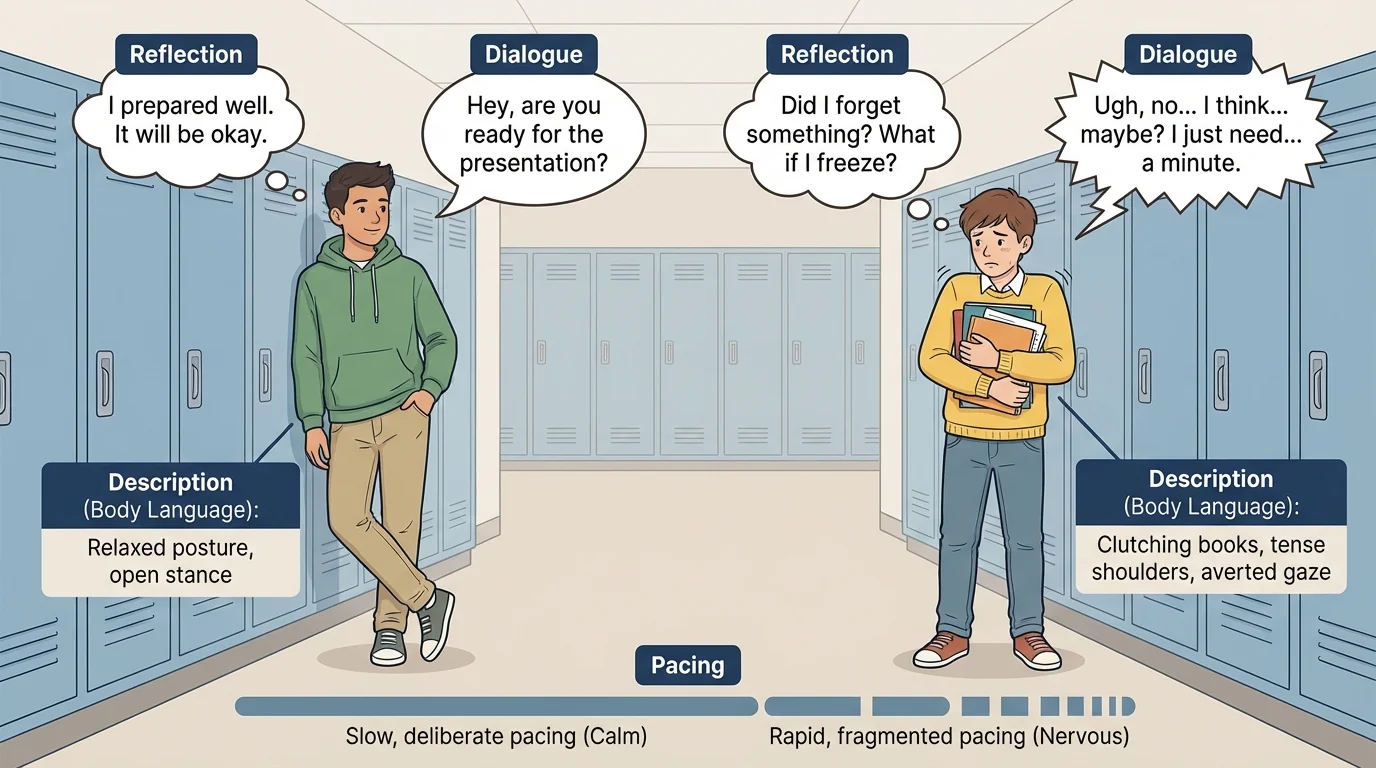
Writers also use dialogue tags and action beats carefully. A dialogue tag identifies the speaker, as in "she said" or "he asked." An action beat shows what a character is doing while speaking, as in "Maya tugged at her sleeve." Action beats often reveal emotion more vividly than extra tags.
Compare these versions:
Comparing weak and strong dialogue
Weak: "I am nervous about the audition," Elena said nervously.
Stronger: Elena pressed the music sheet flat against her knee. "I can't feel my hands."
The stronger version avoids repeating the obvious and lets the reader infer her emotion.
Dialogue should be balanced with other techniques. A page of only conversation can become hard to follow. Readers need context: who is speaking, where they are, how they move, and what the conversation means.
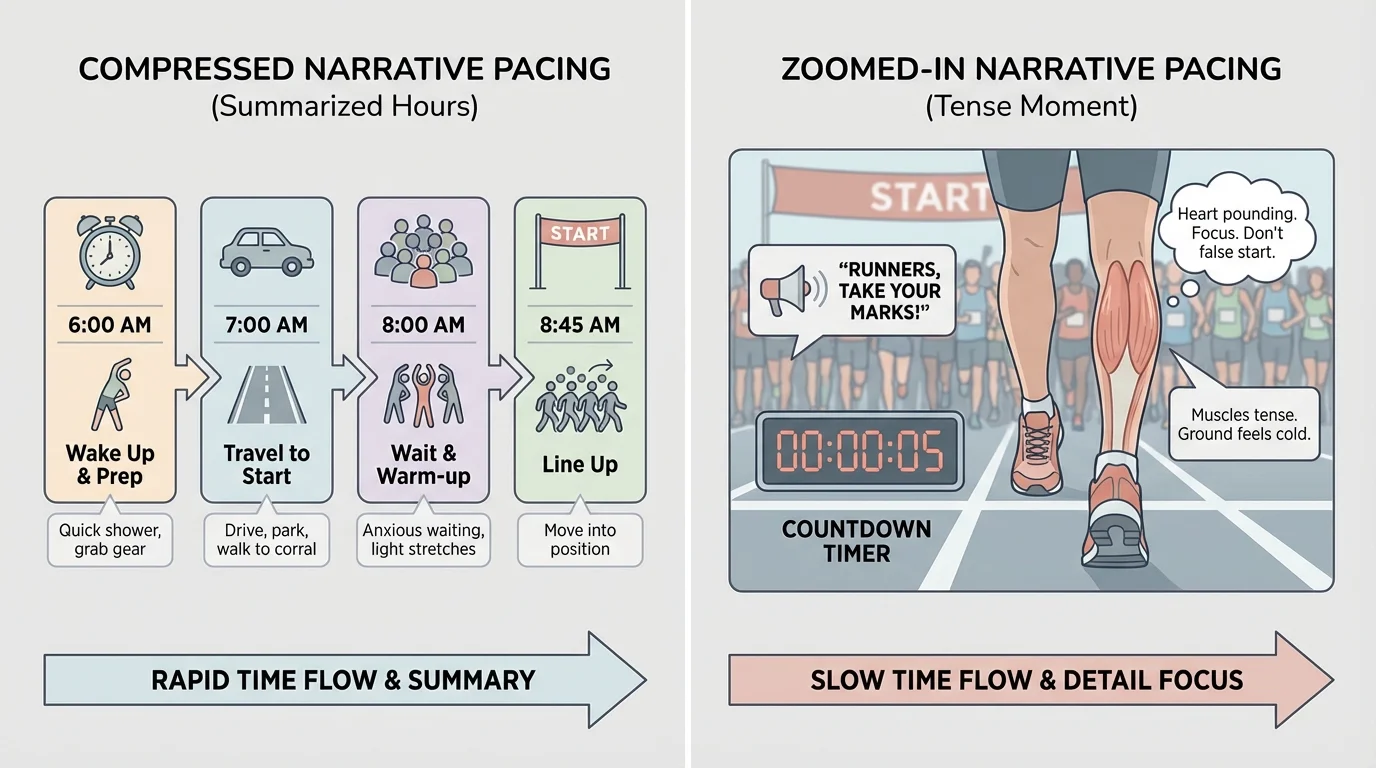
Pacing controls how quickly or slowly a narrative unfolds. As [Figure 2] illustrates, writers can summarize long stretches of time in a sentence or slow down a few seconds into a detailed scene. This choice shapes the reader's attention.
Writers speed up pacing when the exact details are not the most important part. For example: "For the next three weeks, we practiced every afternoon until the dance felt more like muscle memory than fear." That sentence covers many days quickly.
Writers slow down pacing when a moment matters deeply. A slow-paced section may include sensory details, brief actions, pauses, and thoughts. For example: "The microphone squealed. My throat tightened. Somewhere in the dark, a chair scraped the floor. I looked at the first row, then the second, then finally at the judge lifting her pen." This makes the reader experience the moment second by second.
Sentence structure affects pacing too. Short sentences often feel fast, sharp, or tense. Longer sentences can feel thoughtful, descriptive, or flowing. Paragraph breaks also matter. A sudden one-line paragraph can create emphasis. A longer paragraph can slow the reader down.
Skilled writers vary pacing. If every part is described in extreme detail, the story feels slow and heavy. If every part is rushed, the story feels thin. Important moments deserve space. Less important parts can be summarized.
Later in a narrative, a writer may return to the contrast shown in [Figure 2] by zooming in on a turning point and then moving quickly through the aftermath. That balance helps the story feel both focused and complete.
Sensory detail is description connected to the five senses: sight, sound, smell, taste, and touch. Sensory detail helps readers enter the setting instead of just hearing about it from a distance.
As [Figure 3] shows, specific description is usually stronger than vague description. "The hallway was noisy" gives some information, but "locker doors slammed while wet sneakers squeaked across the tile" creates a sharper picture and sound. The goal is not to pile up random details. The goal is to choose details that fit the mood and purpose of the scene.
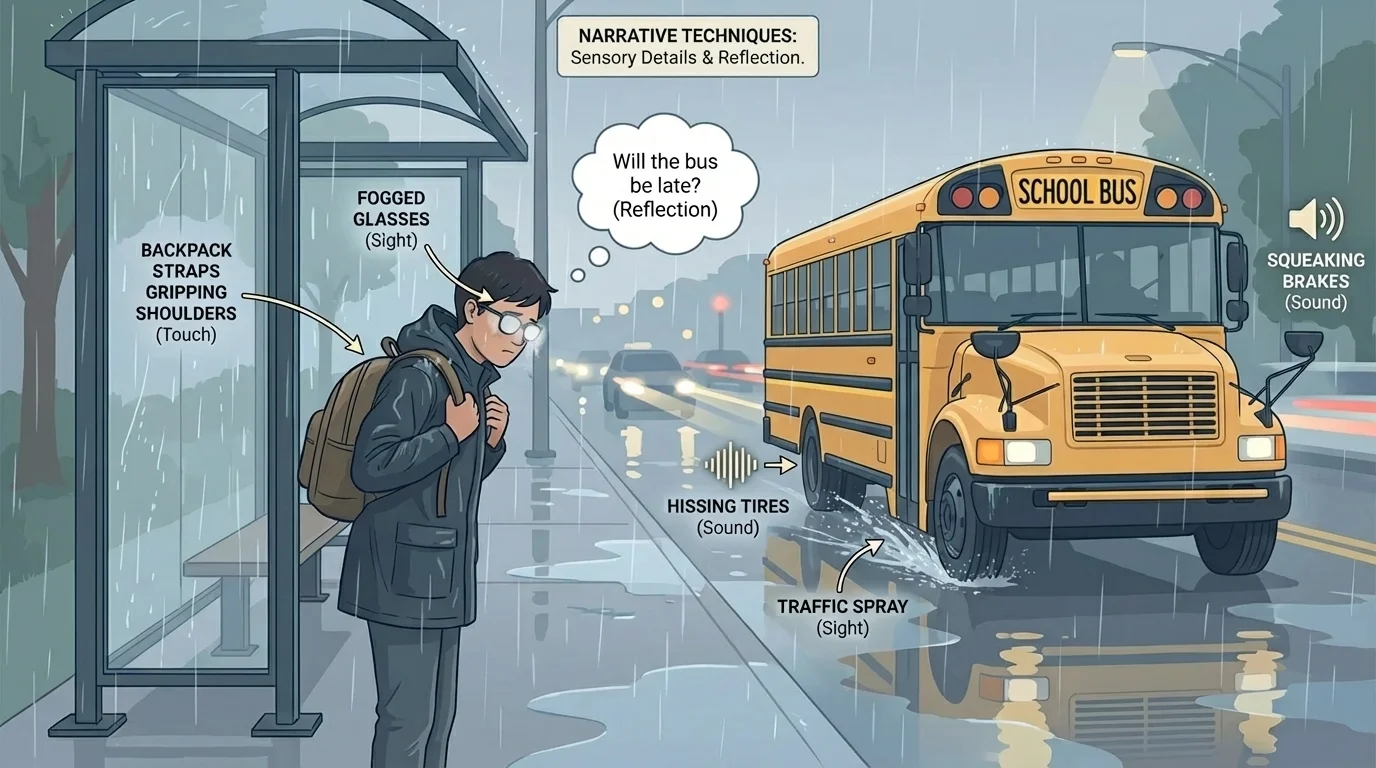
Description can develop setting, the time and place of a story. It can also reveal character. A character who notices the crack in a trophy case, the dust on a piano bench, and the buzzing lights may be observant, anxious, or distracted. What a narrator notices tells us something about that narrator.
Description also creates mood, the emotional atmosphere of a scene. Compare these details:
"Sunlight spilled across the kitchen table, and cinnamon drifted from the oven."
"The kitchen light hummed above a sink full of gray dishwater."
Both sentences describe a kitchen, but they create very different moods.
Professional novelists often cut generic adjectives such as nice, bad, or beautiful during revision and replace them with concrete details. Readers tend to remember a single sharp image more than a broad label.
That is why description should be relevant and sufficient. Too little description leaves the reader confused. Too much slows the story and buries the important action. Writers choose the details that matter most.
Reflection is the part of a narrative where the narrator or character thinks about the experience. Reflection is not the same as action. Action shows what happened. Reflection helps readers understand what the event meant, what was learned, or how the character changed.
As [Figure 4] illustrates, reflection can happen during the event, after it, or both. During a tense scene, a character might think, "If I opened the text now, I would know in one second whether everything changed." Afterward, the narrator might look back and realize, "I had spent months worrying about winning, but what stayed with me was how my sister waited outside the gym long after everyone else left."
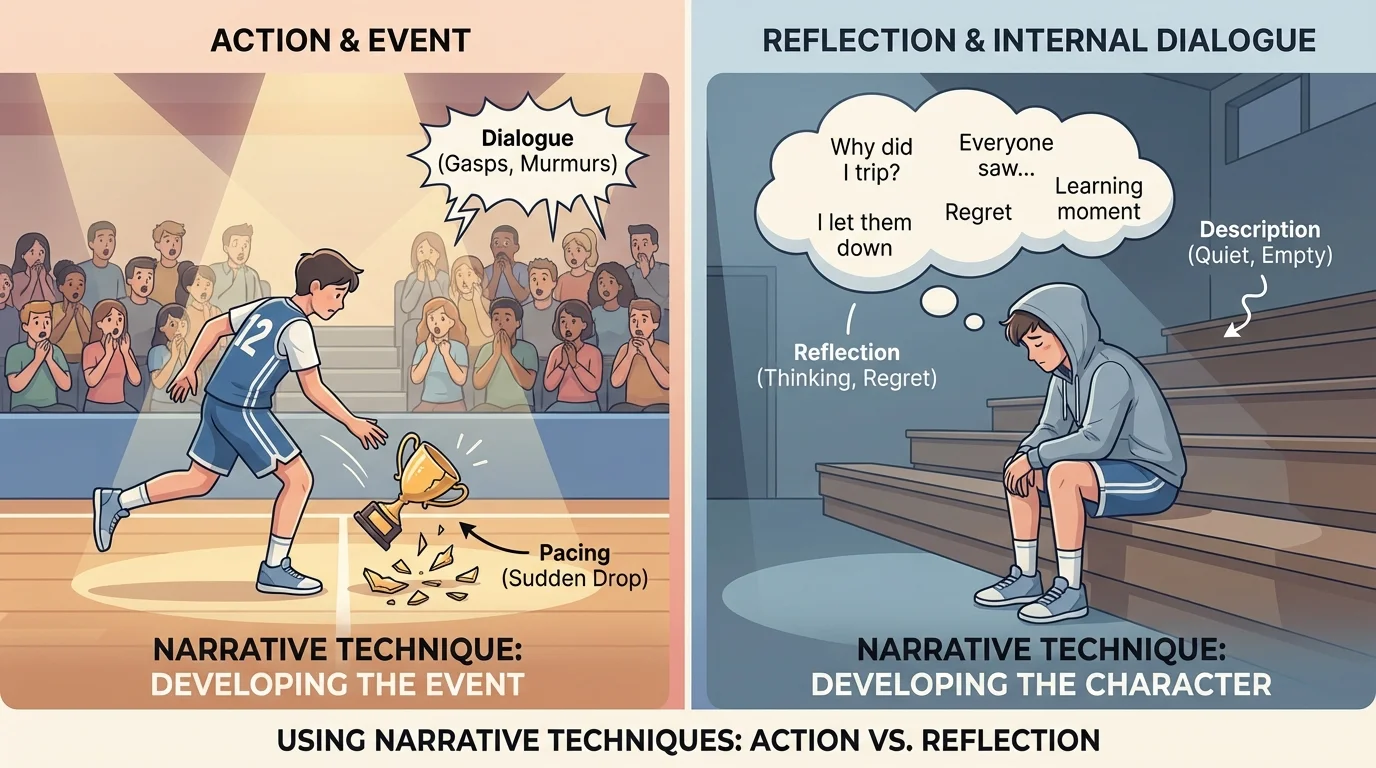
Reflection is where a narrative often gains depth. Without it, events may feel disconnected or empty. With it, readers understand the inner experience. They see not only what happened, but how the experience affected the person telling the story.
Strong reflection is specific and honest. It avoids broad statements like "I learned a lot that day." Instead, it names the actual realization: "I had always confused being loud with being brave." That sentence reveals a personal insight, so it feels earned.
As the contrast in [Figure 4] makes clear, a meaningful narrative often depends on both the outer event and the inner response. Reflection connects those two layers.
The strongest narratives rarely use only one technique at a time. A single scene may combine dialogue, pacing, description, and reflection. That combination makes the writing feel alive and complete.
How techniques work together
Think of narrative techniques as parts of one system. Dialogue lets readers hear characters. Description lets readers see and feel the scene. Pacing controls tension and attention. Reflection explains why the event matters. When all four support the same moment, the narrative becomes more vivid and meaningful.
Consider this short scene:
"You're late," my lab partner said as I slipped into the science room. Rainwater dripped from my sleeves onto the floor. The class was already bent over the tables, their voices low, glass beakers flashing under the fluorescent lights. I started to explain about the bus, but the words stuck. All morning I had been telling myself that missing one quiz would not matter. Seeing my name written alone on the empty answer sheet, I knew I had not really believed that."
This passage uses dialogue, sensory description, pacing, and reflection. The line of speech creates tension. The setting details make the room feel real. The pace slows at the moment of realization. The reflection gives the scene emotional meaning.
Narratives need more than vivid sentences. They also need structure. A reader should be able to follow the beginning situation, the development of events, the key turning point, and what changes by the end.
Writers often use transitions to guide the reader through time and action. Words and phrases such as later that afternoon, at first, meanwhile, after a long pause, and by the time we reached the parking lot help readers move smoothly through the narrative.
Clear sequencing also depends on cause and effect. Events should connect. If a character storms out of a room, readers should understand what led to that moment. If a narrator ends the story with a changed view, readers should see the experiences that caused that change.
| Technique | What it does | Common mistake | Stronger choice |
|---|---|---|---|
| Dialogue | Reveals character and moves action | Talking without purpose | Use speech to reveal conflict or information |
| Pacing | Controls story speed | Giving every moment equal space | Slow down key moments, summarize less important ones |
| Description | Builds setting, mood, and realism | Using vague or excessive details | Choose precise details that fit the scene |
| Reflection | Adds meaning and shows growth | Stating a lesson too generally | Express a specific insight or realization |
Table 1. A comparison of major narrative techniques, their purposes, common mistakes, and stronger writing choices.
A narrative can begin in the middle of the action, but even then, the writer must provide enough context for the reader to understand the situation. Clear structure does not mean predictable structure. It means understandable structure.
Revision is where many narratives become truly effective. First drafts often include parts the writer needed in order to discover the story, but not all of those parts belong in the final version.
When revising, a writer can ask: Where should the story slow down? Where should it move faster? Does the dialogue sound natural and purposeful? Are the descriptive details specific and relevant? Does the reflection reveal something meaningful? Are the events arranged clearly?
Revision example
Draft sentence: I was scared when I walked into the office.
Step 1: Add description
The office smelled like copier ink, and the metal chair felt cold through my sweatshirt.
Step 2: Add pacing and action
I stopped at the doorway, read the principal's note on the wall without taking in a single word, and only then sat down.
Step 3: Add reflection
Until that moment, detention had seemed like something that happened to other people.
The revised version gives the reader a fuller experience instead of only naming the emotion.
Writers should also watch for overuse. Too much dialogue can feel confusing. Too much description can bury the action. Too much reflection can interrupt momentum. Narrative techniques are most effective when each one appears where it is needed.
In the end, strong narrative writing is about control. The writer controls what the reader notices, hears, feels, and understands. By using dialogue, pacing, description, and reflection with purpose, a writer can turn lived or imagined experience into a story that feels vivid, clear, and meaningful.
