A great discussion is not just a line of people taking turns speaking. It is more like a puzzle being built in real time. One person adds a fact, another offers a different point of view, and a third notices a pattern no one else saw at first. The students who make discussions powerful are often the ones who can connect those pieces. They ask the question that links two or three ideas together, and they answer in a way that pushes the conversation forward instead of stopping it.
Think about situations beyond school: a coach and players planning strategy, scientists comparing results, a city council hearing different opinions, or journalists interviewing several people about the same event. In each case, success depends on more than speaking clearly. It depends on listening closely enough to notice relationships among ideas. In class discussions, that same skill helps students move from simple comments to deeper understanding.
When you can ask strong connecting questions and respond with support, you show that you are doing three things at once: listening, thinking, and communicating. That matters in literature discussions, science labs, social studies seminars, and everyday problem-solving with classmates.
Collaborative discussion works best when students do not treat each comment as separate. Instead, they look for patterns, disagreements, cause-and-effect relationships, and missing information. This is where a synthesis question becomes powerful: it combines ideas from different speakers into a new, stronger question or insight.
Connecting question means a question that links the ideas of two or more speakers so the group can compare, clarify, evaluate, or expand the discussion.
Evidence is support for an idea. It can come from a text, a fact, an example, a direct quotation, data, or a clear observation.
Observation is something you notice directly, such as a pattern in a text, a result in an experiment, or a behavior in a discussion.
Asking these questions and giving supported responses does not mean you must always agree. In fact, some of the strongest discussions include respectful disagreement. What matters is that your response connects clearly to what others said and is supported by something real and relevant.
In a discussion, strong listeners hear more than individual comments; they hear relationships. For example, one student may argue that homework builds responsibility, another may say too much homework causes stress, and a third may point out that homework affects students differently depending on after-school responsibilities. A connecting question might be, "How do these ideas fit together? Is the real issue homework itself, or how much and what kind?"
This kind of question does not ignore the previous comments. It uses them. It shows that the speaker has listened carefully and is trying to move the group toward a clearer understanding. That is different from asking a random question that could have been said at any time.
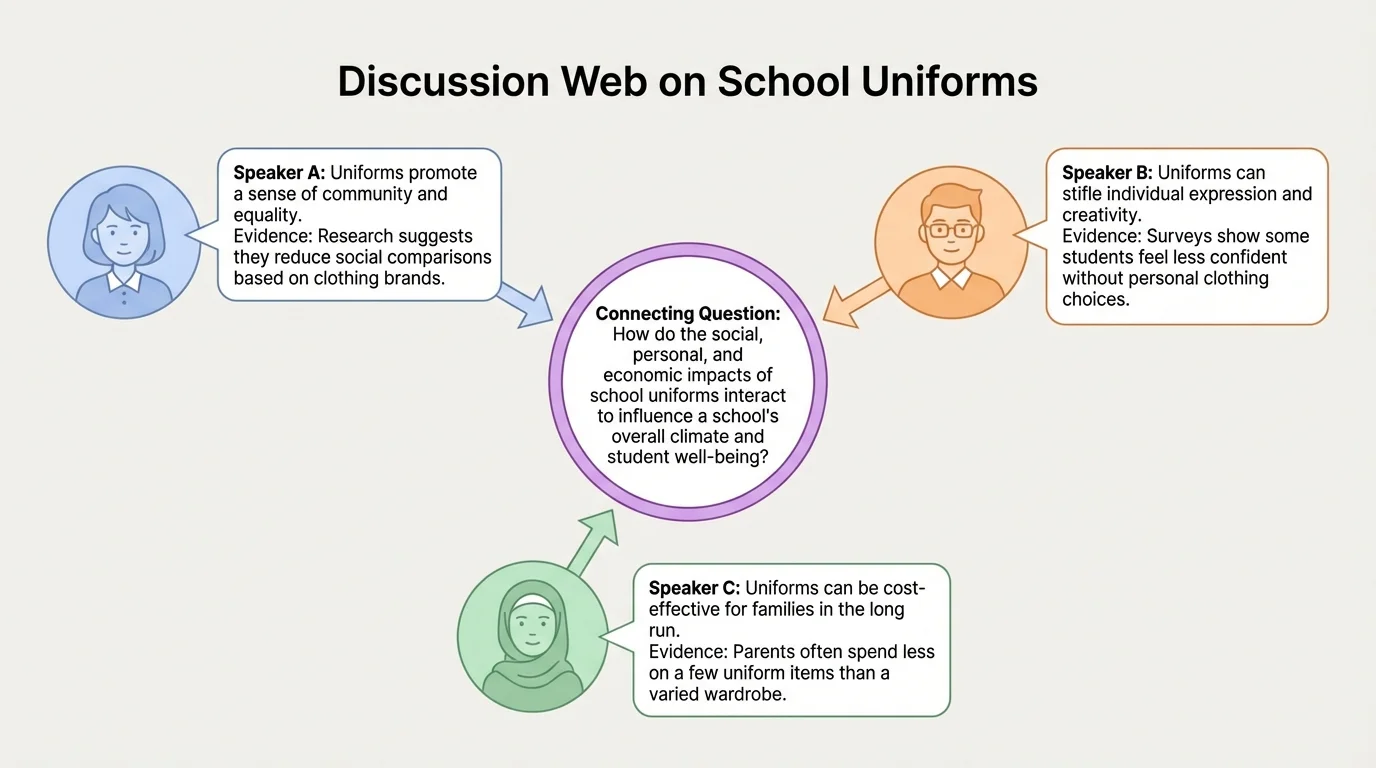
Connecting ideas across speakers often involves noticing one of several relationships:
Suppose a class is discussing whether schools should start later in the morning. One student mentions teen sleep science, another talks about transportation problems, and another mentions after-school sports. A connecting question could be, "How can schools balance the health benefits of later start times with the scheduling problems several people mentioned?" That question links multiple comments and opens the door to solutions, much like the relationship map in [Figure 1].
Later in the same discussion, the relationship map in [Figure 1] still matters because the best questions often pull several strands into one focused issue instead of letting the conversation split apart.
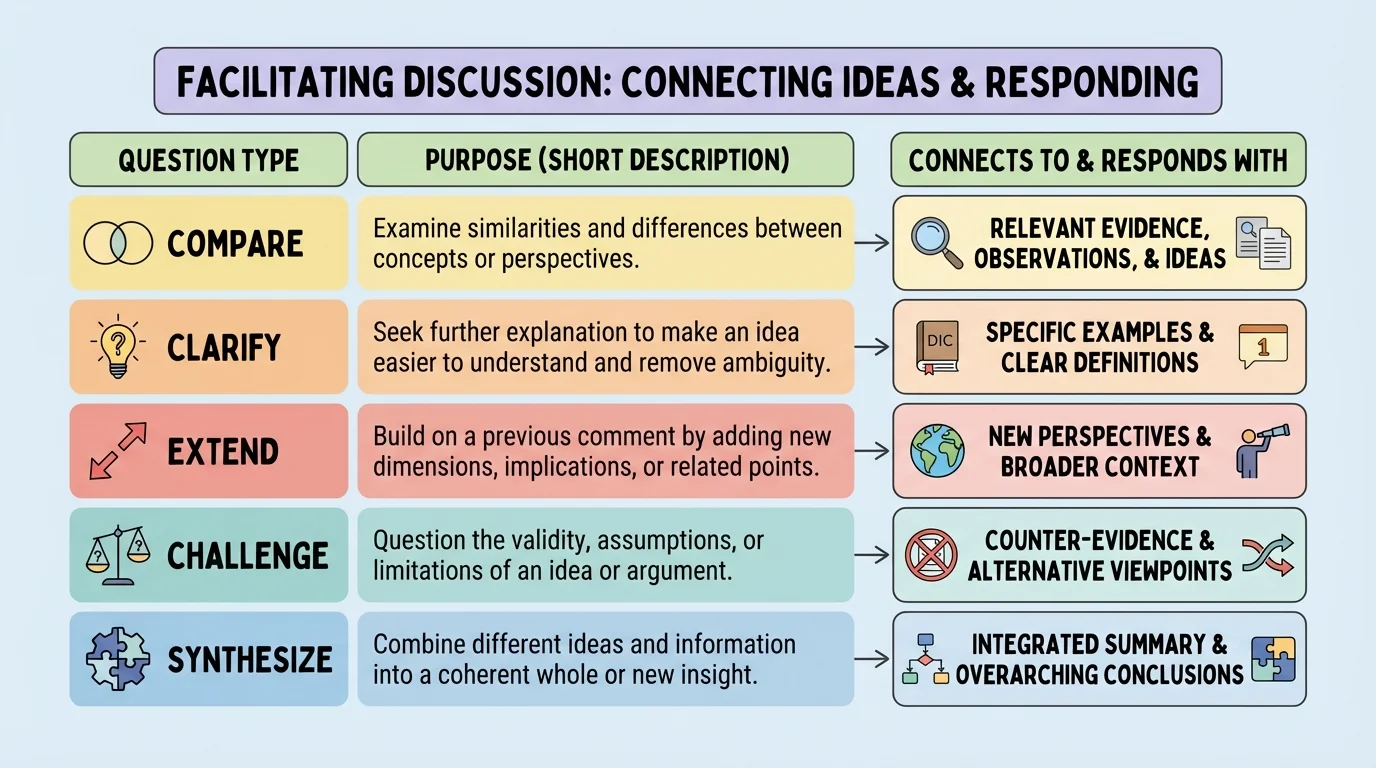
Not all good questions do the same job. Some help the group understand what a speaker meant. Others compare ideas or test whether a claim is well supported. Skilled discussion leaders choose question types based on what the conversation needs, as shown in [Figure 2].
These question types help students decide how to move a conversation forward instead of repeating what has already been said. A thoughtful question should come from the discussion itself, not from a script in your head.
Here are several important types of connecting questions:
Clarification questions help when a comment is unclear. Example: "When you say social media is distracting, do you mean during class, during homework time, or both?"
Compare-and-contrast questions help the group examine similarities and differences. Example: "How is Maya's idea about screen time different from Jordan's point about online learning?"
Cause-and-effect questions explore relationships between events or ideas. Example: "If students have more choice in assignments, how might that affect motivation?"
Extension questions push an idea further. Example: "If that solution works in one school, would it also work in a larger district?"
Challenge questions test evidence or reasoning respectfully. Example: "What evidence supports the claim that uniforms improve behavior?"
Synthesis questions combine several comments into one bigger issue. Example: "Several people mentioned cost, fairness, and student expression. Which of those seems most important in deciding the policy?"
A strong connecting question is usually specific, tied to what people actually said, and open enough to invite thought. A weak question is vague, disconnected, or answerable with one word.
| Weak Question | Why It Is Weak | Stronger Version |
|---|---|---|
| "What do you think?" | Too broad; does not connect ideas. | "How does your point about fairness connect to Eli's argument about school rules?" |
| "Are uniforms good?" | Too general; ignores discussion details. | "Several speakers mentioned cost and discipline. Which issue matters more when judging uniforms?" |
| "Can you explain?" | Needs focus. | "Can you explain why you think homework helps learning more in math than in reading?" |
Table 1. Examples showing how vague discussion questions can be revised into stronger connecting questions.
One useful habit is to listen for repeated ideas. If three students mention fairness in different ways, that repetition signals an opportunity for a connecting question. Another useful habit is to listen for tension: when two comments seem to clash, the discussion is ready for a question that helps the group examine the disagreement more deeply.
A strong response follows a clear line of thinking, as [Figure 3] shows: first understand the comment or question, then choose support, then explain how the support fits. Many weak responses fail because they skip the middle step. They react quickly but do not provide evidence, observation, or reasoning.
When someone asks you a question or comments on your idea, begin by identifying what they are really asking. Are they asking for proof, clarification, an example, or a counterargument? Once you know that, choose support that matches the question.
Relevant support can include a quotation from a text, a fact from research, a detail from a class article, a result from a lab, or an observation from discussion. The key word is relevant evidence: your support must connect directly to the point being discussed, not just sound impressive.
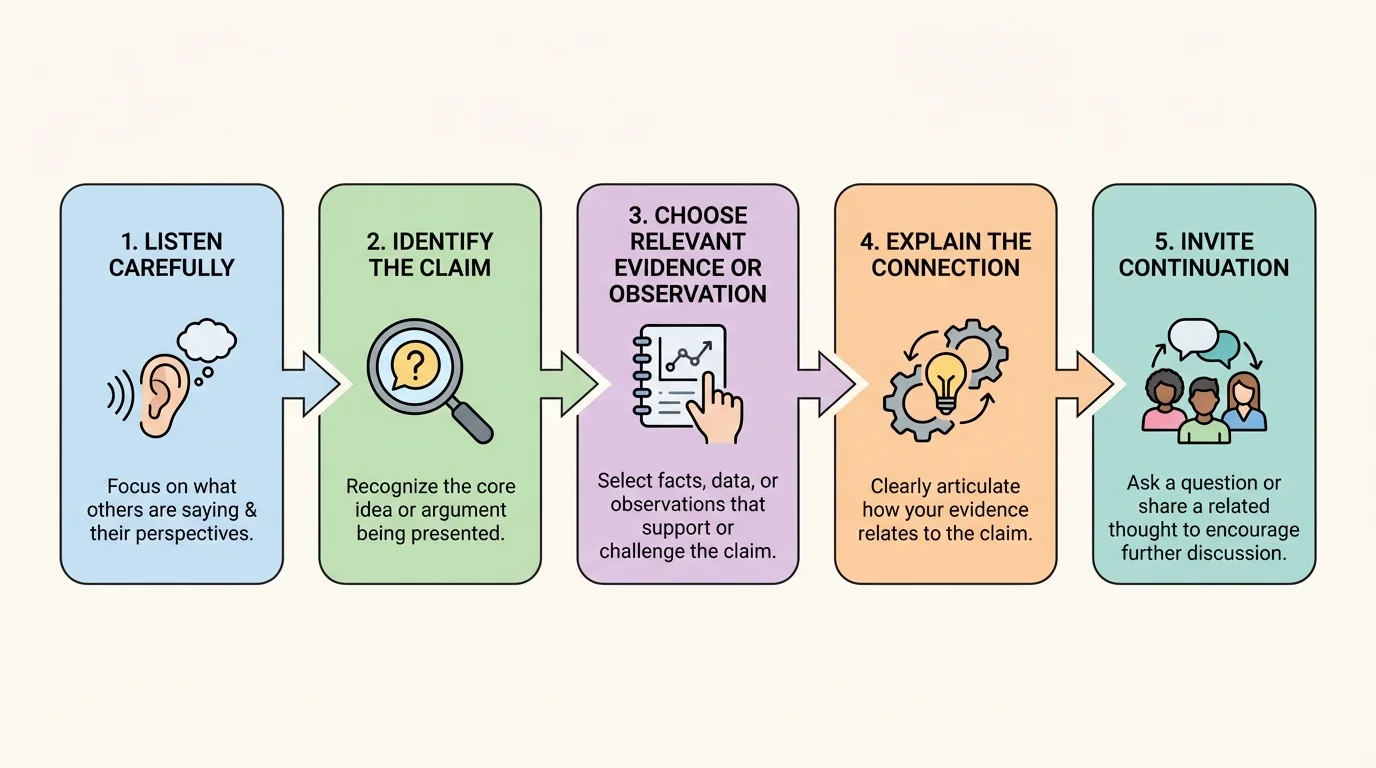
Here is a useful response pattern:
This pattern matters because evidence alone is not enough. If you just drop in a quote or fact without explaining it, the group may not see why it matters. Explanation is what ties support to the argument.
What makes evidence strong in discussion
Strong evidence is accurate, specific, and connected to the point at hand. A direct quotation from a text may work well in a literature or history discussion. Data from an experiment may be stronger in science. A clear personal observation can be useful when the discussion is about classroom experience, but personal opinion without support is usually weaker than text-based or fact-based evidence.
You can also respond with observations. For example: "I noticed that all three examples in the article involve cities, not rural areas, so the author's argument may not apply everywhere." That is an observation because it comes from noticing a pattern. It becomes stronger when you explain why the pattern matters.
Even when you disagree, your response should stay connected and respectful. Instead of saying, "That's wrong," try, "I see your point, but the data in paragraph 6 suggests a different conclusion." Respectful language keeps the discussion open.
When the group starts moving quickly, the sequence in [Figure 3] helps you slow your thinking just enough to make a stronger response instead of a rushed one.
Discussion is collaborative, which means your goal is not to win every exchange. Your goal is to help the group understand the issue more fully. That is why tone matters. Students who use respectful language make it easier for everyone to contribute.
Useful sentence starters can help:
Respect does not mean avoiding disagreement. It means disagreeing in a way that stays focused on ideas, not people. Compare these two responses: "You clearly didn't understand the article" and "I interpreted the article differently because the author's examples focus on a different audience." The second response is more productive because it addresses interpretation, not the person.
Professional discussion leaders often spend more time listening for patterns than planning their own next comment. That is one reason moderators in interviews and debates can ask sharp follow-up questions: they are tracing connections as people speak.
Another part of building on others is acknowledging when someone helped your thinking. Saying, "After hearing both sides, I'm changing my view slightly," shows maturity and careful listening. In strong collaborative discussions, changing your mind because of evidence is a strength, not a weakness.
Different discussions call for different kinds of support. If your class is discussing a novel, you may need quotations or details from the text. If you are discussing whether a cafeteria change worked, observations from student experience may matter. If you are discussing an environmental issue, scientific data may be the strongest support.
A useful way to think about support is to ask: "What kind of evidence best fits this claim?" For example, if someone says a character is brave, a strong response might point to a scene where the character risks something important. If someone claims that exercise improves concentration, stronger support might come from a study or article rather than from one person's opinion.
Not all evidence has equal strength. A personal story can be vivid, but one example does not prove a general rule. On the other hand, a statistic may sound strong, but if it does not match the topic closely, it may not be relevant.
| Type of Support | Best Use | Example |
|---|---|---|
| Text evidence | Literature, history, article discussion | A quotation or detail from a chapter or source |
| Observation | Patterns, behaviors, results you directly notice | "I noticed the speaker gave three examples, all from one city" |
| Fact or data | Science, social issues, policy claims | A statistic from a reliable source |
| Experience | Topics involving daily life or classroom practice | A shared experience with assignment choices |
Table 2. Types of support and situations where each is especially useful in discussion.
One advanced move is combining more than one kind of support. For example: "I agree with the article's claim about noise affecting focus, and I've observed the same thing during independent reading when the room gets louder." That response blends text evidence and personal observation.
Earlier speaking and listening skills still matter here: come prepared, pay attention to the speaker, refer to specific details, and speak one at a time. Connecting ideas across speakers depends on those habits.
When you choose support, ask yourself whether it is current, accurate, and directly related. A detail that sounds interesting but does not answer the question can weaken your response instead of strengthening it.
Many discussion problems come from good intentions with weak execution. Students may want to contribute, but their questions or responses may not actually move the conversation.
One common mistake is asking a question that is too broad. "What do you think?" may invite participation, but it does not guide the discussion. A stronger version names the ideas being connected.
Another mistake is giving evidence without explaining it. For example, quoting a line from a text and then stopping leaves the audience to do the interpretive work. You need to show how the evidence supports your point.
A third mistake is using unrelated support. If the discussion is about whether school lunch should change, a statistic about homework time probably does not help. Relevance matters as much as accuracy.
A fourth mistake is repeating what others already said without adding anything. Repetition can show agreement, but discussion grows when you add a connection, a question, or a new piece of support.
Finally, some students respond to disagreement emotionally instead of logically. A stronger habit is to pause, restate the other person's point fairly, and then respond with evidence. That keeps the discussion focused on reasoning rather than tension.
Fixing weak discussion moves
Step 1: Weak question
"Is recycling good?"
Step 2: Identify the problem
The question is too broad and does not connect any speaker's ideas.
Step 3: Revise it
"Mia said recycling programs are expensive, but Luis argued they save resources over time. How should communities balance short-term cost with long-term environmental benefit?"
The revised version is stronger because it connects two speakers and frames a real issue for the group to explore.
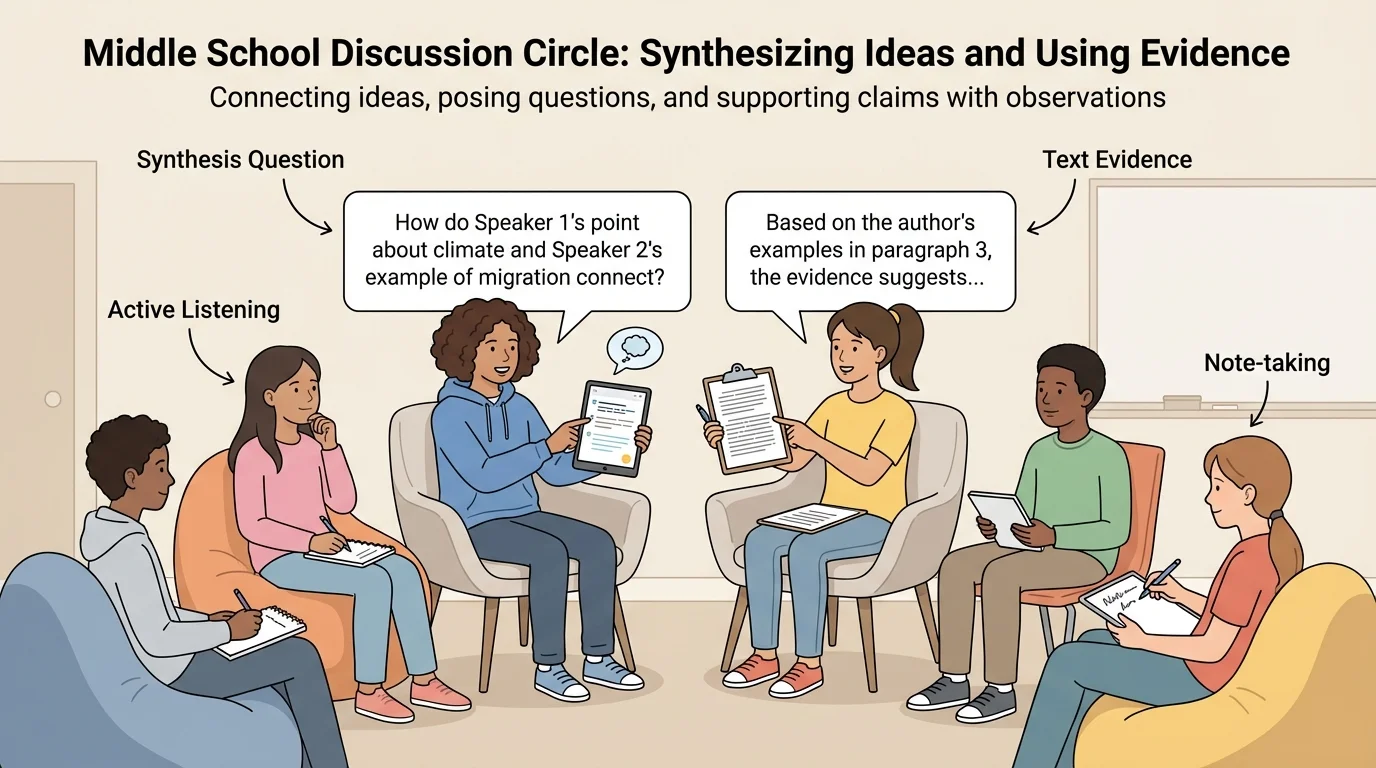
These corrections may seem small, but they change the quality of a conversation dramatically. Better questions create better thinking, as the classroom scene in [Figure 4] suggests.
It helps to hear what this skill sounds like in a realistic classroom conversation. The example below shows a discussion circle where students refer to notes, ask connecting questions, and answer with support. Below are examples based on common grade 8 discussions.
Scenario 1: Novel discussion
Student A: "The main character keeps making risky choices because she wants freedom."
Student B: "I think she acts more out of anger than freedom."
Student C: "Her decisions also seem influenced by not trusting adults."
A strong connecting question would be: "How do freedom, anger, and mistrust work together in her decisions?"
A strong response might be: "I think mistrust is the main cause because in chapter 7 she refuses help even when it would protect her. That supports Student C's point, but it also explains why her search for freedom becomes risky."
Scenario 2: Science discussion
Student A: "The plants near the window grew taller."
Student B: "But some of the shaded plants had darker leaves."
Student C: "Water amount may have affected growth too."
A strong connecting question would be: "How can we tell whether light or water had the bigger effect on the differences we observed?"
A strong response might be: "Our notes show the window plants received the same watering schedule as the shaded plants, so light seems to explain the height difference more strongly. However, we should still compare leaf color before making a final claim."
Scenario 3: Social studies discussion
Student A: "Industrialization created more jobs."
Student B: "It also caused dangerous working conditions."
Student C: "Some families depended on those factory wages."
A strong connecting question would be: "How should we judge industrialization if it improved income for some people but harmed safety for many workers?"
A strong response might be: "The photographs and worker testimonies suggest the safety problems were severe, so economic growth alone does not tell the whole story. We need to weigh both benefits and costs."
Notice what these examples have in common. The connecting questions do not jump away from the discussion; they gather the ideas already on the table. The responses do not rely on opinion alone; they use notes, text details, observations, or sources.
Later in any live conversation, the kind of scene shown in [Figure 4] reminds us that strong discussion is active: students look at each other, refer to notes, and shape their comments around what others have actually said.
This skill improves with habits. Before a discussion, review the text or topic and note a few important ideas. During the discussion, jot down key points made by others, especially areas of agreement, disagreement, or repetition. Those notes become the raw material for strong connecting questions.
Active collaborative discussion also requires patience. You may think of a great point, but if you stop listening while waiting to speak, you will miss chances to connect ideas. The best contributors often speak a little later because they are listening for the right moment.
Another valuable habit is paraphrasing. Before responding, briefly restate another speaker's idea in your own words: "So you're saying the rule is fair in theory, but hard to apply equally." Paraphrasing shows respect and helps prevent misunderstanding.
Over time, you will notice that the most effective speakers are also careful listeners. They do not just prepare a speech; they build meaning with others. Their questions connect ideas, and their responses add support, clarity, and depth.
"Good discussion is not a battle of voices. It is a search for understanding."
That search for understanding is the real purpose of discussion. When you ask connecting questions and respond with relevant evidence, observations, and ideas, you help the whole group think more clearly.
