Have you ever read a story that felt confusing even though every sentence made sense by itself? One moment the character is at lunch, and suddenly they are at home, then somehow it is three years earlier. The problem is often not the ideas. It is the missing bridges between them. Strong writers build those bridges with transitions. Those small connecting words and phrases can make the difference between a story that feels messy and one that pulls readers forward.
In narrative writing, events need to unfold in a way readers can follow. Whether you are writing about a real experience or inventing a fictional one, your reader needs to know when things happen, where they happen, and how one moment connects to the next. Transitions help create that clarity. They also shape mood, pacing, and meaning.
Transitions are words, phrases, or clauses that connect ideas and help writing move smoothly from one part to another. In narratives, transitions often show sequence, signal a change in time or place, or explain relationships between events and experiences.
Transitions are not decorations. They are tools for structure. A writer who chooses transitions carefully can slow down an important moment, speed through less important events, show a memory, return to the present, or reveal why one event matters. That is why mastering transitions is such an important part of writing effective narratives.
A narrative is more than a list of things that happened. It is an organized retelling of experience or a creation of imagined experience. If a writer simply stacks events one after another, the story can sound flat: "I woke up. I got dressed. I ran outside. I missed the bus." The reader understands the basic facts, but the writing does not guide them through the experience.
Now consider the same idea with transitions: "At first, I thought I had plenty of time. A few minutes later, I realized my alarm had never gone off. By the time I ran outside, the bus was already turning the corner." The transitions do more than connect sentences. They help readers feel the timing and urgency of the moment.
Good transitions also make your writing sound more mature. Instead of repeating simple connectors like then again and again, skilled writers choose transitions that match the exact relationship they want to show.
Writers use transitions in several forms. A transition can be a single word such as later, however, or meanwhile. It can be a phrase such as the next morning, in the distance, or as a result. It can also be a clause, such as after the storm had passed or when I finally understood what had happened.
Each form can do similar work, but the effect is not always the same. Single-word transitions are often quick and efficient. Phrases can add detail. Clauses can create more complex relationships by showing action, timing, or cause inside the transition itself.
Three main jobs of transitions in narratives
First, transitions show the order of events. Second, they signal shifts, such as moving from one time frame or setting to another. Third, they reveal relationships, such as cause and effect, contrast, or reflection. A strong narrative usually uses all three jobs, not just one.
Because transitions carry meaning, writers must choose them precisely. For example, meanwhile suggests that two things are happening at the same time, while afterward shows one event follows another. Those are not interchangeable.
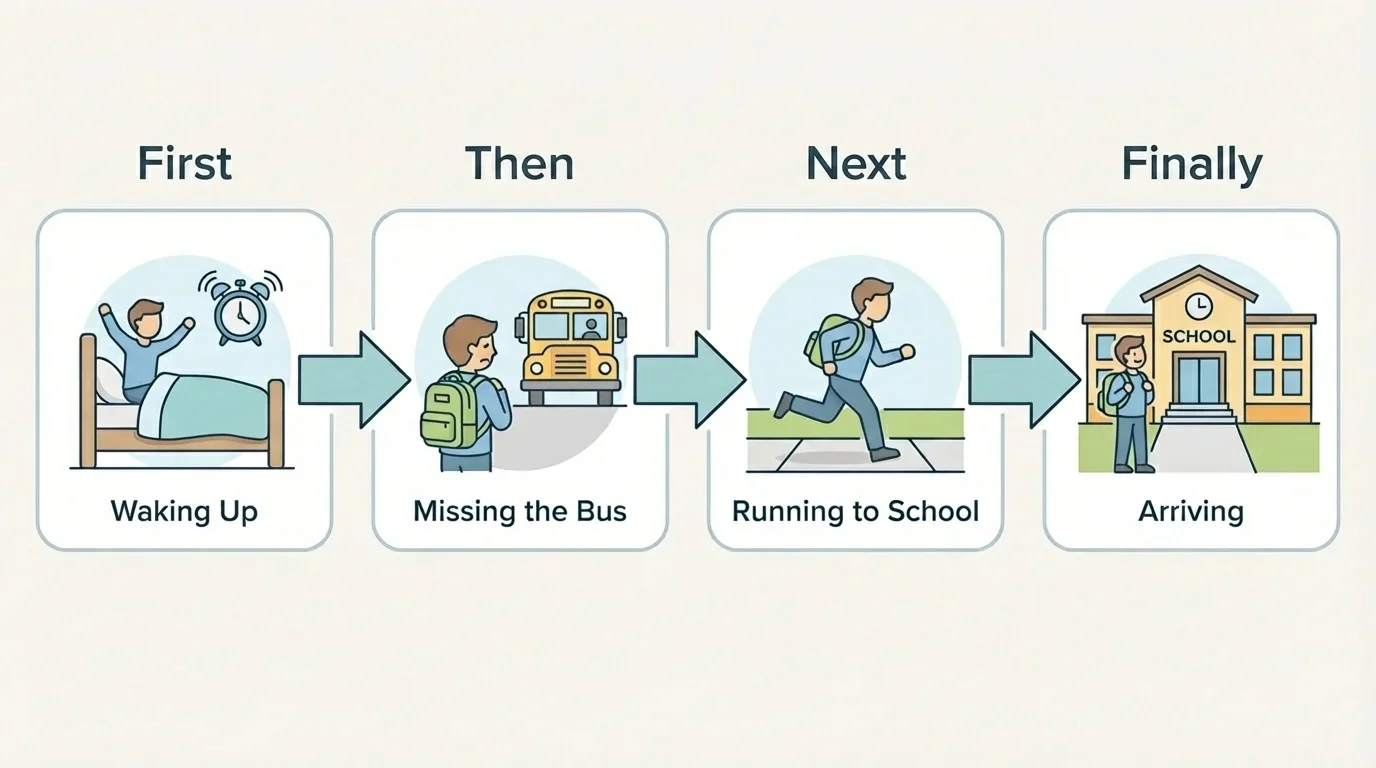
When a story moves in chronological order, sequence transitions keep the path clear for the reader, as [Figure 1] shows through a simple chain of events. These transitions are especially useful when you want the action to unfold step by step.
Common sequence transitions include first, to begin with, next, then, soon, after that, later, eventually, and finally. Each one places an event in relation to what came before.
Sequence transitions also affect pacing, which is the speed at which a story seems to move. Short transitions like then can make events move quickly. Longer transitions like by the end of the afternoon or after what felt like an hour can stretch time and build suspense.
Notice how these examples differ:
"First, Maya heard the smoke alarm. Next, she dropped her backpack and ran to the kitchen. Moments later, she saw only burnt toast and a laughing older brother."
This version moves quickly and clearly. But a writer could change the effect by writing, "At first, Maya froze in the hallway. A second later, the sharp smell of smoke hit her. Only then did she sprint toward the kitchen." The events are similar, but the transitions help shape tension.
Professional authors often revise transitions after drafting the story. They may know what happens first in their minds, but they still need to guide readers across every step on the page.
Later in a narrative, the same sequence idea still matters. As we saw in [Figure 1], readers follow events most easily when each step connects clearly to the next instead of appearing without warning.
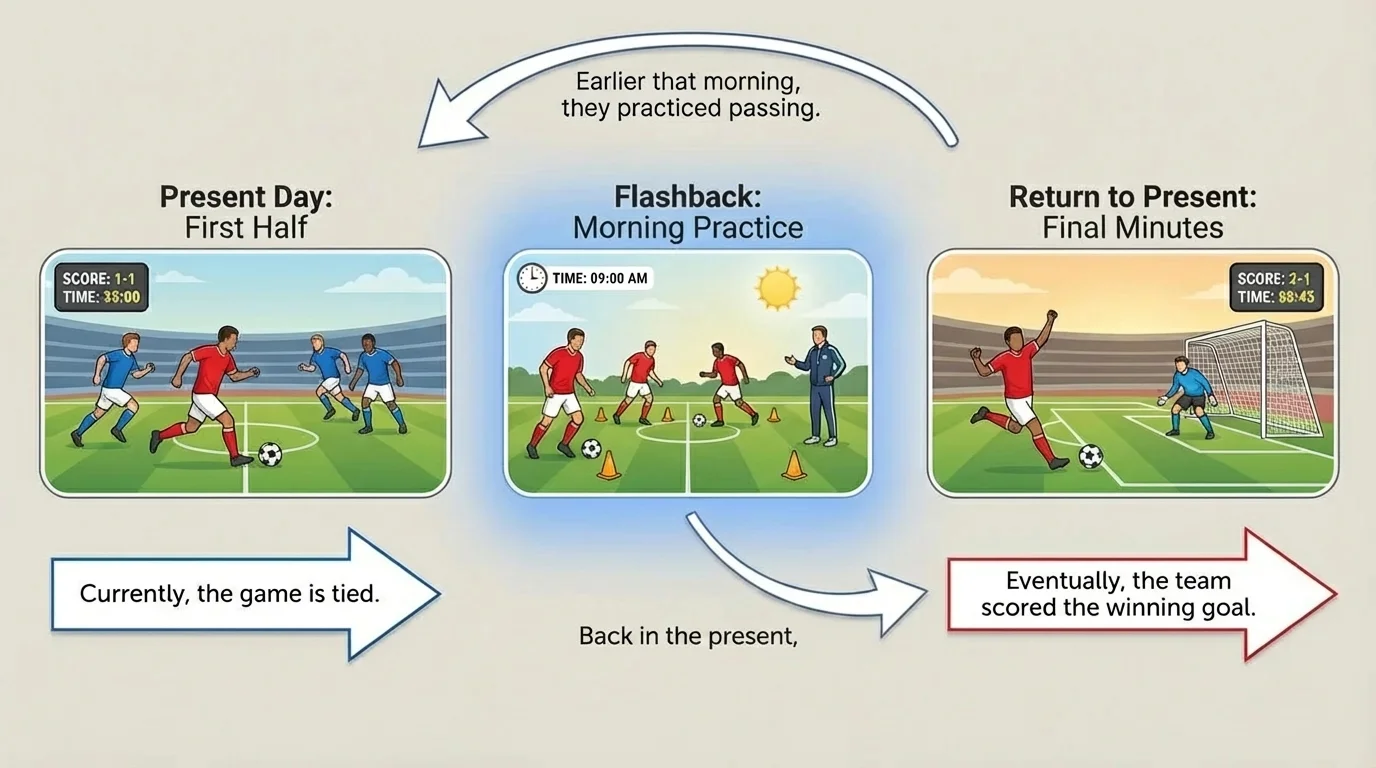
Stories do not always move straight forward. Writers often shift to an earlier memory, jump ahead, or pause the action to reflect. When that happens, readers need clear time frame signals, as [Figure 2] illustrates with movement from the present to the past and back again.
Time-shift transitions can include phrases such as earlier that day, years before, back then, in that moment, the next morning, meanwhile, by sunset, or when I was younger. These tell the reader exactly how the story's timing is changing.
A flashback is one common kind of time shift. Suppose a narrative begins with a runner standing at the starting line. The writer might say, "As the official raised the starting pistol, Elena remembered the freezing practices she had hated in January." That sentence shifts briefly into the past. To make the shift even clearer, a writer could add, "Just three months earlier, she had nearly quit the team."
Returning to the present also requires a signal. A sentence such as "Now, under the bright stadium lights, quitting felt impossible" tells readers that the story has come back to the current scene.
Without clear transitions, time shifts can confuse readers. Compare these two versions:
Confusing: "Jordan waited backstage. He forgot his lines in fifth grade. The curtain opened."
Clear: "Jordan waited backstage. Suddenly, he remembered forgetting his lines in fifth grade. A moment later, the curtain opened, pulling him back to the present."
The second version helps readers move through time with confidence. Later, when you write scenes that include memory or reflection, think back to the time movement shown in [Figure 2]. The reader should never have to guess whether the story is in the past, present, or a return from a memory.
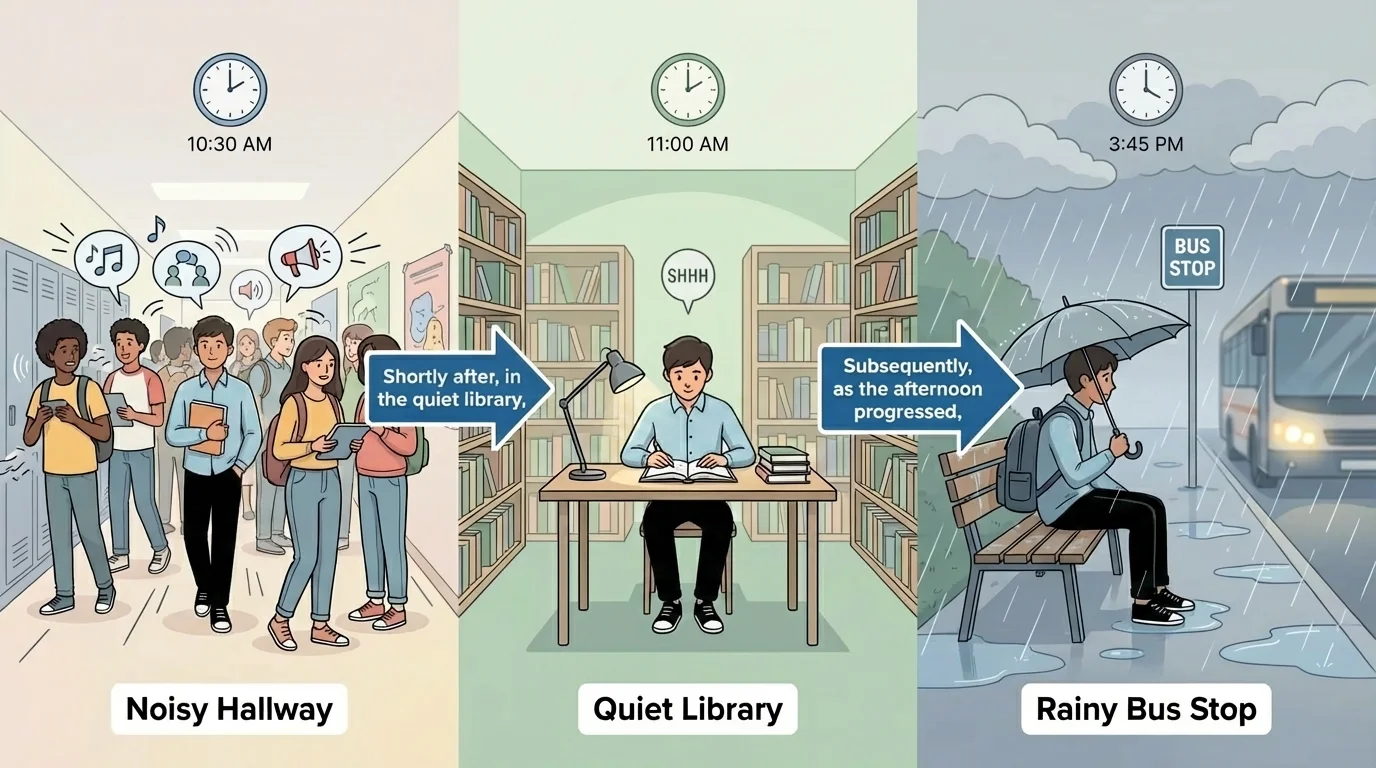
Narratives also move through space. A character may leave a classroom, cross a football field, enter a hospital waiting room, or travel to a different city. Setting transitions help readers follow those changes, and [Figure 3] makes that movement visible by showing one story passing through several locations.
Useful setting transitions include across the street, inside the gym, at the edge of the lake, later, in the cafeteria, back at home, and on the other side of town. Notice that many setting transitions also include time information. In narratives, time and place often work together.
For example: "The thunder followed us all the way home. By the time we reached the porch, our shoes were soaked. Inside the kitchen, Grandma had already lined the counter with towels." The transition inside the kitchen moves the reader cleanly into the new setting.
Setting transitions can also help create mood. "Beyond the stadium parking lot, the street was strangely quiet" gives a very different feeling from "Back in the crowded locker room, everyone was shouting at once." These transitions do not just locate the scene. They prepare the reader emotionally for what comes next.
When writers shift both time and setting at once, they need especially clear wording. For example: "The next afternoon, at the community pool, I finally saw the diver everyone had been talking about." That opening orients the reader immediately.
Not every transition is about time or place. Many transitions show cause and effect, contrast, comparison, emphasis, or reflection. These relationships matter because narratives are not just about what happened. They are also about why events matter and how one experience connects to another.
Cause-and-effect transitions include because, so, therefore, as a result, and for that reason. Example: "The trail markers had washed away in the storm. As a result, we took the wrong path and ended up near the river."
Contrast transitions include however, but, even so, on the other hand, and instead. Example: "I expected the interview to feel scary. Instead, it felt like a real conversation."
Examples of relationships shown by transitions
Step 1: Addition or continuation
"The power went out, and the house fell silent. Meanwhile, rain hammered the windows." This adds another event happening at the same time.
Step 2: Cause and effect
"Nina had practiced the speech every night. Because of that, she spoke with confidence at the assembly." This shows how one event leads to another.
Step 3: Reflection
"I was angry when we got lost. Looking back, that wrong turn gave me my favorite memory of the trip." This shows how the writer now understands the experience.
Reflection transitions are especially powerful in personal narratives. Phrases such as looking back, now I realize, at the time, and only later did I understand help the writer connect past events to present insight.
Relationships among events can overlap. A sentence might show time, setting, and cause all at once: "That night, outside the emergency room, we finally relaxed because the doctor had smiled." Strong transitions often do more than one job.
Effective writers do not rely on the same transition repeatedly. If every sentence begins with then, the writing sounds mechanical. Variety matters because different transitions create different effects.
Compare these options: then, later, soon after, not long afterward, minutes later, and before long. All suggest movement forward in time, but each has its own rhythm and level of precision.
Writers should also match transitions to the mood of the scene. In an action scene, short transitions such as suddenly or in an instant can make the pace feel sharp and urgent. In a reflective scene, phrases like over the next few weeks or little by little may fit better.
Every transition should match the exact meaning of the sentence around it. If two things happen at the same time, use a transition such as meanwhile. If one happens after another, choose a transition such as afterward or later.
Another good strategy is to place transitions in different parts of a sentence. They do not always have to come first. You can write, "We reached the hilltop just before sunset," or "Just before sunset, we reached the hilltop." Varying sentence structure makes writing smoother and less predictable.
Revision often means improving connections between sentences and ideas. [Figure 4] shows how revision can turn choppy writing into smooth, connected narrative. Transitions help readers travel through the scene without stopping to figure out what is happening.
Here is a choppy version: "I opened the email. I stared at the screen. I had made the team. I yelled. My brother ran into the room." The events are understandable, but the writing feels abrupt.
Revising with transitions
Step 1: Identify the relationships between events
The writer needs to show sequence, reaction, and a quick shift in setting within the same moment.
Step 2: Add specific transitions
"When I opened the email, I stared at the screen for a second. Then the words finally sank in: I had made the team. A heartbeat later, I yelled so loudly that my brother came running into the room."
Step 3: Notice the effect
The revised version sounds smoother, clearer, and more dramatic because the transitions guide the reader through the exact order and emotional impact of the moment.
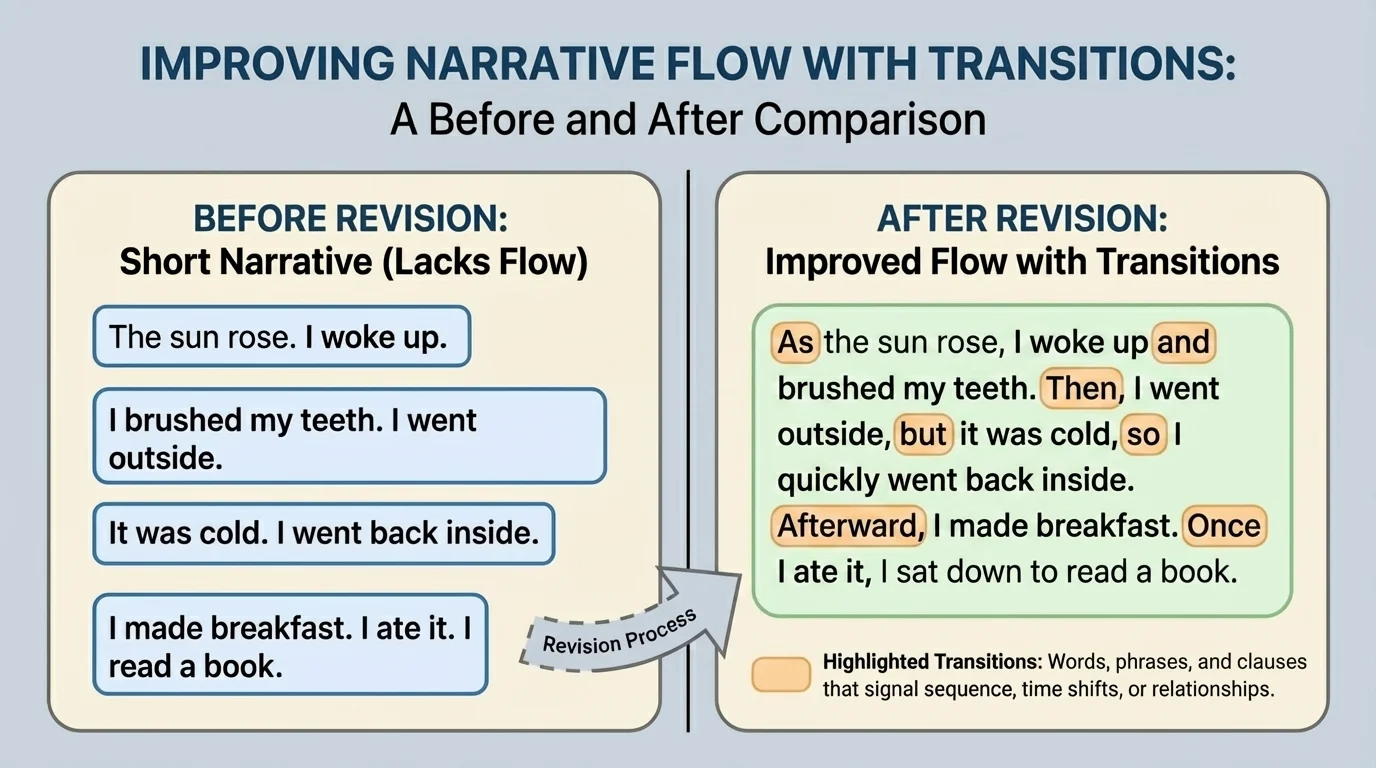
In longer pieces of writing, these improvements matter even more. A reader can follow a whole page of action more easily when the relationships between moments are visible. Much like the comparison in [Figure 4], revision often reveals that the events themselves are strong; what was missing was the language that linked them.
One common mistake is coherence problems caused by weak or missing transitions. Coherence means that the writing fits together in a way that feels clear and logical. If events appear in a random order, the narrative loses coherence.
Another mistake is using transitions that are too vague. For example, later may work sometimes, but it does not tell the reader whether five seconds or five years have passed. When needed, be more precise: later that afternoon, three months later, or by the start of winter.
Writers also sometimes overuse dramatic transitions like suddenly. That word is powerful when something truly unexpected happens. If it appears too often, it loses its effect.
A final mistake is choosing a transition that suggests the wrong relationship. If you write meanwhile when events are not happening at the same time, readers may become confused. Accuracy matters as much as style.
Transitions work best when they support other narrative techniques. Dialogue, sensory details, and description all become stronger when the reader knows how each moment connects to the next.
For example, dialogue can be framed with transitions to show timing: "After a long silence, Dad finally said, 'You did the right thing.'" Sensory details also benefit from transitions: "As we stepped into the garage, the cold metal smell of rain-soaked bikes filled the air."
Transitions can even help reveal character growth. A writer might begin with, "At first, I wanted to prove I could do everything alone," and later write, "By the end of the trip, I understood that asking for help was not weakness." The transitions mark both time and emotional change.
"Good writing leads the reader, not just the writer."
— A useful principle for narrative craft
When you write narratives, think of transitions as signals, bridges, and tools for control. They tell readers where they are, when they are, what changed, and why it matters. The more precisely you use them, the more engaging, clear, and effective your storytelling becomes.
