Have you ever been absolutely sure about something, then heard one new fact that made you rethink everything? That happens in science, sports, history, and everyday conversations. Strong thinkers are not the people who never change their minds. They are the people who listen carefully, notice when someone presents real evidence, and respond in a thoughtful way. In class discussions, this skill matters because learning is not just about speaking; it is also about recognizing when someone else adds important information.
When people work together in discussions, they do more than trade opinions. They compare ideas, test claims, and improve their thinking. A good discussion does not sound like a contest where one person tries to "win." It sounds more like a team effort to get closer to the truth. That is why it is important to acknowledge new information expressed by others and, when warranted, qualify or justify your own views in light of the evidence presented.
In school, you discuss novels, historical events, scientific questions, and community issues. In life outside school, you hear arguments about health, technology, the environment, rules, and fairness. In all of these situations, people bring different experiences and different pieces of evidence. If you ignore new information, your thinking can become rigid. If you accept every new idea instantly, your thinking can become weak. The goal is balance: listen openly, examine the evidence, and respond carefully.
This skill also shows maturity. A mature speaker can say, "I still believe my main point, but I need to adjust part of it," or "That example changes my view," or "I understand your evidence, but I still disagree because my evidence is stronger." These are signs of intellectual honesty, which means being truthful and fair in your thinking.
Acknowledge means to recognize and respond to someone else's idea or information in a meaningful way.
Qualify means to adjust or limit your original statement so it becomes more accurate.
Justify means to support your view with reasons and evidence.
Evidence is information that helps prove, explain, or support a claim.
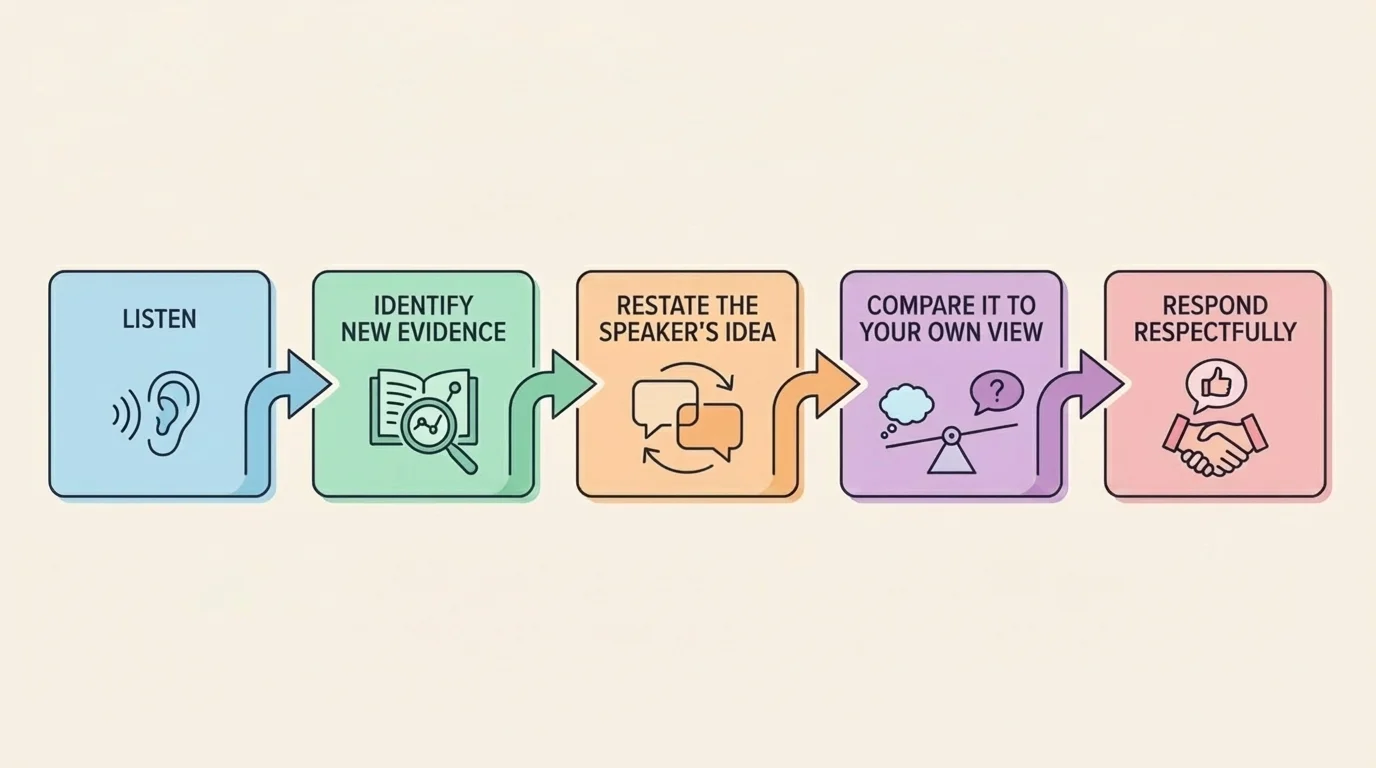
Acknowledging new information does not mean automatic agreement. It means showing that you heard the other person, understood the point, and considered its effect on your own thinking. That process is active, not passive, as [Figure 1] shows through the steps from listening to responding. In a strong discussion, students do not simply wait for their turn to speak. They listen for what is new, important, or convincing.
To acknowledge new information, you first identify exactly what the other speaker added. Maybe they shared a fact, an example, a statistic, a quotation from a text, or a detail you had missed. Then you respond to that information directly. You might paraphrase it, which means putting it into your own words to show understanding. For example, if a classmate says, "School start times affect student attention because sleep research shows teens need more rest," you might respond, "So you're saying the issue is not just convenience; it's also connected to brain development and sleep."
This kind of response does two things. First, it shows respect. Second, it makes the discussion clearer. People are more likely to build on each other's thinking when they feel heard. Acknowledgment keeps a conversation moving forward instead of making it repeat the same opinion again and again.
There are several ways to acknowledge information. You can recognize a point as useful: "That detail helps explain the problem." You can show that you learned something new: "I had not considered that statistic." You can connect the new point to earlier ideas: "Your example supports what Maya said about cost." You can also note that the information changes the discussion: "That changes how I see the issue because it adds a safety concern."
Notice that each of these responses names the other person's contribution. That is important. Vague replies such as "Okay," "I guess," or "That's cool" do not show understanding. Specific acknowledgment does.
A good discussion response has three parts. First, identify the other speaker's idea accurately. Second, explain what that idea means for the discussion. Third, state how it affects your own claim. This pattern helps you avoid both empty agreement and stubborn repetition.
Later, when you need to respond under pressure in a fast-moving discussion, the structure in [Figure 1] remains useful: hear the point, restate it clearly, compare it to your own view, and then decide whether to adjust, support, or challenge your claim.
After acknowledging new information, you have a decision to make. Should you revise your view, partly revise it, or keep it and defend it? That depends on the evidence.
Qualifying your view means making it more precise. Suppose you begin by saying, "Homework is always helpful." Then another student explains that too much homework can lower sleep and increase stress without improving learning. A stronger response would be: "I want to qualify my view. Homework can be helpful when it is meaningful and limited, but too much may do more harm than good." Your opinion did not disappear; it became more accurate.
Justifying your view means giving solid reasons for keeping your position after you have considered the new information. For example, if someone argues that all screen time is harmful, you might respond: "I agree that some screen time can be distracting, but I still think educational technology can be useful because research and classroom examples show that certain tools improve access to information and collaboration." Here, you acknowledge part of the opposing view, then defend your own with evidence.
Sometimes the best response is a full change of mind. That is not weakness. If your claim was based on incomplete information and someone provides stronger evidence, changing your mind can be the most logical move. At other times, the best response is partial change. You keep the main idea, but add conditions, limits, or exceptions. And sometimes the best response is to hold your original view because the new evidence is weak, unclear, or not relevant.
Think of claims as needing the right size. A weak thinker may make claims that are too broad, such as "Everyone learns the same way" or "Video games are bad." A careful thinker qualifies those claims: "Some students learn better with visuals, while others benefit more from discussion," or "Some video games may waste time, but others can support problem-solving or teamwork." Qualification often turns an oversimplified statement into a more truthful one.
Example: Qualifying a claim in a class discussion
Claim: "School uniforms are the best way to improve student behavior."
Step 1: Hear new information.
A classmate says that some schools with uniforms still report discipline problems.
Step 2: Acknowledge the information.
"That's an important point. Uniforms alone do not automatically solve behavior problems."
Step 3: Qualify the original view.
"I want to revise my claim: uniforms may help create a sense of order, but they work best when combined with clear rules and positive school culture."
The revised statement is more balanced and more convincing.
In strong academic discussions, students often move between qualification and justification. They may say, "I agree with part of your point, but..." or "Your evidence makes me narrow my claim..." or "I still hold my position because..." These moves show flexible thinking.
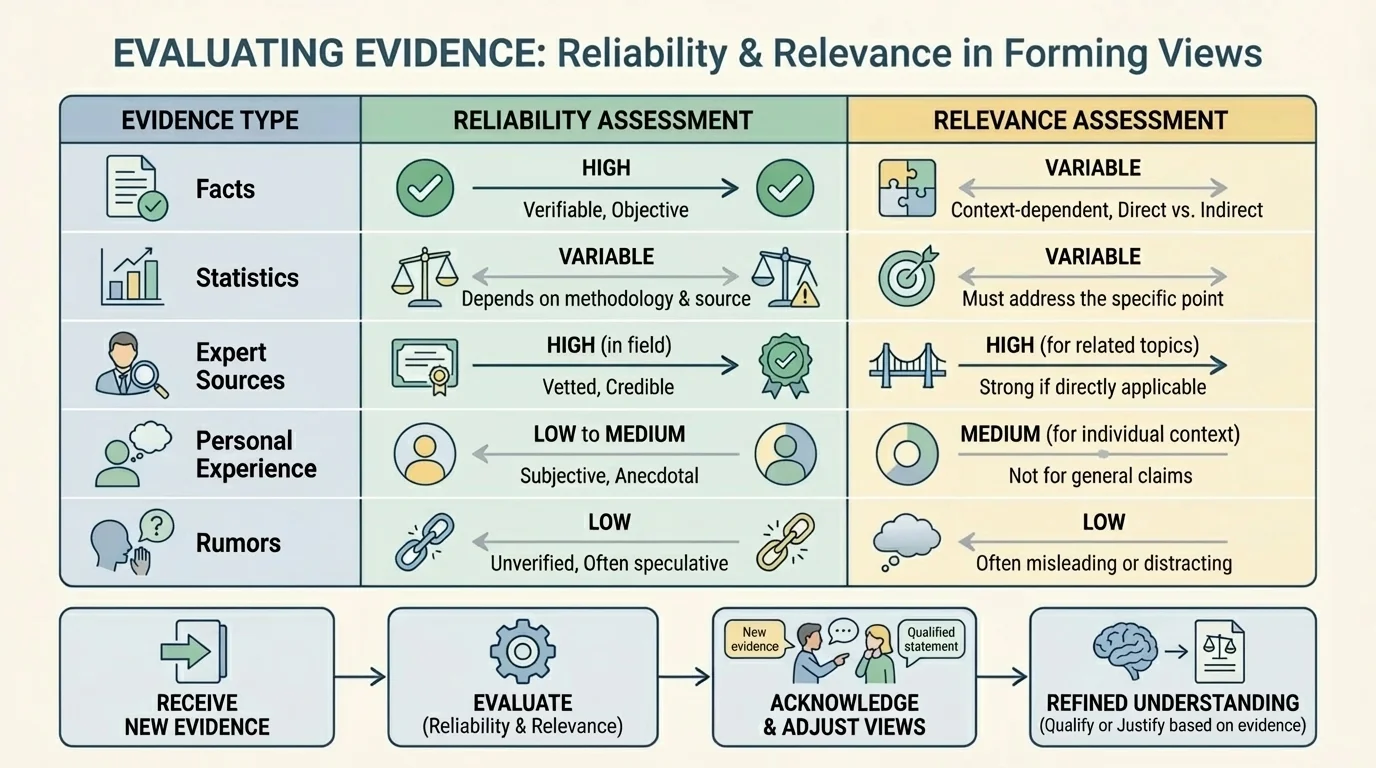
Not all evidence has the same strength. To decide whether you should adjust your view, you need to evaluate what kind of evidence the other person presented. Evidence should be both credible and relevant, as [Figure 2] makes clear by comparing stronger and weaker support. Credible evidence comes from a source that is trustworthy, informed, and accurate. Relevant evidence connects directly to the claim being discussed.
For example, if students are discussing whether a city should add more bike lanes, a traffic study, safety report, or city planning document may be strong evidence. A random social media comment might be weak evidence. If someone brings up a fact about bus schedules, that information may be true, but it is only useful if it connects directly to the bike lane issue.
You should also ask whether the evidence is enough. One example can be helpful, but one example does not always prove a general claim. If one student says, "My cousin learned better online, so online school is best for everyone," that is too broad. Personal experience can add perspective, but it is usually stronger when combined with research, multiple examples, or data.
Another important idea is bias. Bias is a tendency to favor one side in a way that may affect fairness. Everyone has perspectives, but some sources are especially one-sided. If a company advertises its own product, its information may be useful, but it should be checked against other sources too.
| Type of Evidence | What It Is | How Strong It Usually Is | What to Ask |
|---|---|---|---|
| Fact | A verifiable statement | Strong if accurate | Can it be checked? |
| Statistic | A number or data point | Strong if from a reliable source | Who collected it, and how? |
| Expert opinion | View from a knowledgeable person | Often strong | Does the expert have relevant knowledge? |
| Text evidence | A quotation or detail from a reading | Strong in literature and history discussions | Does it support the claim directly? |
| Personal experience | An individual example | Sometimes useful but limited | Is it just one case? |
| Rumor or hearsay | Unverified information | Weak | Is there proof? |
Table 1. Comparison of common evidence types and questions students can ask to judge their strength.
When you evaluate evidence, ask questions such as: Who said this? How do they know? Is this current? Does it connect to the claim? Is there enough evidence, or only one small example? Those questions help you decide whether new information should actually affect your view.
People often become more convinced by confident speakers even when the evidence is weak. That is why careful listeners pay attention to proof, not just to volume, speed, or confidence.
Later in a discussion, [Figure 2] remains helpful as a mental checklist. Before changing your claim, you should compare the kind of evidence being used and ask whether it truly supports the point being made.
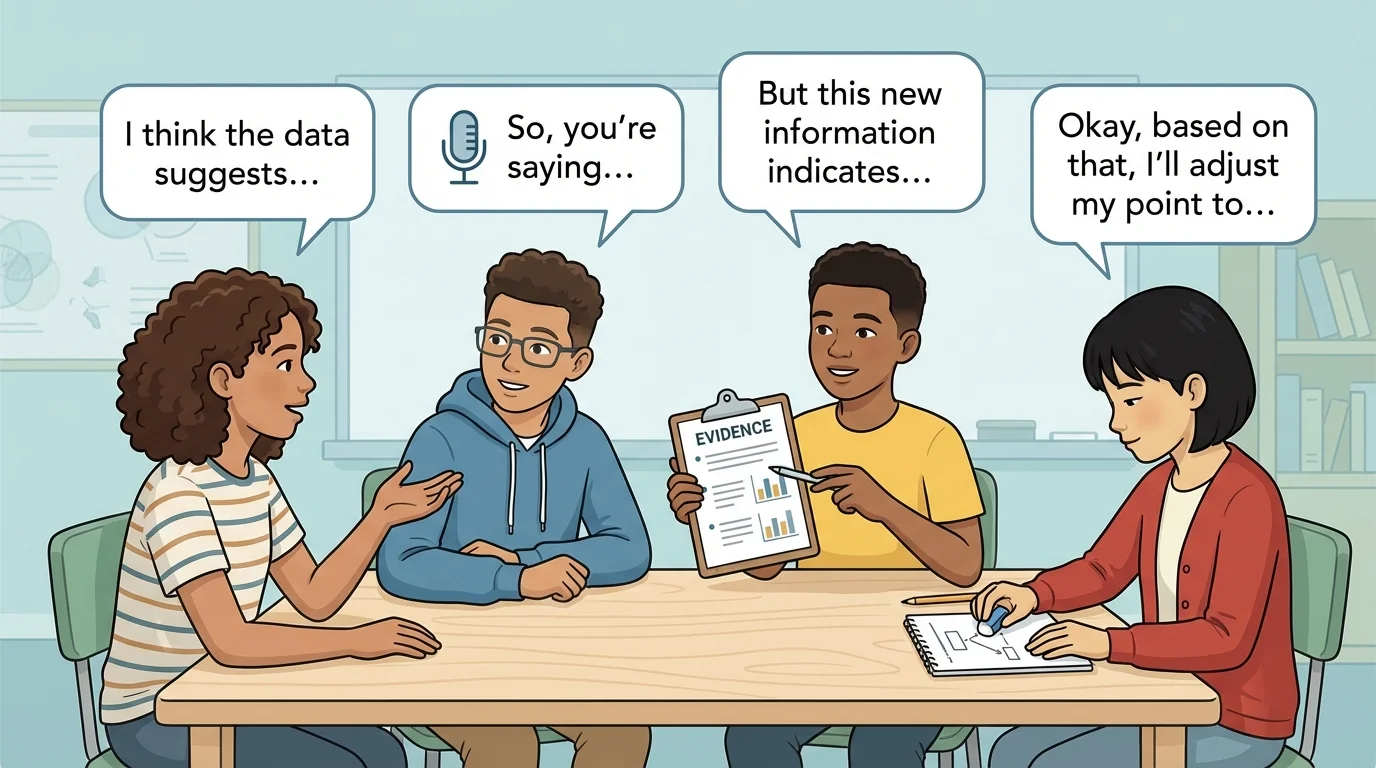
Discussion skills are easier when you have language ready to use. [Figure 3] previews several of these moves in action. These sentence patterns help you sound respectful and clear.
To acknowledge information, you might say: "I hear your point that...," "You're adding that...," "That evidence shows...," or "I had not considered..." To qualify a claim, you might say: "I want to narrow my point...," "I still believe this, but only when...," or "I agree to an extent, although..." To justify a claim, you might say: "I still hold this view because...," "The stronger evidence seems to be...," or "The text supports my argument when it says..."
These are not magic phrases. They work because they make your thinking visible. They show the relationship between someone else's idea and your own response. In a collaborative discussion, clarity matters just as much as confidence.
"The smartest person in the room is the one who can learn."
There is also a difference between polite disagreement and personal attack. Saying, "I'm not convinced by that evidence because it comes from only one example," is respectful. Saying, "That idea is dumb," is not. Effective discussion focuses on ideas, evidence, and reasoning, not on insulting people.
These skills become easier to understand when you hear them in realistic situations. In a group discussion, the moves are visible in how students respond to one another through listening, paraphrasing, citing evidence, and revising a claim. The goal is not to memorize a script but to notice the pattern of good thinking.
Example 1: Science discussion
Topic: Should plastic water bottles be banned at school?
Student A says, "Yes, because they create too much waste."
Student B says, "But some students forget reusable bottles, and they still need water during the day."
Student C responds, "That's a good point about access. I want to qualify the idea of a total ban. Instead of banning all bottles immediately, the school could increase refill stations first and reduce sales over time."
Student C does several things well. The response acknowledges Student B's concern, identifies what new issue was raised, and then adjusts the original idea rather than ignoring the new evidence. That is strong collaborative thinking.
Example 2: Literature discussion
Topic: Is a character brave or reckless?
One student says the character is brave because he risks himself to help others. Another says the character ignores warnings and acts without a plan. A strong response might be: "I see why you call him reckless, especially since the text shows he rushes in without thinking. I still think he is brave, but I would qualify that by saying his bravery is mixed with poor judgment."
Example 3: School policy discussion
Topic: Should phones be allowed during lunch?
A student argues yes, because students may need to contact family. Another student says phone use at lunch can reduce face-to-face socializing. A thoughtful reply could be: "Your point about social interaction matters. I still support phone access, but I would justify it only if there are limits, such as using phones in certain areas or for short periods."
Notice how these examples avoid extremes. The speakers do not pretend the opposing side has no value. They also do not abandon their views for no reason. They adjust in proportion to the strength of the evidence.
Case study: Responding to evidence in a teacher-led seminar
Question: "Does social media mostly help or harm communication?"
Step 1: State an initial claim.
"I think social media often harms communication because it can spread rumors quickly."
Step 2: Hear a classmate's evidence.
A classmate explains that social media also helps people organize community support during emergencies.
Step 3: Acknowledge the new information.
"That example adds an important benefit I had not included."
Step 4: Revise or justify.
"I want to qualify my claim: social media can harm communication when it spreads false information, but it can also help people share urgent updates and coordinate support."
This response becomes stronger because it is more complete.
When you later return to your original position, [Figure 3] reminds you that good discussion is visible in interaction: one speaker adds evidence, another restates it, and then the group's ideas become sharper.
One common mistake is pretending to listen while actually preparing your next speech. Another is responding only to the part you already disagree with and ignoring the new evidence entirely. A third mistake is changing your opinion too quickly just to avoid disagreement. Good discussion requires both openness and judgment.
Another mistake is using absolute words too often: always, never, everyone, no one. These words can make claims easy to challenge because one exception may weaken the whole statement. Qualification helps you avoid this problem by making your claim more precise.
Students also sometimes confuse opinion with evidence. An opinion is a belief or point of view. It becomes stronger when supported with evidence. Saying "I just think so" is not enough in an academic discussion. Saying "I think so because the article states..." or "because the data suggests..." is much stronger.
Good discussions depend on earlier listening skills: making eye contact, not interrupting, taking notes on key points, and asking clarifying questions. Acknowledging and revising ideas builds on those habits.
Sometimes students become defensive because they feel that revising a claim means losing. In truth, discussion is not a game scoreboard. If evidence improves your thinking, that is progress. In science, in historical research, and in everyday problem-solving, people often refine their ideas as they learn more. That is how knowledge grows.
In a one-on-one conversation, this skill helps both people feel respected. In small groups, it prevents the discussion from becoming a set of disconnected speeches. In teacher-led discussions, it helps students trace how ideas develop across the whole class.
Strong collaborators listen for connections. They may link one person's evidence to another person's claim. They may notice patterns. They may point out that two students agree on a basic principle even if they disagree on the solution. This makes discussion more productive because it builds shared understanding.
A student who engages effectively in discussion often does the following: listens closely, refers to earlier comments accurately, speaks clearly, supports claims with evidence, asks useful questions, and adjusts ideas when the evidence calls for it. These habits help create discussions where everyone learns more than they knew at the start.
Whether you are discussing a historical decision, a scientific claim, a poem, or a school issue, the same principle applies: hear new information fully, test it with reason, and let evidence shape your response. That is how thoughtful speakers become thoughtful learners.
