Think about the last movie scene that stuck in your mind. You probably remember more than the main event. You remember the screech of tires, the flicker of hallway lights, the cold rain on a character's face, or the way one sentence of dialogue changed everything. Strong narrative writing works the same way. Readers do not just want to know what happened. They want to feel as if they were there.
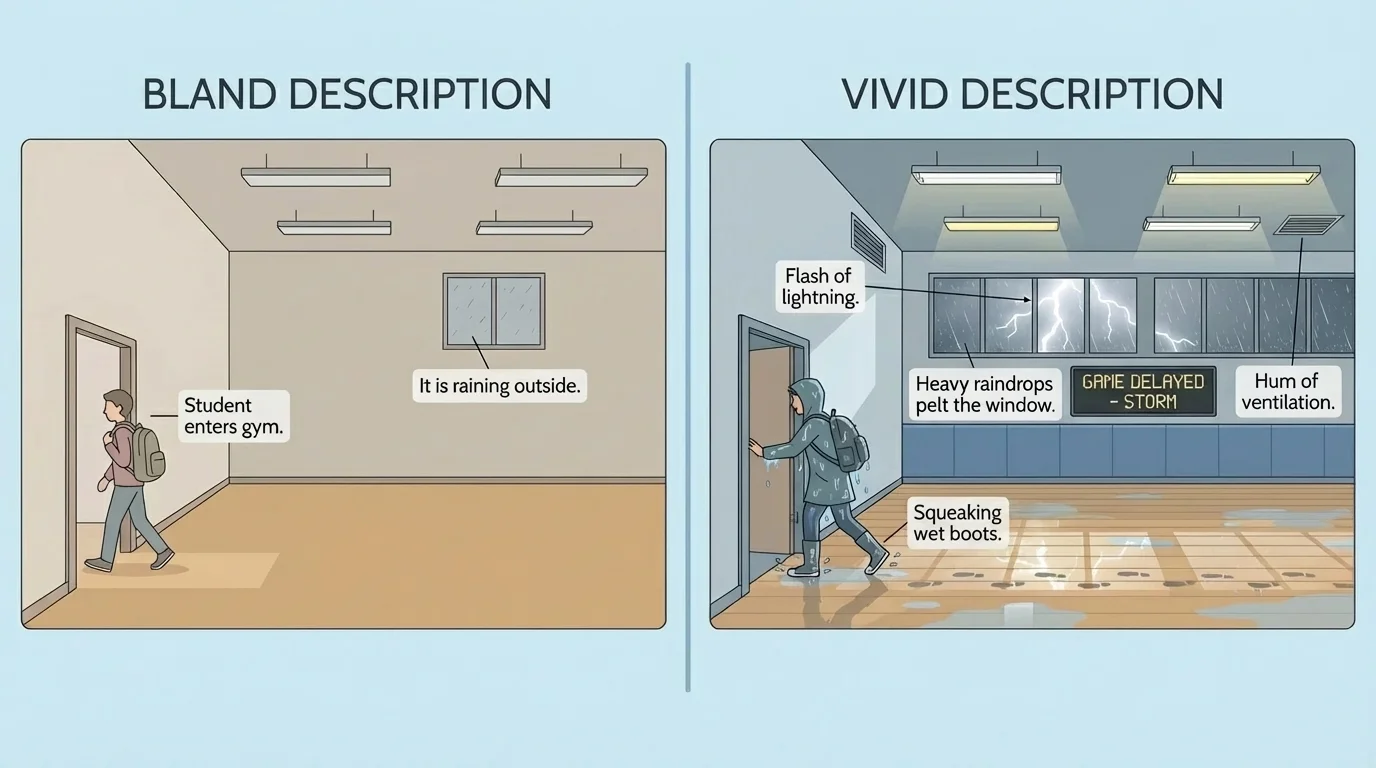
When writers use precise language, readers can build a clear picture in their minds, as [Figure 1] illustrates through the difference between a flat scene and a vivid one. Instead of saying something was "nice," "bad," or "scary," strong writers choose words that show exactly what made it feel that way.
Compare these two sentences: "The gym was loud." and "The gym thundered with bouncing basketballs, squeaking sneakers, and coaches shouting over the echo." The first sentence gives basic information. The second sentence creates an experience. It uses exact details that help the reader hear the scene.
Precise writing matters because narrative writing is not a list of facts. It is the art of guiding a reader through events. If the language is too general, the story feels distant. If the language is specific and relevant, the story feels immediate, believable, and memorable.
Specific language also helps create mood, which is the feeling a piece of writing gives the reader. "The house was old" sounds neutral. "The house sagged under peeling paint, and each porch step groaned like it was warning me away" creates an uneasy mood. The event has not changed, but the words have.
Precise words and phrases are exact, meaningful choices that clearly express an action, object, feeling, or event. Descriptive details are carefully chosen facts or images that help a reader picture the scene. Sensory language uses details connected to sight, sound, smell, taste, and touch to make writing more vivid.
Being specific does not mean adding as many details as possible. It means choosing the details that matter most. A strong narrative often depends more on the right detail than on a large number of details.
Precision begins with word choice. A weak verb often makes writing feel blurry, while a strong verb sharpens the action. Compare "She went across the room" with "She strode across the room," "She shuffled across the room," or "She darted across the room." Each verb changes the reader's understanding of the same basic event.
Strong writers often improve sentences by replacing general words with exact ones. Instead of "thing," name the object. Instead of "went," choose a verb that fits the motion. Instead of "said," consider whether a character muttered, snapped, whispered, or blurted. These choices reveal tone, energy, and emotion.
Nouns matter too. "Bird" is accurate, but "crow" gives a darker, sharper image. "Food" tells little, but "garlic fries" or "burnt toast" instantly creates a clearer picture. Adjectives can help, but they are strongest when paired with exact nouns and verbs. "The old car moved slowly" is less vivid than "The rusted pickup crawled up the hill."
Precise phrases are useful when one word is not enough. For example, "He was nervous" tells the feeling directly. "He rubbed his palms on his jeans and reread the text for the fifth time" shows nervousness through action. In narrative writing, showing often feels stronger than simply labeling.
Sentence revision example
Here is a weak sentence: "The dog was angry."
Step 1: Identify the vague word.
The word "angry" gives a general idea, but it does not help the reader picture the dog's behavior.
Step 2: Add exact action and sound.
"The dog bared its teeth and let out a low growl."
Step 3: Add a relevant detail that increases tension.
"The dog bared its teeth, let out a low growl, and tightened its chain until the metal links rattled."
The final version lets the reader see and hear the anger instead of just being told about it.
Notice that the best version is not longer just for the sake of being longer. It is more effective because every added detail contributes to the scene.
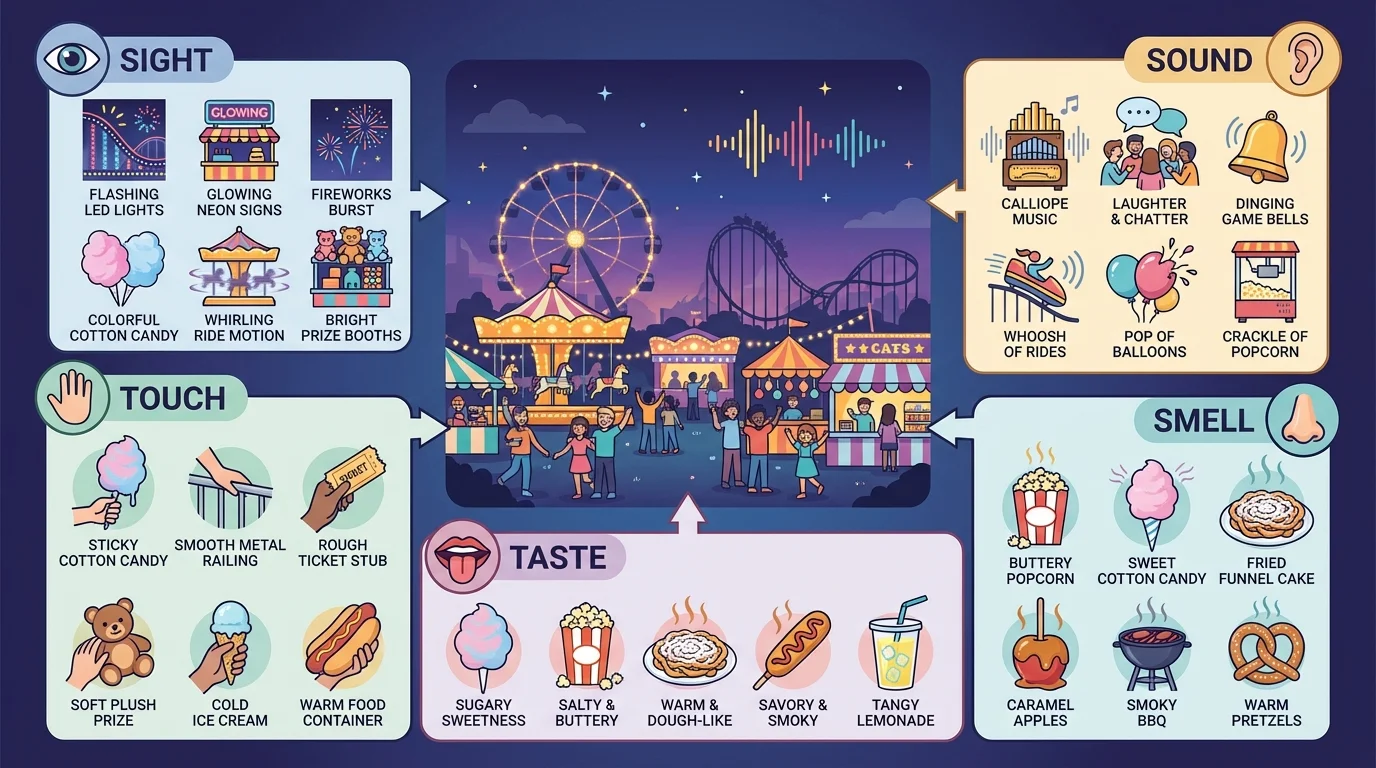
Sensory language helps readers enter a story through the body as well as the mind, and [Figure 2] shows how one setting can be described through all five senses. Good narrative writing often combines what characters see with what they hear, smell, touch, and sometimes taste.
Consider a carnival at night. You might describe the flashing lights, the smell of fried dough, the sticky handle of a game booth, the metallic scream of a roller coaster, and the sharp taste of lemonade. These details do more than decorate the writing. They make the setting feel real.
However, sensory details should be relevant. If a character is racing to catch a bus, readers probably do not need a long description of cloud shapes or every item in a backpack. The details should support the moment, not distract from it.
Sensory language is also one of the strongest tools for shaping mood. The same beach can feel peaceful or threatening depending on the details chosen. "Warm sand and steady waves" create calm. "A hard wind, sharp shells, and gray water" create tension. The setting stays the same, but the sensory details change the emotional effect.
One useful strategy is to focus on two or three strong sensory details instead of trying to include all five senses in every scene. A crowded hallway might be defined by the slam of lockers and the smell of body spray. A winter morning might be defined by air that stings your nose and the crunch of frost under your shoes.
Writers often remember scenes more clearly through smell and sound than through sight alone. That is one reason a single detail like chlorine in the air or the buzz of stadium lights can make a moment feel instantly real.
Specific sensory details can also reveal a character's point of view. One student entering the cafeteria might notice the smell of pizza and feel hungry. Another might notice the roar of conversation and feel overwhelmed. Description is not only about the place itself; it is also about the person experiencing it.
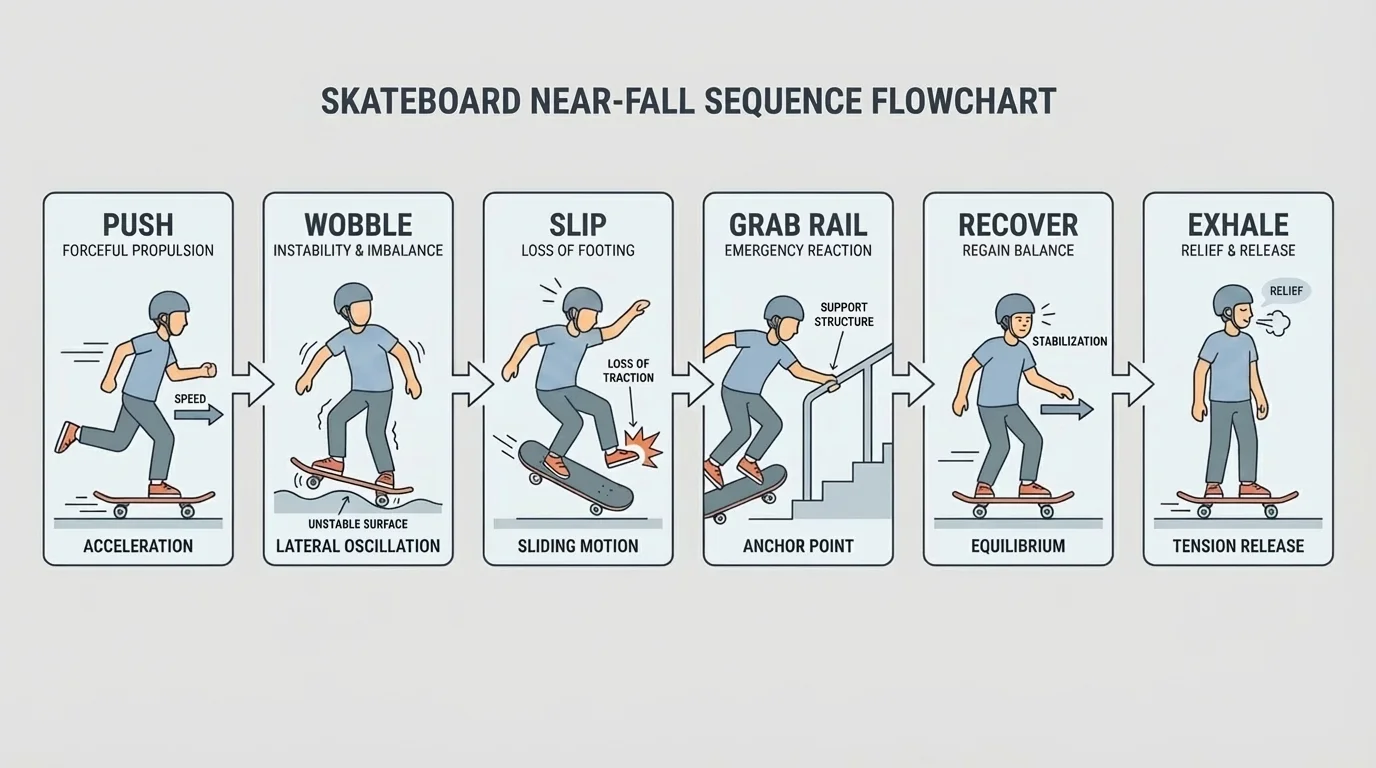
In narratives, action should feel clear and alive rather than rushed or confusing. Important moments deserve careful pacing, and [Figure 3] illustrates how a single event becomes easier to follow when broken into clear steps. Instead of writing "I almost fell off my skateboard, but I was fine," a writer can slow the moment down and show what happened piece by piece.
For example: "My front wheel clipped the curb. The board jerked sideways. For one second, my arms pinwheeled at the empty air. Then my fingers closed around the cold metal rail, and I hung there, breathless, while the skateboard shot into the grass." This version lets the reader follow the sequence and feel the tension.
This is called pacing, the speed at which a writer moves through events. Not every moment should get equal attention. Writers usually move quickly through less important events and slow down during major actions, emotional turning points, or surprising changes.
Clear action also depends on sequence words and logical order. Words and phrases such as first, before I could react, a second later, and afterward help guide readers through events. Even without these signal words, the events should unfold in an order that makes sense.
Verbs are especially important in action scenes. "Moved" is often too weak. "Lurched," "stumbled," "slammed," "snatched," and "lunged" make action sharper and more exact. As with the gym scene in [Figure 1], precision gives readers a stronger mental picture.
Zoom in, zoom out
Strong narratives often "zoom out" to move quickly across minor events and "zoom in" to slow down key moments. A writer might zoom out with "For the next hour, we hiked in silence," then zoom in when a branch cracks nearby or a character discovers something important. This contrast helps the most important action stand out.
Dialogue can also sharpen action and reveal urgency. A single line such as "Don't let go!" can intensify a scene when placed at the right moment. But dialogue works best when supported by action and detail, not used as a shortcut to avoid description.
One of the hardest parts of narrative writing is describing what an experience felt like. Many writers rely on broad emotion words such as "sad," "excited," or "afraid." These words are useful starting points, but they rarely create a strong effect on their own.
Instead, writers can reveal emotion through physical reactions, thoughts, and behavior. Fear might appear as a dry mouth, shaky hands, or a pause at the doorway. Embarrassment might show through a flushed face, a forced laugh, or a sudden focus on the floor tiles. Joy might show in a grin that refuses to fade or in a voice that comes out louder than expected.
This method is often called showing. It does not mean that writers should never tell emotions directly. It means that emotional scenes become more convincing when readers can notice signs and infer feelings from what characters do, notice, and remember.
From telling to showing emotion
Weak version: "I was nervous about the audition."
Step 1: Add body language.
"I kept shifting my weight from one foot to the other."
Step 2: Add a small repeated action.
"I kept shifting my weight and smoothing the corner of my music sheet."
Step 3: Add a thought or sensation.
"I kept shifting my weight, smoothing the corner of my music sheet, and trying to ignore the way my heartbeat thudded in my throat."
The final version conveys nervousness through details the reader can imagine.
Personal experiences become stronger when they include reflection as well as description. A writer can explain why a moment mattered: maybe the loss during a game taught patience, or a missed bus led to an unexpected conversation. Reflection adds meaning, but the event still needs concrete details to feel real.
Revision is where many narratives become vivid. First drafts often contain general language because the writer is focused on getting the event onto the page. During revision, the writer can replace vague words, sharpen images, and remove details that do not serve the scene.
Look at this example: "We walked into the forest, and it was creepy." That sentence gives the basic idea, but not the experience. A stronger version might say, "We stepped under the pine branches, and the temperature dropped so suddenly that I stopped talking mid-sentence." This revision replaces the vague word "creepy" with a specific change the character notices.
Here is another example: "The cafeteria was gross." A more precise version could be, "The cafeteria smelled like spilled milk and overcooked broccoli, and the floor tugged at my shoes with every step." The second sentence provides concrete evidence for the reaction.
| Weak language | Stronger revision | Why it works |
|---|---|---|
| She was mad. | She slammed her locker and answered in clipped, one-word replies. | Shows emotion through action and speech. |
| It was cold. | The wind cut through my sleeves and turned my fingers stiff. | Uses touch to create a clear sensation. |
| The room was messy. | Homework sheets covered the desk, socks hung off the chair, and an empty bowl balanced on the windowsill. | Names exact details instead of labeling. |
| He ran fast. | He sprinted across the parking lot, backpack bouncing against his shoulders. | Uses a stronger verb and adds movement. |
Table 1. Examples of revising vague narrative language into precise, descriptive writing.
Revision often asks two questions: Can the reader picture this? and Does this detail matter? If the answer to either question is no, the sentence may need to change.
Earlier writing lessons may have focused on plot, character, and setting. Those elements still matter here. Precise description does not replace them; it strengthens them by making each part of the narrative clearer and more believable.
Even one carefully revised sentence can improve a whole paragraph. Strong narrative writing grows sentence by sentence.
One common mistake is overwriting, which happens when a writer piles on too many adjectives or unnecessary details. "The incredibly huge, unbelievably terrifying, dark, gloomy, creepy hallway" is less effective than one or two exact details such as "the hallway narrowed into darkness, and one fluorescent bulb buzzed above me."
Another mistake is using clichés, or overused expressions, such as "quiet as a mouse" or "heart pounding like a drum" in every emotional moment. Familiar phrases can weaken writing because they no longer feel fresh. Original details usually create a stronger effect.
Writers also sometimes include details that are interesting but irrelevant. If a scene is about a tense argument, readers may not need a full description of every poster on the wall unless those posters matter to the conflict. Relevant details support the event, character, or mood.
Repetition can be another problem. If every sentence begins with "I saw" or "I felt," the writing can become flat. Varying sentence structure helps the narrative flow. Compare "I saw the rain. I saw the cars. I saw the lights." with "Rain streaked across the windshield while red brake lights smeared across the wet street." The second version sounds smoother and more vivid.
"The difference between the almost right word and the right word is really a large matter."
— Mark Twain
The best fix for most of these problems is thoughtful revision. Replace general words with exact ones, cut details that do not matter, and read sentences aloud to hear whether they sound natural and clear.
These techniques work in both real and imagined narratives. In a real narrative, precise details help the event feel authentic. A writer describing a championship game might mention the sting of sweat in the eyes, the roughness of the ball, or the silence right before a free throw. These details make the memory concrete.
In an imagined narrative, precise details create believability. Even if the story takes place in a future city or on a distant planet, the experiences still need clear sensory details and believable reactions. Readers trust a fictional world when its moments feel specific.
Writers should also think about point of view. A first-person narrator notices details differently than a third-person narrator. A tired hiker may focus on blistered feet and a heavy backpack, while a curious child on the same trail may notice beetles, bird calls, and shiny stones. Description is shaped by who is telling the story.
The same event can be written in many effective ways depending on purpose. If the goal is suspense, the writer may highlight shadows, pauses, and uncertain sounds. If the goal is humor, the writer may focus on awkward motions, surprising comparisons, or exaggerated reactions. The chosen details should fit the effect the writer wants.
Read this short model paragraph: "The bus doors folded open with a tired hiss, and warm air smelling faintly of rubber and wet coats rushed over me. I stepped up, fishing for my pass, while drops of rain slid from my hood onto the ridged metal floor. Every seat was taken except one near the back, where a boy balanced a trumpet case on his knees and tapped a rhythm against the window. As the bus pulled away, the city lights blurred into yellow streaks, and for the first time all day, I stopped thinking about the test I had failed."
This paragraph works because the details are specific and connected to the moment. The writer does not describe everything on the bus. Instead, the paragraph selects details that create a believable scene: the hiss of the doors, the smell of wet coats, the ridged metal floor, the trumpet case, and the blurred lights. These details support both the setting and the narrator's experience.
Notice also how the paragraph moves from outer description to inner reflection. That shift helps the event feel meaningful. The final line reveals that the bus ride is not only a setting but also a pause in the narrator's emotional day. This combination of action, sensory detail, and reflection often creates powerful narrative writing.
As the action sequence in [Figure 3] demonstrates, vivid narrative writing often depends on selecting the right moment to slow down. A single second can become memorable when the writer captures its sounds, motions, and feelings with care.
