One unfamiliar word can make a whole paragraph feel confusing. But skilled readers do something powerful: they do not stop immediately or guess wildly. They look at the other words around it, the sentence structure, and the overall message of the paragraph. In other words, they use context. This skill matters everywhere, from understanding directions in a science lab to making sense of a speech in history or a difficult scene in a novel.
When you read, you are not decoding words one at a time like isolated puzzle pieces. You are building meaning from connected ideas. That is why context is so useful. Context is the information around a word or phrase that helps explain what it means. Sometimes that information comes from the same sentence. Sometimes it comes from the sentences before and after it. Sometimes the grammar of the sentence gives an important clue.
Readers often meet words they have never seen before, especially in grade-level texts about science, history, literature, and current events. If you can use context well, you become a more independent reader. You do not need to stop for every unfamiliar word, and you are more likely to keep the meaning of the whole passage in mind.
Context clue is a hint in the words, phrases, sentences, or paragraph around an unfamiliar word that helps a reader determine meaning. Multiple-meaning words are words that have more than one definition, and context helps the reader choose the correct one.
Context is especially important because many words do not have just one meaning. If someone says a player sat on the bench, the word probably means a long seat. If a coach says a player was benched, the meaning changes completely. The surrounding words guide the reader toward the right interpretation.
A context clue can appear in different forms. A sentence may directly explain the word. It may include a synonym, which is a word with a similar meaning. It may show a contrast, giving the opposite idea. It may provide examples. Or it may simply create a situation in which the reader can infer a likely meaning.
Sometimes the clue is obvious. In the sentence, "The desert was arid, or extremely dry, after months without rain," the phrase "extremely dry" clearly defines the unknown word. At other times, the clue is more subtle. In the sentence, "After hiking for hours without water, the group struggled through the arid landscape," you infer that arid means something like dry because of the lack of water and the difficult conditions.
Strong readers stay alert for both direct and indirect clues. They also remember that one clue may not be enough. Often, the best understanding comes from combining several hints.
Readers can spot several common clue patterns, as [Figure 1] illustrates. Learning these patterns helps you notice how authors quietly guide your understanding of unfamiliar words.
Definition or restatement clue: The text explains the word directly. Signal words may include is, means, or, that is, or in other words. Example: "A novice, or beginner, may need extra practice before entering the competition." The phrase "or beginner" gives the answer.
Synonym clue: A nearby word or phrase has a similar meaning. Example: "The room was dim and gloomy." If you know gloomy, it helps you infer that dim means not bright.
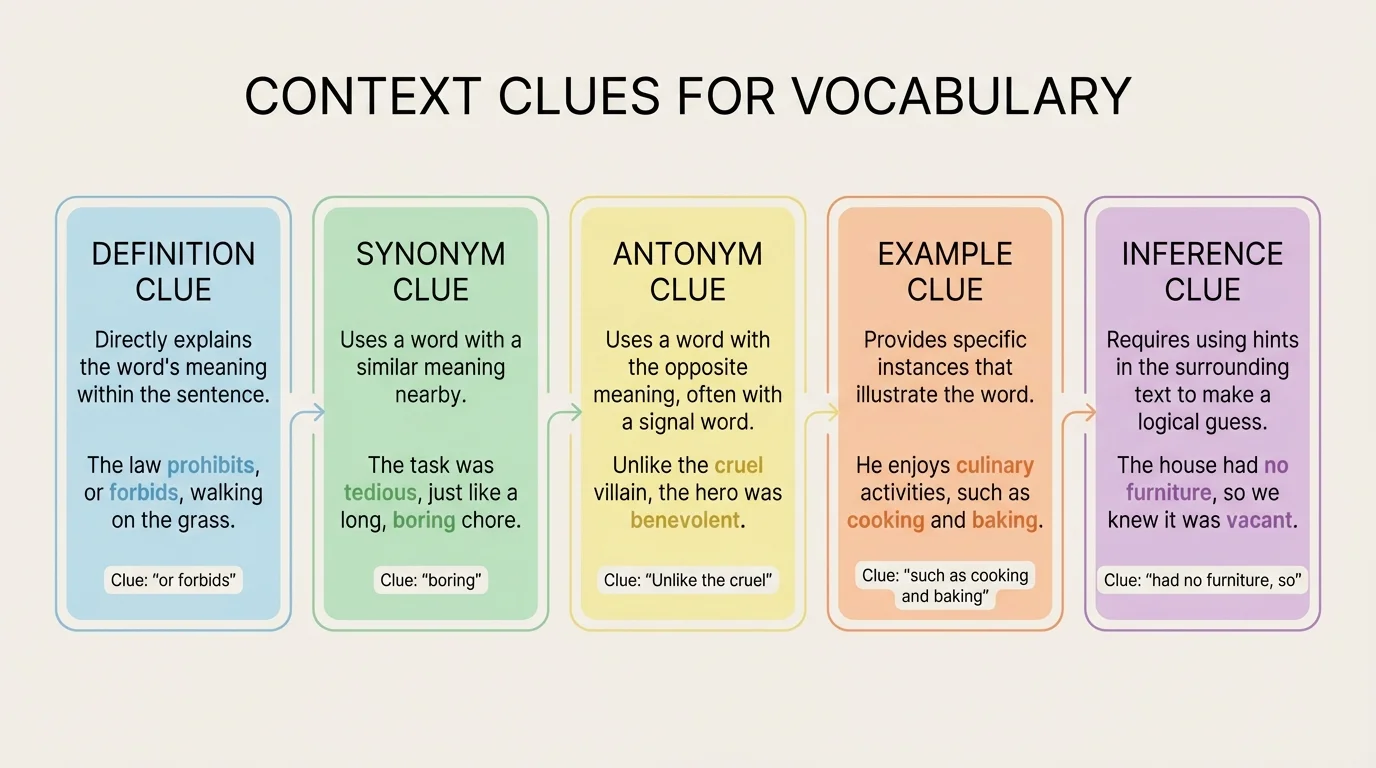
Antonym or contrast clue: The sentence shows an opposite idea. Signal words may include but, however, unlike, instead of, or on the other hand. Example: "Unlike his outgoing sister, Marcus was reserved at the party." Because the sister is outgoing, reserved likely means quiet or less open.
Example clue: The text lists examples that reveal meaning. Example: "Celestial bodies, such as stars, planets, and moons, fill the night sky." Even if you do not know celestial, the examples help you connect it to objects in space.
Inference or general sense clue: The author does not state the meaning directly, but the situation suggests it. Example: "Jada glanced at the clock every few seconds, tapped her foot, and sighed while waiting for the late bus." If the word impatient appeared in that sentence, the actions would help you infer its meaning.
Tone and mood clue: Sometimes the feeling of the sentence helps. If a character speaks in a sharp, angry voice and slams a door, a word describing that behavior probably has a negative meaning. Tone does not always give an exact definition, but it helps narrow the possibilities.
When you read more challenging texts, several clue types may work together. A history textbook might contrast two leaders, give examples of their actions, and create a formal tone. All of that can help you understand unfamiliar vocabulary. Later, when you compare clue types again, [Figure 1] remains useful because it organizes the patterns readers most often encounter.
Context clue examples in action
Step 1: Read the sentence with the unknown word.
"Because the trail was treacherous, with loose rocks and steep drops, hikers moved slowly and carefully."
Step 2: Look for clues around the word.
The phrases "loose rocks," "steep drops," and "slowly and carefully" all suggest danger.
Step 3: Test a possible meaning.
Treacherous likely means dangerous or risky.
The surrounding details support that meaning.
Notice that the sentence never says "treacherous means dangerous." You still figure it out because context provides enough evidence.
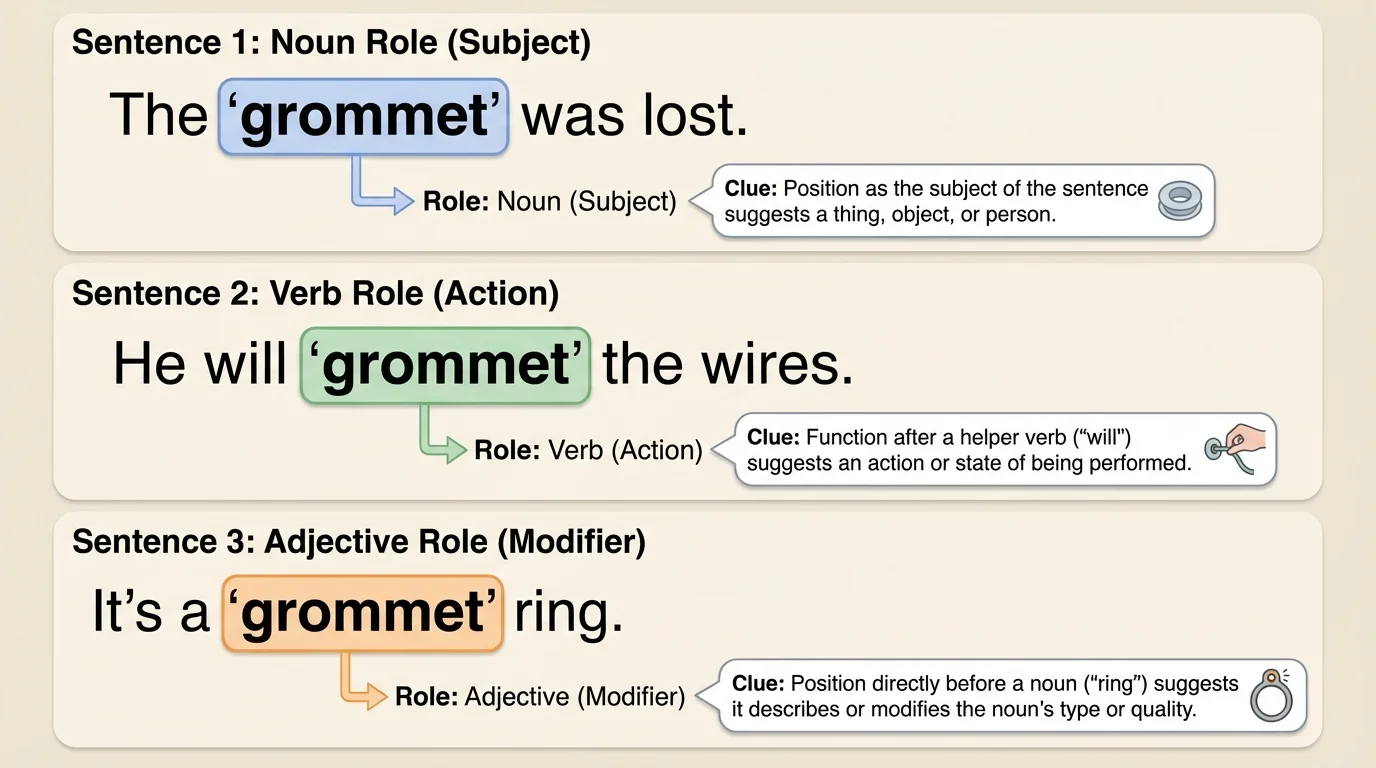
Sometimes meaning becomes clearer when you ask what job the word is doing in the sentence. Grammar acts like a map for meaning, and [Figure 2] shows how a word's role can guide your thinking before you even settle on a definition.
A word might function as a noun, verb, adjective, or adverb. If an unknown word comes after the or a, it may be a noun. If it shows action, it may be a verb. If it describes a noun, it may be an adjective. This does not give the exact meaning by itself, but it narrows your options.
Consider the sentence: "The fragile vase cracked when it was moved." Because fragile appears before the noun vase, it functions as an adjective. The rest of the sentence tells you the vase cracked easily, so fragile likely means delicate or easily broken.
Now consider this sentence: "During the debate, the audience began to murmur when the speaker avoided the question." Because the word comes after to, it functions as a verb. The audience is doing something. The surrounding idea suggests a low, quiet sound of reaction, so murmur likely means to speak or make a soft sound quietly.
Word position also helps with phrases. In the sentence, "Her comment was out of line during the meeting," the phrase comes after a linking verb and describes the comment, so it acts like an adjective phrase. The formal setting and negative tone suggest the phrase means inappropriate or disrespectful.
When you look back at [Figure 2], you can see why grammar matters: the same unfamiliar form does not mean much until you know what role it plays in the sentence.
Many readers make a mistake by looking only at the sentence containing the unknown word. But authors often spread meaning across an entire paragraph. One sentence introduces a difficult word, and the next two or three sentences explain it through details, examples, or results.
For example, read this short paragraph: "The city created a initiative to reduce food waste. Local restaurants donated extra meals, schools taught composting, and community gardens used leftover plant material. Within a year, less trash went to landfills." Even if you do not know initiative, the paragraph shows organized actions toward a goal. You can infer that it means a plan, program, or effort.
The overall topic matters too. In a science article, the word density has a specific meaning related to how much matter is in a given space. In a crowd-control article, density may refer to how closely packed people are. The subject of the paragraph helps guide the correct interpretation.
Sentence clues and paragraph clues work together
A sentence may give a first hint, but the paragraph often confirms it. Effective readers move outward: they read the word, then the sentence, then nearby sentences, and finally the whole section if needed. This keeps them from making a quick guess that does not fit the full passage.
Text structure can also support meaning. In a cause-and-effect paragraph, the results of an action may explain an unfamiliar word. In a compare-and-contrast paragraph, differences between two ideas may clarify vocabulary. In a sequence paragraph, steps in a process may reveal what a word describes.
Some of the trickiest reading moments happen when you know a word already, but the author is using a different meaning. These are multiple-meaning words. Context is essential because your first idea may be wrong.
Take the word draft. In one context, it means a current of air: "A cold draft slipped through the window." In another, it means a preliminary version of writing: "After peer review, she revised the first draft of her essay." In sports, a draft can mean selecting players for a team. The letters are the same, but the surrounding topic changes the meaning.
The word charge can also shift meaning. In science, particles may have electric charge. In a store, a customer may charge a purchase to a card. In a battle scene, soldiers may charge forward. This is why readers should not lock onto the first definition they remember.
When the correct meaning is unclear, ask: What is happening in this sentence? What subject is the paragraph about? What meaning best fits everything around the word? That approach helps you choose carefully rather than automatically.
Many common English words have developed multiple meanings over time because people reuse familiar words in new settings, such as technology, sports, and science. That is why context has become even more important in modern reading.
Writers sometimes use multiple-meaning words on purpose to create humor, suspense, or wordplay. In literature, this can make a line more interesting, but it also means readers must pay close attention to the surrounding details.
Strong readers do not rely on luck. They follow a mental process, and [Figure 3] illustrates that sequence clearly: read around the word, identify its role, find clue patterns, test a meaning, and then reread to check whether the sentence makes sense.
This strategy is flexible because not every text gives the same kind of clue. Sometimes the best clue is a direct definition. Sometimes it is grammar. Sometimes it is the paragraph's overall point. The goal is not to use one trick every time. The goal is to choose from a range of strategies.
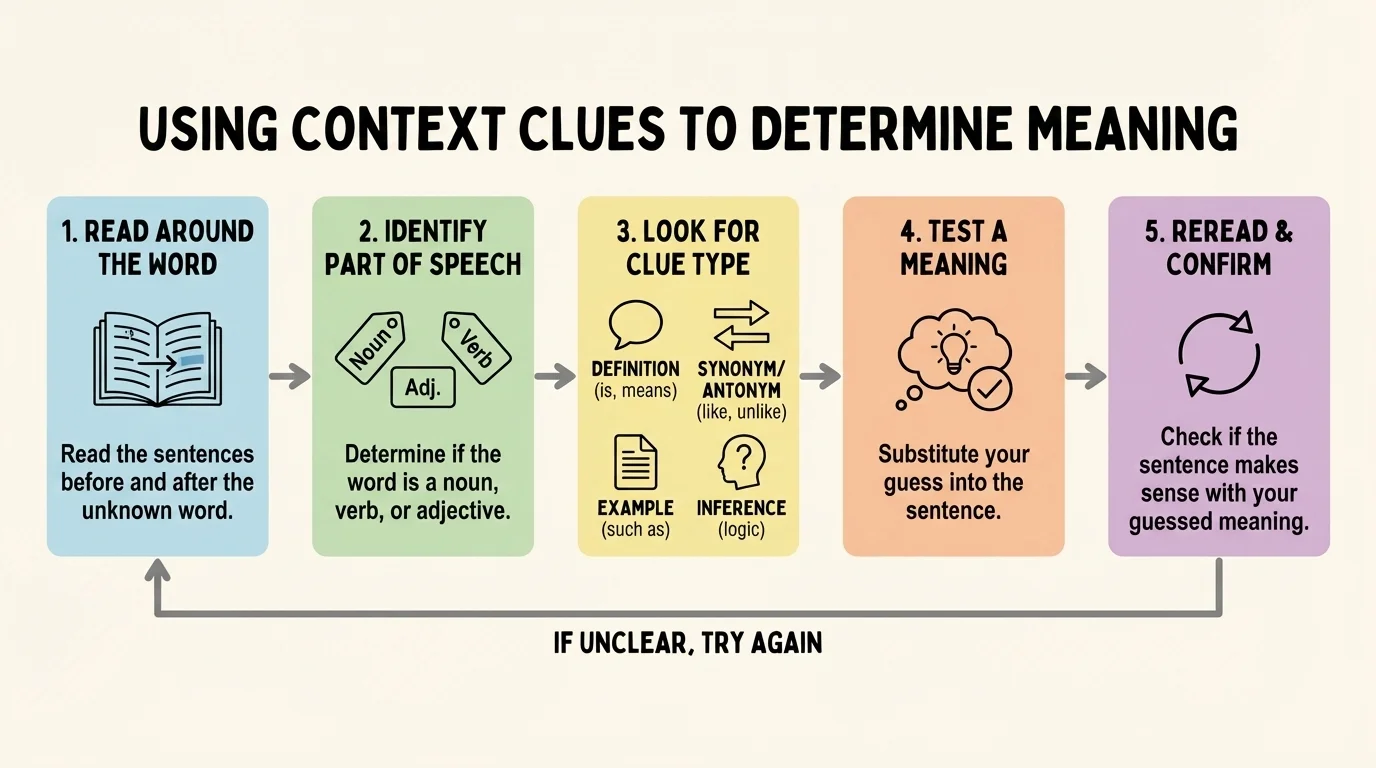
Step 1: Read the whole sentence, not just the unknown word. Sometimes the meaning becomes clear immediately when you finish the sentence.
Step 2: Read the sentence before and after it. These sentences may include examples, explanations, or contrasts.
Step 3: Determine the word's function. Is it naming something, describing something, showing action, or completing an expression?
Step 4: Look for clue types. Is there a definition, synonym, antonym, example, or a general sense of the situation?
Step 5: Try a possible meaning. Substitute your guess into the sentence.
Step 6: Reread and check. If the sentence and paragraph still make sense, your guess is probably close. If not, revise it.
Applying the strategy
Read this sentence: "The committee's decision was unanimous; every member supported the proposal."
Step 1: Read around the word.
The semicolon connects the unknown word to the explanation that follows.
Step 2: Identify the clue.
The phrase "every member supported the proposal" restates the idea.
Step 3: Test a meaning.
Unanimous means all in agreement.
The context directly confirms that meaning.
Later, when you need to solve a harder example without a direct restatement, [Figure 3] still applies because the same sequence helps you slow down and think through the evidence.
One common mistake is guessing too quickly from only one nearby word. If the clue is weak, your guess may be inaccurate. Good readers collect more than one piece of evidence.
Another mistake is ignoring the grammar of the sentence. If you think an unknown word is an action but it is actually describing a noun, your interpretation may drift away from the text. Remember that sentence structure helps narrow meaning.
A third mistake is choosing a familiar meaning of a word without checking whether it fits the paragraph. This happens often with multiple-meaning words. Always test the meaning against the full context.
When you infer, you combine clues from the text with what you already know. Context clues are a special kind of inference: instead of inferring a hidden idea or theme, you infer the meaning of a specific word or phrase.
Finally, do not expect context to give a perfect dictionary definition every time. Sometimes context gives an approximate meaning, and that is enough to understand the passage. If a word is central to the whole text, then you may need to confirm it later with another source. But while reading, an accurate general sense is often the goal.
In science, context helps you understand technical vocabulary. If a lab report says a material is conductive and then explains that electricity passes through it easily, the context gives the meaning. In history, a speech might describe a leader as resolute by showing that the leader refused to give up during a crisis. In literature, an author may reveal a character's melancholy through actions, setting, and tone instead of through a direct definition.
Outside school, the same skill matters when reading news articles, instructions, contracts, game rules, websites, and social media posts. New words appear constantly in technology, medicine, and current events. Readers who use context effectively can adapt faster and understand more.
This skill also improves writing. When you write, you can help your audience by placing clues around difficult words. Skilled writers often define a term, give an example, or contrast it with another idea so readers can follow the meaning without stopping.
| Clue type | What to look for | Quick example |
|---|---|---|
| Definition | A direct explanation nearby | "A peninsula, land surrounded by water on three sides..." |
| Synonym | A similar word or phrase | "The path was narrow, tiny, and hard to follow." |
| Contrast | An opposite idea | "Unlike the noisy hallway, the library was tranquil." |
| Example | Specific instances listed | "Predators such as hawks, wolves, and sharks..." |
| Inference | Situation suggests meaning | Actions and details imply the idea |
Table 1. Common context clue types and the signals readers can use to identify them.
The more you read complex texts, the more automatic this process becomes. You start noticing clue patterns, sentence roles, and paragraph signals almost without thinking. That is one mark of a growing reader: not knowing every word in advance, but knowing how to figure words out.
