A single word can change the meaning of an entire paragraph. Think about the word draft. In one class it might mean a current of air. In another, it might mean an early version of an essay. In sports, it can mean choosing players for a team. Strong readers do not just guess and move on. They know how to check a word carefully, using the right reference tool to unlock exactly what the author means.
When you read grade-level texts, you meet words that are new, words that have several meanings, and words that belong to special subjects such as science or history. To understand these words accurately, you need more than one strategy. Context clues help, but context does not always give a full answer. That is why readers use reference materials such as dictionaries, glossaries, and thesauruses in both print and digital form.
Reading is not just saying words correctly. It is about building meaning. If you misunderstand one important term in a textbook, article, speech, or story, the whole passage can become confusing. For example, if a science article says a material is conductive, knowing that word means "able to carry heat or electricity" helps you understand the topic. Without that meaning, the sentence stays blurry.
Reference skills also matter because many words are multiple-meaning words. If you choose the wrong definition, you misread the sentence. Good readers pause, check, compare meanings, and return to the text with a clearer understanding.
Reference materials are sources readers use to find information about words, including pronunciation, spelling, meaning, origin, usage, and part of speech.
Part of speech is the job a word does in a sentence, such as noun, verb, adjective, or adverb.
These skills are useful far beyond school. People use reference materials when writing emails, preparing presentations, reading instructions, studying current events, and learning technical vocabulary in jobs and hobbies.
A dictionary is the most common reference source for words. A general dictionary gives broad information about words used in everyday English. It usually includes spelling, pronunciation, definitions, parts of speech, and sample uses. Some dictionaries also show word origin and common phrases.
A glossary is a list of important terms found in a specific book, article, or subject. A science textbook glossary explains science words. A novel may include a glossary for historical or cultural terms. Glossaries are especially useful when a word has a meaning that is special to one topic.
A thesaurus helps you find synonyms and antonyms. It is useful when writing and revising, but it must be used carefully. A thesaurus gives related words, not perfect replacements. You still need a dictionary or context to make sure the new word fits.
Some reference materials are general, and some are specialized. General sources cover common language. Specialized sources focus on a field such as medicine, law, music, engineering, or literature. As texts become more complex in middle school and beyond, readers need to know when a general source is enough and when a specialized source is better.
A dictionary entry contains several kinds of information, as [Figure 1] shows. Learning to read all parts of an entry is important because the definition alone may not answer every question you have about a word.
Most entries begin with the pronunciation. This may be written with a phonetic guide or with respelling marks that show how the word sounds. A digital dictionary may also include an audio button so you can hear the word spoken aloud. This is especially helpful for words you have seen in reading but never heard in conversation, such as epitome or genre.
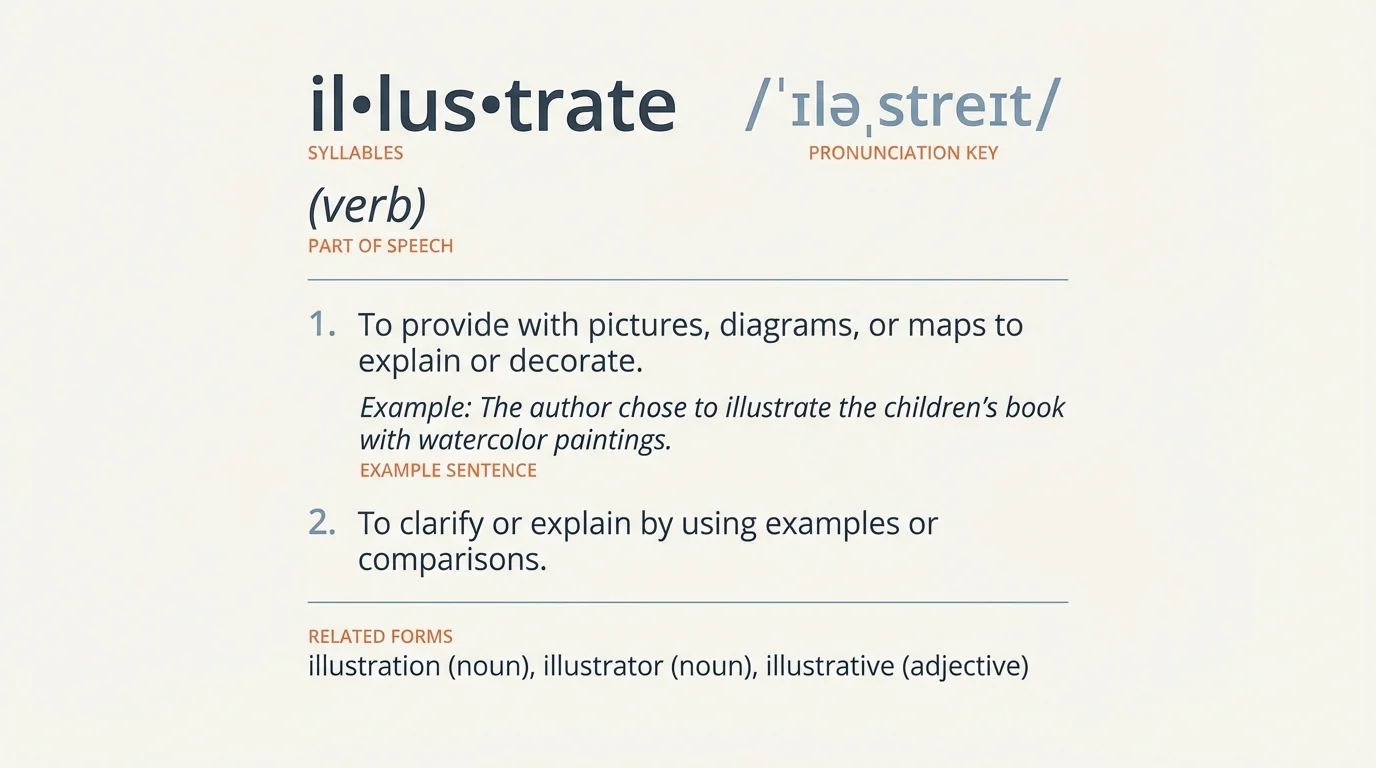
Next, the entry often gives the word's part of speech. This matters because the same spelling can belong to different parts of speech. For example, record can be a noun, as in "She broke the school record," or a verb, as in "Please record the interview." The pronunciation may even change depending on the part of speech.
Dictionary entries also list numbered definitions. These are not random. They separate different meanings of the same word. If you only read the first definition, you may miss the one that fits your sentence. Example sentences, guide words, and usage notes can help you decide which meaning matches the context.
Some entries include additional information such as syllable breaks, word origin, informal or formal usage labels, and whether a meaning is common in a specific field. Later, when you compare meanings in context, the structure in [Figure 1] helps you know exactly where to look.
Reading a dictionary entry carefully
Suppose you see the word charge in a passage. A dictionary may list several meanings.
Step 1: Find the part of speech in the sentence.
In "The store will charge a fee," charge is a verb.
Step 2: Ignore definitions for the wrong part of speech.
You would skip meanings such as "an accusation" if that meaning is listed as a noun.
Step 3: Compare the remaining meanings to the sentence.
Here, the correct meaning is "to ask as a price" or "to demand payment."
This process is faster and more accurate than guessing.
Notice that the sentence itself helps narrow your choices. Reference materials work best when you use them together with the text around the word.
Context clues are the words, phrases, and ideas around an unfamiliar word. They help you decide which dictionary meaning fits best, and [Figure 2] illustrates how the same word can shift meaning from one sentence to another.
Take the word volume. In math or science, it may mean the amount of space something takes up. In music or technology, it may mean loudness. In publishing, it may mean a book in a series. If you read, "Turn down the volume before the meeting starts," the surrounding words suggest sound, not space or books.
Now consider these three sentences: "The container has a large volume." "Please lower the volume on the speaker." "She checked out the final volume of the trilogy." The repeated word is the same, but the nearby words—container, speaker, and trilogy—signal different meanings.
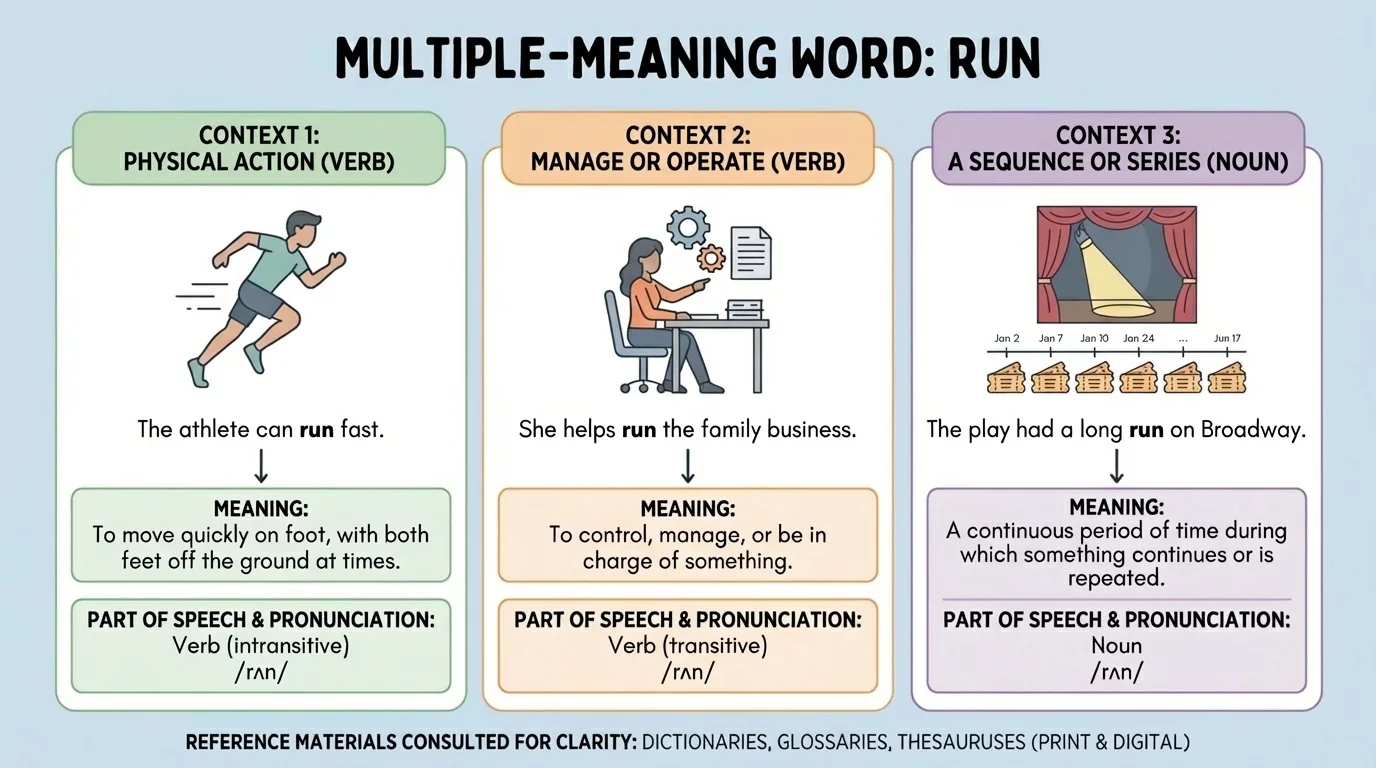
Context can also help you determine part of speech. In "The coach gave sound advice," sound is an adjective meaning reliable or solid. In "We heard a strange sound," it is a noun. In "The alarm will sound at noon," it is a verb. The word around it changes its job and its meaning.
When you look up a word, do not separate the entry from the sentence you are reading. Instead, move back and forth between them. The sentence tells you what kind of meaning to search for, and the reference source confirms it. The comparison in [Figure 2] reminds you that one spelling can lead to several valid definitions.
Use context first, then confirm with a source
Context gives a possible meaning, but reference materials provide precision. This combination is powerful because it prevents both wild guessing and careless dictionary use. Readers who use both strategies understand texts more deeply.
This is especially important in academic reading, where authors often choose exact terms. A nearly correct meaning is sometimes not correct enough.
Some words seem familiar but have special meanings in certain subjects. In everyday speech, theory can mean a guess or idea. In science, it means a well-supported explanation based on evidence. A general dictionary may help, but a science glossary gives the meaning that fits the class text more precisely.
In history, a word like ratify has a specific civic meaning connected to officially approving a law, treaty, or amendment. In literature, symbolism refers to the use of symbols to represent bigger ideas. In computer science, bug usually means a problem in software or hardware, not an insect.
This is why specialized resources matter. A subject glossary, encyclopedia, academic website, or field-specific dictionary can explain how experts use a term. When a text includes technical vocabulary, start by asking, "Is this a regular everyday word, or is it being used in a special discipline?"
Many common English words have developed highly specific meanings in academic fields. The word cell, for example, means something very different in biology, prisons, and spreadsheets.
Specialized reference materials are also useful because they often include diagrams, examples, and related terms from the same field. That extra support can make complex reading much more understandable.
Readers today use both paper and screen-based tools, and [Figure 3] compares their main strengths. Neither format is automatically better in every situation. The best choice depends on what you need.
Print dictionaries and glossaries can help you slow down and study an entry carefully. You can see nearby words on the page, which sometimes helps you notice patterns in spelling or meaning. Print sources are also useful when internet access is limited or when a teacher wants students to practice alphabetical searching.
Digital reference tools are fast and flexible. You can type a word, hear its pronunciation, switch languages, search related forms, and sometimes see examples from real texts. Many digital tools also let you click directly from one word to another, which is convenient during research or online reading.
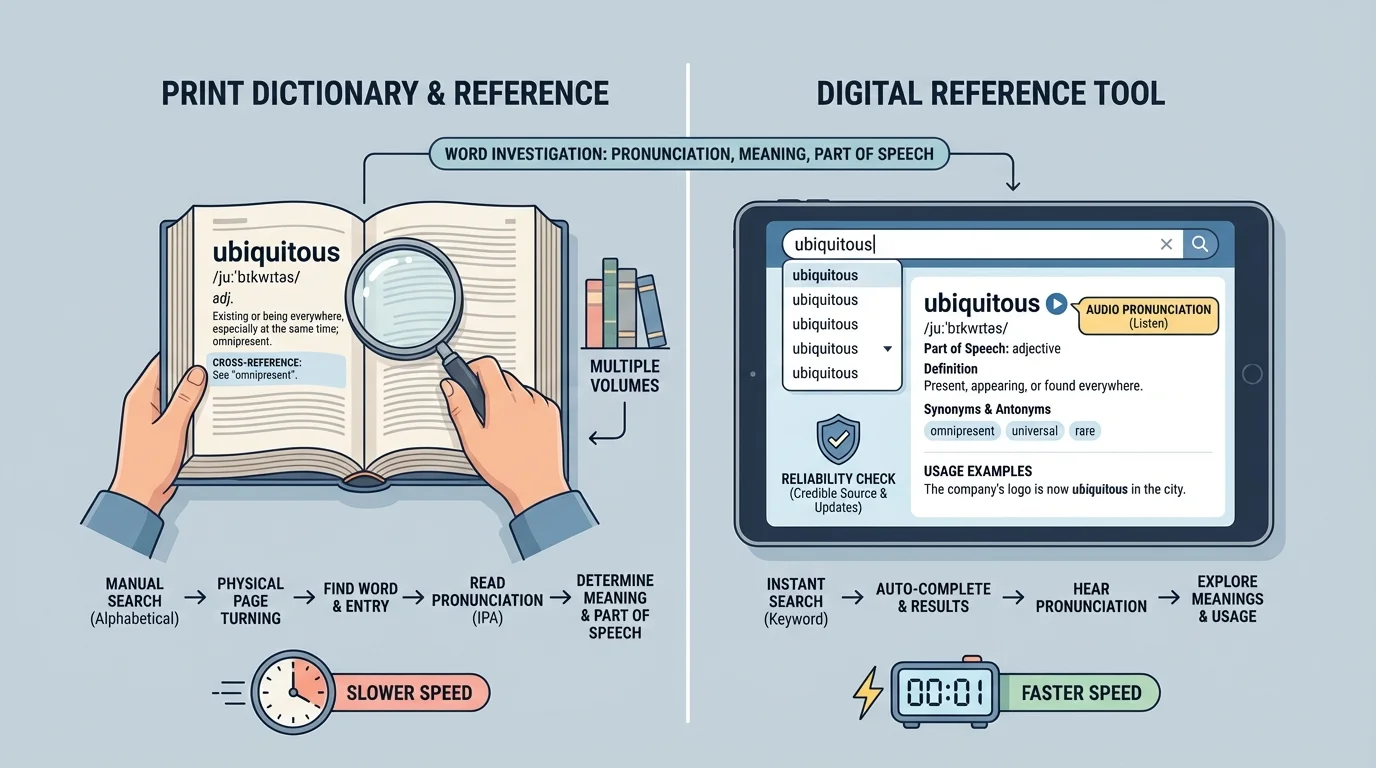
However, digital speed can create mistakes if you trust the first result without checking it. Some websites are more reliable than others. Good sources are usually published by well-known dictionaries, schools, universities, libraries, or trusted educational organizations. If a site looks messy, gives no source, or includes strange examples, be cautious.
Print tools also have limits. They may not include audio pronunciation, and they can be slower when you need to check several related words quickly. As shown in [Figure 3], the smartest readers choose the tool that matches the task: depth and focus in print, speed and extra features in digital form.
| Tool | Best For | Possible Limitation |
|---|---|---|
| General dictionary | Everyday word meanings, pronunciation, part of speech | May be too broad for technical subjects |
| Subject glossary | Terms in one book or field | Usually limited to that subject |
| Thesaurus | Finding related words while writing | Synonyms may not fit the exact context |
| Digital dictionary | Fast search, audio, related forms | Quality depends on the website or app |
| Print dictionary | Careful study, dependable editing | Slower to search and no audio |
Table 1. Comparison of common reference tools and when they are most useful.
A thesaurus can improve writing, but only when used with judgment. If you want to avoid repeating the word important, a thesaurus may suggest significant, essential, major, or critical. These words are related, but they are not identical.
This difference is called connotation, the feeling or association a word carries in addition to its basic meaning. For example, slim and skinny can both describe a thin person, but they do not sound the same in tone. One is often positive, while the other may sound negative.
That is why a thesaurus should not be your only tool. After finding a possible synonym, check the dictionary meaning and reread the sentence. Ask whether the word fits the tone, topic, and part of speech. This extra step prevents awkward writing.
Choosing a synonym with care
A student wants to revise the sentence "The movie had a strange ending." A thesaurus suggests odd, unusual, and bizarre.
Step 1: Compare tone.
Unusual sounds neutral. Bizarre sounds much stronger.
Step 2: Match the writer's purpose.
If the ending was surprising but not extreme, unusual may fit better than bizarre.
Step 3: Check the final sentence.
"The movie had an unusual ending" is more precise if the tone is calm and analytical.
Writers use thesauruses to strengthen word choice, but readers can also use them to understand shades of meaning between similar terms.
When you meet an unfamiliar word, use a clear process instead of stopping randomly or skipping it completely. First, read the whole sentence and the lines around it. Look for context clues such as examples, contrasts, definitions, or cause-and-effect signals.
Second, decide what kind of information you need. Do you need pronunciation? A definition? The part of speech? A subject-specific meaning? This question helps you choose the right tool. If the word is clearly technical, a glossary or specialized dictionary may be better than a general thesaurus.
Third, examine the reference entry carefully. Check all meanings that match the part of speech in your sentence. Fourth, test the most likely meaning by placing it back into the sentence. If it makes sense and fits the topic, you probably found the right meaning.
Finally, keep reading and see whether the paragraph continues to support your choice. Skilled readers stay flexible. If later information does not fit, they return to the reference source and reconsider.
You already use word parts and context clues to make smart guesses. Reference materials do not replace those strategies; they sharpen and confirm them.
This process becomes faster with practice. Eventually, you will know when a quick check is enough and when a word deserves a closer look.
One common mistake is choosing the first definition without reading the others. Dictionaries often list several meanings, and the first one may not match your text. Another mistake is ignoring the part of speech. A word used as a verb may have a different meaning from the same word used as a noun.
A third mistake is trusting every online result equally. Some digital sources are excellent, but others are oversimplified, inaccurate, or missing usage notes. If a definition seems odd, compare it with another reliable source.
Students also sometimes replace a word with a thesaurus synonym that does not fit the context. This can make writing sound unnatural or even change the meaning completely. Precision matters more than sounding fancy.
Another mistake is checking a word but not returning to the text. Reference materials only help if you reconnect the definition to the sentence, paragraph, and topic the author is discussing.
These skills appear in every subject. In English language arts, you use them to understand complex reading and improve your own writing. In science, you use them to decode technical terms. In social studies, you use them to understand government, economics, and historical vocabulary. In math, you may need to distinguish between everyday and academic meanings of words like mean, rational, or table.
Outside school, reference skills help when you read product instructions, compare information online, interpret news articles, learn from videos, and communicate clearly. Accurate word knowledge is a real-world advantage. People who check words carefully are less likely to misunderstand directions, spread false information, or choose weak wording in important situations.
"The difference between the almost right word and the right word is really a large matter."
— Mark Twain
That idea captures why reference materials matter. A precise word builds precise thinking. The more carefully you use dictionaries, glossaries, and thesauruses, the more effectively you can read, write, speak, and learn.
