Some lines of writing hit like a drumbeat. Others creep in quietly, then stay in your head for hours. That difference is not luck. It comes from style—the writer's careful choice of sounds, images, and visual layout on the page. In narrative writing, style helps a reader hear the narrator, sense the mood, and feel the moment as if it is happening right now.
When writers tell a real or imagined story, they do more than report events. They create a voice, the distinct personality that comes through in the writing. A nervous narrator may sound clipped and breathless. A confident narrator may sound sharp and direct. A reflective narrator may use longer, smoother sentences. Voice grows from many choices working together, including word choice, sentence rhythm, figurative language, and even where words sit on the page.
Narratives become engaging when details are relevant and purposeful. A strong writer does not pile on effects just to sound fancy. Instead, each effect helps reveal a character, build a mood, slow down or speed up pacing, or show how the narrator experiences events.
Voice is the unique personality, attitude, and feeling that come through in a piece of writing. Stylistic techniques are deliberate writing choices that shape how the language sounds and feels. Figurative language uses comparison or exaggeration to express ideas in vivid ways. Graphic elements are visual choices on the page, such as capitals, spacing, line length, or word placement, that affect meaning and emphasis.
A narrative voice can sound personal, dramatic, funny, thoughtful, or tense. The same event—walking into school late, hearing thunder, missing a winning shot—can feel completely different depending on the style used to tell it.
Think about hearing two people tell the same story. One says, "I went outside and it was raining." Another says, "Rain hammered the sidewalk, and I ran through the silver noise with my backpack over my head." Both sentences describe rain, but the second has stronger voice because it uses vivid details and rhythm. Style turns information into experience.
[Figure 1] In narratives, style helps a writer do several important jobs at once. It can show emotion without directly naming it. It can reveal what kind of person the narrator is. It can make scenes feel fast, slow, loud, quiet, joyful, or frightening. It can also guide the reader's attention to what matters most.
Writers of stories, memoirs, spoken-word poems, songs, and even personal essays all depend on style. Athletes use body language. Musicians use tempo and volume. Writers use language and layout in the same way: to control effect.
Many memorable lines from books, speeches, and song lyrics stay in people's minds because of sound patterns and striking imagery, not just because of the basic information in the sentence.
A strong narrative sequence needs clear events, but it also needs a believable human presence behind those events. Style is one of the main tools that creates that presence.
Alliteration and onomatopoeia are sound-based techniques that make writing more expressive. Sound matters because readers do not just understand words; they also hear them in their minds. That inner sound affects mood, energy, and emphasis.
Alliteration is the repetition of beginning consonant sounds in nearby words. For example: "The wind whipped and whistled through the broken window." The repeated sound connects the words and gives the sentence a musical quality. In narrative writing, alliteration can make a description feel smooth, harsh, playful, or intense, depending on the sounds chosen.
Onomatopoeia uses words that imitate sounds, such as buzz, crash, snap, hiss, or thud. These words put sound directly into the scene. "The locker door slammed with a BANG" feels more immediate than "The locker door closed loudly." Onomatopoeia is especially useful in action scenes, suspenseful moments, or any part of a narrative where the senses matter.
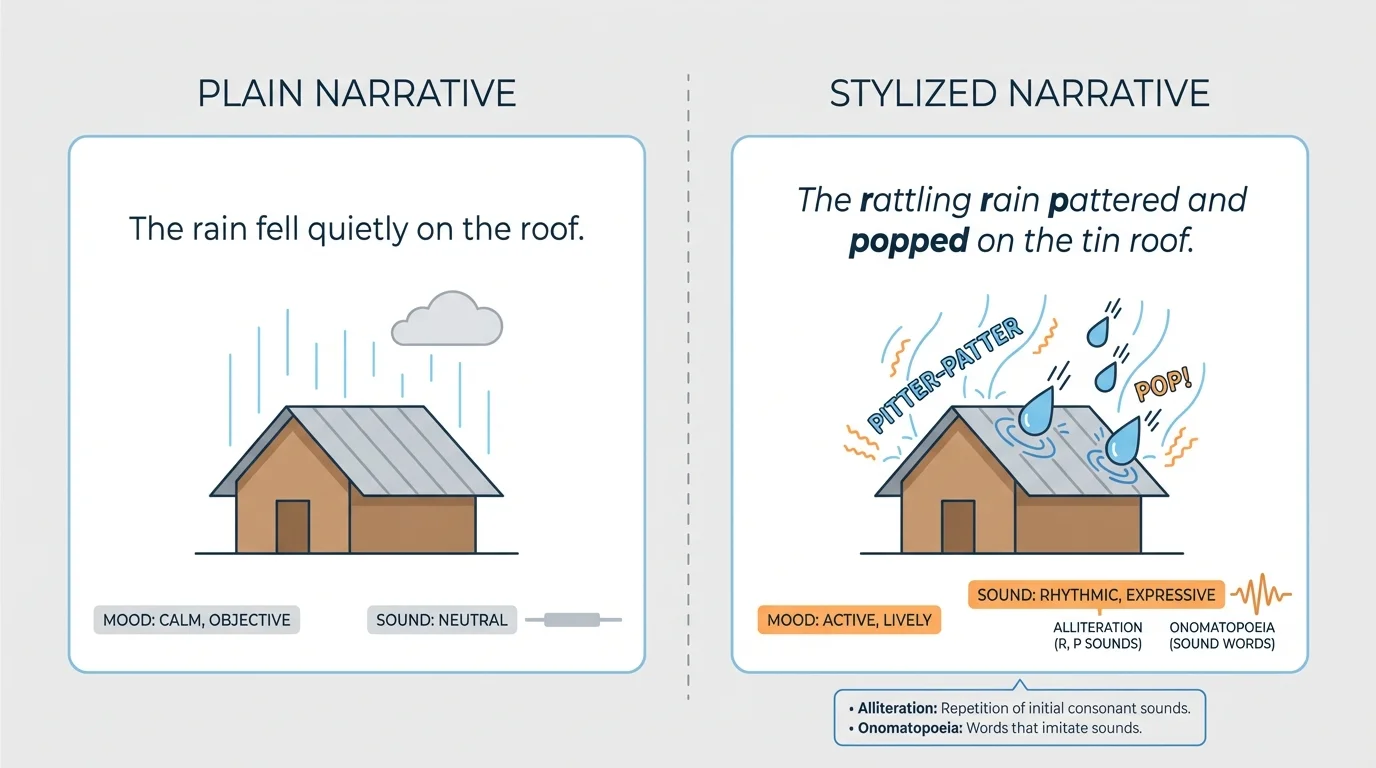
Sound techniques also affect pacing. Short, sharp sounds such as crack, clap, and snap can speed up a moment and make it feel sudden. Softer repeated sounds such as s, m, or l can slow a sentence and make it feel calm or secretive.
Compare these examples:
Plain: "The leaves moved in the wind."
Styled: "The leaves shivered and swished in the sharp September wind."
The second sentence uses alliteration in "sharp September" and sound-rich word choice in "shivered" and "swished." These choices make the scene more vivid and give the narrator a more active voice.
Writers must still be careful. Too much alliteration can sound forced. Too many sound words can make serious writing feel cartoonish. The goal is not to stuff a sentence with effects. The goal is to choose effects that fit the scene.
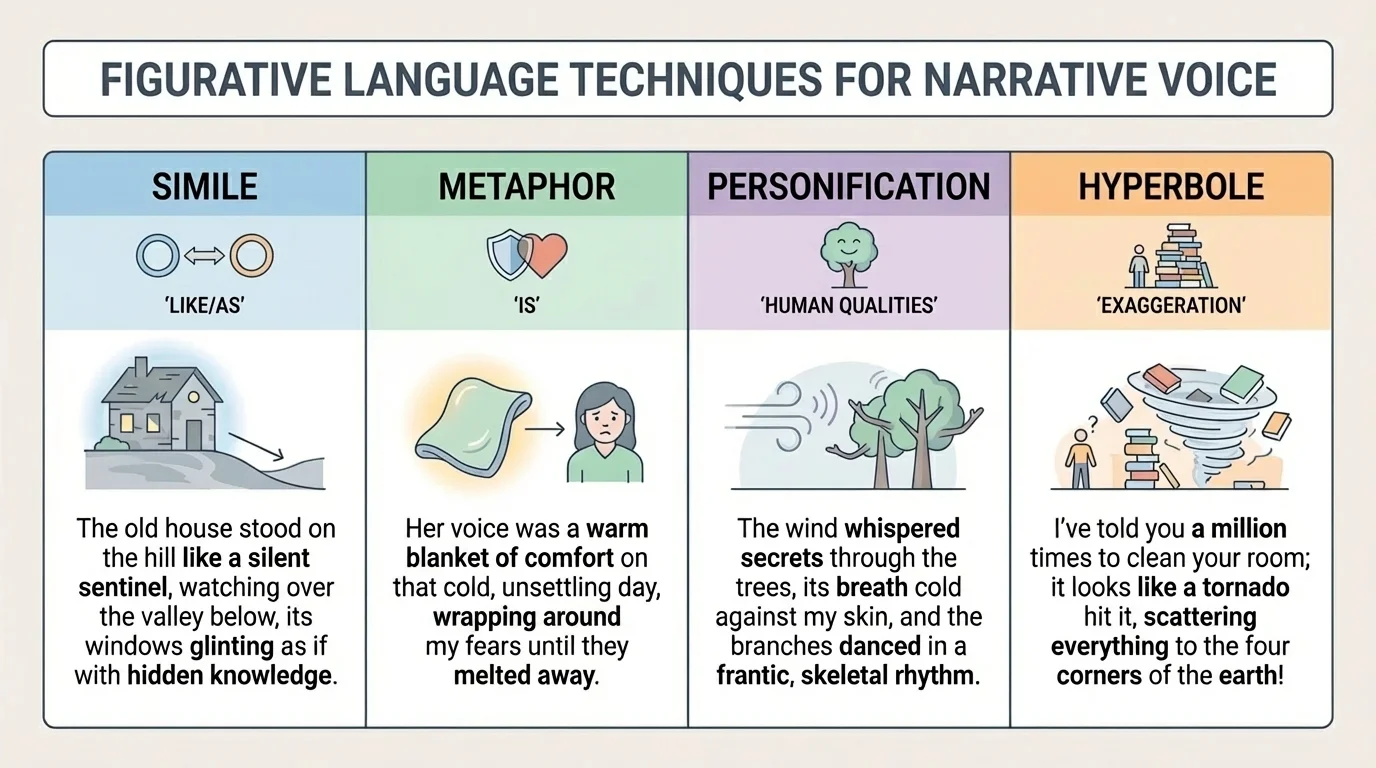
Figurative language helps writers say more than the literal facts. It allows description to carry emotion, perspective, and meaning. Instead of simply telling what something looks or feels like, figurative language shows how the narrator experiences it.
[Figure 2] A simile compares two unlike things using words such as like or as. Example: "My stomach twisted like a knot in a rope." This does more than say the narrator is nervous. It gives a physical image of that tension.
A metaphor makes a direct comparison without using like or as. Example: "The hallway was a battlefield." A metaphor can be stronger and more surprising than a simile because it presents the comparison as if it is true. The reader immediately senses conflict, pressure, and danger.
A personification gives human traits or actions to nonhuman things. Example: "The old floorboards complained beneath my steps." The floorboards do not literally complain, but personification makes the setting feel alive and helps build mood.
A hyperbole is deliberate exaggeration for effect. Example: "I had told him a million times to stop kicking my chair." This is not meant literally. It expresses frustration and personality.
Each type of figurative language can reveal character. A narrator who says, "My thoughts were bees trapped in a jar," sounds different from one who says, "My thoughts were browser tabs all crashing at once." Both metaphors suggest overwhelm, but the second has a more modern, tech-based voice. That is an important idea: figurative language should fit the narrator's world.
Figurative language can also deepen sensory writing. Consider these examples:
Literal: "The soup was hot."
Simile: "The soup hit my tongue like a small fire."
Literal: "The gym was noisy."
Metaphor: "The gym was a thunderstorm of sneakers, whistles, and shouting."
Literal: "The morning was quiet."
Personification: "The morning held its breath."
Figurative language is most effective when it is fresh and specific. Overused comparisons such as "cold as ice" or "busy as a bee" may communicate meaning, but they usually create a weaker voice because readers have heard them too many times. Strong voice often comes from comparisons that feel surprising yet believable.
Strong figurative language matches the moment. In an action scene, a quick, sharp metaphor may work better than a long, detailed comparison. In a reflective scene, a slower image can help the reader stay with the narrator's thoughts. The best comparison is not always the fanciest one; it is the one that most clearly fits the feeling, setting, and character.
Later in a narrative, these same techniques can return to build patterns. If storms represent fear early in a story, then another storm image later may signal the return of that fear, as shown in the organized examples in [Figure 2].
[Figure 3] The page itself can carry meaning. Writers sometimes express voice not only through words but through how those words appear. This does not mean random formatting. It means using visual choices to support pacing, emphasis, and emotion.
Capital letters can signal shouting, urgency, intensity, or a sudden emotional spike. For example: "I reached for the railing and missed. Then—DROP." The capitalized word visually stands out and makes the fall feel immediate. However, if everything is capitalized, nothing feels important. Capitals work because they are unusual.
Line length can change rhythm. Short lines can slow the reader down or create suspense. They can also mimic breathing, hesitation, or shock. Longer lines can feel flowing, thoughtful, or overwhelming. This is especially useful when a narrative includes poetic moments or internal thoughts.
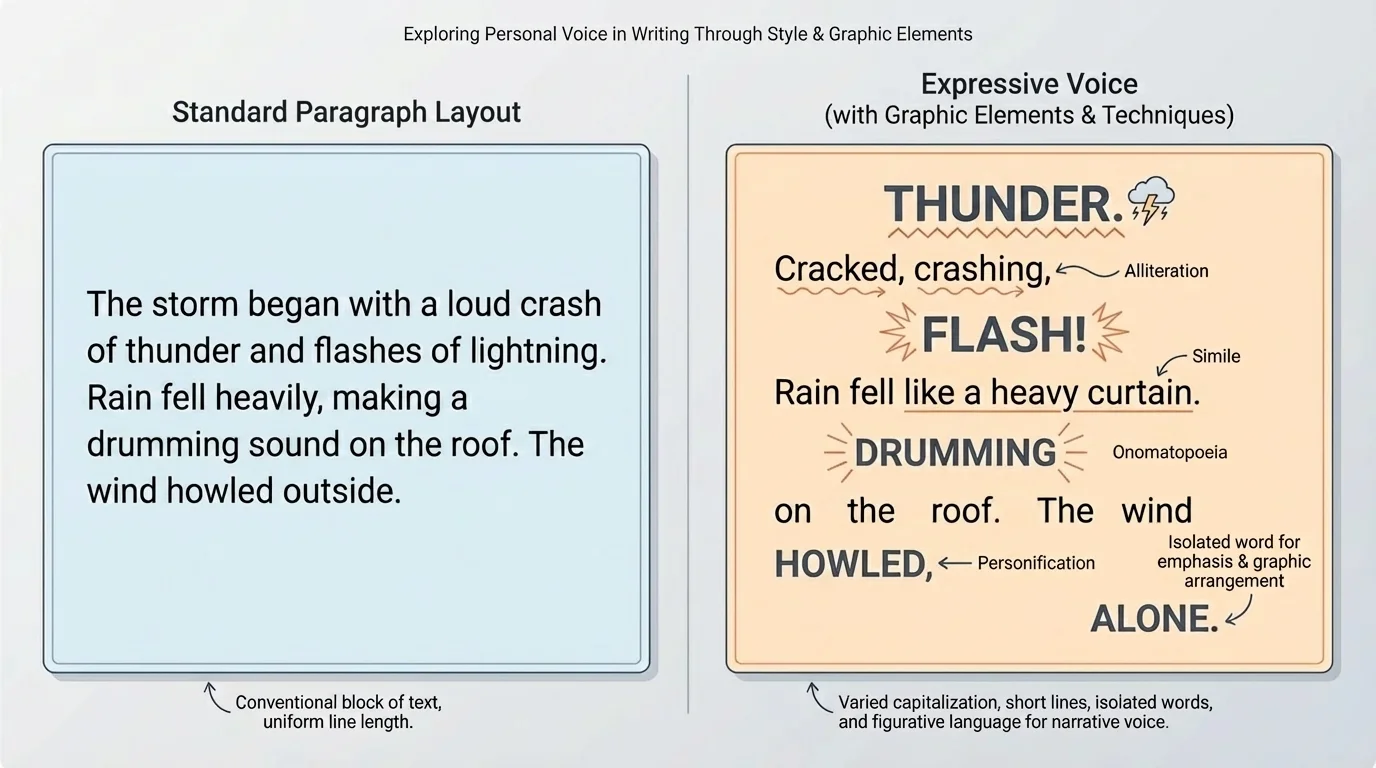
Word position matters too. A single word placed alone can act like a spotlight. Example:
"I opened the envelope.
Read the first line.
And stopped.
Immediately."
Putting Immediately alone gives it extra force. In a standard sentence, that impact would be smaller.
Writers also use punctuation as a visual and rhythmic tool. Dashes can interrupt. Ellipses can trail off or suggest uncertainty. Sentence fragments can reflect panic, speed, or thought. For example: "I heard footsteps. Closer now. Too close." The fragments create tension.
Graphic elements work especially well when a narrator feels strong emotion. A text message scene, a panic moment, a spoken-word performance, or a memory breaking apart in the narrator's mind may all benefit from careful visual shaping. As with all style choices, the visual effect should help the reader understand the experience, not distract from it.
Narrative voice is the voice of the person telling the story. Sometimes it sounds similar to the real writer's own personality. Sometimes it belongs to an invented character and is very different from the writer. Either way, the voice should feel consistent and believable.
A personal voice often grows from the writer's real way of observing the world. Maybe the writer notices small sounds, unusual comparisons, or dry humor. In a personal narrative, these habits can make the writing feel authentic. In a fictional narrative, voice comes from character. A competitive athlete might describe everything in terms of training, risk, and pressure. A musician might hear rooms in terms of rhythm and echo. A scientist-minded narrator might notice patterns and details others ignore.
Voice is built by many small choices. Here are some of the most important:
Good narrative writing does not simply describe what happened. It shows who is telling the story and how that person sees events.
Comparing voice in the same event
Event: A student waits outside the principal's office.
Step 1: Neutral version
"I sat outside the office and waited for my name to be called."
Step 2: Anxious voice
"I sat outside the office, knees bouncing, while the clock hacked the seconds into tiny pieces."
Step 3: Confident voice
"I leaned back outside the office and waited. Let them call me when they were ready."
The event is the same, but the voice changes the reader's understanding of the narrator.
Notice that the anxious version uses personification in "the clock hacked the seconds," while the confident version uses shorter, firmer sentences. Voice is not just what the narrator says. It is how the narrator says it.
The strongest narratives often combine several techniques at once. A writer may use sensory detail, figurative language, dialogue, sound effects, and visual emphasis in the same scene. The key is control. Each choice should support the scene's purpose.
Consider this plain version: "I entered the dark gym and heard thunder outside. I was nervous about the speech."
Now consider a richer version: "The gym swallowed me in one gulp. Thunder grumbled above the roof, and the microphone squealed when I touched it. My note cards shook in my hands like trapped birds. 'You're up,' someone whispered, and suddenly every chair in the room seemed to turn and stare."
This second version uses a metaphor in "The gym swallowed me," onomatopoeia in "squealed," a simile in "like trapped birds," and personification in "chairs...stare." It also includes dialogue and sensory detail. The result is a stronger narrative voice and a more vivid emotional experience.
Style can also help with logical pacing. If an important event happens quickly, the writing may shift into short sentences and strong sounds. If the narrator is reflecting, the writing may slow down with longer descriptions and more thoughtful imagery.
Descriptive details are strongest when they are connected to the situation and the narrator's perspective. Sensory language should not feel pasted on. It should help the reader see, hear, smell, taste, or feel what matters in the moment.
Dialogue can contribute to voice too. A narrator who notices exact tone, pauses, and word choice in conversation sounds different from one who summarizes speech quickly. Even a single line of dialogue can sharpen a scene when it reveals conflict or emotion.
Strong writers make choices based on effect. Before using a technique, it helps to ask: What do I want the reader to feel here? What does this reveal about the narrator? Does this comparison fit the character? Does this formatting help the pacing?
Here is a useful way to think about purpose:
| Technique | Best used for | Possible risk |
|---|---|---|
| Alliteration | Musical sound, emphasis, mood | Can sound forced if overused |
| Onomatopoeia | Action, immediacy, sensory detail | Can sound exaggerated in serious scenes |
| Simile | Clear comparison, emotion, imagery | Can become cliché |
| Metaphor | Strong insight, deeper meaning, mood | Can confuse if too mixed or abstract |
| Personification | Atmosphere, emotional setting | Can feel artificial if every object is personified |
| Hyperbole | Humor, intensity, dramatic voice | Can weaken realism if misused |
| Capital letters and spacing | Visual emphasis, shock, pacing | Can distract if used too often |
Table 1. Common stylistic techniques, their main strengths, and risks to watch for.
Purpose also depends on genre and scene. A suspense story may use short lines and sharp sound words. A reflective personal narrative may use metaphor and slower sentence rhythms. A humorous narrator may use hyperbole more often. A serious narrator may use visual emphasis very sparingly.
Effective writing often sounds natural, but it is usually carefully crafted. Readers should feel the effect without feeling the writer pushing too hard.
[Figure 4] Good style often emerges during revision, not only in the first draft. Writers reread and ask whether a scene sounds flat, generic, or inconsistent. They replace weak verbs, sharpen comparisons, remove unnecessary words, and add emphasis where needed in a before-and-after revision.
Revision is also when writers check balance. A page full of metaphors may feel overloaded. A dramatic scene with no sensory detail may feel empty. A story with visual formatting everywhere may lose its power because the reader stops noticing it.
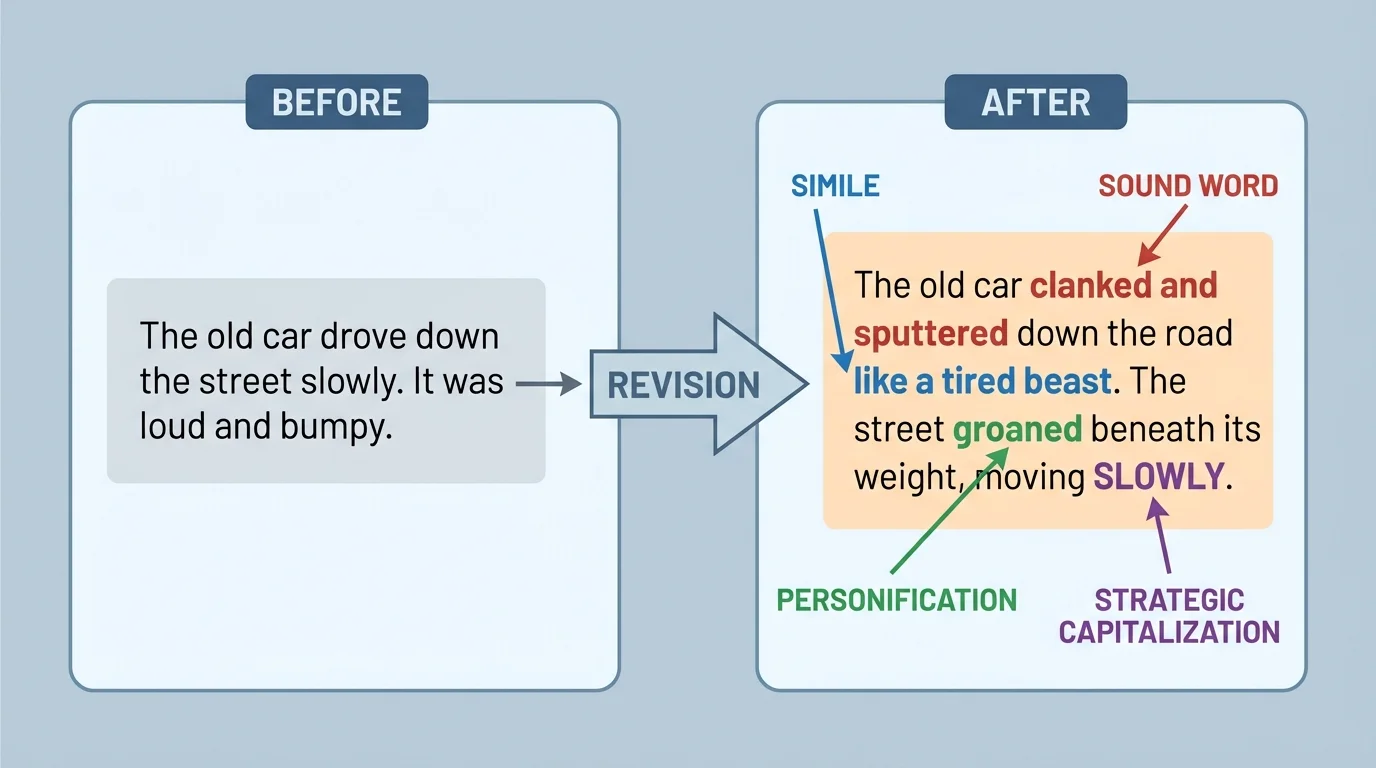
Look at this revision process:
Draft sentence: "I was scared when the power went out."
Revised sentence: "The lights snapped off, and the room lunged into blackness. My breath turned thin as thread. Somewhere in the kitchen, a glass tapped once against the counter. Then silence. Huge silence."
The revision does not simply say "I was scared." It creates fear through onomatopoeia, personification, sensory detail, and sentence rhythm. Later, if the writer wants to increase intensity even more, a graphic choice might isolate a word such as "Silence." on its own line.
Revising a flat sentence into a stronger voice
Original: "The bus was late, and I was annoyed."
Step 1: Add sensory detail
"The bus was late, and cold rain soaked through my sleeves."
Step 2: Add figurative language
"Cold rain soaked through my sleeves, and the minutes dragged like wet shoes."
Step 3: Add voice and emphasis
"Cold rain soaked through my sleeves, the minutes dragged like wet shoes, and the bus still did not come. Not at 7:10. Not at 7:15. Not at all."
The final version sounds more frustrated because rhythm, repetition, and detail work together.
When revising, it helps to read the writing aloud. Alliteration becomes easier to hear. Pacing becomes clearer. Awkward or overdone effects stand out more quickly. Reading aloud is one of the best ways to test whether a narrative voice feels real.
As your writing grows stronger, you begin to notice that style is not decoration added at the end. It is part of meaning. The way a story sounds, the images it uses, and the way it looks on the page all help express the experience itself. That is why thoughtful style makes narrative writing more powerful, memorable, and personal.
When you look back at examples such as the sound contrasts in [Figure 1], the figurative language categories in [Figure 2], the visual emphasis in [Figure 3], and the revision changes in [Figure 4], the main pattern becomes clear: every technique is strongest when it helps the reader feel the narrator's exact perspective.
