Some of the most memorable people in literature are not heroic all the time, not honest all the time, and not even sure of themselves all the time. That is exactly why they feel real. A character who wants two opposite things at once, makes painful choices, hides feelings, changes under pressure, or surprises the reader is often more powerful than a perfectly consistent character. When readers analyze these layered people closely, they begin to see that character is not just part of a story. Character often is the story.
In literary analysis, the goal is not simply to say whether a character is "good" or "bad." Strong readers ask deeper questions: What does this person want? What fears or pressures shape that desire? Why do they act one way in public and another in private? How do they affect others, and how are they affected in return? As those questions become more precise, the reader moves from summary into analysis.
A complex character is interesting because the character feels human. Real people often carry mixed emotions, conflicting responsibilities, private regrets, and changing beliefs. Literature reflects that truth. When a character is torn between loyalty and ambition, love and pride, safety and justice, readers see the tension between inner life and outward action. That tension creates drama and meaning.
Complex characters also challenge readers to think carefully instead of making fast judgments. A person in a novel might do something harmful for a reason that is understandable, or something admirable for reasons that are selfish. This does not excuse every action, but it forces readers to notice nuance. Literature becomes richer when readers recognize contradiction instead of flattening a character into one label.
Many famous protagonists are remembered not because they are flawless, but because they are divided. Their uncertainty, guilt, pride, or fear often creates the very conflict that makes the story compelling.
Because of that, analyzing character helps readers understand nearly every other literary element. Plot grows out of decisions. Conflict grows out of desire. Theme grows out of what a character learns, refuses to learn, gains, loses, or values.
[Figure 1] A character becomes complex when the reader can identify multiple qualities, pressures, and motives working at the same time. A simple character may serve one clear purpose in a text and remain mostly unchanged. A complex character, however, may be generous in one situation and cruel in another, brave in public and terrified in private, or sincere but also manipulative.
One major sign of complexity is motivation. Motivation means the reason behind a character's actions. In stronger literature, characters rarely act for only one reason. A student might join a team for friendship, status, competition, and family approval all at once. In the same way, a literary character may speak, hide, confess, attack, or sacrifice for mixed reasons.
Another key sign is conflicting motivations. A character may want success but also want to remain moral. A character may want freedom but fear loneliness. A character may love someone and resent that same person. These tensions matter because they make choices difficult. If every decision were easy, the story would lose depth.
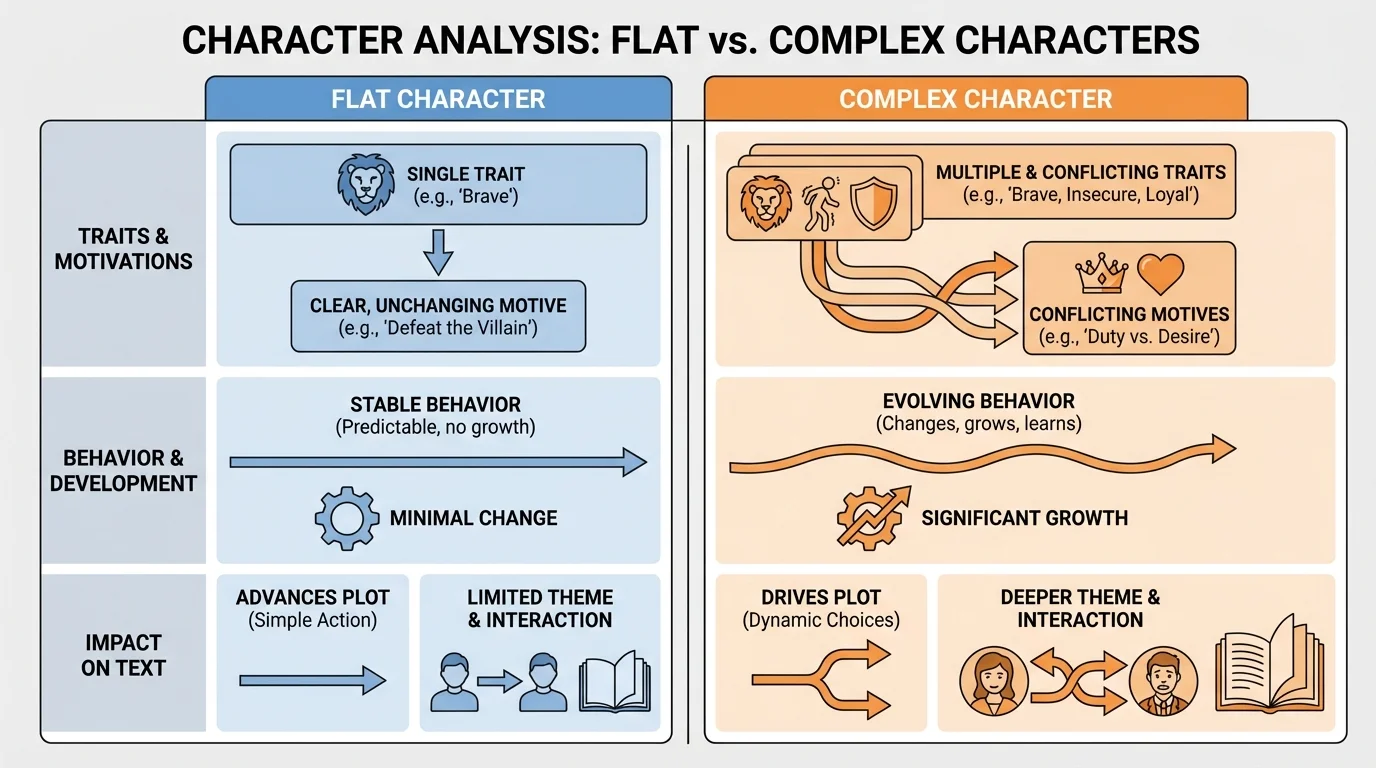
Complexity also appears through contradiction. Contradiction does not mean the author wrote the character badly. It often means the author understands human behavior. Someone can be protective and controlling, confident and insecure, loyal and dishonest. The reader's task is to ask how these traits fit together and what pressures make one side appear more strongly at certain moments.
Characterization is the way an author reveals a character through description, actions, dialogue, thoughts, and the reactions of others. A character arc is the pattern of change, growth, decline, or self-discovery a character experiences over the course of a text.
Writers build complex characters through direct characterization, such as narration that tells the reader what the person is like, and indirect characterization, such as speech, behavior, and choices. Often the most important details are indirect. A character who says "I'm fine" while avoiding eye contact and destroying a letter tells the reader much more than the words alone.
[Figure 2] To analyze a character well, readers need to follow that person from the beginning of the text to the end, watching for shifts in goals, fears, and self-understanding. A single scene can be important, but strong analysis usually examines a pattern across multiple moments.
Start by asking who the character is at the beginning. What does the character believe? What does the character want? What weaknesses or blind spots are already visible? Then move to the middle of the text. What new conflict tests that person? What relationships become strained? What secrets are exposed? Finally, examine the ending. Has the character changed, resisted change, or been destroyed by refusing to change?
Turning points are especially important. A turning point is a moment when a decision, discovery, or event forces a character in a new direction. The best analyses do not just name the turning point; they explain why it matters. If a character tells the truth after lying for most of the novel, the reader should ask what changed: guilt, pressure, loyalty, maturity, or loss.
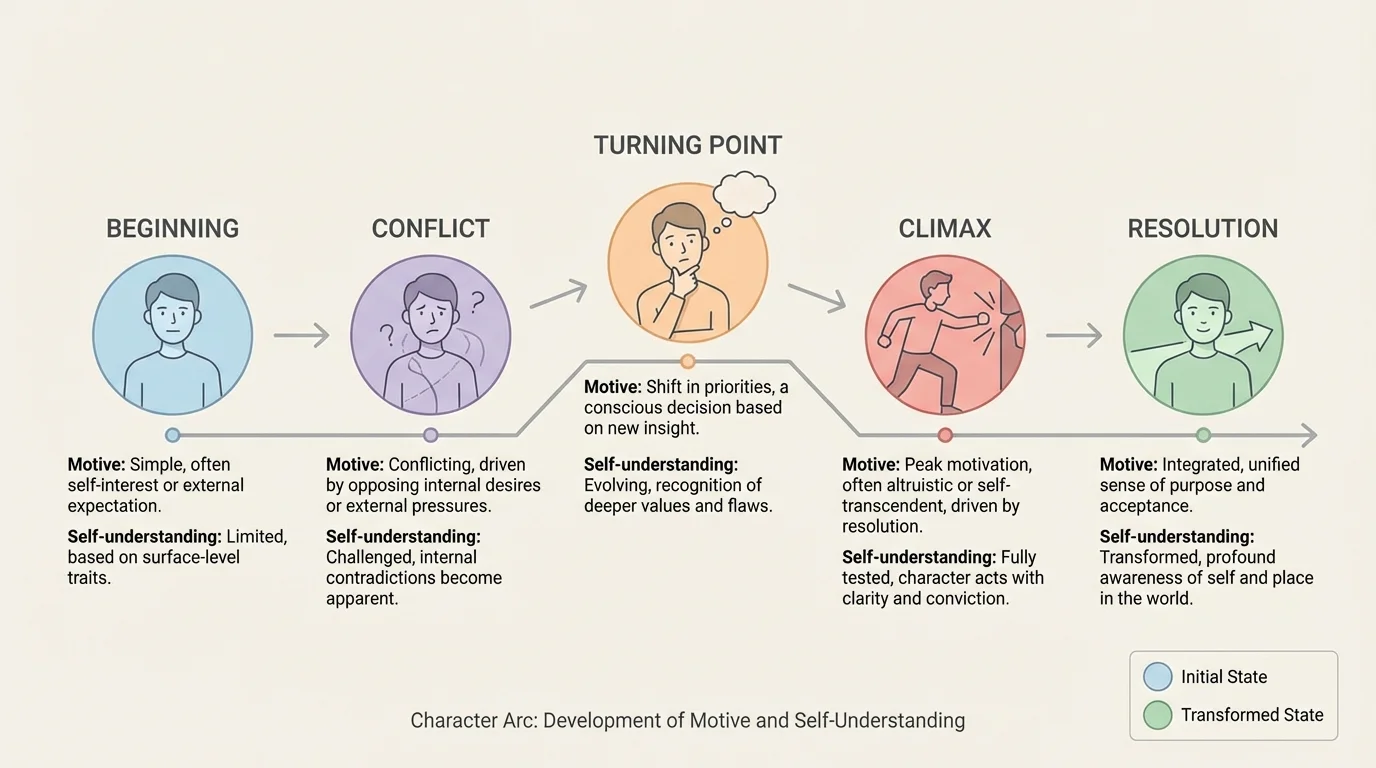
Readers should also notice whether the development is positive, negative, or mixed. Not every character grows wiser. Some become more trapped by pride, fear, anger, or obsession. For example, a tragic character may gain insight too late to avoid disaster. That is still development. Change does not always mean improvement.
As the text unfolds, evidence matters. Readers can trace development through a character's actions, dialogue, internal thoughts, repeated symbols connected to that character, and how others respond to them. If multiple pieces of evidence point in the same direction, the analysis becomes much stronger than a single isolated quote.
Case study: Macbeth
In Shakespeare's Macbeth, Macbeth begins as a respected warrior, but his ambition is joined by fear, imagination, and moral hesitation.
Step 1: At the start, Macbeth is honored and capable, which makes him more than a simple villain.
Step 2: After hearing the witches' prophecy, his ambition intensifies, but he still understands that murdering Duncan is wrong.
Step 3: Once he chooses violence, guilt and paranoia reshape him, and he becomes increasingly ruthless.
His development matters because the play shows how unchecked ambition can corrupt a person from the inside out.
Macbeth's arc is powerful because he does not begin as a monster. He becomes one through repeated choices. That pattern is central to analyzing complexity: readers should ask not only what a character does, but how one choice makes the next choice easier or harder.
[Figure 3] Characters do not develop in isolation. Their interactions with others reveal sides of them that narration alone may hide. A person may seem calm until challenged by a rival, protective when dealing with a younger sibling, dishonest under pressure from authority, or unexpectedly vulnerable with a trusted friend.
Relationships often act like mirrors, tests, or pressures. A mirror relationship reflects a hidden trait. A test relationship pushes a character to make a moral choice. A pressure relationship forces the character to respond to expectation, temptation, fear, or dependence. When readers look closely at these patterns, they can explain how interaction shapes development.
Consider how dialogue works. A character's word choice, silence, sarcasm, hesitation, or honesty can shift depending on who is present. This means that analyzing the same character in different relationships can reveal complexity. Someone who sounds confident with friends may sound defensive with parents or guarded with a romantic partner.
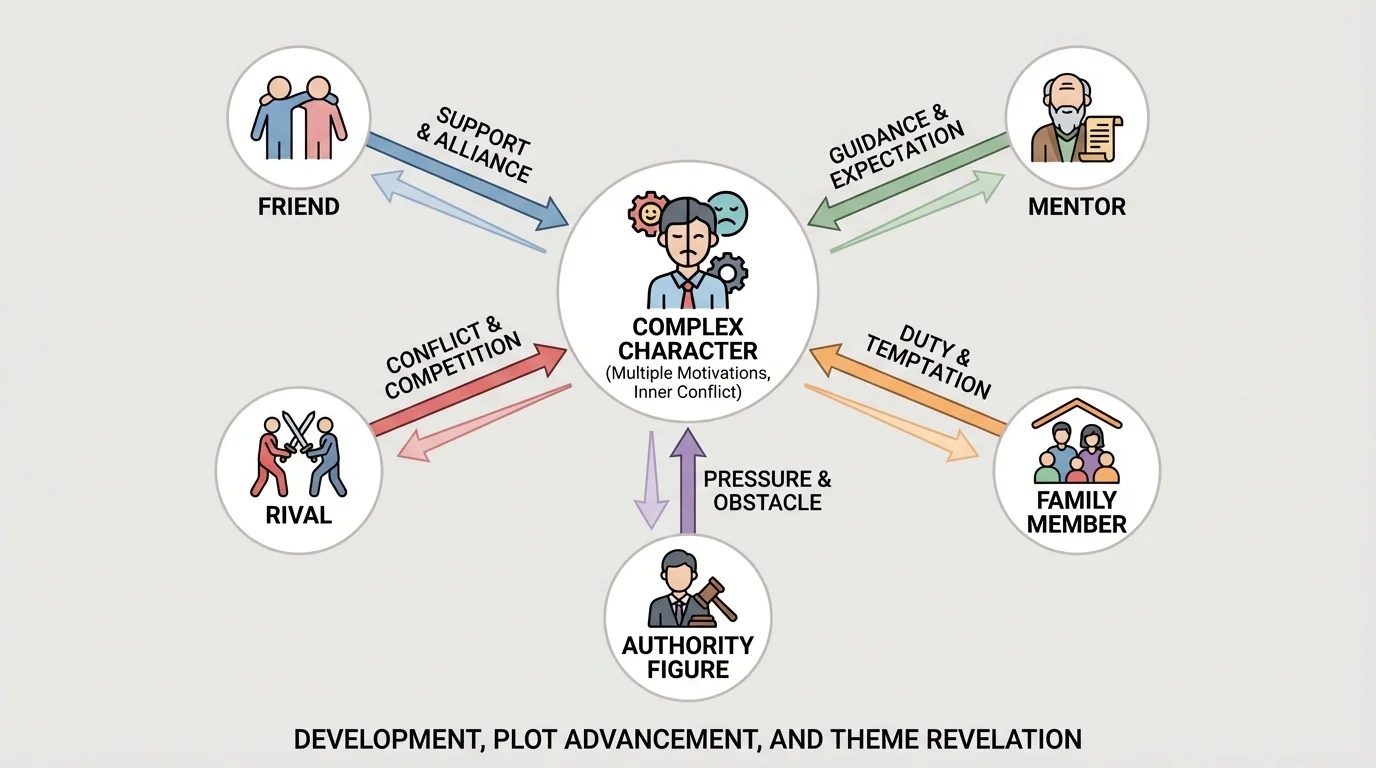
Other characters can also function as contrasts. A foil is a character whose qualities highlight another character's traits. For instance, a cautious friend can make the protagonist's recklessness more visible. A morally steady character can make another person's decline stand out more sharply. By comparing the two, readers understand both more clearly.
Interaction reveals identity
A character's inner life becomes visible through relationships. Conflict with others often exposes values, while loyalty, betrayal, jealousy, admiration, and dependence reveal what the character fears losing or hopes to gain.
In Angie Thomas's The Hate U Give, Starr Carter is complex partly because she moves between different social worlds. Her interactions with family, friends, police, and classmates reveal pressure, code-switching, fear, courage, and growing political awareness. She is not the same in every setting, and that variation is exactly what makes her realistic and layered.
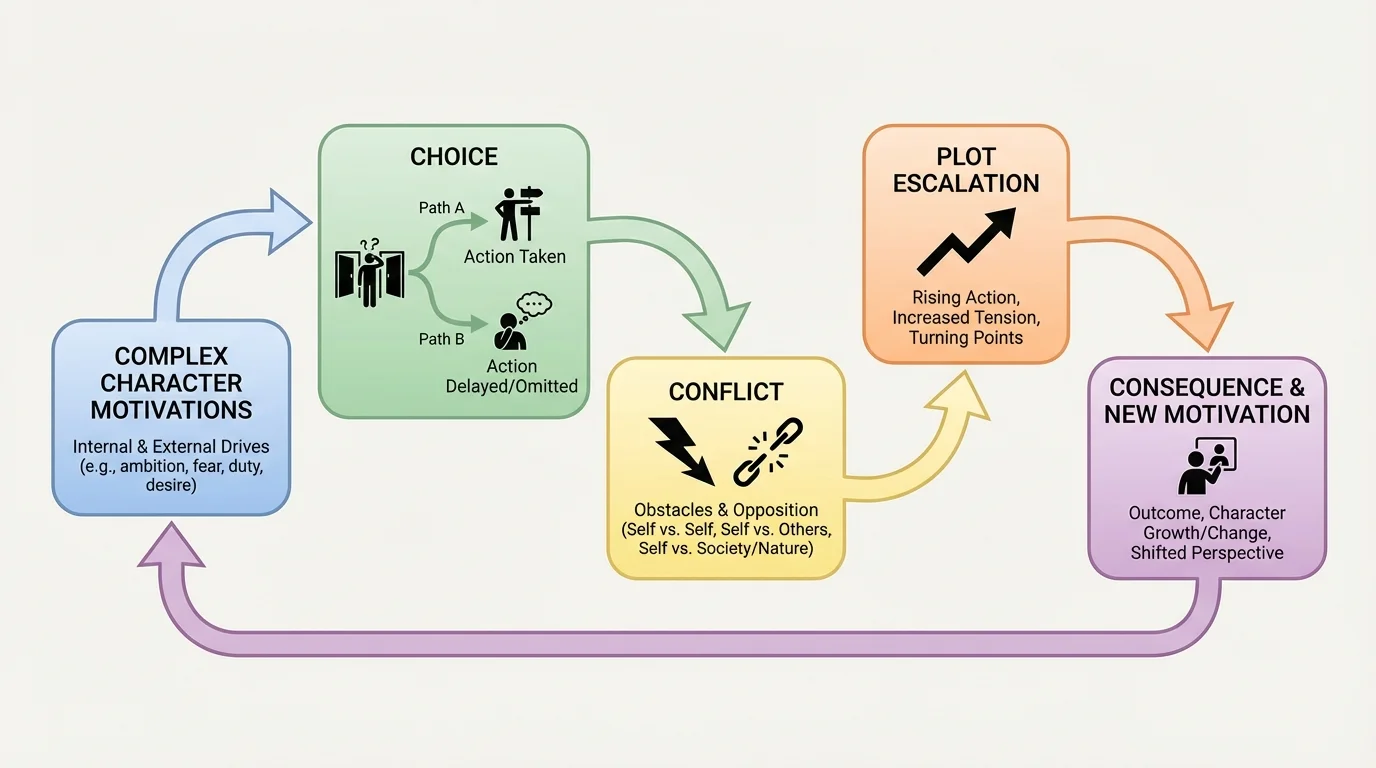
[Figure 4] Stories move forward because characters act, hesitate, hide, confess, resist, or change, and the chain from internal motive to external consequence is clearly shown. Plot is not just a list of events that happen to characters. In strong literature, events happen because of what characters want and what they are willing or unwilling to do.
If a character has conflicting motives, that conflict often creates the central problem of the story. A person who wants truth but fears the consequences of speaking may delay a confession. That delay can create misunderstanding, tension, and later crisis. A person who wants power but also wants to appear honorable may choose deception rather than open force. The plot grows from the pressure between desire and restraint.
Readers should pay attention to cause and effect. Ask: Which choice starts the conflict? Which reaction makes it worse? Which moment changes the direction of the story? When a character's decision leads to consequences, those consequences often reveal something deeper about personality and values.
Consider Romeo and Juliet. Romeo is not just "romantic." He is impulsive, emotional, and intense. Juliet is loving but also brave and increasingly decisive. Their traits move the plot. Their rapid commitment, secrecy, and willingness to defy family expectations create the pace and danger of the tragedy. If they were less intense, the plot would be entirely different.
Likewise, in Ray Bradbury's Fahrenheit 451, Guy Montag's growing dissatisfaction drives the novel forward. At first he accepts the world around him. Then curiosity, discomfort, and moral awakening push him toward books and rebellion. His internal change leads directly to external conflict. A character arc is not separate from plot; it often creates the plot's major turning points.
A theme is a central idea or insight a text explores about life, society, or human nature. Complex characters help develop theme because their struggles make those ideas concrete. Instead of reading an abstract message about ambition, prejudice, loyalty, or identity, the reader sees that idea lived out through choices and consequences.
For example, if a novel explores the theme that silence can support injustice, a complex character might understand the truth but remain quiet out of fear. That inner conflict makes the theme meaningful. If the same character later speaks out, the text may suggest that courage requires sacrifice. If the character remains silent, the text may emphasize the cost of passivity.
Theme becomes strongest when character and idea are tightly connected. Macbeth's moral collapse develops a theme about ambition and corruption. Starr Carter's growth develops themes about voice, identity, and justice. Montag's transformation develops themes about conformity, censorship, and awakening. In each case, the theme is not just stated; it is shaped by a person's internal struggle.
"Character is fate."
— A famous idea often linked to literary interpretation
This idea is useful because it reminds readers that who a character is influences what happens. A character's motives and choices are not random details; they often determine the direction and meaning of the whole text.
Strong analysis begins with careful observation. Instead of jumping to a conclusion, gather evidence. Notice repeated patterns in the character's language, actions, and responses to conflict. Ask what the character says, what the character does, what the character avoids, and what other characters reveal about them.
It also helps to separate inference from guesswork. An inference is a conclusion based on evidence. If a character repeatedly changes the subject when family is mentioned, refuses invitations home, and reacts strongly to a sibling's letter, a reader can infer emotional conflict connected to family. That inference is stronger than a random assumption because it rests on patterns in the text.
Analysis is different from summary. Summary tells what happened. Analysis explains how and why it matters. A strong paragraph about character includes a claim, textual evidence, and explanation connecting that evidence to development, plot, or theme.
Readers should also pay attention to the author's structure. Sometimes an author delays key information about a character's motives, creating mystery. Sometimes a first-person narrator reveals bias, meaning the reader must question the narrator's self-description. Sometimes a sudden decision only makes sense when placed beside earlier clues. Looking at structure helps readers understand when and how complexity is revealed.
Juliet in Romeo and Juliet develops quickly from a sheltered daughter into someone capable of defying family authority. Her love is genuine, but so are her fear, urgency, and determination. Her interactions with Romeo, the Nurse, and her parents show different sides of her character. Through those relationships, the play develops themes of love, conflict, youth, and social pressure.
In To Kill a Mockingbird, although Scout is younger than many high school protagonists, she remains a useful example of development. She begins with a child's limited understanding of prejudice and justice. Through interactions with Atticus, Jem, Calpurnia, and the community, she gradually learns to interpret people more thoughtfully. Her development helps advance themes about empathy and moral courage.
In Fahrenheit 451, Montag's conflict is both personal and societal. He is not instantly rebellious. His fear, confusion, curiosity, and dissatisfaction clash inside him. Those conflicting motives make his transformation believable. His interactions with Clarisse, Mildred, Beatty, and Faber each reveal a different pressure, much like the relationship model shown earlier.
In The Hate U Give, Starr's complexity grows from navigating race, grief, fear, family loyalty, friendship, and public truth. Her character develops over time, her relationships constantly test her identity, and her choices move the plot while also developing the novel's themes of justice and voice. This is a strong example of how one character can connect all major elements of a text.
One common mistake is reducing a character to one adjective. Calling Macbeth "ambitious" or Juliet "in love" is not wrong, but it is incomplete. Better analysis identifies multiple motives and explains how they interact.
Another mistake is confusing action with motive. Two characters might commit the same act for very different reasons. Readers should ask not just what happened but why it happened, what pressures shaped it, and what it reveals.
A third mistake is ignoring change. If a reader describes only the beginning of a novel, the analysis may miss the whole arc. Character analysis must consider development across time, especially at major turning points.
Finally, avoid unsupported claims. Saying that a character is jealous, guilty, or courageous means little unless the text provides evidence. The strongest interpretation combines clear claims with precise details and thoughtful explanation.
