You can understand a surprising amount of language without knowing every word. Skilled readers do this constantly. When they meet an unfamiliar term in a novel, an article, or a textbook, they do not automatically stop. Instead, they look at the surrounding words, the sentence pattern, the author's tone, and the topic. In other words, they use context. This is one of the most practical reading skills you can develop, because it helps you read more smoothly in every subject.
Suppose you are reading a news article and encounter a word like "volatile." If the article says that a volatile chemical must be handled carefully because it can ignite easily, you already have a strong clue about its meaning. If a sports article says a coach has a volatile temper, the meaning shifts, but the context still guides you. The surrounding language helps you build meaning even before you open a dictionary.
Context matters because many texts include words that are unfamiliar, technical, or used in unusual ways. Authors also use words with more than one meaning. Strong readers stay flexible. They gather evidence from what comes before and after the word, ask what role the word plays, and test a likely meaning against the whole passage.
Context is the language and situation surrounding a word or phrase that helps reveal its meaning.
Context clue is a hint in the sentence, paragraph, or larger text that helps a reader infer meaning.
Infer means to make a logical guess based on evidence rather than direct explanation.
Using context does not mean guessing wildly. It means making a careful, evidence-based interpretation. Good readers pay attention to details, not just vague impressions.
A context clue can be obvious or subtle. Sometimes an author directly defines a difficult word. Sometimes the author gives examples or contrasts. Other times, the clue comes from the overall idea of a paragraph. You may not arrive at a perfect dictionary definition, but you can often get close enough to understand the text accurately.
For example, read this sentence: "The desert at night can be frigid, so hikers packed heavy blankets and thermal clothing." Even if you do not know "frigid," the details about blankets and thermal clothing suggest that it means very cold.
Notice that context clues often work together. A reader might use the sentence's main idea, a nearby example, and the word's grammar at the same time.
Writers use several common clue patterns, as [Figure 1] shows. Learning to recognize these patterns makes unknown words less intimidating because you know what kind of evidence to look for.
One common type is a definition clue. In this case, the author explains the word directly. Example: "Photosynthesis, the process plants use to make food from sunlight, is essential for most life on Earth." The phrase after the comma defines the term.
Another type is a synonym or restatement clue. Example: "The old bridge was precarious, or dangerously unstable, after the storm." The phrase "dangerously unstable" restates the meaning of "precarious."
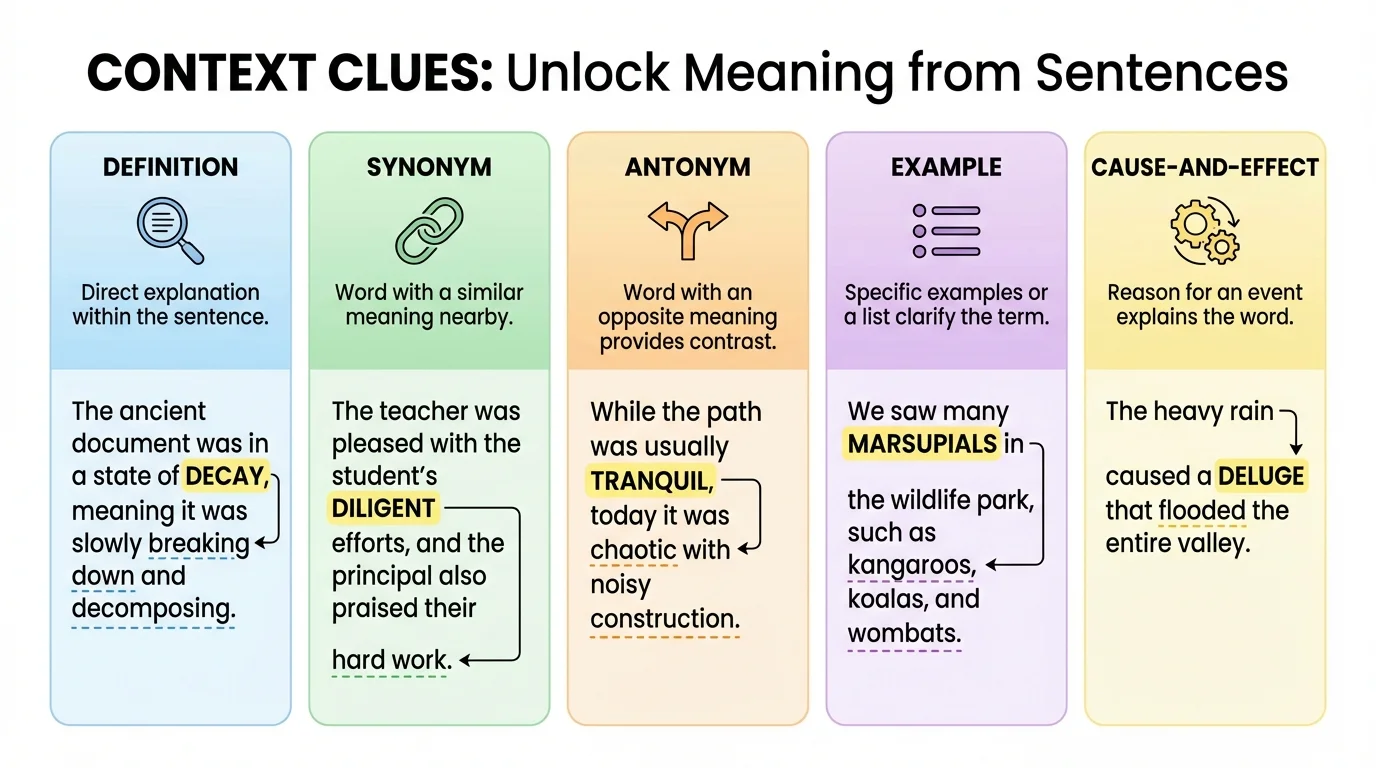
A third type is an antonym or contrast clue. Example: "Unlike her outgoing sister, Mina was reserved and quiet." Even if you do not know "reserved," the contrast with "outgoing" points toward a meaning like shy or self-controlled.
A fourth type is an example clue. Example: "Celestial bodies, such as planets, stars, and moons, have fascinated humans for centuries." The examples help you infer that "celestial bodies" are objects in space.
A fifth type comes from cause-and-effect relationships. Example: "Because the trail was inundated after days of rain, hikers had to wade through deep water." The effect, hiking through deep water, suggests that "inundated" means flooded.
Sometimes there is no single clue word like "or" or "such as." Instead, the whole sentence gives a general sense. Example: "After staying awake for two nights to finish the project, Jalen felt utterly depleted." Even without a direct explanation, the situation suggests that "depleted" means drained or exhausted.
Reading several clue types in one sentence
Sentence: "The archaeologist handled the artifact with extreme care; the object was fragile, delicate enough to crumble if pressed too hard."
Step 1: Identify direct clues.
The phrase "delicate enough to crumble" gives a clear explanation.
Step 2: Connect that explanation to the unknown word.
If something can crumble when pressed, it is not strong or durable.
Step 3: Test a meaning in the sentence.
Replacing "fragile" with "easily broken" fits perfectly.
The best inferred meaning of fragile is easily damaged or broken.
As you continue reading, later clues often confirm your first inference. If the next sentence says the artifact cracked when lifted, your interpretation becomes even stronger, much like the clue patterns summarized in [Figure 1].
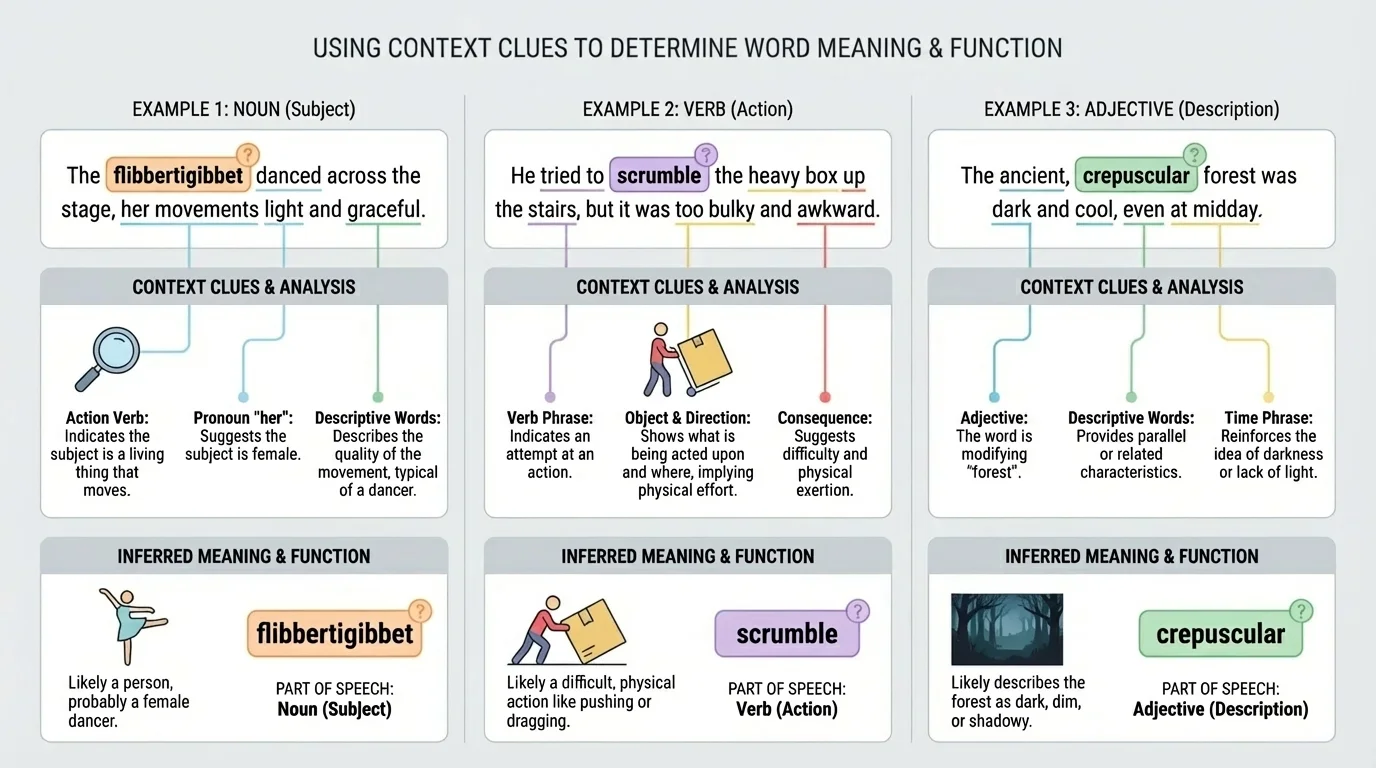
Context is not only about meaning; it is also about grammar. A word's placement in a sentence can tell you whether it is acting as a noun, verb, adjective, or adverb. That matters because knowing the part of speech helps narrow the possible meaning, as [Figure 2] illustrates.
Look at this sentence: "The speaker's remarks were so ambiguous that the audience could not tell what she actually believed." The word follows "were so," which suggests it is an adjective describing "remarks." The rest of the sentence explains the effect: the audience could not tell what she believed. So "ambiguous" likely means unclear or having more than one possible meaning.
Articles like "a," "an," and "the" often signal that a word is a noun. Words after linking verbs such as "is," "seems," or "became" are often adjectives. Words ending in common suffixes can also help. For instance, words ending in "-ly" often function as adverbs, and words ending in "-tion" often function as nouns. These are not perfect rules, but they are useful clues.
Punctuation can help too. Dashes, commas, parentheses, and colons often introduce explanations. In the sentence "The room was filled with detritus—scattered scraps of paper, broken plastic, and dust," the dash introduces a definition by example. The punctuation is doing part of the explanatory work.
Consider another sentence: "She tends to mitigate conflicts before they grow into serious arguments." Because the word follows "to," it is acting as a verb. The phrase after it explains what happens: conflicts are kept from growing worse. That suggests "mitigate" means reduce or make less severe.
Grammar as a clue system
When you do not know a word, ask two questions at once: "What is this word doing in the sentence?" and "What idea around it makes sense here?" Meaning and grammar work together. If a word is clearly a verb, you should not test a noun meaning. If it describes a noun, look for an adjective meaning that fits the surrounding details.
This is why context reading is more accurate than random guessing. You are not grabbing the first meaning that sounds familiar. You are matching meaning to structure.
Sometimes one sentence is not enough. To infer a word accurately, you need to read the whole paragraph or even the entire text. Different text types use context in different ways, as [Figure 3] illustrates.
In a narrative text, context often comes from character actions, setting, and tone. If a character "lurched" down a dark hallway after an injury, the action and situation suggest an unsteady movement. Stories often reveal meaning through what characters do rather than through direct definitions.
In an argumentative text, context may come from claims, evidence, and the author's position. Suppose an editorial says, "The policy is not merely ineffective; it is detrimental, draining resources while solving nothing." The reasoning and negative tone suggest that "detrimental" means harmful.
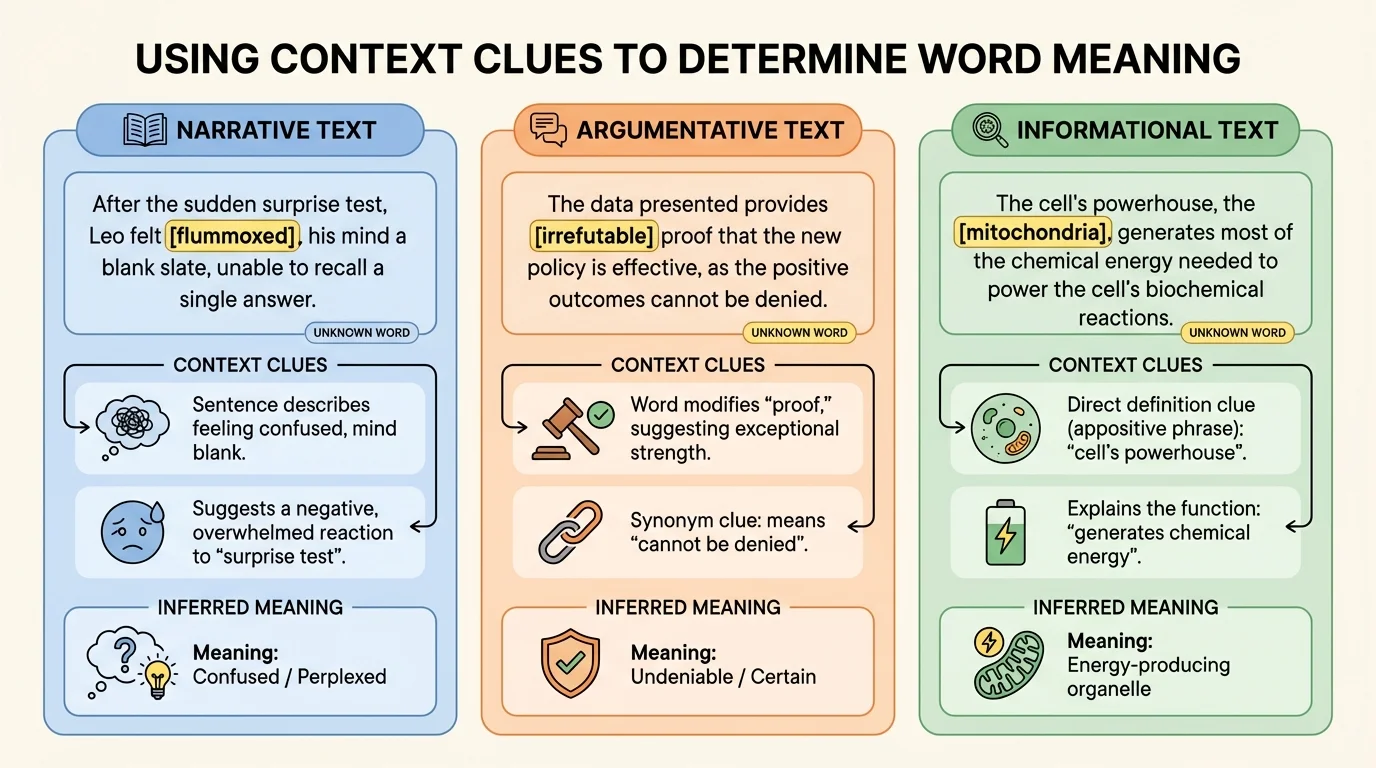
In an informational text, context often comes from explanations, examples, and precise details. A biology passage might say, "Some organisms are nocturnal, becoming active mainly after sunset and resting during the day." The informative explanation makes the word clear.
The tone of the passage also matters. If an author describes a plan as "bold," the word may sound positive in one article and reckless in another, depending on the surrounding language. This is one reason you should avoid deciding meaning from a single nearby word. Paragraph-level context is often more trustworthy.
When readers miss larger context, they can misunderstand not only a word but the whole message. The text type comparison in [Figure 3] reminds us that the same inference skill must adapt to different kinds of reading.
Many English words have more than one meaning. Context helps you choose the right one. Think about the word "draft." In one context, it means a preliminary version of writing. In another, it refers to a current of air. In sports, it can refer to selecting players. In government, it can refer to compulsory military service in certain historical contexts.
Read these examples carefully. "She submitted the first draft of her essay." Here, "essay" tells you the word relates to writing. "A cold draft slipped through the window frame." Here, "cold" and "window frame" point to moving air. "The team had the first pick in the draft." Here, the sports setting changes the meaning entirely.
This is why readers must stay flexible. Memorizing one definition is not enough. You must ask, "Which meaning fits this sentence, this paragraph, and this topic?"
Some of the most common English words are also among the most confusing because they have many meanings. Words like "set," "run," and "light" can shift dramatically depending on context.
Phrases can also depend on context. If someone says a proposal is "on thin ice," the phrase is not about actual frozen water. The surrounding discussion about risk or danger shows that it means the proposal is in a weak or risky position.
Context is powerful, but it has limits. Sometimes the text gives enough information for a strong inference. Other times, it gives only a partial idea. You may understand whether a word is positive or negative without knowing its exact meaning. That can be enough for comprehension in the moment.
For example, if a history text says a leader used "draconian" laws to silence critics, you may infer that the laws were harsh or severe from the negative context. That may be enough to follow the paragraph. Later, you might check a dictionary to sharpen your understanding.
However, in technical subjects such as science, law, or medicine, precision can matter a lot. If a chemistry text uses a specialized term, rough understanding may not be sufficient. In those cases, context gives you a starting point, but you should verify the meaning.
Inference is not certainty. It is a reasoned conclusion based on evidence. When the stakes are high or the word is central to understanding the text, confirm your inference with a trustworthy source.
Strong readers know when to move on and when to pause. That decision is part of reading skill too.
When you meet an unfamiliar word, follow a simple process. First, read to the end of the sentence without panicking. Second, look for direct clues such as definitions, examples, or contrasts. Third, identify the word's function in the sentence. Fourth, read the surrounding paragraph for the larger idea. Fifth, test a possible meaning by substituting it mentally into the sentence. If the sentence still makes sense, your inference is probably close.
Here is that process in action with the sentence: "The scientist was meticulous, recording every temperature change, time interval, and color shift during the experiment." The examples of careful record-keeping suggest that "meticulous" means very careful and precise. If you replace it with "careless," the sentence stops making sense. Testing the meaning helps confirm your conclusion.
Applying the full strategy
Sentence: "After the company ignored several warnings, the data breach was inevitable."
Step 1: Read the full sentence.
The key idea is that warnings were ignored.
Step 2: Look for cause-and-effect.
Ignoring warnings leads to the breach.
Step 3: Infer a meaning.
If the breach followed naturally from the company's actions, "inevitable" means something like certain to happen or unavoidable.
Step 4: Test it.
"The data breach was unavoidable" fits the sentence well.
The context supports the meaning unavoidable.
This strategy keeps you active and analytical. Instead of seeing unfamiliar words as barriers, you treat them like puzzles with evidence.
One mistake is relying on only one clue. A single nearby word can mislead you. Better readers combine sentence clues, grammar clues, and paragraph clues.
Another mistake is forcing a familiar meaning onto a word with multiple meanings. If you know one definition of "charge," for example, you might miss whether the text means electrical charge, a criminal accusation, a rush forward, or a fee.
A third mistake is ignoring tone. The same word can feel approving, neutral, or critical depending on the passage. Pay attention to whether the author sounds supportive, skeptical, angry, amused, or formal.
Finally, do not assume your first guess is always correct. Good readers revise. If later details do not fit your original inference, update it.
In literature, context helps you understand imagery, symbolism, and unusual word choices. In history, it helps you interpret speeches, laws, and primary sources whose language may feel distant. In science, context helps you approach technical vocabulary before formal definitions appear. In everyday life, it helps you read news, instructions, contracts, websites, and social media more critically.
It also makes you a more independent reader. Instead of stopping for every unfamiliar word, you learn to think through meaning. That increases both speed and comprehension.
"The meaning of a word is largely known by the company it keeps."
— A principle of language study
When you use context well, you are not just decoding words. You are reading like a detective: gathering clues, testing possibilities, and building understanding from evidence.
