A coach says a team suffered a "tough loss," a news report says workers were "let go," and a poem describes "deafening silence." None of these phrases work in a simple, literal way. Writers and speakers constantly choose words that do more than name facts; they soften, sharpen, complicate, and deepen meaning. Learning to interpret figures of speech is not just about spotting fancy language. It is about understanding what a writer wants you to feel, notice, or question.
When people read too literally, they can miss the real message of a sentence. A figure of speech is a phrase or expression that communicates more than the direct dictionary meaning of its words. Sometimes it creates vivid imagery. Sometimes it softens a harsh truth. Sometimes it packs contradiction into a short phrase so readers feel tension or complexity.
In literature, figurative language helps develop mood, character, and theme. In arguments, it can make ideas more persuasive or memorable. In informational writing, it may make a difficult concept easier to understand, though it must be used carefully so it does not confuse readers. Interpreting it correctly means paying attention not only to the phrase itself, but also to who says it, where it appears, and why it is there.
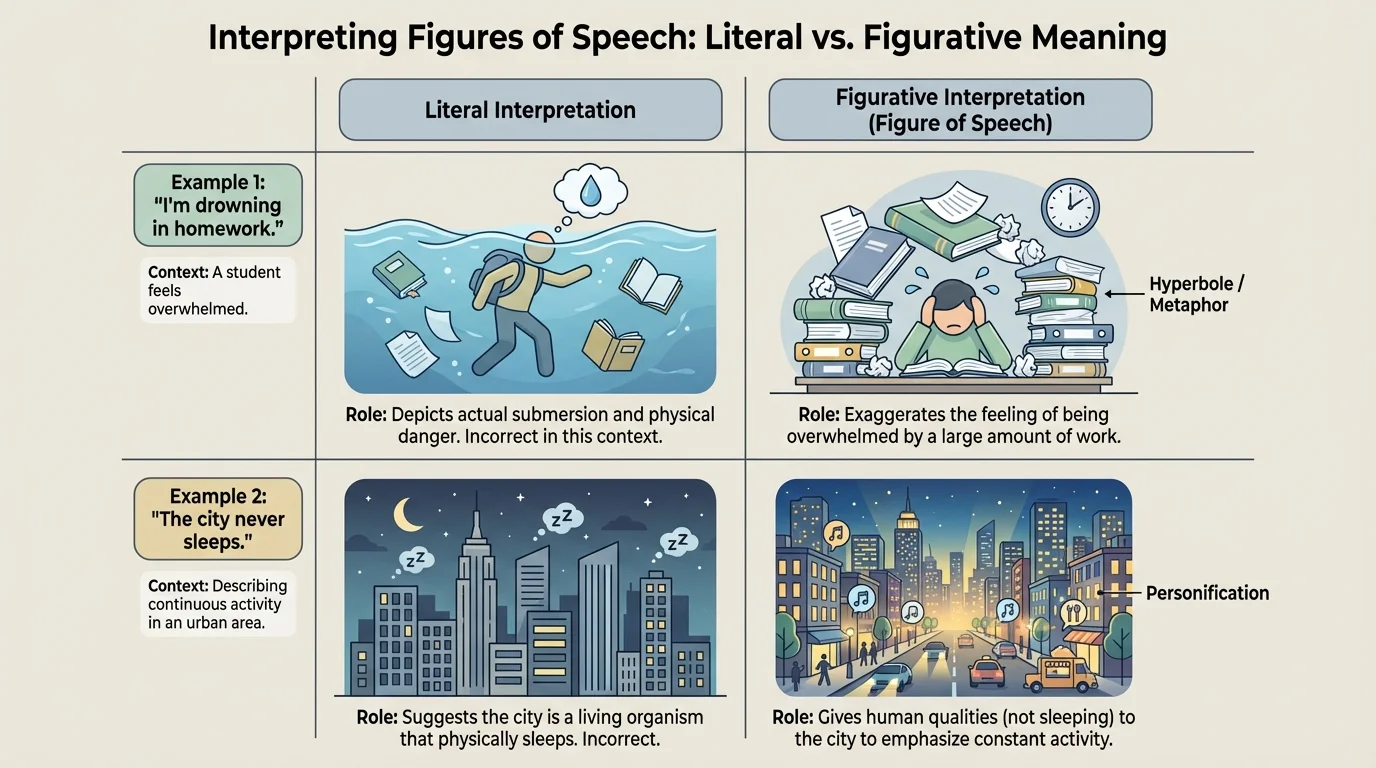
Figurative language uses words in a nonliteral way to express an idea more effectively. The key to understanding it is context, as [Figure 1] shows in a side-by-side comparison of literal and figurative readings. Context includes the surrounding words, the sentence structure, the topic, the speaker, and the situation.
Suppose a character says, "I'm drowning in homework." Literal reading would mean actual water and actual drowning. Context tells us that this is impossible in the situation, so the reader understands the phrase figuratively: the speaker feels overwhelmed by schoolwork. The words themselves matter, but the surrounding details matter even more.
Literal meaning is the direct, ordinary meaning of words.
Nonliteral meaning is a meaning that goes beyond the direct definition.
Figure of speech is a word or phrase used in a nonliteral way to create a particular effect or meaning.
Readers also use parts of speech and grammar to interpret meaning. If someone writes, "The city never sleeps," the grammar shows that the city is the subject of the sentence and performs a human action. Since cities do not literally sleep, the sentence uses nonliteral language to suggest constant activity. Strong readers notice that mismatch and ask what effect it creates.
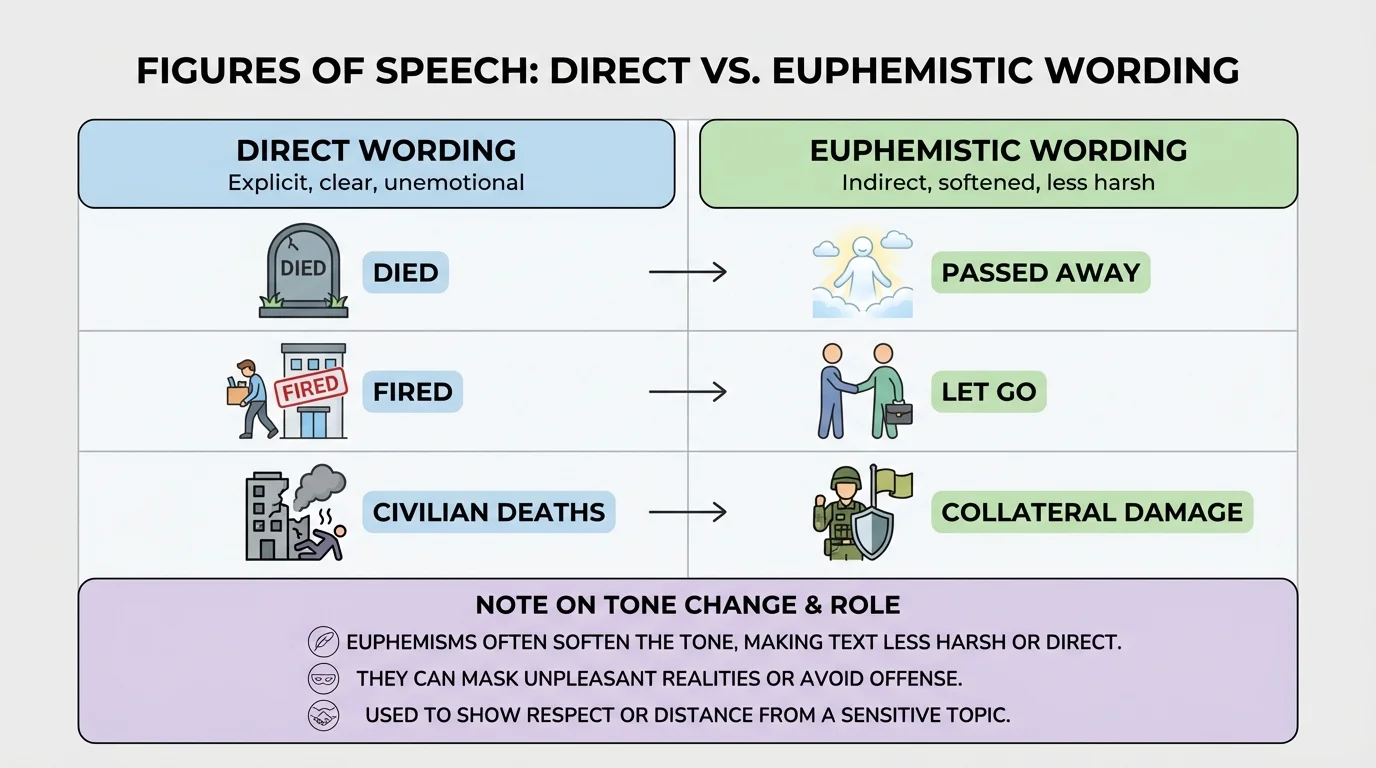
A euphemism is a mild, indirect, or less harsh expression used in place of one that may seem blunt, painful, embarrassing, or offensive, as [Figure 2] demonstrates through pairs of direct and softened wording. Euphemisms often appear in conversations about death, illness, money, war, and employment.
For example, instead of saying someone "died," a writer may say the person "passed away." Instead of saying workers were "fired," a report may say they were "let go." Instead of calling a military attack "civilian deaths," an official statement may call them "collateral damage." These choices are not neutral. They shape tone and influence how readers respond.
The role of a euphemism depends on context. In one text, it may show kindness or respect. A grieving family member who says "passed away" may be choosing gentle language because the moment is painful. In another text, a euphemism may hide responsibility or reduce the emotional impact of serious events. A government statement that replaces vivid truth with technical-sounding language can distance readers from the human cost.
How euphemism affects tone and purpose
Euphemism can soften language, protect feelings, avoid taboo topics, or make difficult realities easier to discuss. It can also be manipulative. When readers analyze euphemism, they should ask whether the softened language is compassionate, evasive, polite, strategic, or dishonest.
Consider this sentence from a fictional school board announcement: "Several positions will be restructured next semester." On the surface, the wording sounds formal and calm. But in context, readers may realize that jobs are being cut. The euphemism makes the action sound less severe. The role of the phrase is not just to communicate information; it also controls emotional response.
Writers may use euphemism to reveal character. A character who constantly avoids direct language may seem cautious, privileged, uncomfortable with conflict, or unwilling to face reality. In a novel, that choice can reveal personality without the author stating it directly.
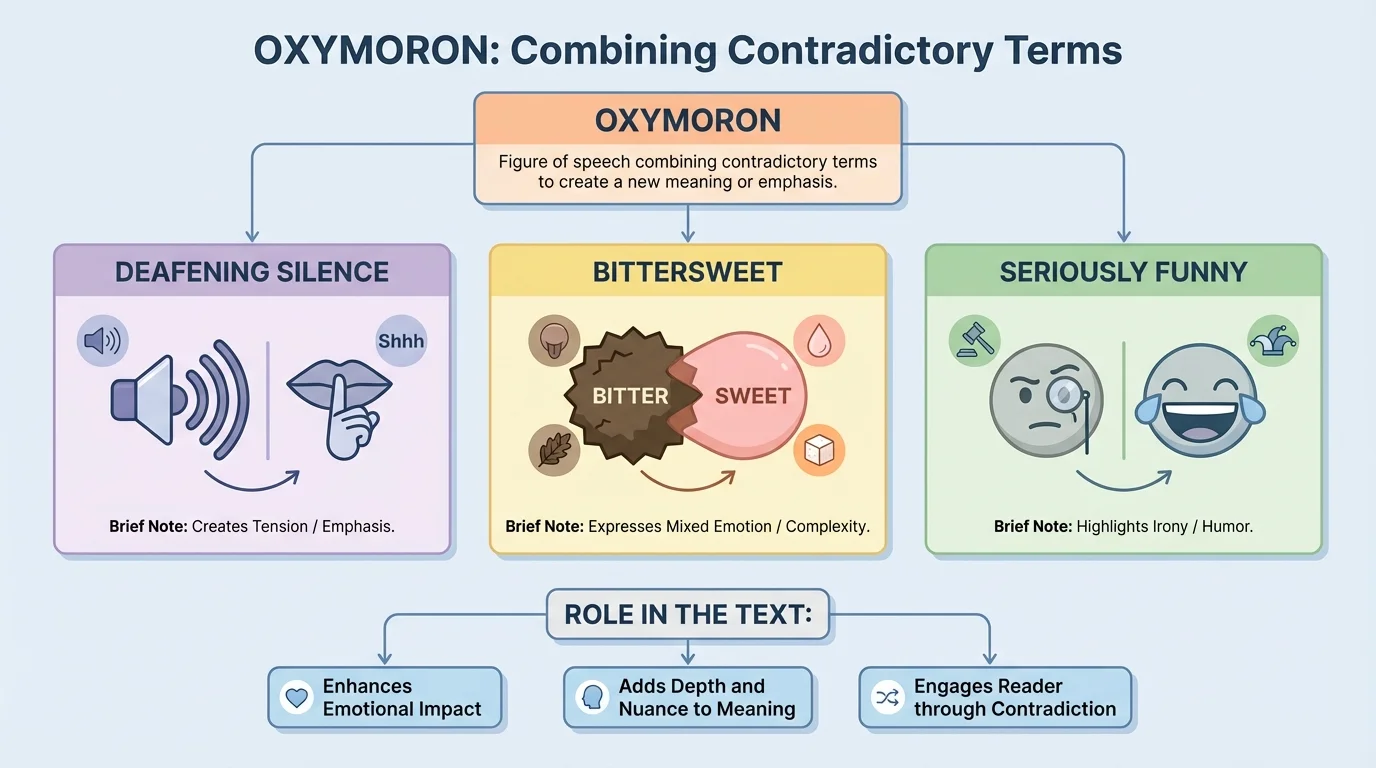
An oxymoron is a figure of speech that joins two words whose meanings seem to contradict each other, and [Figure 3] illustrates how those apparent opposites create a richer idea than either word could alone. Common examples include "deafening silence," "bittersweet," "living dead," and "seriously funny."
At first glance, an oxymoron can seem illogical. Silence is not literally deafening. Something cannot be both bitter and sweet in exactly the same way at the same time. But language is not always trying to be scientifically exact. Sometimes contradiction captures an emotional truth better than plain description does.
If a writer describes the moment after bad news as "a deafening silence," the phrase suggests that the silence feels intense, overwhelming, and impossible to ignore. If a memoir calls graduation "bittersweet," the writer communicates mixed emotions: pride and sadness, ending and beginning, gain and loss. The contradiction is the point. It expresses complexity.
Analyzing an oxymoron in context
In this sentence: "After the championship game ended, the locker room fell into a deafening silence."
Step 1: Identify the contradiction.
"Deafening" suggests overwhelming sound, while "silence" suggests no sound.
Step 2: Use context.
The team has just lost a major game, so the silence is emotionally heavy, tense, and powerful.
Step 3: Analyze the role.
The oxymoron intensifies mood. It helps readers feel the emotional shock in the room.
Oxymorons often appear in poetry, fiction, speeches, and song lyrics because they are compact but layered. They can create irony, tension, humor, or emotional depth. When you encounter one, do not dismiss it as a mistake. Ask what kind of complicated reality the writer is trying to express.
Euphemism and oxymoron are important, but they belong to a larger family of figurative language. Knowing nearby categories helps you avoid confusion.
Metaphor compares two unlike things by saying one thing is another. "Time is a thief" suggests that time steals moments from our lives. Simile also compares unlike things, but usually uses "like" or "as," as in "The crowd moved like a wave."
Hyperbole is deliberate exaggeration. "I have told you a million times" does not mean exactly one million repetitions. Understatement does the opposite by making something seem less important than it really is. After a serious storm, saying "We had a little weather" minimizes the event for effect.
Personification gives human qualities to nonhuman things. "The wind whispered through the trees" suggests a soft, hushed sound. Verbal irony occurs when a speaker says one thing but means something quite different, often for emphasis or sarcasm. If someone looks at a disastrous group project and says, "Well, that went perfectly," the intended meaning is the opposite of the literal words.
| Figure of speech | What it does | Example | Likely effect |
|---|---|---|---|
| Euphemism | Softens or masks direct meaning | "passed away" | Gentler tone or possible evasion |
| Oxymoron | Combines opposites | "bittersweet" | Complex emotion or tension |
| Metaphor | States one thing is another | "Time is a thief" | Strong image or idea |
| Simile | Compares using "like" or "as" | "cold as ice" | Clear comparison |
| Hyperbole | Exaggerates deliberately | "a mountain of work" | Emphasis |
| Understatement | Downplays deliberately | "a bit of a problem" | Irony or restraint |
Table 1. Comparison of several common figures of speech, their functions, examples, and effects.
Strong interpretation follows a process. First, notice language that seems unusual, exaggerated, softened, or contradictory. Then ask whether a literal reading makes sense. If it does not, the phrase is probably figurative.
Next, look closely at nearby clues. What is happening in the scene or paragraph? What emotions are present? Who is speaking, and to whom? A euphemism in a hospital waiting room may function differently from a euphemism in a political speech. An oxymoron in a love poem may reveal mixed feelings, while the same kind of contradiction in satire may mock confusion or hypocrisy.
When you analyze word choice, remember that meaning comes from more than dictionary definitions. Tone, audience, sentence structure, genre, and purpose all shape how language works.
After identifying likely meaning, ask what the figure of speech does. Does it soften a hard truth? Make an idea memorable? Reveal the speaker's emotions? Create humor or irony? Build mood? Connect to a larger theme? Interpretation is not complete until you explain the role of the language in the text.
A useful pattern is this: identify the figure, explain its figurative meaning, and analyze its effect. For example: "The phrase 'bittersweet' is an oxymoron. It suggests that the event brings happiness and sadness at once. This deepens the text's tone by showing the character's mixed emotions about change."
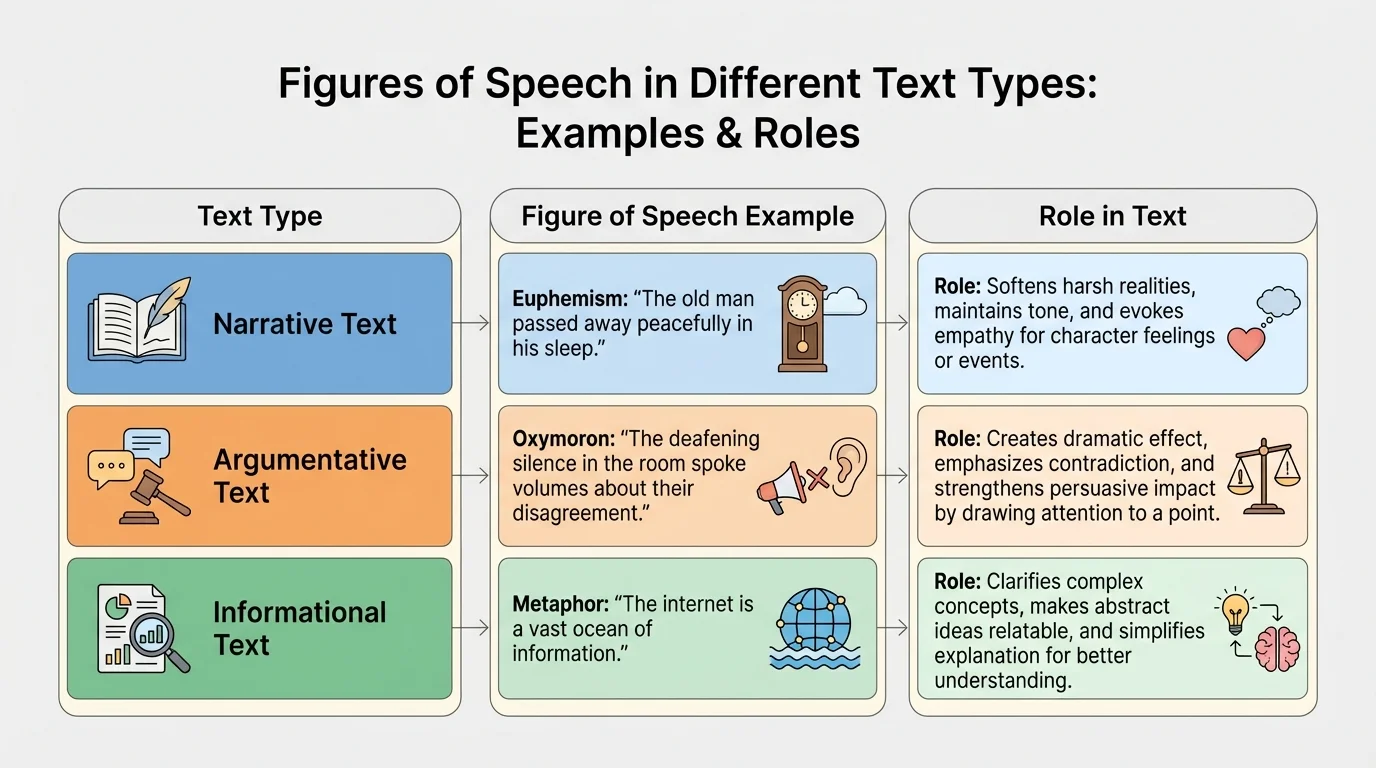
The same figure of speech can do different work in different kinds of writing, as [Figure 4] shows through a comparison of narrative, argumentative, and informational texts. To analyze well, readers need to connect figurative language to the larger purpose of the whole text.
In narrative texts, figures of speech often build atmosphere, reveal character, and strengthen theme. If a narrator describes summer as "a beautiful prison," the oxymoron suggests both pleasure and confinement. Maybe the character lives in comfort but feels trapped. The phrase does not just sound interesting; it reveals inner conflict.
In argumentative texts, figures of speech can persuade. A writer might use euphemism to make a controversial policy sound more acceptable, or a striking oxymoron to expose contradiction in an opponent's position. For example, calling a policy "organized chaos" criticizes it in a compact, memorable way. Readers should ask whether the language clarifies the argument or manipulates emotion.
In informational texts, figurative language is usually more limited, but it still appears. Science writers may say a black hole is a "cosmic vacuum cleaner," not because it literally cleans, but because the comparison helps readers picture gravitational pull. Informational writers must balance vivid language with precision. If the figure of speech becomes too dramatic or inaccurate, it can mislead.
Later in a text, the same figure may connect to a larger idea or theme. A euphemism repeated throughout a war novel may show how characters avoid confronting trauma. An oxymoron repeated in a memoir may reinforce the idea that growing up involves contradictory feelings. As with [Figure 3], contradiction is often used not to confuse readers but to express emotional truth.
Many phrases that began as vivid figures of speech become so common that people barely notice them. Expressions like "breaking the ice" or "falling apart" often feel ordinary, but they still shape meaning and tone.
Careful analysis becomes clearer when you see it in action. The goal is not only to name the device, but also to explain how context changes meaning and why the writer chose it.
Example 1: Euphemism in a narrative
Passage: "At dinner, no one said that Grandpa had died. They only whispered that he had passed away, as if softer words could cushion the fact."
Step 1: Identify the figure of speech.
"Passed away" is a euphemism for "died."
Step 2: Interpret in context.
The family is grieving, so the softened phrase reflects emotional pain and a desire to speak gently.
Step 3: Analyze the role.
The euphemism creates a tender, sorrowful tone and shows that the characters are struggling to face loss directly.
Notice that the analysis depends on context. In a different passage, the same euphemism might sound formal, distant, or evasive. Meaning and effect do not come from the phrase alone.
Example 2: Euphemism in an argumentative text
Passage: "The company described the factory closure as a workforce adjustment, but hundreds of families lost their main source of income."
Step 1: Identify the figure.
"Workforce adjustment" functions as euphemistic language.
Step 2: Interpret in context.
The phrase hides the harsher reality of layoffs.
Step 3: Analyze the role.
The writer highlights the euphemism to criticize corporate language and expose the gap between official wording and human consequences.
This kind of analysis is especially important in public language, advertising, and politics. Euphemism can influence what readers feel justified in ignoring.
Example 3: Oxymoron in a memoir
Passage: "Leaving home for college was a bittersweet victory."
Step 1: Identify the figure.
"Bittersweet" is an oxymoron combining opposite feelings.
Step 2: Interpret in context.
The speaker is proud of moving forward but sad to leave family and familiar places.
Step 3: Analyze the role.
The oxymoron captures the complexity of transition and contributes to a reflective, mature tone.
As [Figure 4] reminds us, the role of figurative language changes with genre, but emotional complexity is one of its most powerful uses across many text types.
One common mistake is assuming every unusual phrase is symbolic or deeply hidden. Sometimes a phrase is simply a familiar idiom or a small exaggeration. Readers should support interpretation with actual context rather than guessing wildly.
Another mistake is stopping too soon. It is not enough to say, "This is an oxymoron," or "This is a euphemism." That labels the technique, but does not explain meaning. Strong analysis finishes the thought: what does the phrase mean here, and what role does it play in the text?
A third mistake is ignoring tone and speaker. If a sarcastic character uses euphemism, the effect may be mocking rather than polite. If a serious narrator uses oxymoron, the effect may be thoughtful rather than humorous. Voice matters.
Finally, do not assume figurative language always makes writing better. Sometimes it can blur meaning, weaken precision, or manipulate emotion. Critical readers appreciate artistry, but they also evaluate whether the language serves the text honestly and effectively. That is especially true when analyzing euphemism, as we saw earlier in [Figure 2], where softened wording can either respect feelings or conceal truth.
"The difference between the almost right word and the right word is really a large matter."
— Mark Twain
When you read closely, figures of speech stop being decorative extras. They become evidence. They show how authors shape perspective, guide emotion, and compress complicated ideas into memorable language. Whether the phrase softens reality like a euphemism or sharpens contradiction like an oxymoron, your task is always the same: read the words, read the context, and explain the effect.
