A strong presentation rarely becomes strong on the first try. Professional speakers rehearse in front of coaches, filmmakers test scenes with audiences, and musicians listen to recordings of themselves to notice what works and what needs improvement. Presenters improve the same way: by using responses from other people to see what is working, what is confusing, and what needs revision. Feedback is not a sign that a presentation failed. It is one of the main tools that helps a speaker make the presentation clearer, more credible, and more effective.
When you present, you are not just sharing information. You are trying to reach an audience for a particular reason. Maybe you want to inform classmates about renewable energy, persuade a school group to support a community project, or explain a historical issue in a clear, organized way. That means revision should not be random. It should be based on what helps the presentation match its purpose and connect with its audience.
Feedback is information you receive about your presentation that helps you judge its quality and improve it. Good feedback helps you answer important questions: Did the audience understand the main idea? Was the evidence convincing? Did the presentation hold attention? Did the organization make sense? Did the delivery support the message or distract from it?
Without feedback, a speaker often judges the presentation only from the speaker's own point of view. That is a problem because what feels clear in your head may not sound clear to listeners. You already know your topic, your plan, and your intended meaning. Your audience does not. Feedback helps you see the gap between what you meant to communicate and what listeners actually received.
Feedback also improves credibility. If people say your evidence seems weak, your sources seem questionable, or your explanation sounds one-sided, those comments point to a serious issue. A credible presentation is not just smooth and confident. It is accurate, balanced, and supported by trustworthy information.
Feedback is information about how well a presentation works for its audience.
Revision is the process of making purposeful changes based on evaluation.
Evaluation means judging quality by using clear criteria such as organization, evidence, clarity, and delivery.
Revision is most effective when it is connected to evaluation. In other words, you do not change things just because someone commented. You compare comments with clear standards. If a class presentation is supposed to be accurate, organized, and suited to the audience, then feedback should help you decide whether those standards were met.
Not every comment is equally helpful. Useful feedback has a clear focus when it compares vague reactions with comments that lead to specific revision. A comment like "It was good" may be positive, but it does not tell you what to keep. A comment like "Your explanation of the causes of the Civil War was clear, but your conclusion did not connect back to your main claim" gives you something you can use.
[Figure 1] Useful feedback is usually specific, constructive, and actionable. Specific means it identifies an exact part of the presentation. Constructive means it aims to improve the work, not insult the speaker. Actionable means it suggests a change that can actually be made.
Consider the difference between these comments:
| Comment | How useful it is | Why |
|---|---|---|
| "Nice job." | Low | Positive but too general to guide revision. |
| "You talked too fast in the middle." | Medium | Identifies a problem but does not explain where or how it affected understanding. |
| "When you explained the data from your survey, you sped up and skipped what the percentages meant, so the audience may have missed your point." | High | Names the section, the problem, and the effect on the audience. |
Table 1. Comparison of general and specific feedback comments.
Strong feedback often refers to criteria. Criteria are the qualities used to judge a presentation. If the presentation must include a clear claim, organized evidence, accurate sources, and effective speaking skills, then feedback should connect to those areas instead of staying at the level of personal taste.
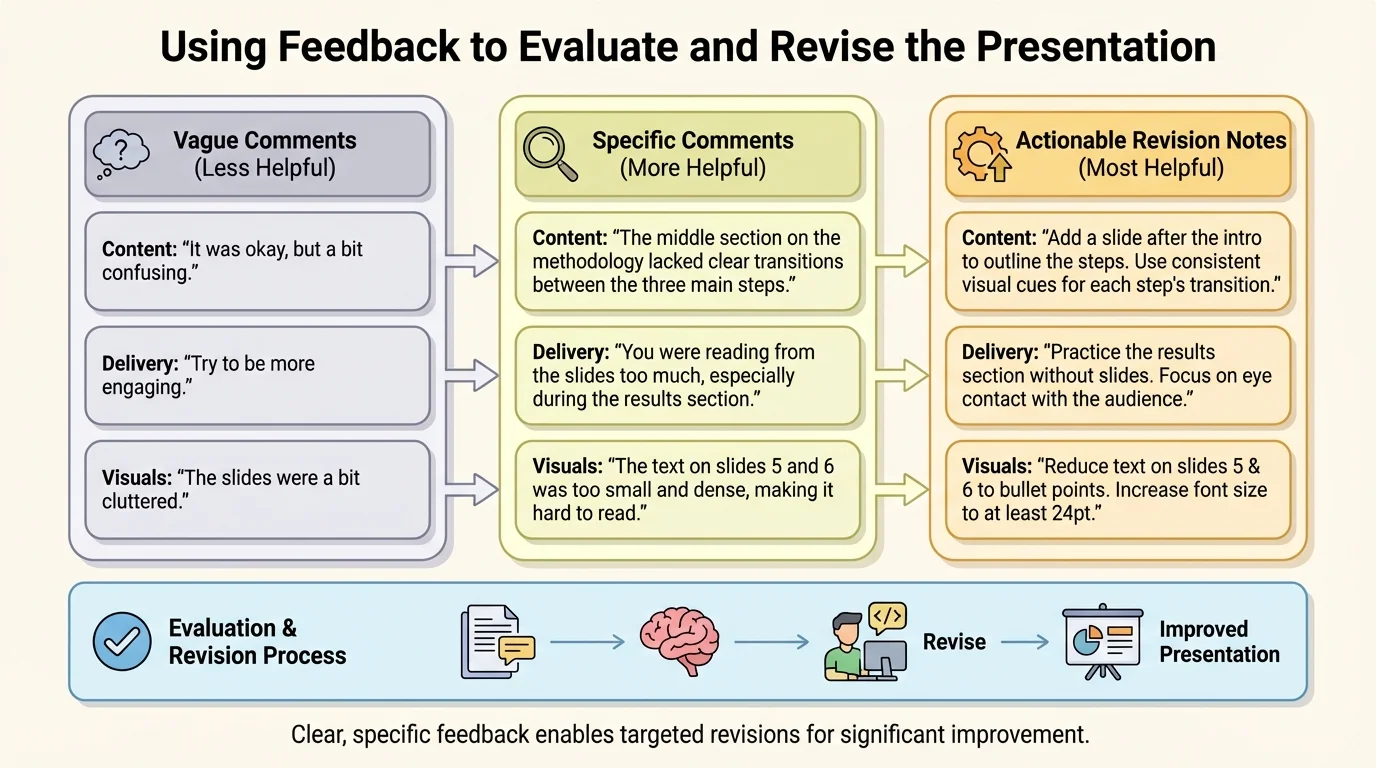
That does not mean opinions never matter. Audience reactions are important, especially if the audience feels bored, lost, or unconvinced. But the most useful opinions explain why the reaction happened. A listener who says, "Your slide had too much text, so I stopped listening to you and started reading," gives you valuable information about visual design and audience attention.
Many professional speakers ask for feedback on just one or two focus areas at a time. Instead of asking, "How was it?" they may ask, "Was my claim clear?" or "Did my examples feel relevant?" Narrower questions often lead to better revision.
Another sign of useful feedback is balance. Good reviewers can point out strengths as well as problems. If several people say your opening story was engaging, that is a clue to keep it. Revision is not only about fixing weaknesses. It is also about protecting the parts that already work well.
One comment can be helpful, but patterns matter even more. When several people notice the same issue, the problem is more likely to be real and important. If three classmates say your evidence is strong but your transitions are abrupt, that repeated response tells you where revision should probably begin.
[Figure 2] A smart way to handle feedback is to sort comments into categories such as content, organization, evidence, visuals, and delivery. This makes a scattered set of notes easier to read. Instead of seeing ten separate comments, you begin to see patterns. For example, five comments about pacing and volume suggest a delivery issue, while repeated comments about unclear examples suggest a content issue.
Patterns are especially useful because one individual comment may reflect personal preference, while repeated comments often reveal a larger audience need. If one person says your introduction was too serious but everyone else found it effective, you may not need to change it. If many people say they did not understand your main claim until the middle, that is much more significant.
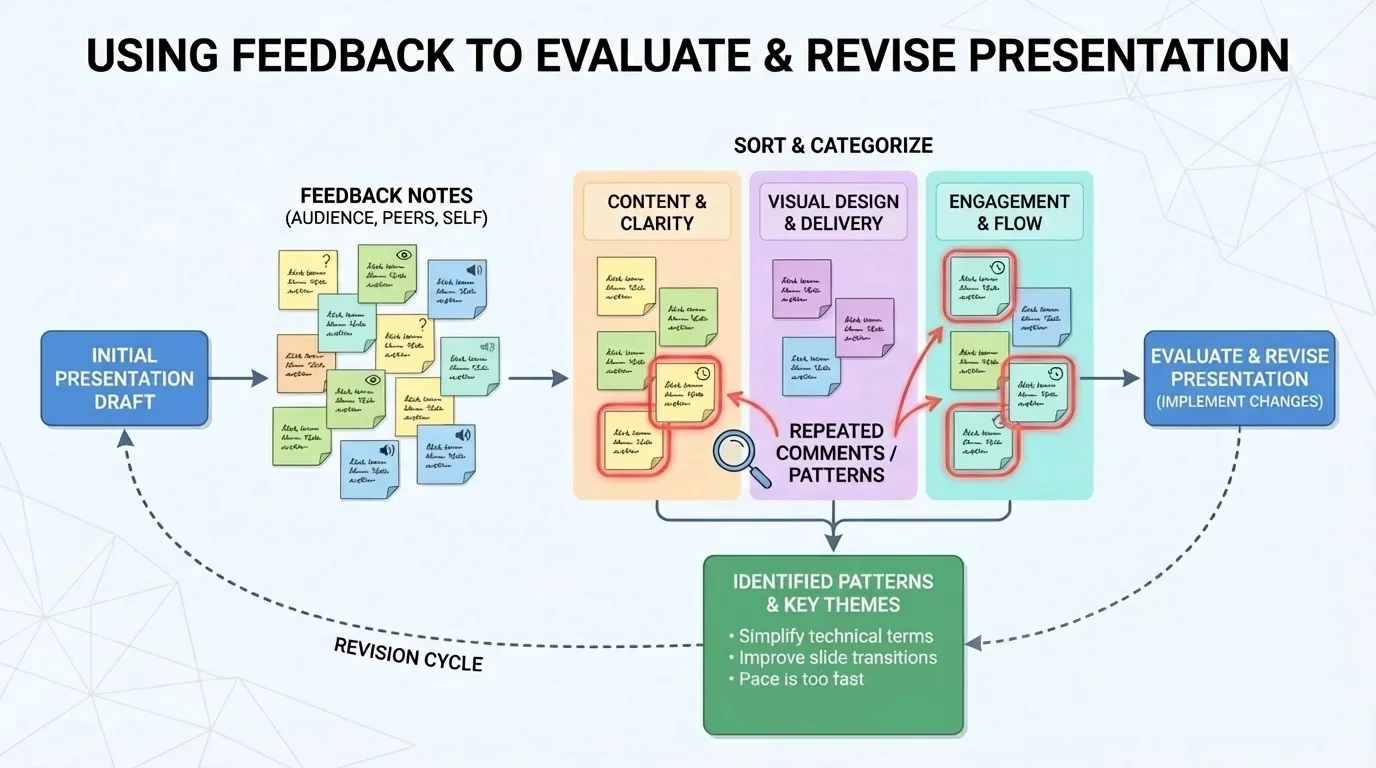
When listening for patterns, pay attention to both direct and indirect feedback. Direct feedback includes written comments, peer reviews, teacher notes, and spoken responses. Indirect feedback includes audience behavior: confused facial expressions, people looking back and forth at each other, sudden loss of attention, or laughter at the wrong moment. These reactions can reveal confusion even when nobody says it out loud.
Later, when you revise, the pattern idea still matters. As seen earlier in [Figure 1], the strongest notes are the ones that move from reaction to explanation. When those stronger notes repeat across several reviewers, they become a powerful guide for improvement.
Accepting feedback does not mean obeying every comment. Skilled presenters evaluate feedback before using it. A comment should be judged by at least three questions: Is it credible? Is it relevant to my purpose? Does it fit my audience?
Credible feedback comes from a source you can trust to observe carefully or understand the expectations of the assignment. A teacher may notice whether your evidence is sufficient and your reasoning is sound. A classmate may be especially helpful in judging whether the explanation is easy to follow. A target audience member can tell you whether the language feels appropriate and interesting. Different people have different kinds of insight.
Relevant feedback connects to what your presentation is trying to do. Suppose your goal is to persuade the student council to add more recycling bins. A comment saying your topic is "not exciting enough" may matter less than a comment saying your evidence does not prove the plan is practical. The first is more about personal reaction; the second goes straight to your persuasive goal.
Audience fit is also crucial. A presentation for ninth graders should not sound exactly like a presentation to city officials, and a speech for a science class should not sound exactly like one for an assembly. Sometimes feedback from one person reflects what that person prefers, not what the intended audience needs. Evaluating feedback helps you tell the difference.
Why not all feedback should be weighted equally
If one expert questions the accuracy of your facts, that comment may matter more than several casual reactions about style. If several audience members are confused by the same point, that pattern may matter more than one person's preference about color or font. Good revision depends on judgment, not just on collecting lots of comments.
It also helps to separate feedback about the message from feedback about the speaker. "Your explanation of the graph was rushed" is about the presentation. "You are bad at public speaking" is not useful evaluation. Professional revision focuses on choices and effects, not personal attacks.
Revision can happen in many places, not just in the script. A presentation is a combination of ideas, structure, evidence, visuals, and spoken delivery through the parts of a full presentation. Effective revision means identifying which part needs work and changing that part on purpose.
[Figure 3] Revising the content: Sometimes feedback shows that the ideas themselves need improvement. You may need to add background information, define a key term, include another example, or remove irrelevant details. If listeners say, "I understood your topic, but I was not sure why it mattered," then the content may need stronger explanation of significance.
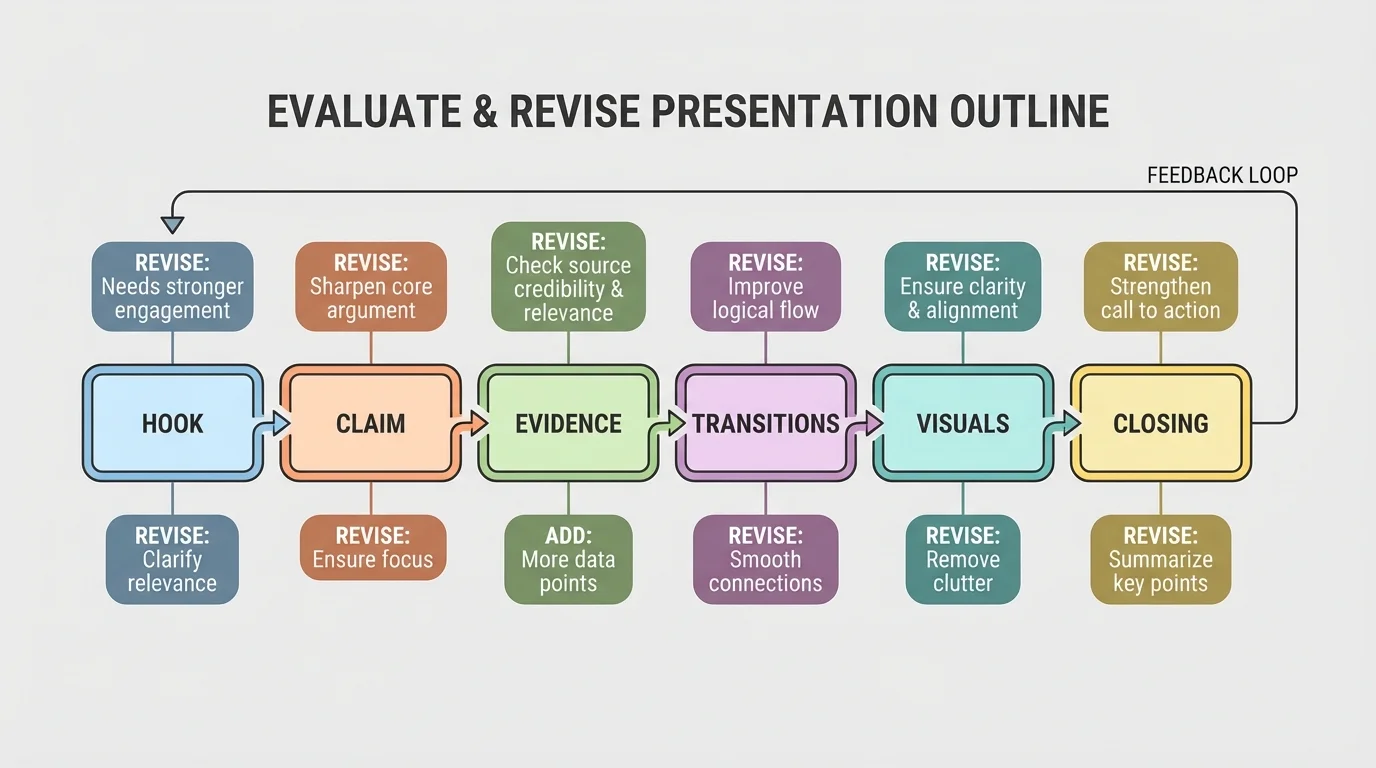
Revising the organization: If people say the presentation felt scattered, revision should focus on order and transitions. You may need a clearer introduction, more logical sequence, or stronger connection between points. For example, a speech about social media effects might work better if it moves from mental health, to communication, to privacy, rather than jumping between ideas without signaling the shifts.
Revising the evidence: Feedback may show that your support is too weak, too limited, or not credible enough. In that case, revision could mean replacing a random website with a reliable study, adding a statistic from a trusted organization, or including a counterclaim and response. This is especially important in persuasive presentations, where unsupported claims weaken trust.
Revising the visuals: Slides, charts, images, and graphs should support speaking, not compete with it. If the audience spends more time reading the slide than listening to you, the visual is doing too much. Revision may involve shortening text, enlarging key words, improving contrast, simplifying a graph, or choosing images that actually clarify the point.
Revising the delivery: Some feedback focuses on how the presentation sounds and feels. A strong message can be weakened by monotone voice, lack of eye contact, filler words, or pacing that is too fast or too slow. If several people mention these issues, then the content may be solid while the delivery needs more rehearsal.
To see how feedback leads to revision, think about a student presenting on sleep deprivation in teenagers. Reviewers say the facts are interesting, but the introduction is too broad, the survey result is not explained, and the ending feels sudden. Those comments point to three different revisions: tighten the opening, explain the evidence more clearly, and build a stronger conclusion. This kind of targeted change is more effective than simply "practicing more."
Case study: Revising a presentation on plastic pollution
A student gives a presentation arguing that the school should reduce single-use plastics. After rehearsal, the student receives several comments.
Step 1: Identify repeated feedback
Peers say the opening statistic is powerful, but the main claim appears too late. Two listeners also say one slide has too much text, and the final call to action is unclear.
Step 2: Match the comments to presentation parts
The delayed claim is an organization problem. The crowded slide is a visual design problem. The unclear ending is a purpose problem because the audience does not know what action to take.
Step 3: Revise on purpose
The student moves the claim into the introduction, turns one text-heavy slide into three short bullet points with a single image, and rewrites the conclusion so it clearly asks the school to replace plastic utensils with reusable options.
The revised presentation becomes easier to follow and more persuasive because each change responds to a specific audience need.
As the structure in [Figure 3] makes clear, strong revision often improves connections between parts, not just the parts alone. A better hook supports a clearer claim. Clearer evidence supports stronger credibility. A stronger conclusion helps the audience remember the message.
Feedback is not limited to the end of a presentation. It can guide improvement before, during, and after speaking as a continuing cycle rather than a one-time event. Effective speakers use each stage differently.
[Figure 4] Before presenting, feedback usually comes from rehearsal. You might practice in front of a partner, record yourself, or ask someone to listen for specific traits such as clarity, timing, or persuasiveness. This stage is powerful because you still have time to make major changes.
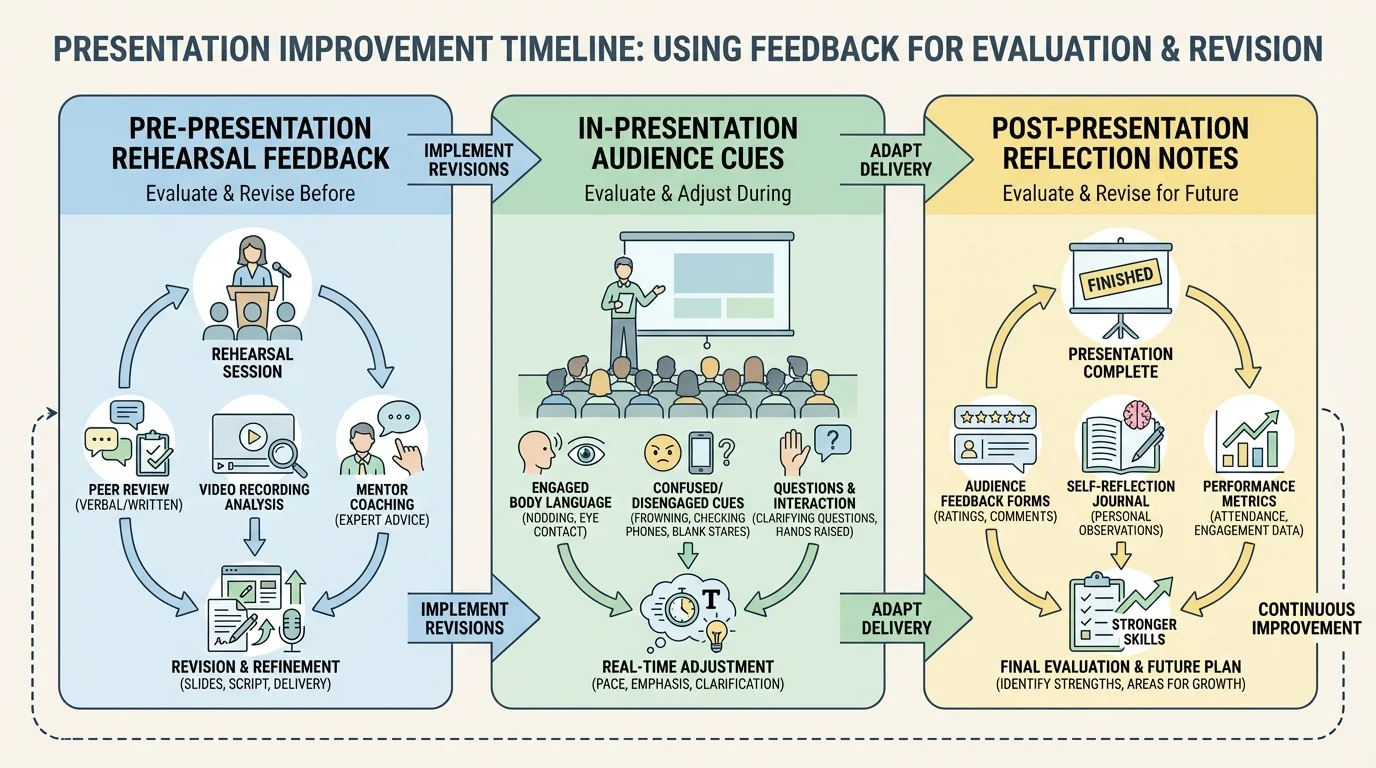
During presenting, feedback comes from audience response. You may notice confused looks, disengagement, or sudden interest when you tell a story or show an image. Skilled speakers adjust in the moment. They may slow down, repeat a key point, explain a term, or pause to let the audience process information.
After presenting, feedback becomes a tool for future growth. Teacher comments, audience questions, self-reflection, and peer notes help you see what worked and what should change next time. Even if you will not give the exact same presentation again, the lesson still matters. Patterns in one speech often appear in later speeches too.
For example, a student may learn after several presentations that the strongest content appears in the middle while the conclusions are often rushed. That repeated pattern suggests a habit, not a one-time issue. The timeline in [Figure 4] helps show that revision is not an afterthought; it is built into the whole presenting process.
Good presentations already depend on clear organization, credible evidence, and audience awareness. Feedback helps you test whether those features are actually coming across to listeners the way you intended.
Self-feedback also matters. Watching a recording of your own presentation can reveal habits you do not notice while speaking, such as repeated phrases, limited movement, reading from slides, or weak eye contact. In some cases, self-review is the fastest way to catch delivery issues.
Receiving criticism can be uncomfortable. That reaction is normal. Presentations feel personal because they involve your ideas, your voice, and your performance in front of others. But strong speakers learn to separate the work from the self. Feedback about a presentation is not a judgment of your value. It is information about choices and effects.
A professional response to feedback includes listening fully, asking clarifying questions, and taking notes before deciding what to change. Instead of arguing immediately, a speaker might ask, "Which part felt unclear?" or "What made the evidence seem weak?" Those questions turn general comments into useful revision tools.
It also helps to avoid two extremes: accepting everything or rejecting everything. If you accept every suggestion, your presentation may lose focus. If you reject all criticism, your presentation may stay confusing or ineffective. The goal is thoughtful judgment.
"Revision is not punishment for getting it wrong. It is the method for making meaning clearer."
Respectful feedback culture matters in classrooms too. When students give one another honest, focused comments, everyone improves. Strong peer reviewers do not just point out flaws. They explain effects, refer to criteria, and suggest practical next steps.
A clear process makes feedback easier to use. First, gather comments from several sources: peers, teacher, self-review, and audience reaction. Second, sort the comments into categories. Third, look for patterns. Fourth, decide which feedback is most credible and relevant. Fifth, make a revision plan with priorities.
Priority matters because not all problems are equally important. Usually, larger issues should be fixed before smaller ones. If the main claim is unclear, fix that before changing font color. If the evidence is weak, improve the sources before polishing gestures. Small delivery improvements matter, but they cannot rescue a presentation whose ideas are confusing or unsupported.
A useful revision plan might sound like this: "First, move my claim to the end of the introduction. Second, replace my weakest source with one from a reliable organization. Third, shorten slide three. Fourth, rehearse the transition into the conclusion and slow down during the final point." Notice that each revision is concrete and connected to feedback.
After revising, test the presentation again. New feedback helps you see whether the changes actually worked. Revision is strongest when it is cyclical: present, evaluate, revise, and present again. That process gradually builds skill, confidence, and effectiveness.
Over time, using feedback well turns you into a more independent speaker. You begin to predict likely audience questions, notice weak points earlier, and revise before someone else has to point them out. That is one sign of real growth: not just getting comments, but learning how to think like an evaluator of your own work.
