A novel can outlast the century that produced it. A play written hundreds of years ago can still affect modern readers, while a new young adult novel can spark public conversations almost immediately. That is one of literature's most powerful qualities: it speaks from a particular moment in history, yet it can keep speaking long after that moment has passed. To understand that power fully, readers must look beyond plot and ask a deeper question: What forces shaped this text, and what has this text shaped in return?
When readers study a story, poem, drama, or memoir, they are not just reading words on a page. They are also encountering the beliefs, conflicts, fears, and hopes of the world in which the text was created. A love story written in a strict, tradition-bound society will not feel the same as a love story written in a culture that values individual freedom. A war poem written by someone who fought in battle will likely differ from one written by someone reflecting years later. Context helps explain these differences.
Without context, readers may still understand what happens in a text, but they can miss why it happens in that particular way. They may overlook why a character's choices are limited, why a narrator sounds rebellious or cautious, or why a theme would have felt urgent to the original audience. Context does not replace close reading. Instead, it makes close reading stronger and more accurate.
Historical context is the set of real-world events, social conditions, political ideas, and cultural attitudes surrounding a text's creation and reception.
Literary context is the relationship between a text and other literature, including genre traditions, literary movements, styles, and common themes.
Theme is a central idea or insight about life that a text develops through its characters, plot, setting, and language.
[Figure 1] Readers in grades 9 and 10 often move from asking, "What is this text about?" to asking, "Why was this text written this way?" That shift is important because strong literary analysis depends on interpretation, not just retelling. Context gives you evidence for interpretation.
A text's historical context includes the events and conditions of its time, while its literary context includes the traditions and models that influenced it. Historical context might include segregation in the United States, the rise of totalitarian governments, changing roles for women, or the trauma of war. Literary context might include the conventions of tragedy, the realism of modern fiction, the style of satire, or the influence of earlier writers.
For example, William Shakespeare's Romeo and Juliet belongs to the literary tradition of tragedy. Knowing that helps readers notice how fate, family conflict, impulsive decisions, and fatal endings work together. At the same time, the play reflects social ideas from its time, such as the importance of family honor and arranged marriage. Both kinds of context matter.
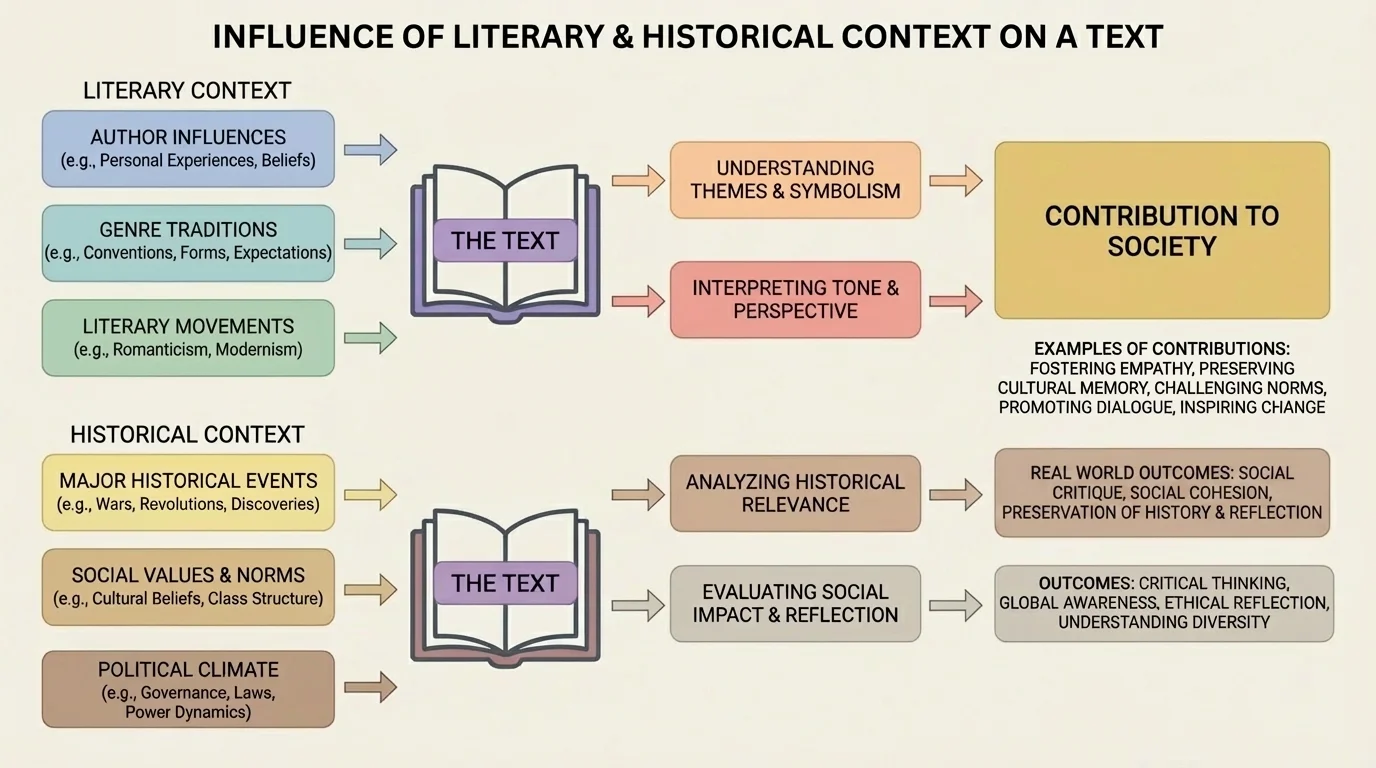
Context is not the same as background trivia. It is not just a list of facts about an author or a date written in the corner of a textbook. Useful context directly helps explain a text's meaning, style, or effect. If a detail about the time period does not connect to the text's ideas, it is probably not central to the analysis.
It is also important to separate context from summary. Saying that a novel is about a trial, a family, or a war is summary. Explaining that the trial reflects racial injustice in a segregated society, or that the family conflict reflects changing gender expectations, is contextual analysis.
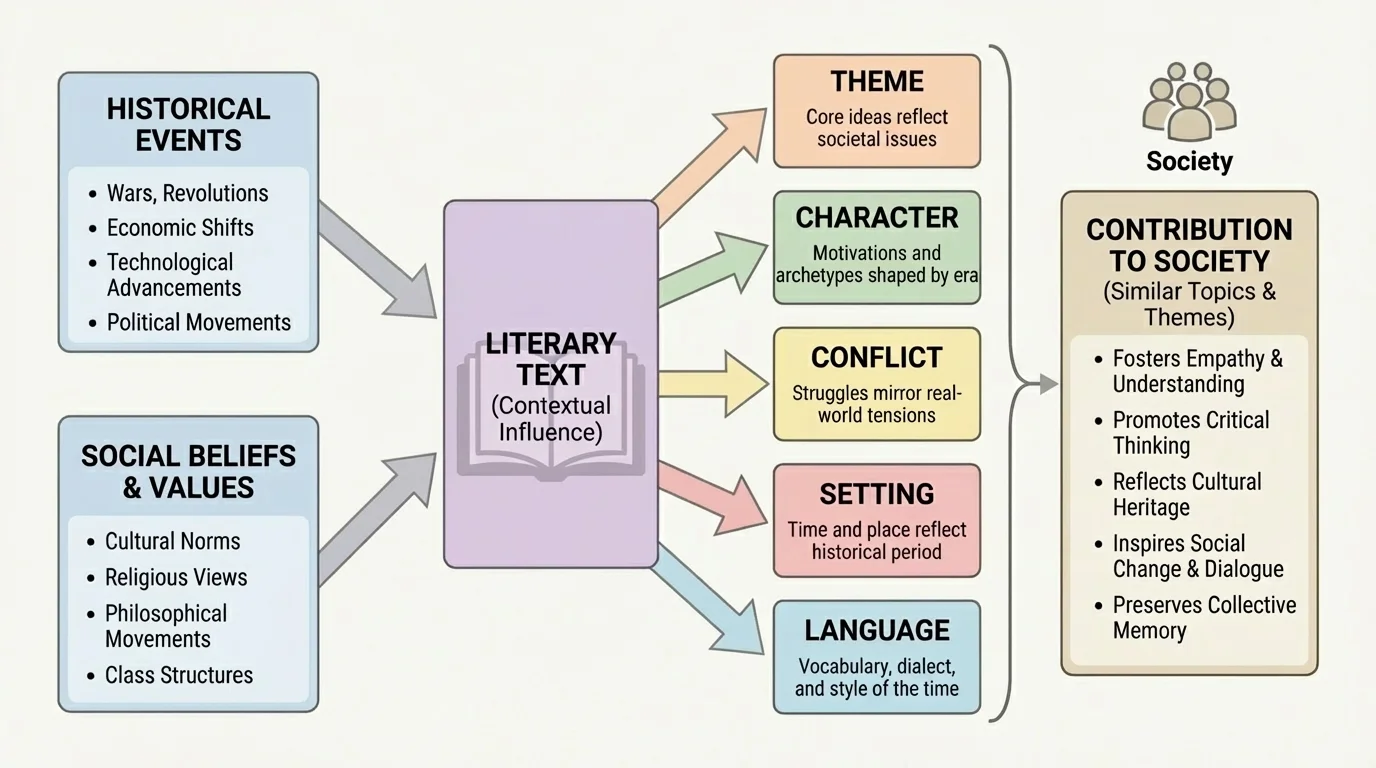
[Figure 2] Context shapes what a text says and how it says it. Historical pressures and literary traditions can affect a text's theme, characters, conflict, setting, language, tone, and structure.
Theme: Social issues often become themes in literature. A text written during censorship may explore truth and propaganda. A text written during civil rights struggles may explore justice, voice, or inequality.
Character: Characters are shaped by the expectations of their society. In some texts, characters face strict rules about class, race, religion, or gender. Their choices make more sense when readers understand those limits.
Conflict: External conflicts often grow out of real tensions in society. Internal conflicts may also reflect historical pressures. A character torn between duty and freedom may represent a larger cultural struggle.
Language and form: Writers choose forms and styles that connect to literary movements and audiences. A satirical novel may use exaggeration to criticize politics. A memoir may use plain, direct language to make a personal experience feel immediate and authentic.
Consider George Orwell's Animal Farm. On the surface, it is a story about farm animals. In context, it becomes a political allegory shaped by the Russian Revolution and the rise of Stalinism. The pigs' manipulation of language, the rewriting of rules, and the betrayal of equality all gain deeper meaning when readers connect the text to its historical moment.
Now consider Elie Wiesel's Night. Its historical context is the Holocaust. That context affects every aspect of the memoir: its stark tone, its themes of dehumanization and survival, and its emotional power as testimony. The text is not simply a personal story. It is also a witness to historical atrocity.
Context does not lock a text into one meaning. Knowing context does not mean there is only one "correct" interpretation. Instead, context helps rule out weak interpretations and support stronger ones. It allows readers to explain why a theme emerges, why a character acts in a certain way, and why the work mattered to its first audience and still matters now.
A strong reader uses context carefully. If every line of a poem is forced to match one historical event, the analysis can become too narrow. The goal is balance: close reading of the text itself, supported by relevant knowledge about the world around it.
When reading older literature, students sometimes judge characters or authors only by today's standards. That reaction is understandable, but analysis becomes stronger when it first asks what assumptions the original audience may have held. This does not mean excusing injustice or harmful ideas. It means understanding them clearly.
For example, in Romeo and Juliet, Juliet's age and lack of independence can feel disturbing to modern readers. Historical context helps explain why family control over marriage was treated differently in that period. That context does not make every action acceptable, but it helps readers analyze how power works in the play.
Likewise, Harper Lee's To Kill a Mockingbird must be read in relation to segregation and racism in the American South. The novel's courtroom scenes, community tensions, and moral arguments become more meaningful when viewed within that setting. The novel also reflects the limitations of its own time, which readers today continue to debate. That debate is part of literary study too.
Some books that are now considered classics were once controversial, banned, or strongly criticized. Their ability to disturb, challenge, or question accepted ideas is often part of what gave them lasting influence.
Reading in context also means noticing audience. Who was expected to read or hear the text? A Shakespeare play performed in a theater full of mixed social classes works differently from a modern novel assigned in school. Audience shapes style, references, and even which ideas are presented openly or indirectly.
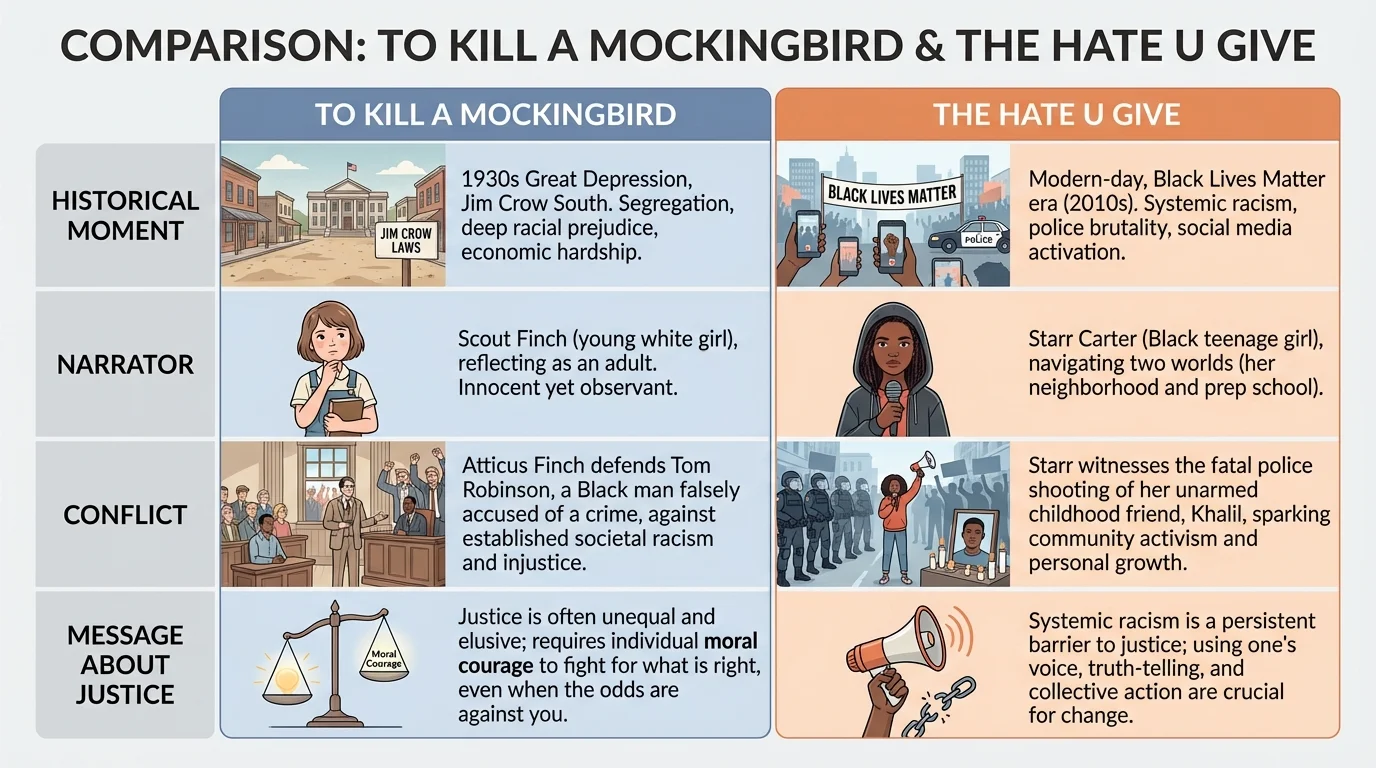
[Figure 3] Some of the richest analysis happens when readers compare works that explore similar subjects in different times and places. Similar themes can appear in very different historical moments, and comparison reveals both connection and difference. A text about injustice in the 1930s and a text about injustice in the 2010s may share concerns, yet their language, assumptions, and solutions may differ.
One useful comparison is Harper Lee's To Kill a Mockingbird and Angie Thomas's The Hate U Give. Both works address racism, justice, and the moral pressure to speak out. However, they come from different historical moments. Lee's novel reflects the era of legal segregation and is narrated through a child's perspective looking back at a community. Thomas's novel reflects contemporary conversations about police violence, media representation, and activism, and it gives a teenage narrator direct control over her own voice.
Because of that difference in context, the theme of justice develops differently. In Lee's novel, justice is tied to the legal system's failures and an individual's moral courage. In Thomas's novel, justice also involves protest, community voice, and public narrative. The shared topic links the texts, but context changes how the theme is expressed.
Another strong comparison is between war poetry from different periods. A patriotic poem written before combat may present war as noble sacrifice. A poem written by a soldier after trench warfare may present war as brutal and senseless. The topic is the same, but the lived historical experience reshapes the theme.
Readers can also compare literary context. A dystopian novel such as The Hunger Games draws on earlier dystopian traditions, including works like Orwell's 1984. Both question power and control, but they address different audiences and fears. The earlier novel reflects anxieties about surveillance and authoritarian governments in the twentieth century. The later novel speaks to concerns about spectacle, inequality, and media culture in the twenty-first century. As seen earlier in [Figure 2], context influences both the content and the form of these warnings.
| Work | Main Topic | Important Context | Effect on Theme |
|---|---|---|---|
| Romeo and Juliet | Love and conflict | Family honor, patriarchal society, tragic tradition | Love appears intense but trapped by social violence |
| To Kill a Mockingbird | Justice and racism | Segregation in the American South | Moral courage is tested in an unjust society |
| The Hate U Give | Justice and identity | Modern activism, media, policing | Speaking out becomes a form of resistance |
| Animal Farm | Power and corruption | Russian Revolution, totalitarianism, satire | Political ideals can be betrayed by leaders |
| Night | Survival and memory | The Holocaust, memoir tradition | Witnessing becomes a moral duty |
Table 1. Comparison of selected literary works, their contexts, and how those contexts shape theme.
[Figure 4] Literature matters not only as art but also as a social force. When multiple works address similar themes such as freedom, oppression, identity, or justice, they create a larger conversation that can influence how people think and act.
One major contribution is building empathy. Literature allows readers to experience perspectives they may never live themselves. Reading a memoir of genocide, a novel about discrimination, or a poem about exile can deepen emotional understanding. This does not solve injustice by itself, but it can make indifference harder.
Another contribution is preserving memory. Some works keep historical experiences alive for future generations. Night, for example, does more than tell one person's story. It helps preserve the memory of the Holocaust and warns against forgetting. In this way, literature can become part of a society's moral record.
Literature also contributes by challenging accepted beliefs. Satire, protest literature, and socially critical novels often expose hypocrisy or cruelty. Orwell's work challenged political lies. Upton Sinclair's The Jungle helped draw attention to labor and food safety conditions. Plays, novels, and poems can pressure readers to question what seems normal.
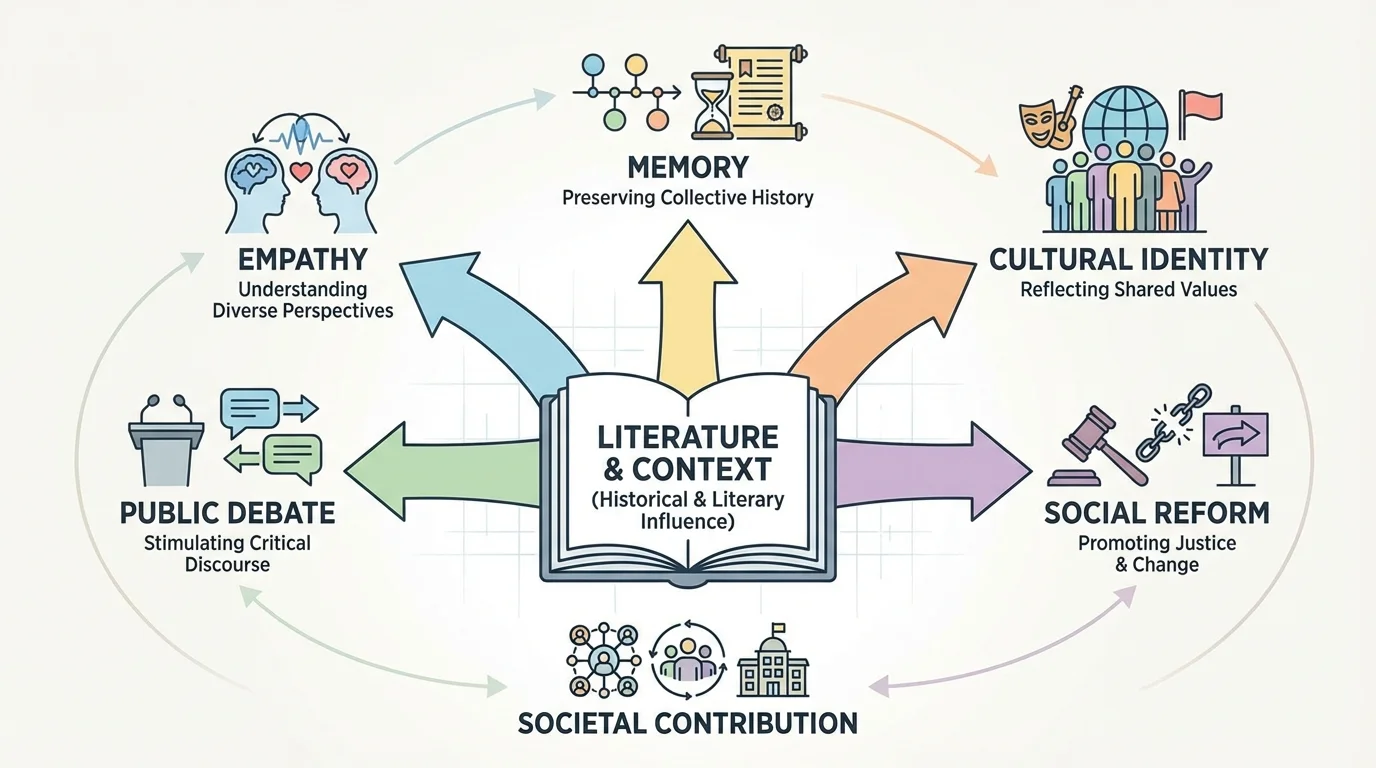
A further contribution is shaping public conversation. Some literary works become part of national debates about education, rights, race, war, or gender. Even when people disagree about a text, that disagreement can matter. It means the work is active in public life rather than silent on a shelf.
Literature can also strengthen cultural identity. Stories, folktales, oral histories, and novels can preserve language, traditions, and community values. For groups whose voices have been ignored or erased, literature can become a way of asserting presence and dignity.
"If there is a book that you want to read, but it hasn't been written yet, then you must write it."
— Toni Morrison
Of course, not every text improves society in the same way. Some works reinforce harmful ideas, and some reflect the prejudices of their era. Evaluating contribution means being honest about both influence and limitation. A powerful work can be socially important even if it is incomplete, controversial, or flawed.
Consider Romeo and Juliet. Its contribution to society includes shaping how later cultures imagine romantic love, youth, and rebellion against family pressure. At the same time, the play also reveals the destructive effects of inherited hatred. Its lasting influence appears not only in literature classes, but in films, songs, and modern retellings.
Consider To Kill a Mockingbird and The Hate U Give together. Their shared concern with racism and justice shows how literature can keep a social issue visible across generations. As [Figure 3] demonstrates, the later text does not simply repeat the earlier one; it updates the conversation by shifting voice, setting, and historical focus. Together, the books help readers trace both change and continuity in American society.
Case study: evaluating a work's social contribution
Claim: Night makes a major contribution to society because it preserves memory and confronts readers with the human cost of hatred.
Step 1: Identify the historical context.
The memoir emerges from the Holocaust, a genocide carried out by Nazi Germany during World War II.
Step 2: Connect context to textual features.
The plain, direct style and focus on dehumanization, fear, and survival make the historical reality feel immediate rather than distant.
Step 3: Explain the contribution to society.
By bearing witness, the memoir helps later generations remember the past, recognize warning signs of hatred, and understand why memory matters.
This evaluation works because it connects historical context, literary choices, and social impact.
Another case study is Animal Farm. Its contribution lies in making political corruption understandable through allegory. Readers who might not study a detailed history of Soviet politics can still understand how revolutionary ideals can collapse into dictatorship. The text remains socially valuable because propaganda and abuse of power still exist.
When readers return to the broader model shown in [Figure 4], they can see that literature's contribution is rarely just one thing. A single work may preserve memory, challenge power, and build empathy at the same time.
To analyze context and evaluate literary contribution well, readers should build claims in stages. Start with the text itself. Notice key details: repeated images, conflicts, tone, characterization, narration, and patterns in the ending. Then connect those details to context. Ask what historical conditions or literary traditions help explain these choices.
Next, move from explanation to evaluation. Do not stop at saying that a text reflects its time. Ask what the work does in society. Does it challenge injustice? Give voice to overlooked experiences? Reinforce traditional values? Influence later writers? Keep a historical memory alive? A strong evaluation makes a judgment and supports it with evidence.
For example, a weak claim might say, "This novel is important because it is about racism." A stronger claim would say, "This novel contributes to society by exposing how racism shapes institutions and daily life, and by encouraging readers to question silence and complicity." The second version explains the nature of the contribution.
Good literary analysis usually combines three kinds of evidence: details from the text, relevant context from the world around the text, and reasoning that explains why those details matter. Quoting a line is not enough unless you interpret it.
It is also useful to compare multiple works on the same theme. If two texts address freedom, identity, or injustice differently, that difference can strengthen your evaluation. It shows that literature does not speak with one voice; it creates an ongoing cultural conversation.
One common mistake is presentism, which means judging the past only through today's values without first understanding its original context. Readers should still think ethically, but they should avoid shallow conclusions that erase historical complexity.
Another mistake is confusing topic with theme. A topic may be war, love, race, or power. A theme is what the text says about that topic. Two works can share a topic but present very different themes.
A third mistake is assuming that author biography explains everything. An author's life can matter, but texts also respond to genre, audience, politics, and cultural tradition. Literature is shaped by many forces, not just one.
Finally, avoid making huge claims without evidence. Saying that a book "changed the whole world" is too broad unless supported. Better evaluation is specific: describe how a work influenced readers, public debate, literary tradition, or cultural memory.
When students learn to connect close reading with context, they become stronger readers of both literature and society. They begin to see texts not as isolated assignments but as living responses to real human struggles. That is why literature study matters: it teaches us how words can emerge from history, enter public life, and continue shaping the world.
