A powerful piece of writing can change a school policy, influence a vote, or shift the way people think about a problem. But strong writing is not just about having an opinion. Two students can care equally about the same issue and still write very different arguments because one understands why they are writing and who they are writing to. That difference often determines whether the writing feels convincing or forgettable.
When writers create an argument, they make choices. They choose what claim to present, what evidence to include, what tone to use, and what details to leave out. Those choices should never be random. Effective argument writing begins with a clear sense of purpose and audience. If a writer ignores either one, the argument may be accurate but still fail to connect with readers.
For example, a student writing to a principal about extending library hours would likely sound different from a student posting online to classmates about the same issue. The main point may stay similar, but the style, evidence, and level of formality would change. In argument writing, the writer is not only expressing a view; they are trying to move a specific audience toward understanding, agreement, or action.
Purpose is the writer's main reason for writing. Audience is the specific group of readers or listeners the writer wants to reach. Rhetorical appeals are strategies writers use to persuade an audience, especially through credibility, emotion, and logic.
A clear purpose and a clear audience help writers stay focused. They also help readers trust the argument because the writing feels thoughtful rather than careless or unfocused.
In argumentative writing, purpose usually goes beyond simply stating what the writer believes. A writer may want to persuade readers to accept a claim, encourage them to take action, analyze a text or issue, or explain why a problem matters. Purpose acts like a guide. It helps the writer decide what belongs in the piece and what does not.
If the purpose is to persuade the school board to improve cafeteria food, the writing should focus on reasons and evidence that board members are likely to value, such as student health, budget choices, and feedback from the school community. If the purpose is to analyze how a speech convinces its audience, the writing should examine techniques, evidence, and rhetorical choices rather than simply saying whether the writer agrees.
Purpose also affects structure. A call-to-action argument may build toward a strong final recommendation. An analytical argument may spend more time explaining how and why the evidence supports a claim. In both cases, purpose shapes the writing from beginning to end.
Arguments are not just opinions. A strong argument includes a clear claim, valid reasoning, relevant evidence, and attention to other viewpoints. Purpose helps the writer decide how to arrange those parts for maximum impact.
Writers sometimes have more than one purpose at once. An editorial about recycling at school, for instance, may aim to inform readers about waste, persuade them that change is necessary, and encourage them to support a new policy. When that happens, one purpose should still lead the piece so the argument stays clear.
Audience expectations shape nearly every writing decision, as [Figure 1] shows through differences in tone, evidence, and concerns for different readers. Readers bring beliefs, values, experiences, and background knowledge with them. They also expect different levels of formality. A principal may expect respectful, organized writing with evidence from school life. Classmates may respond better to direct language, shared experiences, and practical examples.
Writers should ask several questions: What does this audience already know? What does this audience care about? What objections might this audience have? What tone will seem appropriate and respectful? The answers help writers decide which points to emphasize.
Consider the issue of later school start times. Students may care most about sleep, stress, and concentration in class. Parents may also want to know about safety, transportation, and after-school schedules. Administrators may focus on attendance, bus routes, staffing, and costs. The claim may be the same, but the argument becomes stronger when the writer addresses each audience's real concerns rather than assuming everyone thinks alike.
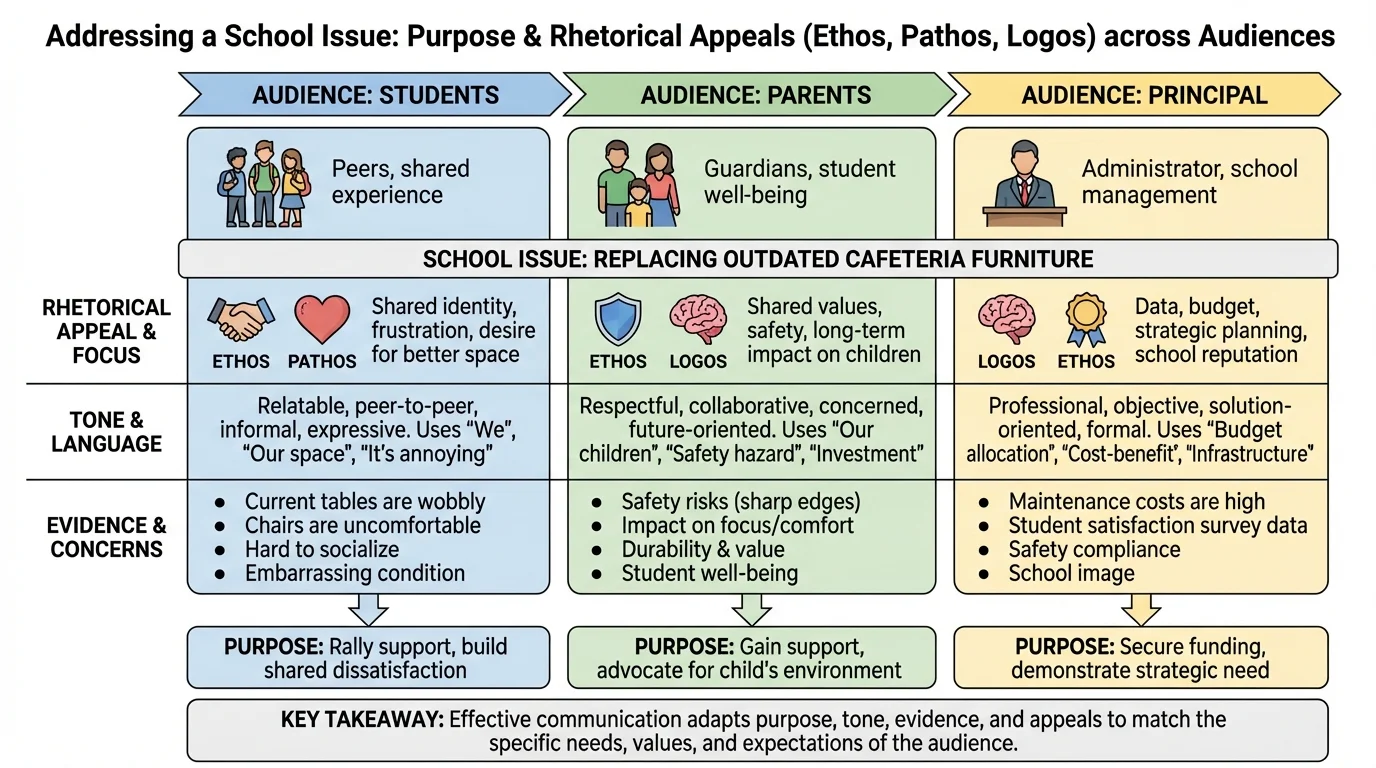
Understanding an audience does not mean telling people only what they want to hear. It means presenting a truthful argument in a way that makes sense to them. Skilled writers meet readers where they are and then guide them forward.
This is also where tone matters. A sarcastic tone may damage trust with a serious audience. A highly emotional tone may seem out of place in a formal analysis. A flat, detached tone may fail to motivate readers when the purpose is to inspire action. Audience awareness helps writers choose language that fits the situation.
Writers often rely on three major persuasive tools, and [Figure 2] illustrates how each one works differently: ethos, pathos, and logos. These appeals come from ancient rhetoric, but they are still widely used today—in speeches, advertisements, opinion essays, debates, and even social media posts. The best writers understand not only what these appeals are, but also when and how to use them.
Ethos is an appeal to credibility and character. A writer uses ethos by sounding knowledgeable, fair, trustworthy, and respectful. Credibility can come from expertise, careful research, honesty about limits, and a willingness to address opposing views. For example, a student arguing for later school start times strengthens ethos by referring to reliable studies, using accurate facts, and avoiding exaggerated claims.
Pathos is an appeal to emotion. This does not mean manipulating readers with drama. It means helping readers feel the human importance of an issue. A writer may use pathos by describing a real situation, choosing vivid details, or showing what is at stake. For instance, an argument about teen sleep might mention students struggling to stay awake while driving to school in the dark. That image creates emotional urgency.
Logos is an appeal to logic and reasoning. Writers use logos when they present facts, statistics, cause-and-effect relationships, comparisons, and clear explanations. If a student argues that later school start times improve academic performance, the writer should include research findings, attendance data, and reasoning that links adequate sleep to concentration and memory.
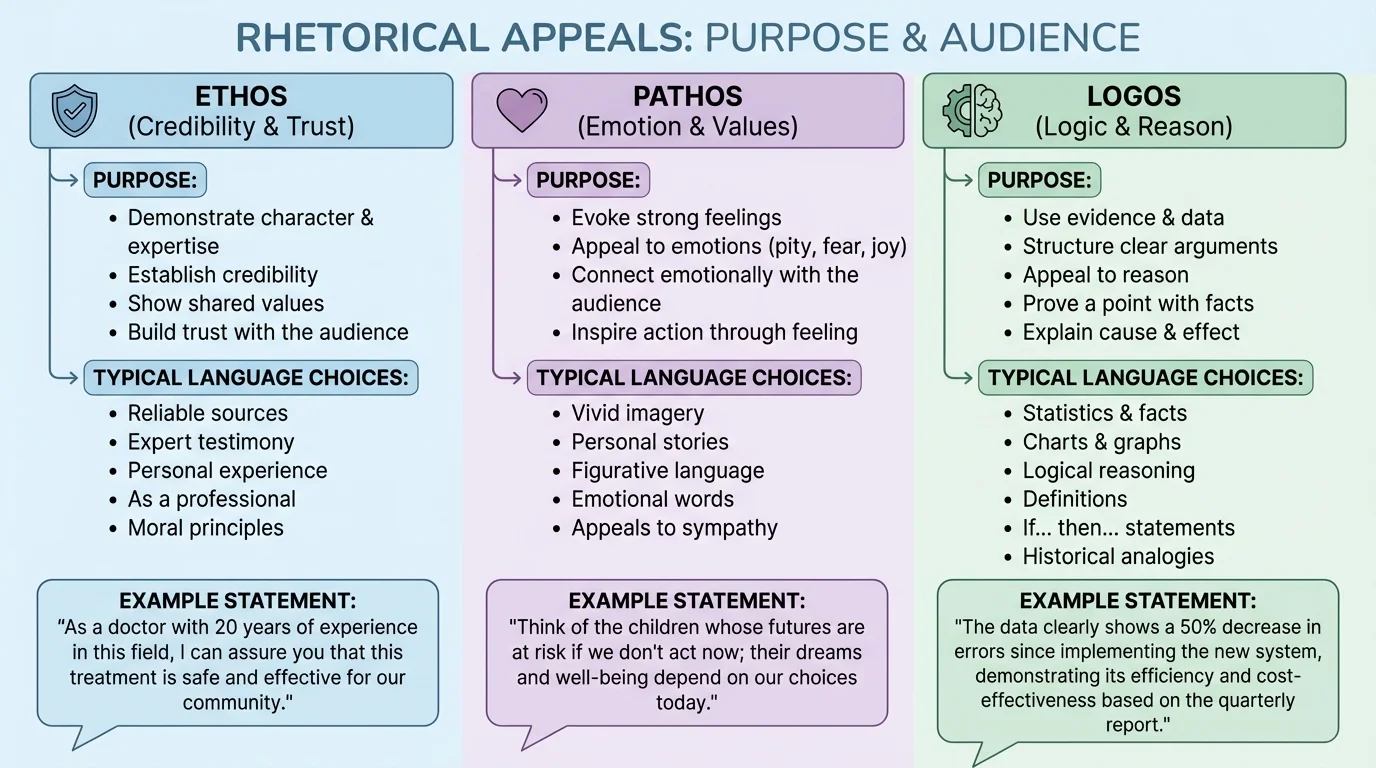
These appeals are not opposites. Strong arguments often blend all three. A writer may establish credibility, present evidence, and show why the issue matters emotionally. When used together, the appeals can support one another.
How the appeals work together
An argument is usually strongest when readers trust the writer, understand the logic, and care about the outcome. Ethos helps readers believe the writer is credible. Logos helps them see that the reasoning makes sense. Pathos helps them recognize the human importance of the issue. If one appeal is missing, the argument may feel incomplete.
Still, balance matters. Too much pathos without enough evidence can feel manipulative. Too much logos without a sense of human impact can feel cold or disconnected. Too much focus on ethos without clear reasoning can sound self-important rather than persuasive.
Rhetorical appeals become most effective when they support the structure of an argument. An argument usually includes a claim, reasons, evidence, and an answer to counterclaims. Each part can use appeals differently.
The claim states the writer's position. The claim should be clear and arguable, not vague or obvious. For example, "Schools should start later because teens need sleep to learn and stay healthy" is stronger than "Sleep is important." The stronger claim points toward reasoning and evidence.
The evidence supports the claim. This may include facts, expert opinions, examples, observations, or quotations from reliable sources. Evidence usually strengthens logos, but it can also support ethos by showing that the writer has done careful research. If the evidence includes real stories or examples, it may also contribute to pathos.
The writer's counterclaim is the opposing viewpoint. Addressing it fairly can strengthen ethos because it shows honesty and maturity. It also improves logos because it demonstrates that the writer has tested the argument against other possibilities rather than ignoring them.
Example: one claim, three appeals
Claim: Schools should provide free water stations in every hallway.
Step 1: Using ethos
A credible writer might say that school nurses and health organizations recommend regular hydration for concentration and physical well-being. This sounds informed and responsible.
Step 2: Using logos
The writer could explain that students who do not have easy access to water may become distracted, and reusable water stations reduce plastic bottle waste. This connects cause and effect.
Step 3: Using pathos
The writer might describe an athlete trying to get through afternoon practice after a long day with limited access to water. This helps readers feel the issue.
Each appeal supports the same claim in a different way.
When students write arguments, they sometimes think persuasion means making the writing sound dramatic. In reality, persuasion usually depends more on thoughtful choices than on forceful language. Good argument writing is controlled, specific, and purposeful.
The same issue can be framed in very different ways, and [Figure 3] shows how a writer might choose different appeals and evidence for different situations. Suppose the topic is later school start times. A speech to students might use pathos by describing exhaustion and stress, along with logos about concentration. A letter to parents might emphasize safety, health, and research. A proposal to the school board might focus most heavily on logos and ethos, using studies, attendance trends, and practical planning.
This does not mean one audience gets "real facts" while another gets only emotional language. Instead, it means the writer selects the most relevant combination of appeals. For a formal decision-making audience, strong logos and ethos usually matter most. For an audience that needs motivation or awareness, pathos may play a larger role.
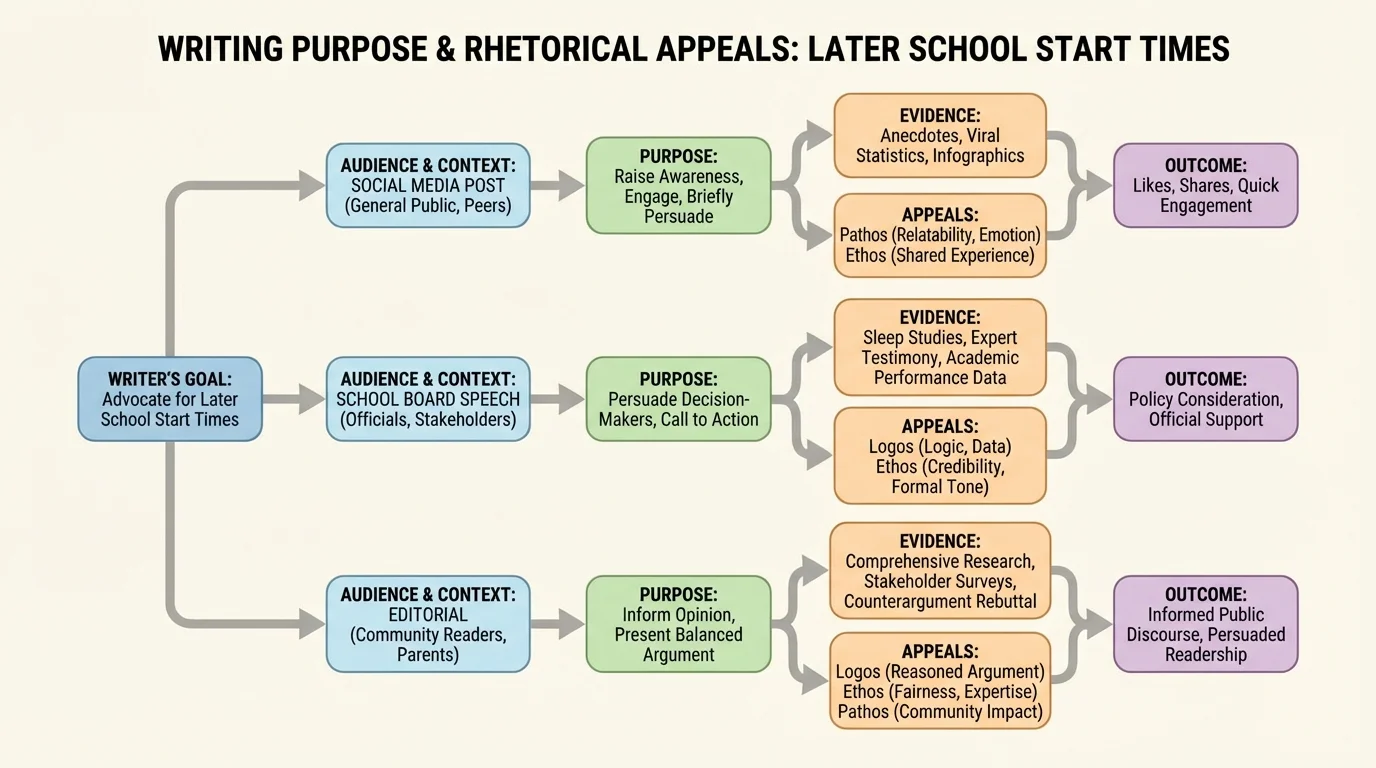
Purpose matters here too. If the purpose is to analyze a speech, the writer may discuss how the speaker builds ethos, pathos, and logos. If the purpose is to change policy, the writer must actively use those appeals. Analysis studies persuasion; argument performs it.
| Situation | Likely Audience | Most Useful Appeals | Best Evidence Choices |
|---|---|---|---|
| Letter to principal | School leader | Ethos, logos | School data, respectful reasoning, practical solutions |
| Speech to students | Peers | Pathos, logos | Shared experiences, clear examples, relevant facts |
| Editorial for community paper | General public | Ethos, logos, pathos | Research, local impact, human stories |
| Literary analysis essay | Teacher or academic readers | Ethos, logos | Textual evidence, explanation, precise interpretation |
Table 1. Comparison of how purpose and audience affect rhetorical choices in different writing situations.
The comparison in [Figure 1] still matters here: a writer who ignores audience concerns may include good evidence but fail to answer the questions readers actually have.
Persuasive writing should be strong, but it should also be fair. An argument becomes weaker when it relies on bias, distortion, or emotional pressure instead of valid reasoning. Bias can appear when a writer presents only one side, ignores evidence that weakens the claim, or uses loaded language to make readers react before they think.
For example, saying "Only a careless person would oppose later school start times" attacks people instead of addressing reasons. That damages ethos and weakens logos. A fairer writer would recognize concerns such as transportation or after-school activities and respond to them respectfully.
Writers should also avoid common logical fallacies. A fallacy is an error in reasoning that may sound convincing at first but does not actually prove the claim.
Common fallacies in argument writing
Step 1: Hasty generalization
Drawing a broad conclusion from too little evidence. Example: "Two students disliked the new lunch menu, so the whole school hates it."
Step 2: False dilemma
Pretending there are only two choices when more exist. Example: "Either we ban phones completely or students will never learn."
Step 3: Ad hominem
Attacking a person instead of the argument. Example: "Her opinion on homework does not matter because she is always complaining."
Step 4: Slippery slope
Claiming one step will automatically lead to extreme results without evidence. Example: "If school starts later, eventually no one will care about schedules at all."
Fair argument writing does not hide complexity. It deals with it. This makes the writer seem more thoughtful and more trustworthy. As we saw in [Figure 2], ethos depends on credibility, and credibility grows when the writer is accurate, balanced, and honest.
Ancient Greek thinkers studied rhetoric over 2,000 years ago, and their ideas still shape modern speeches, court arguments, political debates, and advertising.
Being unbiased does not mean avoiding a position. It means supporting a position with valid reasoning and sufficient evidence rather than twisting facts to force a conclusion.
Rhetorical appeals are not separate decorations added at the end of a paper. They are built through everyday writing choices. Word choice, sentence style, organization, evidence, and tone all affect how readers respond.
Diction, or word choice, shapes tone. Precise language usually supports logos because it reduces confusion. Respectful language supports ethos because it shows maturity. Vivid but accurate language can support pathos by helping readers picture the issue without exaggeration.
Organization matters too. A logical structure makes the writing easier to follow. Many arguments work best when they begin with a clear claim, develop reasons in separate parts, include strong evidence, address counterclaims, and end with a purposeful conclusion. If readers cannot follow the structure, even good evidence may lose force.
Source quality is also essential. A well-supported argument depends on credible evidence from reliable sources. Quoting an expert, using a trustworthy study, or citing school data can strengthen ethos and logos. Weak or questionable sources can damage the whole argument.
"The art of persuasion is not in tricking people, but in helping them see what is true and important."
Transitions help as well. Words such as because, therefore, however, and for example guide readers through the reasoning. They signal how ideas connect, which strengthens logos and makes the argument feel more controlled.
Consider this short argumentative approach: a student argues that schools should expand mental health support services. The purpose is to persuade administrators to add counseling resources. The audience is school leadership, teachers, and possibly parents.
The argument might begin by establishing ethos through a respectful tone and reference to reliable sources on teen stress. It might then use logos by presenting evidence about wait times for counseling, rising stress levels, or the connection between mental health and attendance. Pathos might appear in a brief but powerful example of a student who struggles silently because help is not easy to access.
Case study: analyzing effectiveness
Sentence set: "Schools should expand counseling support because students cannot learn effectively when stress and anxiety go unaddressed. According to national and local reports, more teens are reporting mental health challenges each year. When students wait weeks for help, small problems can become crises. Expanding support is not only compassionate; it is a practical investment in attendance, safety, and academic success."
Step 1: Purpose
The purpose is persuasion aimed at decision-makers.
Step 2: Audience needs
The audience likely wants both human and practical reasons, so the writing addresses student well-being and school outcomes.
Step 3: Appeals used
Ethos appears through measured tone and reference to reports. Logos appears through cause-and-effect reasoning. Pathos appears in the concern for students whose needs go unanswered.
Step 4: Why it works
The argument does not rely on emotion alone. It combines credible language, evidence, and urgency.
This example also shows that the strongest pathos is often restrained. A brief, truthful detail can be more effective than a dramatic paragraph full of exaggeration. Readers usually trust writing more when emotion is grounded in facts.
Before drafting an argument, writers should be able to answer four questions clearly: What is my purpose? Who is my audience? What will this audience expect? Which appeals will best help me meet those expectations honestly and effectively?
During revision, writers should test each paragraph against those questions. Does this evidence actually help my audience understand the issue? Does my tone fit the situation? Am I building trust? Am I using emotion responsibly? Have I explained my reasoning clearly? Have I treated opposing views fairly?
Strong argument writing is not just about sounding convincing for a moment. It is about building a case that readers can respect, follow, and take seriously. As [Figure 3] illustrates, effective writers do not change the truth for different audiences; they adjust their approach so the truth reaches people in the clearest and most persuasive way.
