A story can tell you that a character feels trapped, or it can make you feel the walls closing in through sharp imagery, repeated sounds, and a symbol that keeps returning at key moments. That difference is the power of style. In strong narratives, writers do more than report events. They shape language so readers sense hidden meanings, notice patterns, and stay emotionally connected from beginning to end.
When you write a real or imagined narrative, your job is not only to build a plot. You also choose how the story sounds, looks on the page, and feels in the reader's mind. Those choices are called stylistic devices. A stylistic device can be a metaphor, a repeated image, a sudden shift in sentence length, a symbol, or even a deliberate line break or punctuation choice. Together, these elements help communicate ideas that are either stated directly or suggested indirectly.
Narratives are built from events, characters, conflict, and setting, but style gives those parts force. Two writers can describe the same event, such as a late-night train departure, and create very different effects. One might use plain narration: the train left and the station became quiet. Another might write that the station exhaled steam and swallowed the last echo of footsteps. The second version uses personification and imagery to create mood and to suggest loneliness or change.
Style matters because readers do not respond only to what happens. They respond to pattern, rhythm, emotional texture, and emphasis. In a narrative with multiple plot lines, style also helps readers follow connections. A repeated symbol in two different story lines can quietly show that both characters struggle with the same fear, even if they never meet.
Theme is the central idea, insight, or message a text explores about life, people, or society. An explicit theme is stated clearly in the text, while an implicit theme is suggested through details, actions, symbols, and patterns that the reader must infer.
Writers often trust readers to notice these clues. That is why style is not decoration. It is one of the main ways meaning is built.
A narrative may present theme directly, but often it works through an implicit theme, where readers gather meaning from repeated details, contrast, and character choices. As [Figure 1] illustrates, readers move from events to patterns, and from patterns to theme. If a story repeatedly shows a character deleting messages, avoiding mirrors, and hiding awards in a drawer, the text may never say "she fears being seen," yet that theme becomes visible.
An explicit theme can appear in dialogue, narration, or reflection. A character might say, "You can outrun a town, but not your own choices." That line presents an idea clearly. An implicit theme is subtler. It emerges through structure and style: recurring roads, unfinished conversations, and descriptions of motion that never lead to escape.
Writers usually create stronger narratives when they do not force the theme too bluntly. Instead, they layer meaning. A story can contain both explicit and implicit theme at once. A character may state one belief, while symbols and events complicate that belief, showing the truth is larger than the character understands.
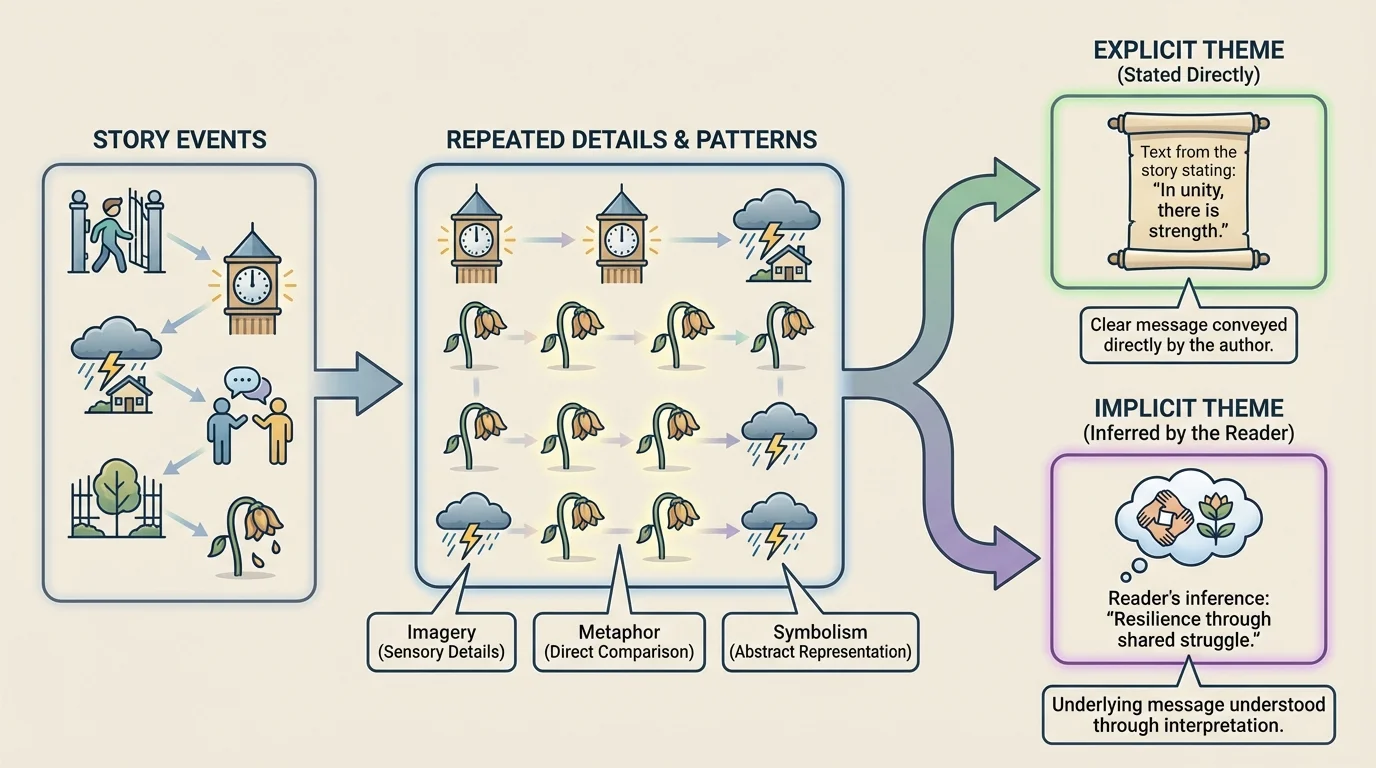
Theme also depends on what the writer emphasizes. If a narrative focuses repeatedly on sacrifice, memory, or isolation, those ideas become thematic. Small details matter. The objects characters keep, the weather that returns, the comparisons used in narration, and the way scenes begin and end all contribute to meaning.
Many memorable themes are never stated in a single sentence. Readers often remember a story's emotional truth because of repeated images or symbols, not because a narrator explains the message directly.
That is one reason literary narratives often reward rereading. On a second reading, readers notice patterns that seemed minor at first but actually shape the entire text.
Figurative language helps writers say more than the literal words mean. A metaphor compares unlike things without using "like" or "as." A simile makes a comparison using those words. Personification gives human qualities to nonhuman things. Symbolism uses an object, place, or action to represent a deeper idea. These devices can reveal theme quickly and powerfully.
Consider this sentence: "The trophy sat in his room like a witness." Literally, a trophy is not alive. But the simile suggests guilt, memory, and pressure. If the story later shows the same trophy hidden under a bed, the object becomes a symbol of expectations the character cannot escape. This supports an implicit theme about achievement and identity.
Poetic techniques can also strengthen narrative prose. Repetition can emphasize obsession, fear, hope, or inevitability. Alliteration can make a phrase more memorable or musical. Assonance and consonance create subtle sound patterns. These are not only for poetry. In fiction, sound can shape mood. A line filled with hard consonants may feel tense; a line with long vowels may feel slow or reflective.
Example of figurative language shaping theme
Plain version: "Mara was nervous before the race."
Step 1: Add imagery and metaphor
"At the starting line, Mara felt a hive of wings beating inside her ribs."
Step 2: Add a repeated image that can become symbolic
"The white line on the track looked less like a mark and more like a border she had to cross alone."
Step 3: Connect the device to theme
The metaphor of wings suggests restless fear, while the border image suggests growth through risk. The scene now supports a theme about courage and change rather than merely reporting nervousness.
Writers should be careful, though. Strong figurative language is precise. Weak figurative language is vague, overdramatic, or unrelated to the scene. If every sentence contains a metaphor, the effect becomes heavy and confusing. Style works best when it is intentional.
Imagery makes readers experience the world of a story through the senses. As [Figure 2] shows, a single scene can include sight, sound, touch, smell, and taste. Effective imagery does not pile up random description. It selects details that match the mood, reveal character, and support theme.
Visual imagery describes what is seen: flickering neon, cracked sidewalks, a jacket sleeve dark with rain. Auditory imagery captures sound: brakes shrieking, a phone buzzing against a metal bench. Tactile imagery describes texture and physical feeling: damp cuffs, cold railings, heat trapped under stage lights. Smell and taste are used less often, but when chosen well, they make scenes vivid and memorable.
Suppose a story follows two siblings waiting outside a hospital. The writer could describe the buzzing lights, the bitter coffee, the sting of antiseptic in the air, and the plastic chair pressing into a tired back. These details do more than decorate the setting. They communicate anxiety, exhaustion, and emotional strain without needing to name each emotion directly.
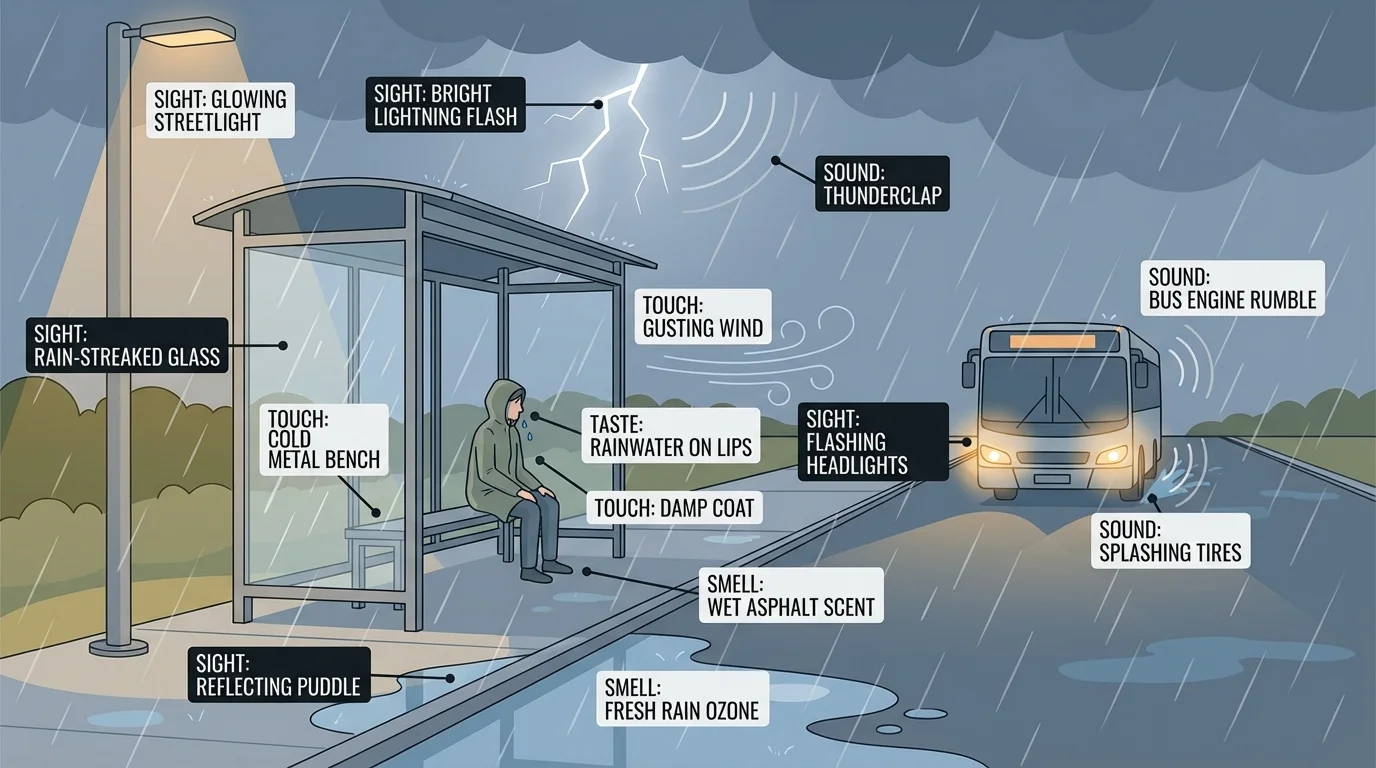
Imagery is especially important in narratives with emotional turning points. During a reunion, grief scene, accident, confession, or escape, sensory details slow the moment enough for readers to feel its weight. This is one way style supports well-structured event sequences. The writer chooses where to zoom in and where to move quickly.
Imagery can also connect different plot lines. One plot line might describe city lights as sharp and electric, while another describes stars as cold and unreachable. Later, both characters may see reflections in glass, creating a visual link between separate experiences. That repeated image suggests a shared theme of distance or self-examination.
As the sensory layering in [Figure 2] demonstrates, the strongest details are usually the ones that reveal more than setting. They also hint at mood, conflict, or theme.
Style is not limited to word choice. It also includes graphic elements and structural choices on the page. Sentence length can create speed or pause. A one-sentence paragraph can emphasize shock. Ellipses can suggest hesitation. Dashes can create interruption or abrupt thought. Italics can mark inner emphasis. White space can create silence, distance, or fragmentation.
In narrative writing, these choices should still serve clarity. A fast-paced chase scene may use short sentences: "He slipped. Grabbed the rail. Kept running." A reflective memory scene may use longer, flowing sentences that mirror thought. If a story includes text messages, notes, or headlines, those graphic elements can help distinguish forms of communication and build realism.
| Stylistic choice | Typical effect | Best use in narrative |
|---|---|---|
| Short sentence | Tension, speed, impact | Action, shock, sudden realization |
| Long sentence | Reflection, complexity, flow | Memory, description, emotional build |
| One-sentence paragraph | Emphasis | Turning point or reveal |
| Repetition | Focus, rhythm, obsession | Theme, emotional intensity, pattern |
| Italics | Inner voice or stress | Thought, memory, key phrase |
| White space | Pause, silence, fragmentation | Loss, shock, time shift |
Table 1. Common stylistic choices in narrative writing and the effects they often create.
These features can support both engagement and theme. For example, a fragmented page layout can mirror a character's fractured memory. A repeated isolated phrase can remind readers of an unresolved fear. However, graphic choices should never make the story hard to follow. Readers should notice the effect, not struggle with the format.
Style and structure work together. A narrative becomes more powerful when stylistic devices match the moment in the plot. During a climax, short sentences and sharp sounds may intensify danger. During reflection, slower syntax and repeated images may help readers understand the deeper meaning of events. Strong writers connect style to sequence, not just to decoration.
This is especially important in longer narratives. As plot lines develop, style helps signal shifts in time, perspective, and emotional weight.
Every narrative has an intended audience. A serious realistic story about family pressure will likely use different stylistic choices from a satirical mystery or a suspense narrative. Writers should ask what response they want: tension, sympathy, curiosity, unease, excitement, or reflection. The chosen devices should fit that purpose.
Tone is the writer's attitude toward the subject, while mood is the feeling created in the reader. Dark symbolism and compressed sentences can create an uneasy tone. Rich sensory detail and warmer comparisons may create a reflective or hopeful mood. If the tone shifts sharply without reason, readers can feel lost. If the style remains exactly the same in every scene, the narrative can feel flat.
Audience also affects how noticeable your devices should be. Some narratives use subtle symbolism that readers discover gradually. Others use dramatic repetition and clear motifs because the story aims for a bold emotional impact. The best choice depends on genre, purpose, and context.
Readers make inferences by combining details from character actions, setting, dialogue, and narration. Stylistic devices strengthen those inferences because they direct attention to what matters most.
A useful rule is this: choose devices that sharpen meaning rather than showing off. If a line sounds impressive but does not fit the character, setting, or event, it weakens the narrative.
In narratives with more than one plot line, style becomes a tool for coherence. As [Figure 3] shows, separate story lines can be linked through recurring motifs, mirrored imagery, or contrasting tones. One plot line might follow a student musician preparing for an audition, while another follows her grandfather losing access to old memories. If both plot lines repeatedly return to broken music, static, and unfinished melodies, the narrative suggests a shared theme about memory and voice.
Writers can use contrast just as effectively as similarity. One plot line may use bright, crowded imagery and quick dialogue. Another may use stillness, dim light, and long sentences. The contrast helps readers feel the difference between the worlds while still noticing the deeper connection.
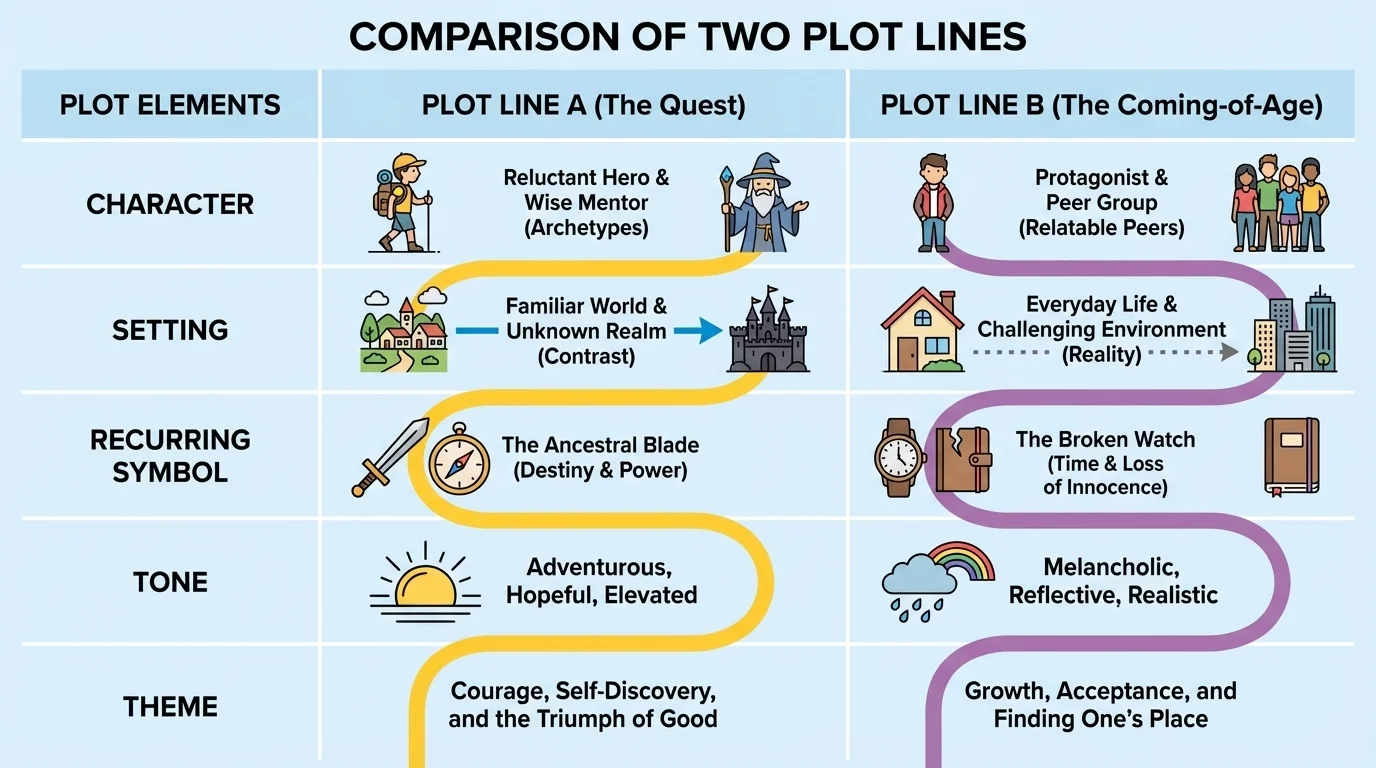
Symbols are especially useful across plot lines. A river, a window, a train ticket, or a song lyric can recur in different contexts. Each time it appears, its meaning can grow. In one thread, the river may suggest escape. In another, it may suggest danger. Together, those meanings create complexity rather than contradiction.
Voice can also vary across plot lines. A first-person section may sound restless and immediate, while a third-person section feels more distant. The writer can still unify both through recurring phrases, parallel scene structures, or shared images. The comparison in [Figure 3] makes this easier to see: different tones do not prevent unity if the thematic patterns remain consistent.
Look at this short passage: "By dawn, the bakery windows glowed like small promises. Nia stood across the street with flour still on her coat from the night shift at the factory, staring at the sign her mother once painted by hand. Half the letters had faded. She could still read them." This passage uses simile, visual imagery, and symbolism. The glowing windows suggest hope. The fading letters suggest loss, time, and financial struggle. The final sentence is simple, but emotionally powerful. It hints at an implicit theme about inheritance, endurance, and choosing whether to continue a family dream.
Now compare it to a flatter version: "Nia looked at the bakery and thought about whether to keep it." The information is present, but the scene has little atmosphere, emotional texture, or thematic depth. Stylistic devices do not replace plot, but they make plot meaningful.
Case study: one event, two different styles
Event: A student opens a college rejection email.
Version A: direct but limited
"Lena opened the email and saw she had not been accepted. She felt disappointed and closed her laptop."
Version B: stylistically shaped
"The screen lit her face in a cold blue square. She read the first line once, then again, as if the words might rearrange themselves out of pity. Outside, the marching band kept practicing for Friday night, every brass note bright and impossible."
Analysis
Version B uses imagery, contrast, and subtle personification. The band music intensifies Lena's isolation, and the line about words rearranging themselves suggests denial. The passage supports an implicit theme about ambition, disappointment, and public success versus private failure.
Strong narratives often rely on restraint. Notice that the second version never directly says Lena is devastated. Instead, it lets detail and sound communicate that feeling.
"Style is a way to say who you are without having to speak."
— Common writing principle
In narrative writing, style also reveals what the story cares about. What gets described fully? What gets repeated? What gets left unsaid? Those choices guide the reader toward theme.
One common mistake is overloading every line with devices. If every object is symbolic and every sentence is dramatic, readers stop noticing what matters. Another mistake is cliché, an overused phrase or image that no longer feels fresh, such as "cold as ice" or "heart of gold." Clichés weaken engagement because they do not create a specific, original effect.
Mixed imagery is another problem. If a writer says a character is "drowning in homework while climbing a mountain of stress and dodging bullets," the images compete instead of building a clear feeling. Strong style usually develops one fitting image pattern at a time.
Revision means checking whether each stylistic choice serves character, scene, and theme. Ask whether a metaphor matches the situation, whether imagery is specific rather than generic, whether repetition is purposeful, and whether formatting choices improve meaning instead of distracting from it.
Revision example
Overwritten version: "The hallway was a tornado of chaos, a jungle of noise, a furnace of panic, and Maya's heart was a war drum exploding into a hurricane of dread."
Step 1: Identify the issue
The sentence uses too many competing images. The effect becomes exaggerated and unclear.
Step 2: Choose one image pattern
"The hallway roared around Maya, but all she could hear was the drumbeat in her throat."
Step 3: Check the result
The revised sentence keeps the sound imagery, creates tension, and is easier for the reader to picture.
When revision is done well, style becomes sharper, not louder. The goal is not to sound fancy. The goal is to make readers feel, notice, and understand more deeply.
As you read or write narratives, pay attention to the relationship between device and effect. A symbol might connect two plot lines. A sound pattern might intensify suspense. A single repeated image might quietly build an implicit theme across the entire story. These are the tools that help narratives become memorable rather than merely complete.
