Have you ever looked at a book page and known something even before hearing all the words? That happens because books use words and pictures together. In informational books, the words tell facts, and the pictures help us see those facts. Good readers learn to look at both.
When we read an informational book, the text gives us information with words. An illustration gives us information with a picture. The illustration and the text go together on the page. They help tell about the same topic.
Text is the words we read. Illustration is a picture that goes with the words. The relationship between them is how they connect and help each other.
Sometimes the words say, "A bee lands on a flower." The picture may show the bee on the petals. The words tell the fact, and the picture shows what that fact looks like. When we notice that connection, we understand the page better.
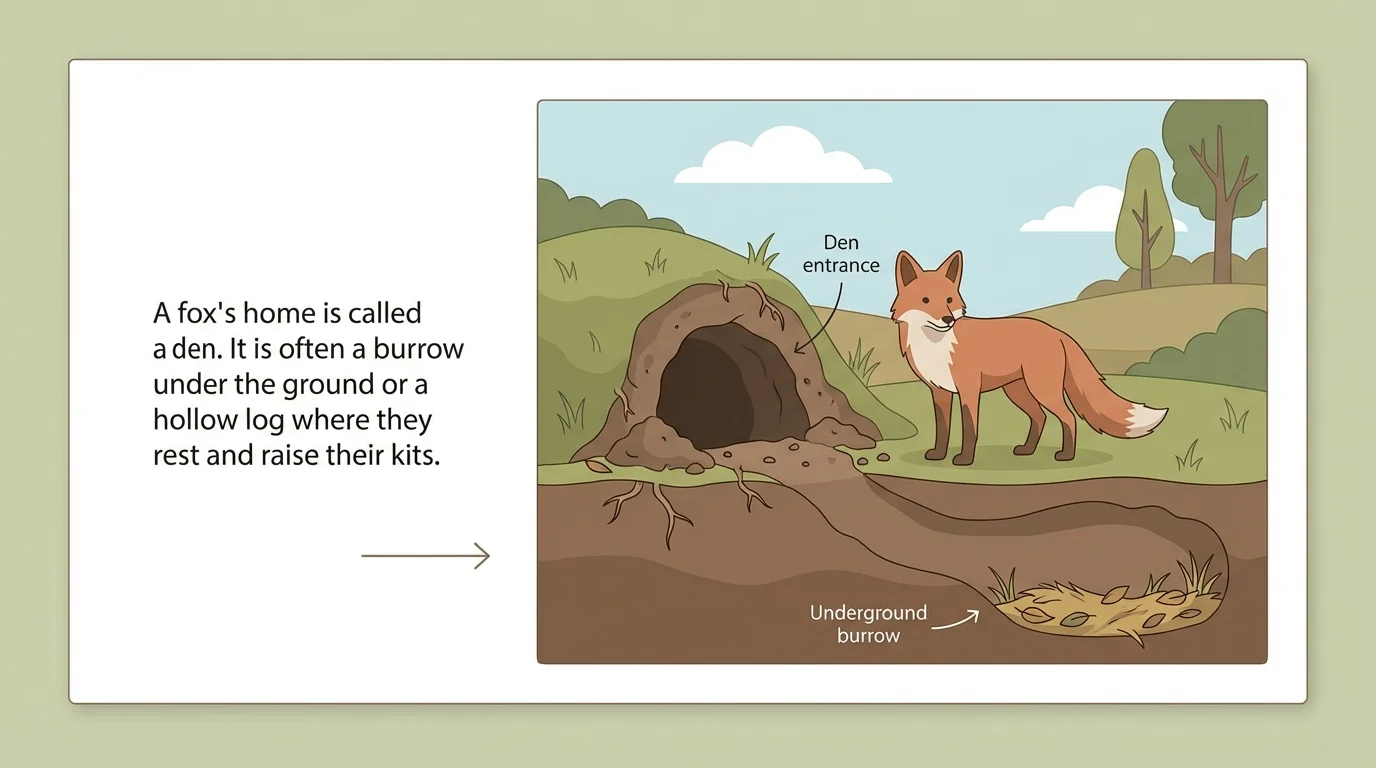
An illustration can show a person, a place, a thing, or an idea. In an animal book, as [Figure 1] shows, the words might say that a fox lives in a den. The illustration shows the fox and the den, so the reader can see the animal and its home.
If the text says, "The farmer feeds the chickens," the illustration may show the farmer, the chickens, and the food. That is a picture of a person and things. If the text says, "Penguins live where it is very cold," the illustration may show ice and snow. That is a picture of a place.
Some ideas are not objects you can hold. The text may say, "Plants need sunlight to grow." The illustration may show a plant under the sun. The picture helps show the idea of growing with sunlight.
When you look at a page, ask, "What in the picture is also in the words?" That question helps you find the connection between the illustration and the text.
Some informational books use pictures to help readers notice tiny details, like the shape of a bird's beak or the stripes on a fish, that might be hard to imagine from words alone.
Pictures do not need to show every single word. They show the important parts. If the text says, "Seeds grow into plants," the illustration may show a seed, a sprout, and a flower. The picture helps the reader understand the idea of change and growth.
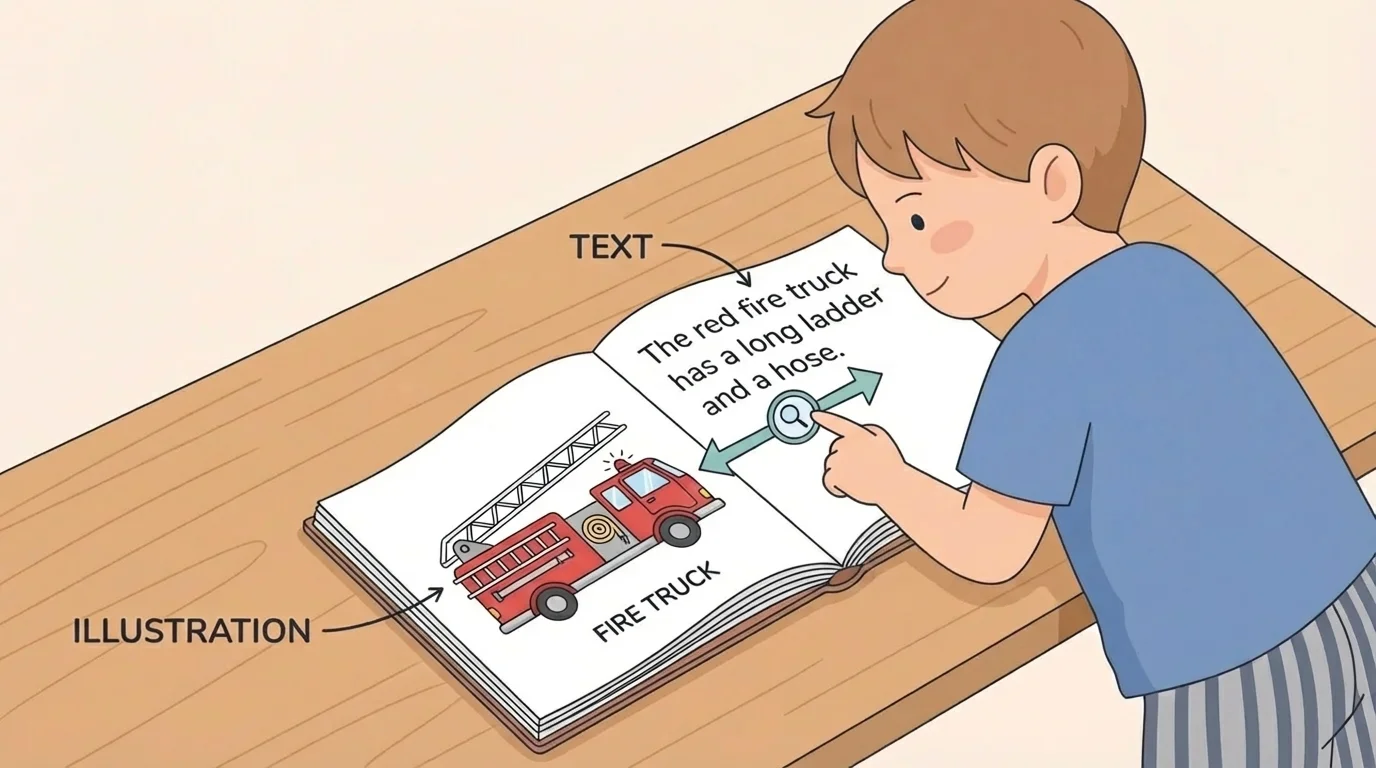
Good readers check for matching details, as [Figure 2] illustrates with a fire truck page. If the text says "red fire truck," the picture should show a red truck. If the text says "a ladder," we look for the ladder in the illustration.
This is called using details. Details are the small parts that help us know more. We can look for colors, shapes, actions, and parts. If the text says, "The turtle has a hard shell," the illustration should show the shell.
Sometimes the picture shows that something is big or small. If the text says, "An elephant is large," the illustration may show a very big elephant. The words and the picture match because they share the same information in different ways.
If a page says, "Fish swim in water," but the picture shows birds in a tree, that does not match. Readers learn to notice when the picture fits the words and when it does not.
Looking at a page together
The text says, "A cactus grows in a dry desert."
Step 1: Listen to the words.
We hear cactus, grows, dry, and desert.
Step 2: Look at the illustration.
We look for a cactus and a dry, sandy place.
Step 3: Say the relationship.
The illustration shows the cactus and the desert from the text.
When you say how the picture and the words fit together, you are describing their relationship.
Sometimes the text says something short, and the illustration helps us understand more. The words may say, "A spider has eight legs." The illustration lets us count the legs. The picture helps make the fact clear.
Pictures can support understanding
An illustration does not replace the words. Instead, it supports the words by showing what the words mean. Readers use both together to understand the whole page.
If the text says, "The moon changes shape in the sky," the illustration may show different moon shapes. The words tell the fact, and the picture helps the reader see the changes. That is how a picture can add understanding.
Later, when you look back at the fox page in [Figure 1], you can notice that the illustration does more than show a fox. It also helps explain where the fox lives. The picture supports the meaning of the text.
Readers can use simple sentences to tell how an illustration connects to the text. We can say, "The picture shows the animal in the words." We can say, "The illustration shows the place the text tells about." We can say, "The picture helps me understand the idea in the text."
Here are some strong ways to talk about a page:
These sentence patterns help us speak clearly about what we see and read.
Informational books can have drawings, paintings, and photographs. As [Figure 3] shows, some books also use a simple diagram. A photo, a drawing, and a diagram can all teach about the same plant in different ways.
A photograph shows what something looks like in real life. A drawing can focus on important parts. A diagram can point to parts with labels, such as leaf, stem, or root. Even though these pictures look different, they still connect to the text.
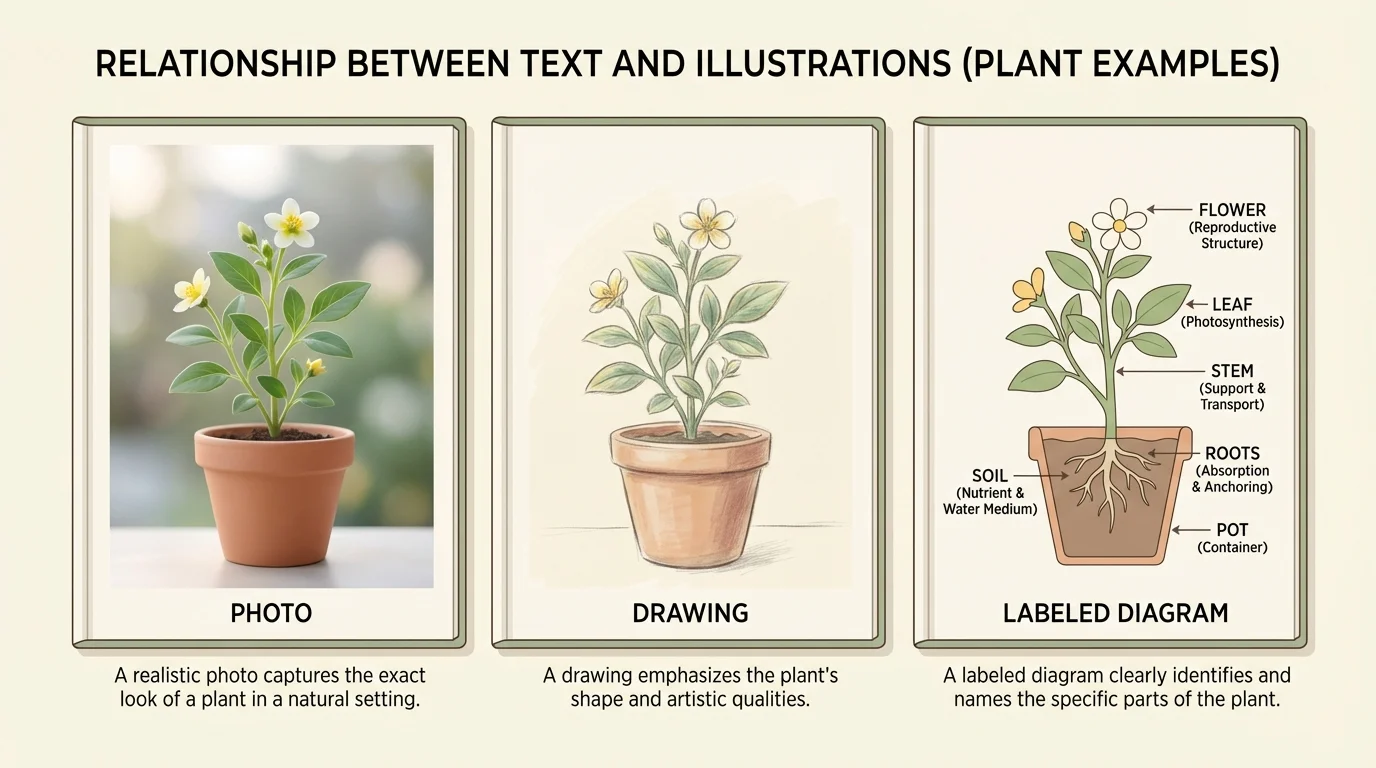
If the text says, "Roots grow under the ground," a labeled diagram may point to the roots. That helps the reader find the exact part the words are talking about.
When you return to the fire truck page in [Figure 2], you can see how the same idea works for many topics. The picture and the words share details, and those details help the reader learn.
When we read, we do not use only our eyes for words or only our eyes for pictures. We use both together to understand the whole page.
As you grow as a reader, you will get better at noticing what the text says and what the illustration shows. That is an important part of understanding informational books.
